

I have spent 8 years on the buy side of this decision, filling 250+ roles a year for engineering and manufacturing businesses. Which means I have watched a lot of organisations pay full market price for capability they already had on the payroll.
You have funded a development programme before. It launched with a kickoff email, a learning platform licence, and managers who genuinely meant it. By month four, completion sat under 30% and nobody was reporting on it any more.
Now you are being asked to fund another one.
Here is the part that never makes it into the business case. You are not deciding whether to develop your people. You are deciding whether to build capability or buy it, and you are already paying one of those two prices.
Most organisations budget development as a benefit. It is a procurement decision.
I know what the buy price looks like because I have signed off on it. Agency fees on senior engineering roles ran 18% to 22% of total compensation in the function I managed.
$9,500 to $12,000
What a single agency placement cost per senior engineering hire in the function I ran, at 18% to 22% of total compensation on packages in the $54,000 to $60,000 range. These are Indian market figures, originally 8 to 10 lakh rupees per hire on a 45 to 50 LPA package, converted here for a US reader rather than presented as US benchmarks.
I am giving you the original currency alongside the conversion on purpose. The absolute numbers belong to one market and one function. The percentage movement is the part that travels, and that is the number I want you to test against your own.
Every figure in this guide is either mine, with the conditions it was produced under stated, or from a source you can click. Where I do not have data, you get the argument instead of a borrowed statistic. Here is what this blueprint gives you:
- The four-layer architecture that has to exist before any strategy works
- Nine strategies, each with its difficulty and real cost stated up front
- A seven-step build sequence you can start on Monday
- A measurement model that survives a CFO conversation
What are Employee Development Strategies?
Employee development strategies are the deliberate mechanisms an organisation uses to build capability in its existing workforce, including skills mapping, internal mobility, stretch assignments, mentorship, and structured learning, aligned to forecast business demand rather than to individual preference. They exist to supply capability the business will need before it has to buy that capability on the open market.
Here’s the difference:
Four words get used interchangeably in most budget meetings. The imprecision costs you the argument before you have presented the plan.
- Training is an event. A two-day safety certification is training.
- Learning and development is a function. It owns the platform, the budget, and the compliance curriculum.
- Employee development is capability built in a person, measured by what they can now do without support.
- Talent development is capability built against an organisational succession need, measured by whether a critical role has a ready successor.
I sit on the buy side of this every week. That is what gives me standing to argue the build side, and it is why I define development as capability supply rather than as helping people grow. One of those definitions makes the trade-off visible. The other hides it.
Why Strategy is the operative word, and why most programmes are not one
Most of what gets called an employee development strategy is a catalogue. A list of available courses and a hope that people use them.
A strategy has four properties a catalogue does not. Run your current programme against these four questions. It takes about two minutes.
- Is it tied to a forecast of the capability the business will need in 12 to 18 months?
- Does it have one named owner with budget authority, rather than a steering committee?
- Are the hours ring-fenced somewhere a capacity plan can see them?
- Have you written down, in advance, what failure looks like?
Answer no to two or more and you have a catalogue. The first question is the one most programmes miss, and it is the one that connects development to strategic workforce planning rather than to the engagement survey.
The old way
- Buy a learning platform
- Publish a course library
- Add development to the engagement survey
- Report completion rates upward
The Lab Way
- Forecast the capability you will need in 12 to 18 months
- Name one owner who controls the budget
- Ring-fence the hours in the capacity plan
- Define the failure condition before launch
That forecast-first instinct is the same one behind the Talent Supply Chain framework. You hold inventory against predicted demand instead of reacting to a vacancy, and Talent Market Pre-Alignment applies the identical logic to people already on your payroll. More on that at Strategy 5.
◆ PRO TIP
Real talk: most well-run organisations fail at least two of those four questions. I have failed three of them on a programme I was personally sponsoring. The point of the test is not to grade you, it is to tell you which of the four gaps to close first.
9 Employee Development Strategies That Work at Scale
The architecture is the foundation. These are the things you build on it.
Each one carries its difficulty and its real cost at the top, because you should be able to scan this section and rule out six of them in ninety seconds. Every strategy also carries the condition under which it fails. That part is not a disclaimer, it is the part that saves you a wasted cycle.
Strategy 1: Map capability signals, not credentials
Identify what a person can demonstrably do by looking at evidence of work rather than at qualifications, titles, or years of service. Then build the employee development plan against the gap between that demonstrated capability and what the business will require.
The mechanism has four moves. Define the capability, define the observable signal that proves it, whether that is a shipped project, a system commissioned, a problem solved, or a portfolio, assess against the signal, and design the development activity to produce the next signal.
This is Inverted Sourcing Funnels pointed inward. When I built skills-based talent pipelines off market analysis rather than off job titles, quality of hire improved by 30%, the largest single methodology gain I have recorded.
◆ FROM THE LAB
Real implementation: earlier in my career I was handed a manufacturing systems analyst role that had been open for months. Traditional sourcing produced 14 qualified resumes. Every one of them had the right degree and none of them had the right evidence.
So I stopped searching for the job title and started searching for the work. Strings built around PLC programming projects and lean manufacturing case studies, aimed at what people had actually built rather than what a CV claimed about them. That search returned 62 candidates.
The person we hired had come off the factory floor. No computer science degree, no relevant job title, and a self-taught Python capability he had used to automate parts of his own line because nobody else was going to do it. He went on to lead digital transformation work.
The lesson is not really about hiring. Credential gatekeeping eliminates your best candidates, and it does exactly the same thing inside your own workforce when tenure and qualification decide who gets developed.

⚠ WATCH OUT
The catch: capability signals are harder to collect than credentials. Organisations that adopt this without a lightweight evidence mechanism revert to titles within two cycles, because titles are already in the system and evidence is not. Decide who captures the signal and where it lives before you launch.
Strategy 2: A 48-hour internal window, enforced
No requisition goes to the external market until it has been visible internally for 48 hours. During that window, recruiters actively approach internal candidates rather than waiting for applications to arrive.
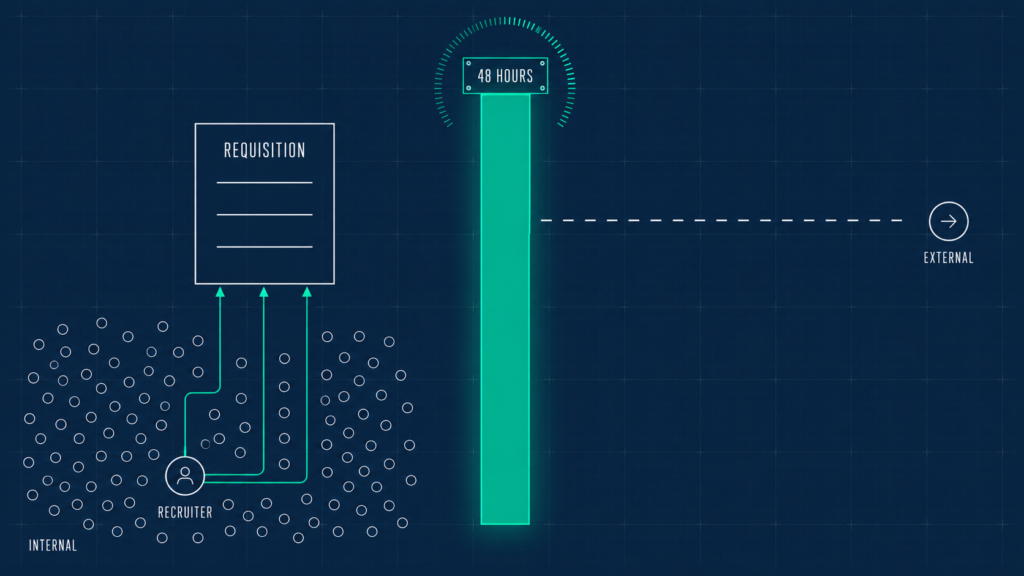
Build the hold into the requisition workflow so it is systemic rather than discretionary. Brief recruiters to source internally with the same rigour they apply externally, and publish internal fill rate as a standing monthly metric. That last part is what stops the policy decaying into a formality.
◆ FROM THE LAB
The Sofia test: I introduced this in a function where two numbers were being raised in every review. External hiring cost, which finance kept circling, and ramp time, which operations kept circling. Everyone agreed internal mobility was the answer. Nothing in the process forced anyone to look.
So we stopped encouraging it and started holding it. Every requisition sat internally for 48 hours before release, and during that window recruiters were expected to go and find internal candidates rather than wait for applications. That second half was the harder change. Waiting for applications is passive, and passive internal sourcing finds only the people already unhappy enough to be looking.
Within the year, 23% of hires were internal moves. The ramp difference was the number that surprised the operations leaders, not me: 28 days to productivity for an internal move against 67 for an external hire.
The policy cost nothing. It was a rule in a workflow, not a culture programme, and it is the single highest-leverage item on this list. Your best candidates are sometimes already on payroll, but only if somebody is made to look before the advertisement goes out.
28 vs 67 days
Time-to-Productivity for an internal move against an external hire in the same function, under an enforced 48-hour internal window.
⚠ WATCH OUT
Common mistake: launching the window without the manager release accounting from earlier in this guide. A 48-hour hold is meaningless if the current manager can veto the move informally afterwards. You will have built a queue, not a channel, and building genuine internal mobility requires both halves.
Strategy 3: Scope it, time-box it, sign it
A stretch assignment is a scoped, temporary piece of real work chosen because completing it builds a named capability the person does not currently have. Most organisations get the work right and the container wrong.
Write a one-page contract before it starts. Both managers and the employee sign it, and it covers five things.
- The capability being built
- The observable output that proves it exists
- The time-box, with a hard end date
- The percentage of the person’s capacity it consumes
- What happens at the end: return to role, new role, or reassessment
An uncontracted stretch assignment is a systems failure, and it produces exactly the burnout-driven attrition that organisations then try to solve with pay. Clear role design and visible skill progression are what hold people, which is why I keep arguing that employee retention is a design problem rather than a compensation problem.
⚠ WATCH OUT
Common mistake: the assignment that never ends and quietly becomes an unpaid second job. The time-box is the protection, and it has to be enforced by somebody other than the receiving manager, who has every incentive to extend it.
Strategy 4: Activate the few, not the many
Stop recruiting mentors broadly and matching at volume. Identify the small group already developing people informally and effectively, give them status, resources, and light structure, and build the programme around their capacity.
Find them through evidence rather than nomination. Who has produced internal promotions, whose team members progress, who people already go to without being told. Then give them a named role, a small cohort, protected time, and visible recognition.
◆ FROM THE LAB
My experience: I have not run a mentorship programme on this model. I have run a referral programme on it, and the distribution is what transfers.
The standard referral scheme I inherited was democratic and underperforming. Open to everyone, promoted to everyone, producing very little. When I looked at who was actually generating hires, the answer was a handful of people, so we stopped promoting to the whole population and built around them instead. Talent Scout status, quarterly meetings, genuine access, and perks that signalled the role mattered.
One senior engineer produced 11 referrals. Nine of them were hired. Eight were still with the company when I last checked, at an 82% conversion rate against a company average of 31%, and roughly $48,000 of avoided agency fees from one person’s network.
Development effort follows the same distribution. A small group carries most of the outcome, and designing for headcount targets rather than for that reality is why employee referral programmes and mentoring schemes fail in the same shape.
◆ PRO TIP
The honest downside: this creates an in-group. People not matched to a power-user mentor can end up stranded, and they will notice. Pair it with an open access route so the concentrated version is an upgrade for some rather than a closed door for everyone else.
Strategy 5: Build before the requisition exists
Talent Market Pre-Alignment is my name for identifying and engaging capability ahead of demand, so that capability, interest, and availability are already aligned before a requisition opens. I built it for the external market. It works better pointed inward.
Here’s how to build it:
- Run a quarterly capability forecast off the business plan, not off open vacancies
- Do an adjacency analysis against your current workforce: who could reach that capability from where they are now
- Name a development cohort per forecast gap, with an owner
- Set the review cadence before the first cohort starts
◆ FROM THE LAB
Real implementation: an automation engineering team I supported was about to scale, and the roles were the kind that take four months to fill on a good day. The instinct in the room was to wait for approved headcount and then start.
We started before the job descriptions existed. I mapped 12 companies across the industrial IoT space to understand how competitors were structuring these teams, which skill combinations they were clustering, and where the people with those combinations actually sat. By the time the requisitions were approved, we had 37 qualified candidates already identified and warm.
Time-to-Offer moved from 68 days to 34.
Here is the part I did not see at the time. That same map told me which capabilities were about to become scarce, which meant it was also a list of what to build in the people already inside the business. Proactive mapping beats reactive posting, and the forecast that finds your external candidates identifies your internal ones at the same moment. One of those groups you have to buy. The other you can build, and you have 12 months of notice to do it.
◆ PRO TIP
The catch: this depends entirely on the quality of the business forecast. In organisations where the 12-month plan is rewritten every quarter, run it against the two or three capabilities that are stable across every scenario and ignore the rest. Anchoring it to strategic workforce planning that nobody believes will produce cohorts built for a plan that no longer exists.
If this is the section where you started taking notes, the Lab newsletter is where the next framework lands first. It goes out to that list before it goes anywhere else.
Strategy 6: The runner-up is a development plan

Every internal selection produces one hire and several strong internal candidates who now know they were not chosen. Left alone, a meaningful share of them leave within twelve months.
Which is absurd, because the panel has just done the diagnostic work for you. Somebody sat in a room and assessed exactly what that person was missing, then wrote it down and filed it.
- Within one week of the decision, the hiring manager or HR Business Partner delivers the specific capability gap the panel identified
- That gap is converted into a written development plan with a named owner
- Re-engagement is scheduled at 3, 6, and 12 months and held in someone’s calendar
This is my Silver Medalist Re-Engagement Loop turned inward. Externally, that system produced four hires over two years from candidates who had previously been turned down, one of whom became a team lead and another of whom referred three external hires. The internal version has better economics, because the person is already on payroll and already assessed.
⚠ WATCH OUT
Red flag: vague feedback. Needed more strategic exposure is not a capability gap, it is a way of avoiding one, and it produces resentment rather than a plan. If the panel cannot name the gap in observable terms, the problem started at the scorecard, not at the feedback conversation.
Strategy 7: Monthly cadence beats annual ceremony
Each month, every manager reviews one capability gap per direct report and names one piece of real work that will address it in the coming month. One gap, one assignment, one month.
How to execute:
Keep the unit deliberately small and require an observable output rather than a conversation record. Roll the outputs up quarterly so the organisation can see what capability actually moved, which is also the only way performance management and development stop being two disconnected calendars.
Rhythm and visible tracking are what turn intent into throughput. The largest campaign I have run held daily recruiter stand-ups, live tracker dashboards, and weekly calls with hiring managers, and it delivered 420+ hires in 10 weeks with recruiter productivity up around 35%. None of that was clever. It was just visible, every day, to someone who cared.
◆ PRO TIP
Pro tip: cadences decay, always. Build in a quarterly roll-up that a named senior leader actually reads, because the rhythm survives exactly as long as somebody senior is looking at the output and no longer.
Strategy 8: AI as co-pilot, never decision-maker
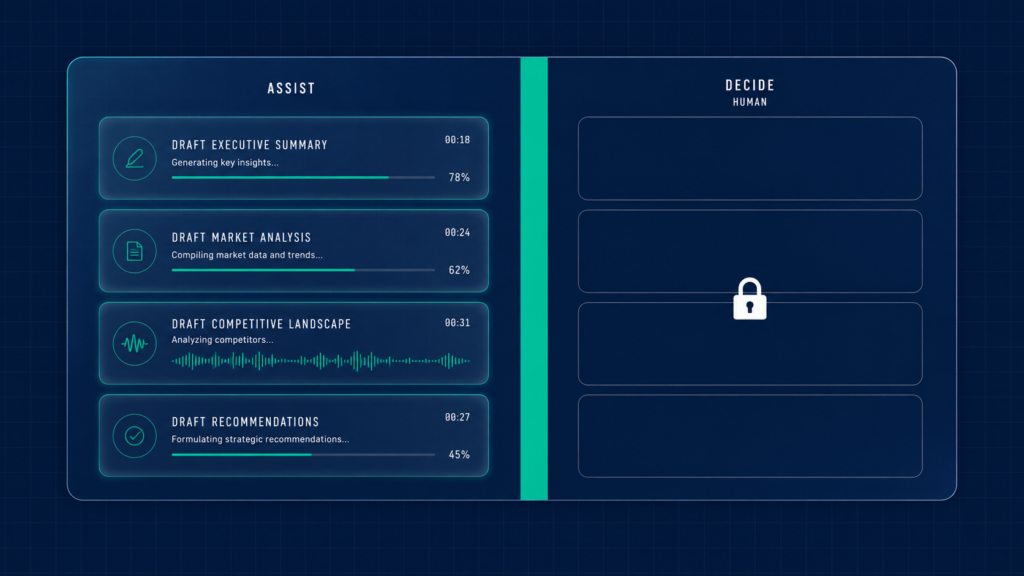
Define the boundary first, before you define the use case. AI accelerates thinking. Managers own judgement, context, and the final call.
What it should do
- Translate business capability requirements into role-level skill language
- Draft development plan structures
- Synthesise market data on how a capability is developing externally
- Check plan language for inclusivity and clarity
What it must not do
- Decide who gets developed
- Assess readiness or potential
- Evaluate a person
- Produce compliance-sensitive documentation unreviewed
Require human validation at every decision point and log which decisions were AI-assisted, so the audit trail exists before anyone asks for it. My verdict on the general-purpose tools has not changed: a genuine productivity multiplier for drafting and research, and not a recruiter. Where AI in HR goes wrong is almost never the drafting, it is the quiet slide from drafting into deciding.
⚠ WATCH OUT
Watch out: two real risks. Algorithmic bias, where flawed training data reinforces historical patterns about who gets developed, and over-dependence, where the sheer volume of generated plans creates the appearance of a functioning programme with no human judgement behind it. Automated scoring that feeds promotion or termination decisions also carries live regulatory exposure under the EU AI Act and several US state and city rules.
Strategy 9: Ladders for the deskless workforce
Almost all published development guidance assumes a desk, a laptop, a flexible calendar, and a employee development software. A large share of your workforce has none of those things.
Four things change for this population. Development happens on shift rather than around it, certification and licensing become the progression currency instead of course completions, supervisors are the assessment mechanism because there is no platform analytics to lean on, and progression runs on technical depth because the supervisory ladder is narrow.
Define the technical track with named levels and the certification or demonstrated competence required at each. Build assessment into the shift pattern rather than alongside it. Make the senior technical levels visibly comparable in status and pay to the supervisory equivalent.
◆ FROM THE LAB
My experience: this is the population I have spent most of my career hiring for, at 250+ roles a year and, in peak weeks, 40 to 50 technical hires. It is also the population whose capability is most systematically under-identified, because the evidence of it does not live anywhere a system can read.
The factory-floor supervisor from Strategy 1 is the proof. He had taught himself a genuinely valuable technical skill on his own time, and no development framework in that business had any way of seeing it. Volume is exactly why a pathway matters more for this group, not less. When you are moving people at that rate, the ones with unrecognised capability disappear into the average.
⚠ WATCH OUT
The catch: this fails without pay-band alignment, completely and visibly. If the only route to higher earnings runs through supervision, the technical ladder is decorative and every person on the shop floor works that out inside a month. Fix the bands or do not publish the ladder, and if you want the wider argument, it sits inside engineering and manufacturing talent acquisition more broadly.
How to Develop an Employee Engagement Strategy that Runs on Development
To develop an employee engagement strategy that actually moves, build it around development as the primary lever: isolate the development-related items in your existing survey, pick one segment where they score worst, deploy two or three specific development strategies against that segment alone, and re-measure the same items at six months.
Why does this matter?
Engagement is driven by several things HR influences weakly. Pay competitiveness, manager quality, workload, and organisational direction are mostly decided elsewhere in the building.
Development is the one that sits inside HR’s operating control. Of the levers available to you, it has the best ratio of controllability to impact, and that is a narrower and far more defensible claim than the one most employee engagement content makes.
It also connects to the retention argument directly. Retention problems are mostly systems failures rather than compensation failures, and the usual causes are unclear career paths, weak manager capability, poor role clarity, and weak internal mobility. Every item on that list is a development-system item.
The route runs through progression specifically, not through learning content generally. Employees rank career progression as their number one motivation to learn, which is why a course catalogue does not move engagement and a visible lattice does.
Source: LinkedIn Learning, 2025 Workplace Learning Report
◆ PRO TIP
Real talk: development is not the whole of engagement and presenting it as such is how HR loses credibility in the room. If pay is uncompetitive, no development strategy will rescue the score. Claim the lever you control and be visibly honest about the ones you do not.
1
Isolate the development items as your baseline
Pull the development-related questions out of the aggregate score and track them as their own index. The overall number is too noisy to attribute anything to, which is a survey design problem before it is an action-planning problem.
2
Pick one segment, not the organisation
Choose the population where those items score worst and which is large enough to move the aggregate if it improves. One segment, chosen deliberately.
3
Deploy two or three strategies there only
Take two or three of the nine strategies above and run them against that segment specifically. Resist extending them organisation-wide before you have a result.
4
Re-measure the same items at six months
Same questions, same segment, six months later. Only then decide whether to extend, and you will have something a leadership team can act on rather than a two-point movement nobody can explain.
I have watched targeted design outperform broad initiatives in an adjacent area. A diversity pipeline programme that expanded sourcing channels, ran referral drives aimed at underrepresented groups, and built inclusive campus outreach produced measurable improvement in diverse slate ratios at interview stage and better conversion to offer, with no drop in quality of hire. It worked because it was pointed at something specific.
⚠ WATCH OUT
Common mistake: deploying organisation-wide because it feels fairer. It dilutes the effort across populations with different problems and destroys attribution, so you end up unable to prove the thing that worked actually worked.
Here’s the difference:
Four measures connect development activity to an engagement outcome credibly, and you already collect three of them or can collect them cheaply. You do not need new instrumentation. You need to stop reporting the aggregate and start reporting the driver, which is the same discipline behind any of the HR metrics worth putting in front of a leadership team.
- The development-specific survey items, tracked as their own index
- Internal fill rate
- Voluntary attrition inside the target segment
- Time-to-Productivity for internal moves against external hires
For calibration, the best 12-month cohort retention I have recorded was 89%, against a 90% offer acceptance high-water mark. Those are the shapes of number that make a development-to-retention argument concrete rather than theoretical, and yours will differ. Establish your own baseline before you set a target against anyone else’s.
Why Most Employee Development Strategies die in month four
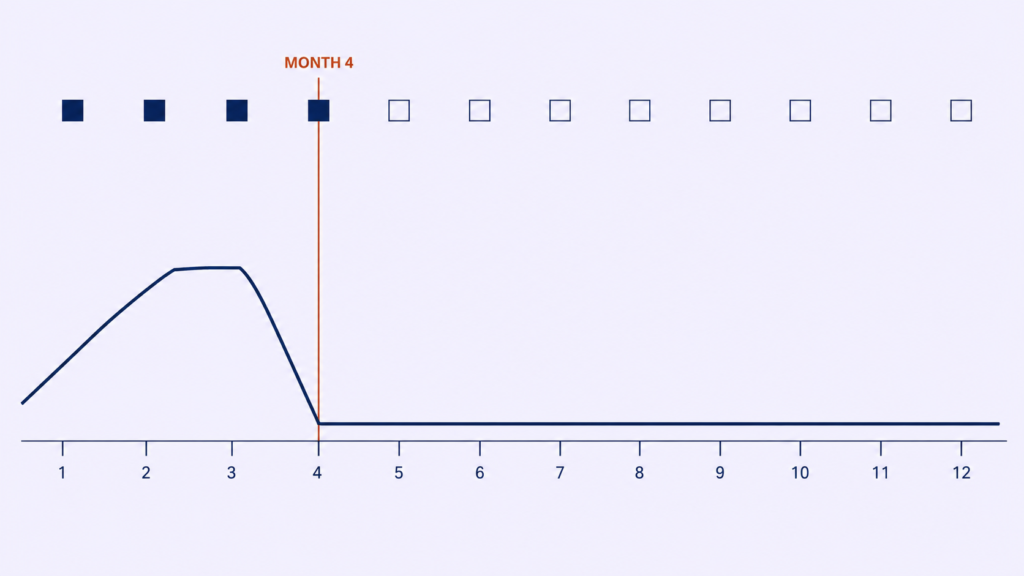
Every article ranking for this keyword sells development. Not one of them performs a post-mortem on why the last one failed.
That omission matters, because you are not starting from zero. You are starting from a workforce that watched the last programme quietly stop, and a leadership team that noticed. Three things kill these programmes, and budget is not one of them.
Failure mode 1: The manager is the bottleneck, not the budget
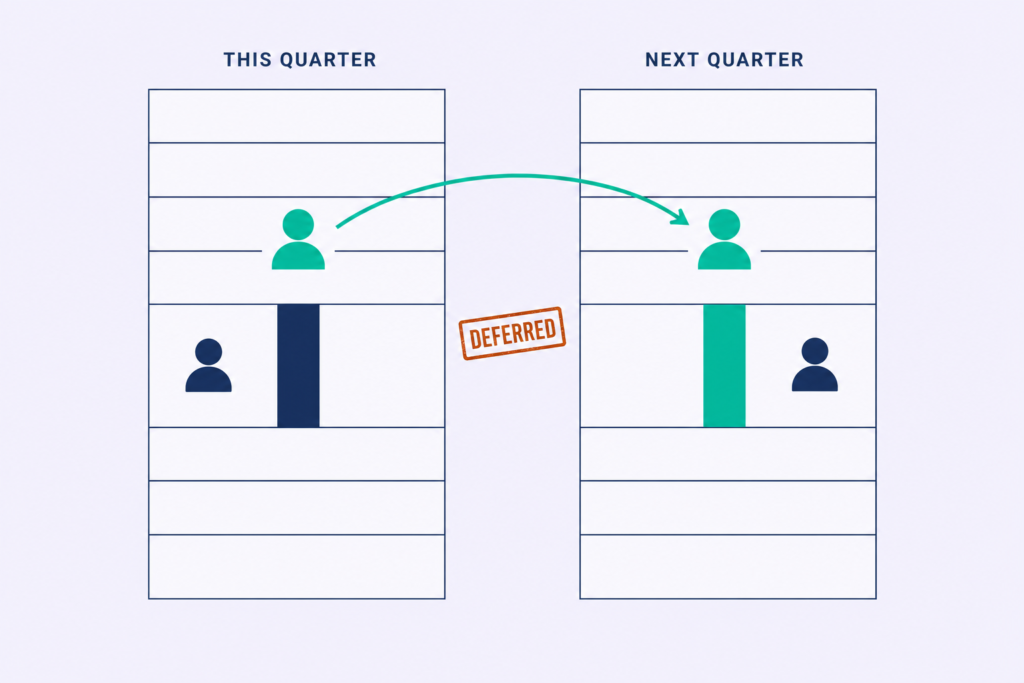
Managers are measured on the output of their team this quarter. Every development activity, whether a secondment, a stretch project, or an internal move, takes capacity out of that team now and returns the benefit to somebody else’s quarter.
So rational managers block development. Not by refusing it. By deferring it.
You will recognise the behaviours. Training approved in principle but the day never released, an internal move agreed and then negotiated into a six-month transition, a strong performer given a not-yet-ready rating by the person who most benefits from keeping them.
⚠ WATCH OUT
Common mistake: escalating an individual blocked move to senior leadership. It fixes that one case and hardens the manager against the next twelve. You have won a transfer and lost a channel.
The fix is not communication. It is accounting.
The old way
- Run manager communications on the value of development
- Add development to the manager scorecard as a soft goal
- Escalate blockers to HR case by case
- Count an internal move out of a team as attrition
The Lab Way
- Issue a release credit or a backfill guarantee
- Credit the releasing manager for capability supplied
- Build the hold into the requisition workflow, not the culture deck
- Report internal moves out as a positive signal
I know this is solvable with a rule rather than a campaign, because I have run the rule. A 48-hour internal window before any role went external produced a 23% internal hire rate in a function that had previously filled almost everything from the market. Nothing about the culture changed. The workflow changed, and building a real internal mobility programme starts there.
Failure mode 2: Nobody owns the hours
Look at the accounting asymmetry. Organisations allocate a development budget in currency, then expect the time to come out of evenings, weekends, or slack capacity that does not exist.
Nobody signs off on hours. So nobody has them.
Low completion rates get read as low motivation. It is a capacity problem wearing a motivation costume, and the two require opposite responses.
How to execute:
- State the allocation as a percentage of working hours, visible in capacity planning alongside project commitments.
- Build capacity plans below full utilisation by design, and name the gap as development rather than leaving it as unlabelled slack.
- Log development hours the same way you log project or billable hours, so the allocation is auditable.
This is not an HR insight. It is standard practice in delivery work, and it is almost unheard of in development work.
The largest hiring campaign I have run delivered 420+ hires in 10 weeks. It worked because weekly targets were mapped backward from the business start date and recruiter and interviewer bandwidth was forecast explicitly rather than assumed. Capability work fails for exactly the same reason hiring campaigns fail, and the reason is always bandwidth.
◆ PRO TIP
The honest downside: in a genuinely under-resourced team, protected time is unaffordable this quarter. There is no clever workaround. The correct decision is to cut the programme rather than run a version that fails and burns the credibility you will need next year.
Failure mode 3: No defined failure condition
A development programme without a pre-agreed failure condition will outlive its usefulness by years. It absorbs budget and manager goodwill and produces nothing anyone can point to.
Nobody kills it, because nobody ever agreed what dead looks like.
A failure condition has four parts, and a version missing any one of them is a sentiment rather than a governance mechanism.
- A named metric
- A threshold on that metric
- A review date
- A decision owner with authority to stop it
Two worked versions. If fewer than 40% of enrolled participants reach a capability milestone by month six, the programme is restructured or stopped. If internal fill rate has not moved by two percentage points in twelve months, the mobility strategy is redesigned rather than re-launched.
◆ FROM THE LAB
The Sofia lens: every HR leader I have watched hesitate over publishing a kill condition assumed it would read as a lack of confidence. It reads as the opposite. A named threshold and a stop date tell a CFO that you are running an investment rather than a campaign, and I have never seen that reduce a budget. I have seen the absence of one lose a programme that was actually working, because there was no agreed standard to defend it against.
None of this stays inside the programme. It shows up in the number your board already looks at. Global employee engagement fell to 20% in 2025, and Gallup attributes part of that decline to a fall in the development opportunities available to employees, alongside reduced clarity of expectations and people not feeling valued.
Source: Gallup, State of the Global Workplace 2026
Translation: a development programme that quietly dies is not a neutral event. It is a measurable withdrawal from the engagement figure you will be asked to explain next quarter, which is why the diagnosis belongs in the HR metrics that matter rather than in the programme retrospective nobody reads.
The Build-vs-Buy Math: What Employee Development Saves you
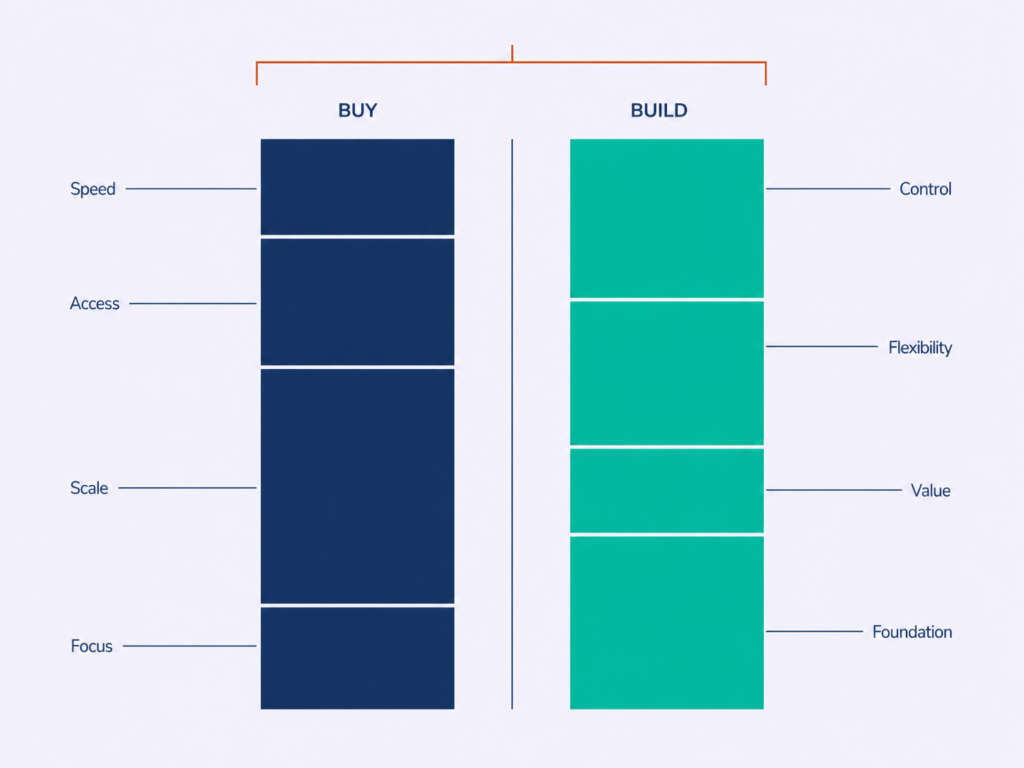
When an organisation needs a capability it does not have, it has exactly two options. Buy it on the external market, or build it internally.
Both have a real cost stack. Neither is automatically cheaper, and anyone who tells you development always wins has not priced it.
The buy stack
- Agency or search fee
- Time-to-Fill drag while the role sits open
- Ramp period for someone who knows neither the systems nor the stakeholders
- Risk premium on an unverified cultural fit
The build stack
- Development hours taken out of delivery
- A temporary productivity dip during the stretch period
- Backfill or coverage cost on the vacated work
- The risk that you build someone who then leaves
◆ FROM THE LAB
Real implementation: I priced the buy stack properly for the first time when a finance director asked me to defend a recruitment budget line by line. Senior engineering roles were costing roughly $7,800 to $9,000 per hire, all in, at 70 to 80 days to fill. Two years later the same roles cost roughly $3,600 to $4,600 at 45 to 50 days, after we shifted the mix toward internal supply and referrals and cut agency reliance by 60% to 70%. Four of six senior roles that would have gone to an agency did not.
Those are Indian market figures for an engineering function, originally 6.5 to 7.5 lakh rupees moving to 3 to 3.8 lakh. I am converting them for a US reader rather than offering them as US benchmarks, and the percentage is the part I would actually stand behind in another market.
45% to 55%
Reduction in cost per hire on senior engineering roles after shifting from agency-led sourcing to internal supply and referrals, with Time-to-Fill moving from 70 to 80 days down to 45 to 50.
Here’s the deal:
Building does not beat buying by default. It beats buying under four specific conditions, and you can check all four against a live requisition this afternoon.
- The capability is adjacent to skills the person already has, so this is a 12 to 18 month build rather than a career change
- The role is hard to source externally in your local market
- Internal ramp is materially faster than external ramp, which you have measured rather than assumed
- You have a retention mechanism to hold the person after the build completes
Buying wins in three situations. The capability is genuinely absent internally, the business need lands inside 90 days, or the skill is commoditised and cheap to acquire on the market.
The third build condition is the one people assume rather than measure. Under the internal-first policy I ran, Time-to-Productivity was 28 days for internal moves against 67 days for external hires. That gap is why lateral movement is not a consolation prize, and the fourth condition held because the best 12-month cohort retention I recorded was 89%. A build only pays if the person is still there.
The external evidence points the same direction. Only 36% of organisations qualify as career development champions, meaning they use multiple tactics to support employee growth, and those that do are more profitable and better at retaining people. In the same report, 88% of organisations name retention as a concern and cite learning opportunities as their top retention strategy.
Source: LinkedIn Learning, 2025 Workplace Learning Report
Which leaves you needing one number to put in front of finance. Not a benefits list. A figure with a method behind it.
1
Count the roles filled internally in the period
Only count roles that would otherwise have gone to the external market. An internal move into a role you would have deleted is not an avoided hire.
2
Multiply by your blended external cost per hire
Blended means agency or search fee, internal recruiting cost, and vacancy drag, for equivalent roles. Use your own numbers, not a published benchmark, because cost per hire varies more by function and market than any benchmark admits.
3
Subtract the fully loaded build cost
Development hours at loaded rate, backfill or coverage, and any external training spend. If you leave the hours out, finance will find them and the whole figure loses credibility.
4
State the net, then state the caveat
Illustratively, using round numbers you should replace with your own: 12 roles filled internally at a blended external cost of $20,000 each is $240,000 avoided, less $70,000 of loaded development and backfill cost, gives a net of $170,000. Say directional, not audited, in the same breath.
◆ PRO TIP
Pro tip: stating the limitations of the figure out loud is what makes finance trust the rest of it. Say which costs you could not capture and which assumption is doing the most work. A number offered with its own caveats gets interrogated once. A number offered as certain gets interrogated every quarter, and building the business case this way is the difference between a second funding cycle and a polite decline.
The Development Architecture: 4 Layers That Have to Exist Before Any Strategy Works
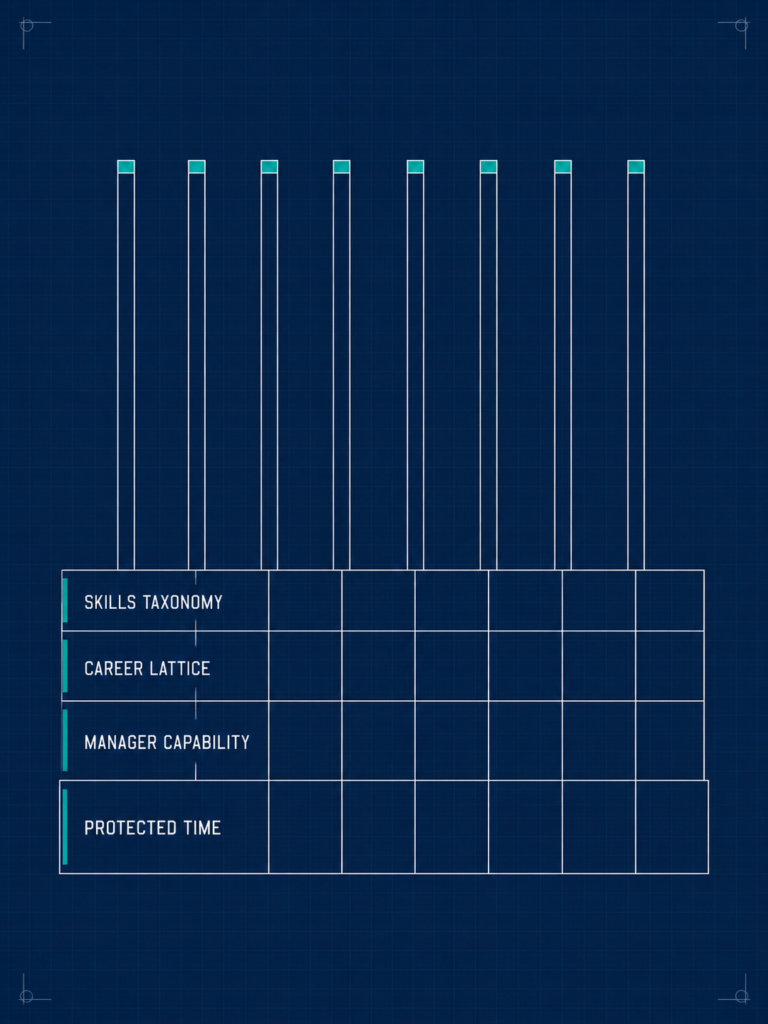
Most articles hand you the strategies as a menu. Pick the ones that fit your culture, they say, as though these things were independent.
They are not. Mentorship without a skills taxonomy produces well-meant conversations pointed nowhere, and stretch assignments without protected time produce burnout in the people you can least afford to lose. Four layers have to exist first, and the nine strategies in the next section only work when they sit on top of these.
Layer 1: Skills taxonomy
The expensive mistake here is attempting a comprehensive enterprise skills taxonomy as a first move. These projects run 12 to 18 months, produce a framework nobody opens, and discredit the wider programme before it starts.
⚠ WATCH OUT
Anti-pattern: the comprehensive taxonomy. The tell is a project plan with a phase called framework design and no named business outcome attached to it. Also avoid the self-reported skills survey as your starting data. Self-assessment has well-known reliability problems and produces a dataset nobody will make a decision from.
Run the opposite sequence. Pick one business outcome under real pressure, a product line scaling, a plant commissioning, a function with chronic vacancy, or a technology migration. Map only the capabilities that outcome requires, at three proficiency levels, in the vocabulary the hiring managers in that function already use.
Ship it in weeks. Extend it only when the next outcome demands it, and be explicit that the taxonomy is deliberately partial. Partiality is the feature.
The vocabulary rule matters as much as the scope rule. Inverted Sourcing Funnels, the framework I use to filter candidates on capability signals rather than resume keywords, applies inward without modification. Describe what someone can demonstrably do, not what their title implies, which is the same discipline that underpins skills-based hiring.
The outcome-first sequence has independent support. Across an analysis of 87 organisations using more than 28 distinct skills strategies, the ones creating measurable value were those that started by defining a specific business outcome, not those that started by building comprehensive skills infrastructure.
Source: Deloitte Insights, Rethinking Skills-Based Talent Models
One compliance note while you are designing this. Where access to development functions as a gateway to promotion, your selection criteria attract the same fairness and adverse-impact scrutiny as hiring selection. Document them and apply them consistently.
Layer 2: A career lattice, not a ladder

The number of promotions available in your organisation is a function of growth and attrition. It is not a function of how many people deserve one.
Which means a development strategy that implicitly promises advancement will break that promise to most of the people who engage with it. The lattice is the answer: documented lateral moves, cross-functional rotations, and depth-based progression within a track, each with its own recognised status and pay implications.
Three things separate a real lattice from a diagram. Published adjacency maps showing which roles are reachable from which, a stated skill delta for each move, and at least one visible senior individual contributor who has progressed without ever managing people.
Why this works:
Lateral movement is faster to productive output than external hiring, and I have the split to prove it: 28 days to productivity for internal moves against 67 for external hires, with 23% of hires in that period coming from inside. Treating internal mobility as a sourcing channel rather than as a retention gesture is what changes the conversation with an operations leader.
◆ PRO TIP
The catch: lattices fail where compensation bands make sideways movement financially punitive. If a lateral move means a pay freeze or a band reset, the map is decorative and your workforce will work that out faster than your leadership team does. Resolve the banding before you publish anything.
Layer 3: Manager capability
Whatever the strategy says on paper, the manager is the delivery mechanism. Every stretch assignment, feedback conversation, mobility recommendation, and development plan passes through one person.
Three capabilities decide whether that person is a conduit or a blockage. They are narrow, specific, and trainable.
- Describing a capability gap in observable behavioural terms rather than trait language
- Designing a piece of real work that closes that specific gap
- Being willing to release a person to a better opportunity elsewhere
Most manager development programmes teach none of these. They teach a conversation framework, which is why you can run the training, see high awareness, and observe no behaviour change at all. Manager effectiveness on development is a diagnostic and design skill, not a personality profile.
Artificial intelligence helps here, within a boundary I hold firmly. A manager can use it to articulate a capability gap or draft a plan structure. The judgement about what work will actually build that capability in that person stays human, and I go into where that line sits at Strategy 8.
⚠ WATCH OUT
Watch out: measuring manager performance on development by counting completed conversations. It rewards the calendar entry and ignores the outcome. Measure one observable thing instead, which is whether a real piece of work was assigned to close a named gap.
Layer 4: Protected time
Failure mode 2 was the diagnosis. This is the specification.
You have three allocation mechanics to choose between, and each carries a real trade-off. The failure state is choosing none of them and assuming all three.
- A fixed recurring block held in the delivery calendar and defended like a customer commitment. Easiest to defend, easiest to erode.
- A capacity plan deliberately built below full utilisation, with the gap named as development. Most robust, hardest to get approved.
- Project-attached development, where build time is scoped into the project estimate from the start. Most likely to survive, but it only develops the capability the current project needs.
Pick one. Name it. Put it in the capacity plan where somebody outside HR can see it, because workforce capacity planning is where development either becomes real or quietly does not.
◆ PRO TIP
Real talk: for some teams the honest answer this quarter is that none of the three is affordable. Recognising that and saying it out loud beats launching a programme you already know will stall. You can run the architecture work now and start the strategies next cycle. That sequencing is a decision, not a delay.
Talent Development Strategies vs. Employee Development Strategies: Where They Diverge
Employee development starts from the person and asks what capability this individual should build next. Talent development starts from the organisation and asks which capabilities the business will require and who should be positioned to supply them. The activities overlap almost entirely. The selection logic, the budget owner, and the success measure do not.
Here’s the difference:
| Employee development | Talent development | |
|---|---|---|
| Starting question | What should this person be able to do next? | Which capabilities will the business need, and who supplies them? |
| Who is included | Everyone, in principle | A selected population against critical-role risk |
| Who owns the budget | The function or business unit | Central HR or the executive team |
| What success looks like | Verified capability in an individual | A ready successor for a named critical role |
The practical consequence is worth stating plainly. Organisations that run only talent development neglect the majority of their workforce, and organisations that run only employee development find themselves without successors when a critical role opens.
Both sit inside the same discipline as far as I am concerned, because both are supply questions. What differs is the time horizon and the unit of analysis: the individual for one, the critical role for the other, which is the same logic that governs any talent management decision worth making.
You do not need two programmes to run both. One architecture, two selection processes.
The four layers and the nine strategies serve both populations without modification. All that changes is who gets selected into which activity and against what criterion: succession planning risk for one track, individual capability gap and business adjacency for the other. This is the Talent Supply Chain view applied to your own workforce, where you are managing capability as a supply system rather than as a set of programmes.
◆ PRO TIP
Pro tip: the structural error to avoid is building two separate programmes with separate owners, budgets, and platforms. It doubles the cost and halves manager engagement, because managers now have two sets of obligations competing for the same calendar. One owner, one architecture, two selection criteria.
How to Build your Employee Development Programme in 7 Steps
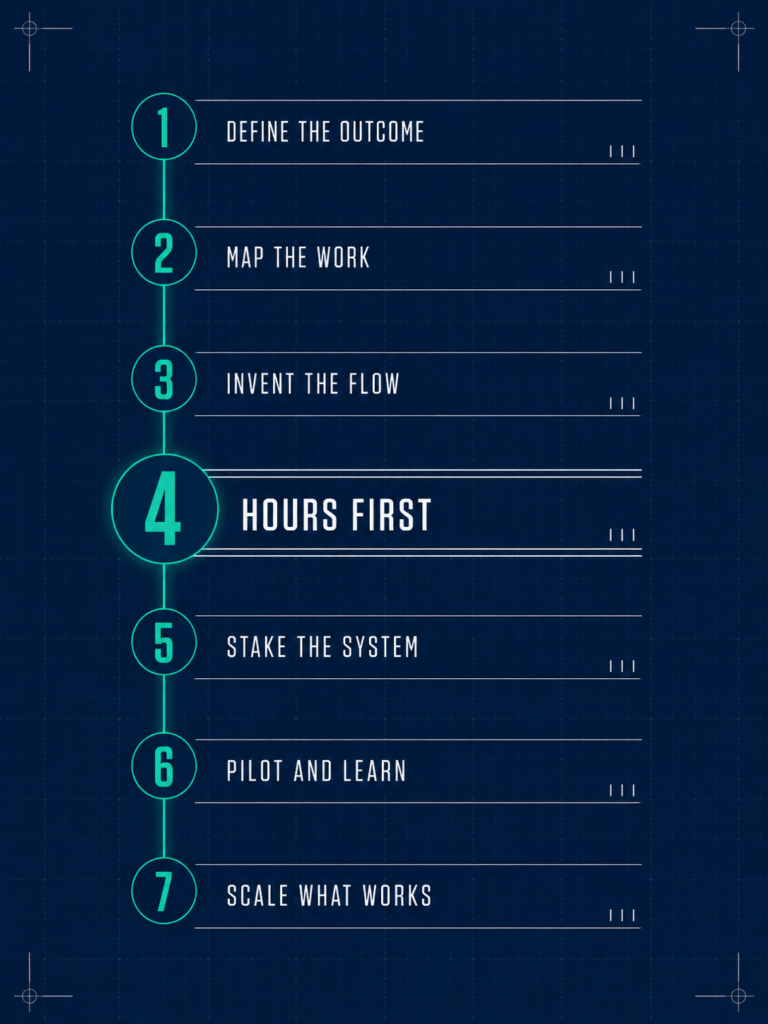
You now know what you are sequencing. That is why this section sits here rather than at the top.
Each step is one discrete action with a stated output. If you did nothing else from this guide, doing these seven in this order would put you ahead of most of the programmes I have seen launched.
1
Step 1: Pick one business outcome
Choose a single named outcome under real pressure in the next 12 to 18 months. A product line scaling, a plant commissioning, a function with chronic vacancy, or a technology migration. Everything downstream scopes to it, and what you get is a defensible boundary plus a sponsor who cares about the result, which is where workforce planning and development finally meet.
2
Step 2: Map the capabilities that outcome needs
Map only what the chosen outcome requires, at three proficiency levels, in the vocabulary the function’s managers already use. Timebox it to four to six weeks and stop when the timebox does. What you get is a working partial taxonomy people apply, rather than a comprehensive one nobody opens, and the same capability-signal discipline that governs skills-based hiring applies here.
3
Step 3: Name the owner and the kill condition
Appoint one owner with budget authority, not a committee, and publish the failure condition at the same moment. What you get is executive confidence, because the programme is visibly being run as an investment. Publishing the kill condition is what produces buy-in, so stop asking for it separately.
- Metric
- Threshold
- Review date
- Decision owner
4
Step 4: Allocate the hours before the budget
Choose one of the three allocation mechanics from Layer 4, name it, and record it in the capacity plan before any spend is approved. What you get is the single strongest predictor of whether the programme is still running at month six. Budget approval feels like the hard part, which is exactly why it gets done first and the hours never get done at all.
5
Step 5: Choose two strategies, not nine
Select two from the list above, one structural and one individual. If you want a default, take the 48-hour internal window as the structural pick, because it is free, it is enforceable through workflow, and it produced a 23% internal hire rate for me. What you get is an intervention small enough to execute properly and attributable enough to evaluate, and pairing it with a stretch contract gives you both halves of internal mobility.
6
Step 6: Install the manager rhythm
Start the monthly cadence: 30 minutes per direct report, one capability gap, one piece of real work, one observable output. Set up the quarterly roll-up to a named senior reviewer at the same time, not later. What you get is the delivery mechanism that converts two chosen strategies into weekly behaviour, and it lives or dies on manager effectiveness rather than on the platform you bought.
7
Step 7: Report avoided hiring cost at six months
At the six-month review, report the four measures alongside the avoided external hiring cost calculation, with the method shown and the limitations stated. What you get is the report that decides whether you are funded for a second cycle. For reference on what credible movement looks like, my own cost per hire went from roughly $7,800 to $9,000 down to $3,600 to $4,600 over two cycles, in an Indian market engineering function.
◆ PRO TIP
Pro tip: name the weakest assumption in your own figure before anyone else finds it. Finance does not need certainty from you, it needs to know you understand where your number is soft. That single habit has done more for my credibility in budget conversations than any dashboard.
Measuring Employee Development: The Metrics Your CFO will Accept
Training hours delivered, courses completed, platform logins, satisfaction scores. Every one of those measures consumption, not capability.
They are worth collecting as operational hygiene and worth nothing in a budget conversation. Here is the test: if the development had no effect whatsoever, would the number change? For all four of those, it would not.
Here’s the deal:
Three categories exist and most HR reporting stops at the first. Consumption metrics count activity, such as hours delivered and courses completed. Capability metrics record what someone can now do, such as verified capability targets and internal promotion readiness. Outcome metrics record what the business got, such as internal fill rate and avoided hiring cost.
The old way
- Report completions and training hours
- Lead with satisfaction scores
- Present a dashboard of twelve unlinked numbers
- Imply a relationship you have not shown
The Lab Way
- Lead with one financial figure and its method
- Support it with four linked measures
- Keep consumption metrics internal as hygiene
- Name which links are correlational before you are asked
⚠ WATCH OUT
Common mistake: sending consumption metrics upward. It teaches leadership that development reporting is not decision-grade, and that impression takes years to reverse. I apply one filter to every number I report, which is whether it could change a decision. If it cannot, it stays in my own file and out of the HR metrics that matter to anyone else.
Four measures trace the mechanism end to end, and the chain is what makes any one of them hard to dismiss.
- Internal fill rate proves the mobility strategy is producing movement
- Time-to-Productivity for internal against external hires proves the capability was real
- Voluntary attrition in the developed segment proves the retention effect
- The development-specific engagement index proves the perception moved
Read as a sequence, that is capability built, movement produced, ramp shortened, retention improved. My own version of that chain ran 23% internal fill rate, 28 days to productivity against 67, and an 89% best 12-month cohort retention.
◆ FROM THE LAB
The Sofia lens: name the correlational links yourself, before somebody in the room does it for you. The retention improvement in a developed segment is correlational, not causal. The people who opt into development are already more likely to stay, and pretending otherwise is the fastest way to lose an analytically minded CFO.
Saying it first costs you nothing and buys you the rest of the argument. I have watched HR leaders defend a genuinely strong programme badly because they overclaimed on one number, and the whole set got discounted.
Then put it on one slide. Not ten.
- Headline: the avoided external hiring cost figure
- Below it: the four measures as supporting evidence
- One line stating the method
- One line stating the limitations
The order matters. Leading with the financial figure and following with the method is what separates a credible report from an advocacy deck, and it is why building the business case for development looks nothing like presenting a programme.
◆ PRO TIP
The honest downside: a directional figure will be challenged, every time, by somebody whose job is to challenge figures. That is fine. Having the method visible on the same slide is what wins the challenge, and having it in an appendix is what loses it.
The Mistakes That Kill Employee Development Strategies
Four failures account for most of what I have watched go wrong. Run this as an audit rather than a reading exercise.
⚠ WATCH OUT
Mistake 1: launching before the architecture exists. Deploying strategies without a skills taxonomy, a lattice, manager capability, or protected time produces an enthusiastic launch followed by a month-four collapse. Run the four-layer check before selecting any strategy, and delay the launch publicly if two or more layers are missing. Saying you delayed for readiness protects your credibility. Launching on the calendar spends it.
⚠ WATCH OUT
Mistake 2: treating managers as communication targets. Briefing managers about the programme rather than changing what they are measured on produces high awareness and zero behaviour change. The fix is the release accounting and the monthly rhythm, because manager effectiveness on development is an incentive question long before it is a training question.
⚠ WATCH OUT
Mistake 3: promising advancement you cannot supply. Building the narrative around promotion in an organisation with few promotions available produces a spike in development engagement followed by a spike in attrition among exactly the people who engaged. Publish the adjacency map, define what progression means without a title change, and make the senior individual contributor track real. Honest career pathing retains better than an optimistic one.
⚠ WATCH OUT
Mistake 4: measuring consumption and calling it impact. The symptom is a programme that looks healthy in reporting and gets cut in the first constrained budget cycle. The reporting was the problem, not the programme. Go back to the four-measure chain and the avoided-cost figure.
There is a fifth problem, and it is not a mistake anyone is making yet. It is the one I would be thinking about if I were designing a programme to run for the next three years.
Junior people have historically built judgement by doing volume work. The routine screening, the repetitive analysis, the administrative grind that nobody enjoyed but everybody learned from, because patterns emerge from repetition and there was no faster route to them.
That substrate is being automated away. In my own function, AI now absorbs the high-volume, low-judgement work so recruiters can move to relationship building and advisory conversations, and I think that shift is good. It also quietly removes the apprenticeship.
We are automating the work that junior people used to learn from, and we have not yet designed what replaces it.
A development strategy built on learn by doing the basics will have nothing left to attach to. Organisations will need to design deliberate judgement-building experiences for early-career people, because the incidental route is closing, and the same caution applies here that applies everywhere else in AI in HR: an automation arms race and the loss of personal contact are real costs, not hypothetical ones.
This is not a Lab opinion looking for company. Drawing on 426 CHROs across 23 industries and four global regions, Gartner names career development alongside compensation as a top attrition driver, and identifies redesigning early-career development programmes to rapidly build expertise as a specific action talent management leaders should take in 2026.
Source: Gartner, Four Trends Talent Management Leaders Should Prepare for in 2026
◆ PRO TIP
Real talk: I do not have the answer to this one. Nobody does yet, and anyone selling you a confident framework for it is guessing. What I would do now is stop assuming your early-career development happens on its own, and start writing down which judgement your junior people used to acquire by accident.
Employee Development Strategies: Frequently Asked Questions
What are the 5 areas of employee development?
The five areas most organisations work across are technical or functional skills, leadership and people capability, business and commercial acumen, interpersonal and communication skills, and career or role progression. The five areas matter far less than whether each one is tied to a forecast business need. An organisation developing all five without a demand signal behind them is running a catalogue rather than a strategy.
How do you create an employee development plan?
Name one capability gap in observable terms, define the piece of real work that will build it, set a time-box and a capacity percentage, name who signs off, and set the review date. For the programme-level version, work through the seven-step build sequence above. The most common failure is a plan that lists courses rather than work, because a course can be attended without anything changing.
What is the difference between employee development and talent development?
Employee development starts from the individual and asks what capability this person should build next, while talent development starts from the organisation and asks which capabilities the business will need and who should supply them. The activities overlap almost entirely. What differs is the selection logic, the budget owner, and the success measure.
How do you measure the ROI of employee development?
Calculate avoided external hiring cost: roles filled internally multiplied by your blended external cost per hire for equivalent roles, minus the fully loaded development and backfill cost. Support that figure with internal fill rate, internal versus external Time-to-Productivity, and attrition in the developed segment. State clearly that the number is directional rather than audited, which is what makes finance willing to work with it.
Why do employee development programmes fail?
They fail on manager incentives, unallocated time, and the absence of a defined failure condition, not on budget or content quality. Managers are measured on current-quarter output and quietly defer development that benefits somebody else’s quarter. The hours are never allocated in any capacity plan, and no threshold exists at which the programme is honestly stopped or redesigned.
What to do on Monday

The organisations that develop people well are not the ones that care most about their people. They are the ones that priced the alternative and did the arithmetic.
Everything in this guide is available to anyone. The frameworks are not proprietary, the strategies are not secret, and the measurement model is four numbers you probably already collect.
What separates the organisations where this works is two things, and neither costs money. Protected hours that appear in a capacity plan somewhere outside HR, and a manager who is credited rather than penalised for releasing somebody good. Both require a decision. Neither requires a budget.
So here is the specific thing to do. Open the most recent development plan filed in your organisation and check whether it names an hour and an owner.
Most will not. That is your starting point, and it is a better one than another programme launch.
If you are rebuilding development planning in your own organisation, particularly the manager-release problem, I would like to hear what is working. Connect with me on LinkedIn and tell me what you found when you opened that plan. The next Lab blueprint goes out to the newsletter list first, and it covers the capability verification methods referenced in Step 2.
