
I led AI-driven prompt engineering inside a large enterprise recruitment function. The tools worked. Proving what they changed was a separate project, and almost nobody runs it.
You are in one of two positions right now. Either you bought an AI tool for HR and nobody on your team can say what it did, or a CFO is about to ask you to buy one.
You have read the vendor pages. They did not move you one inch closer to the question you will be asked in that meeting, which is what changed.
Most HR functions think they have an adoption gap. They have a proof gap.
The tools went in. The instrument that would have measured them never did.
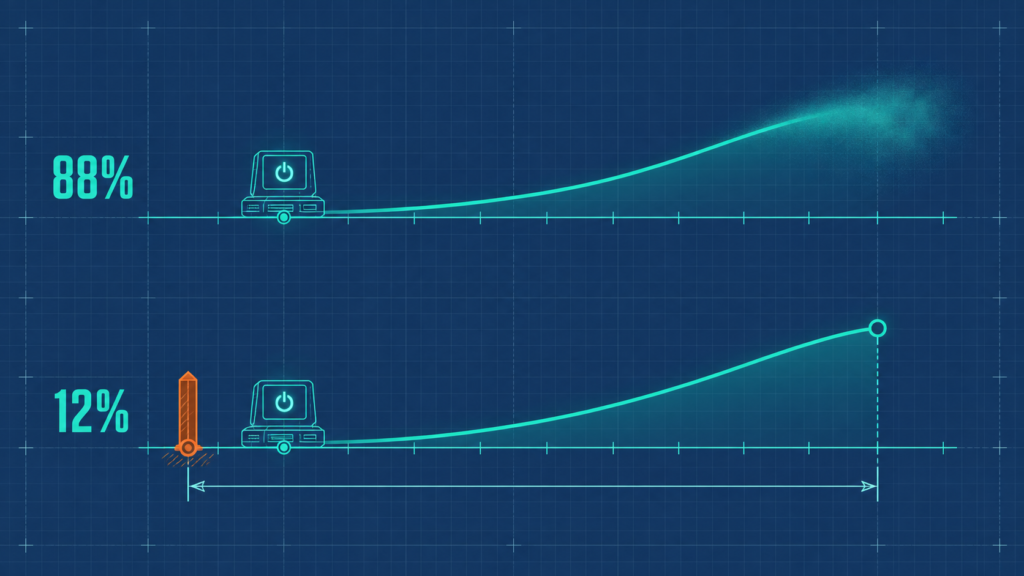
88%
of HR leaders say their organizations have not realized significant business value from AI tools.
Source: Gartner survey of 114 HR leaders and 2,986 employees, July 2025
That is not a measure of how many teams have the technology. Adoption is high and climbing. It is a measure of how many can point at something the business feels.
The second cost is structural, and it is the one that compounds. SHRM’s State of AI in HR 2026 found that 52% of organizations are not involving HR in their AI strategy at all. A function that cannot evidence value on its own tools does not get invited to govern anyone else’s.
By the end of this, you will have:
- A map of where AI sits in the HR function today, function by function, with the limit of each use named
- A four-metric scorecard to set before the pilot starts, and the four baselines to capture before procurement
- Kill criteria written as a threshold and a date, in language you can paste into a procurement document
- A three-seat governance model with one named person per seat
- The compliance items to put on the agenda with employment counsel before deployment
HR Insights Lab approach:
Every benefit claimed on this page carries either a third-party number or a before-and-after from work I ran myself. The claims that carry neither are named as claims and refused. Three of them are refused by name in the benefits section.
What Is AI In Human Resources?
AI in human resources is software that reads, drafts, predicts, and now executes inside HR workflows, working from models trained on language and historical data, not from fixed rules. It shifts the function’s capacity from processing work to exercising judgment on it. The test of whether a tool qualifies is whether its output changes with context.
Here’s the difference:
That definition keeps moving, and the drift is the reason two HR leaders can both say “we use AI” and mean nothing alike. In 2019 the phrase meant resume parsing. By 2023 it meant generative AI in HR, and first-draft writing became the use every team tried first.
In 2026 it means execution. The system does not hand you a recommendation and wait, it completes the step and tells you afterward. Define AI in HR by the technology and your definition expires with the product cycle. Define it by what changes about the work and it survives.
I use AI as a co-pilot, never as a decision-maker, and that principle is what the definition has to protect. AI in HR is a capacity change. It is not an authority change.
It is not HR technology with an AI label on the box:
Most HRIS modules marketed as AI in 2026 are rules-based automation that predates the term. Take the test question to your next vendor call: does the output vary with context, or does it execute a rule somebody wrote? A vendor who cannot answer that in one sentence is selling you AI HR software that is neither.
It is not the same as AI in the workplace:
HR owns two things that get confused constantly. The tools the function runs, and the policy governing everyone else’s use across the organization. Conflate them and the function ends up accountable for neither. Separate them on slide one of any strategy document: AI we run, AI we govern.
It is not a decision-maker:
A model can rank, score, draft, and route. It cannot be accountable for an employment decision, because accountability attaches to a person and a model is not one.
◆ PRO TIP
The catch: any system making an employment decision with no named human answerable for it is a legal exposure wearing the costume of an efficiency gain. The efficiency is real. The exposure arrives later, in writing, from somebody else’s lawyer.
The Types Of AI In HR You Need To Know
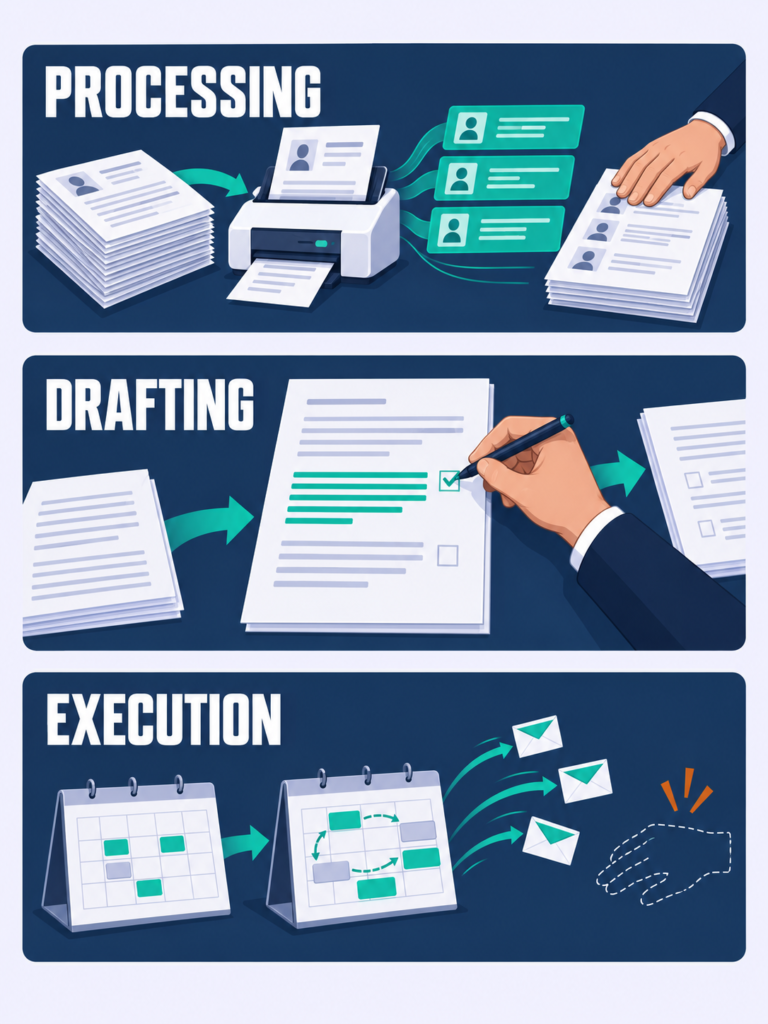
Every vendor page lists the same six categories as equals. Automation, natural language processing, predictive analytics, generative AI, assistants, agents. Six definitions, one flat glossary, no hierarchy.
You do not need six definitions. You need to know which of these changes what your team can do, and which one changes who is in control.
Here’s the difference:
Tier 1, Processing:
Robotic process automation and natural language processing sit here. The work gets faster and nothing about the decision moves. A parser that extracts skills and dates from 400 applications has saved your coordinator a morning, and the shortlist it feeds is still built by a human on human criteria. These are the HR AI tools that need a budget line and no governance conversation. The question this tier forces: is the extraction accurate enough that nobody downstream is quietly correcting it?
Tier 2, Drafting And Prediction:
Generative AI and predictive analytics. A human still decides, and the input they decide on is now machine-produced. That introduces a failure mode Tier 1 does not have: the reviewer rubber-stamps a plausible output they did not check.
This is the tier I have worked in most. I built prompt frameworks for role clarity and skill translation, inclusive job description drafting, structured interview questions, and market insight synthesis, with a human validation step written into each one. The validation step is not a courtesy. It is the only thing standing between Tier 2 and rubber-stamping, and it is the first thing teams drop when the volume rises.
Tier 3, Execution:
The system acts. AI agents for HR schedule, advance, chase, reject, and notify without a person in the sequence. The question this tier forces is a different question entirely: what is this permitted to do, and what is it forbidden to do? Answer that before procurement or you will be answering it after an incident.
| Tier | What it does | HR example | What you must control |
|---|---|---|---|
| 1. Processing | Same decision, less time | CV parsing, document classification, ticket routing | Extraction accuracy, and whether anyone downstream is silently fixing it |
| 2. Drafting and prediction | Machine-produced input to a human decision | Job description drafts, outreach copy, attrition risk models | A named validation step, and evidence that it is being performed |
| 3. Execution | The system acts without a person in the sequence | Interview orchestration, automated scheduling and candidate advancement | Permissions: what it may do, what it may never do, and the audit record of both |
Why The Agentic Shift Is The Category Change That Matters This Year
Recommendation became execution. That is the whole change, and it is the only one on the list that is genuinely new.
Everything built before 2025 produced an output a human then acted on. An agent runs the workflow. Picture interview orchestration: the panel loses a member on Tuesday, and the system re-sequences the slots, notifies the candidate, chases the replacement interviewer, and rebuilds the schedule before a recruiter has opened the calendar.
I have watched this move into pilot phase in recruitment, and the shift is real. Systems have stopped returning inputs and started executing workflows.
Two things change in governance the moment that happens. The audit trail stops asking who decided and starts asking what the system was permitted to do. And the failure mode flips: you are no longer managing a slow process, you are managing a fast wrong one, at volume, across every candidate it touched before anyone noticed.
⚠ WATCH OUT
Watch out: a recruiter who makes a scheduling error affects one candidate. An agent with a bad rule affects everyone in the requisition before Friday. Speed multiplies whatever it is given, and a wrong answer at scale is harder to unwind than a slow one, because the candidates have already received it.
Here is the honest position on agents. This is where the category is genuinely moving, and it is also where the risk concentrates. Buy at this tier as a permissions design problem, and define what the agent may not do before you define what it will.
AI In HR Examples: How The Function Uses It Today
Search this topic and you will find six pages promising examples. Open them and you find categories.
“AI can screen candidates faster” is not an example. It is a capability statement with nobody in it, nothing done, and no result. What follows is organized by function, and each one carries a concrete use, an outcome, and the limit where that use stops.
AI In Talent Acquisition And Sourcing
Adoption is concentrated here. SHRM’s 2026 research puts recruiting at 27%, ahead of HR technology at 21% and learning and development at 17%. Three uses are live and working.
Talent rediscovery is the first and the least discussed. Semantic search across the candidate database you already paid for surfaces people who applied eighteen months ago for a role they were nearly right for, and who are now exactly right for this one. Most teams run this database as an archive. It is an asset.
The second is drafting: job descriptions, outreach sequences, and interview guides produced in first draft and edited by a recruiter. The third is competitor talent mapping at a speed manual research cannot reach. That third one is where my own numbers come from.
Why this works:
Two frameworks sit underneath all three. Intelligence-Led Sourcing means continuous market mapping before a vacancy exists. Talent Market Pre-Alignment, or TMPA, takes it further: identify and engage capability ahead of demand, confirm interest and availability before requisitions open, and hiring stops being reactive and becomes demand-led.
◆ FROM THE LAB

The Sofia lens: at one point in my career I was asked to scale an automation engineering team, in a skill pocket where the qualified population in the region was small enough to count. The standard response would have been to write the job descriptions, post them, and wait. We had watched that cycle run at 68 days to offer, and the business needed the team before that.
So we started before the requisitions existed. We mapped 12 companies across the industrial IoT space, working out who held the relevant engineering capability, how those teams were structured, and which of them were at a point where a conversation would land. That mapping produced 37 qualified candidates who were identified, assessed for fit, and warm before a single job description had been written.
When the roles opened, we were not sourcing. We were calling people we already knew. Average Time-to-Offer fell from 68 days to 34.
The transferable part is not the tooling. It is the sequence. Proactive mapping beats reactive posting, and the work that halved the number happened in the weeks before anyone would have called it recruitment.
The market intelligence work shows up in quality too, and I tracked it method by method. Competition analysis lifted Quality of Hire by 12%. Talent landscape work across comparable industries added 14%. A skill-based pipeline built after market analysis moved it 30%.
◆ PRO TIP
The catch: none of this touches the evaluation decision. AI found the people, ordered the market, and drafted the first version of everything. Who gets hired was decided by humans in every one of those numbers, and moving that line is a different article with a different risk profile.
AI In Onboarding And Employee Service
This is the highest-volume, lowest-judgment surface in HR, which makes it the most defensible first deployment you can pick. Policy questions, document collection, IT and access provisioning triggers, first-90-days nudges. A service agent answering the same 40 questions 8,000 times a year produces a deflection number, and deflection is one of the few HR AI metrics that comes out clean.
Here is the part teams skip. The log of what people ask is the specification for what to automate, and most functions build the automation before they have the log. Publish a better employee onboarding FAQ and you are guessing at the questions. Instrument the questions first and the build writes itself.
◆ PRO TIP
Real talk: deflection is not satisfaction. A chatbot that deflects 70% of tickets while annoying the 30% it fails has moved the cost, not removed it, and the 30% are the ones who will describe your HR function to their manager. Measure both numbers or you are measuring half the outcome.
AI In Learning And Development
Third place on the adoption table at 17%, and climbing. Two uses sit here and they carry very different risk.
Content generation is the visible one: course material, role-specific learning paths, assessment drafts. It is Tier 2 work, a human signs it off, and the exposure is low. The saving that is genuinely large sits somewhere less exciting. Josh Bersin reports a pharmaceutical organization supporting more than 6,000 scientists and manufacturing staff with ten people in L&D, by automating training operations, compliance tracking, and onboarding.
Ten people. That is the scale of what happens when the operations layer of a function moves to machines, and it is the most concrete published number anywhere about what AI does to an HR team’s headcount.
The second use is skills inference from performance and project data. It presents as Tier 1 reporting. It is Tier 2 prediction wearing a dashboard, because an inferred skills profile does not stay in the learning system. It becomes an input to staffing and promotion, and it gets there without anyone deciding it should.
⚠ WATCH OUT
Red flag: the day an inferred skills profile appears in a talent review, it has become a promotion input. Nobody signed that off, the employee cannot see what it says, and the model built it from project data that reflects who got given the good work. Decide in advance whether inference may cross into skills-based hiring and staffing decisions, and write the answer down.
AI In Performance Management
The most oversold use on this list. What AI does here in practice: it drafts review language from manager notes, summarizes feedback across reviewers, and flags inconsistency in rating distributions. What it is sold as: objective performance measurement.
Those are not the same product. A model trained on your historical ratings reproduces your historical rating pattern, including the manager who rates generously and the one who rates everybody a three.
Eric Severson described the version of this problem that predates AI entirely: a room of binders, 98% performance-review completion, and no answer to whether attrition was falling or skills were growing. Point AI at that process and you get 98% completion, faster and cheaper. The throughput was never the problem.
Automating an instrument nobody trusts produces cheaper distrust.
I hold the same position on retention, which I think is mostly a systems failure dressed up as a pay problem. The logic carries across. A performance management cycle that does not change behavior is a systems failure, and AI accelerates systems. It does not repair them.
⚠ WATCH OUT
Common mistake: buying AI to make the performance cycle cheaper to run, before anyone has answered what question the cycle is supposed to answer. Ask that question first. Some of these processes should be eliminated, and an eliminated process needs no license.
AI In Employee Engagement And Retention
Two uses here. One is useful and one is dangerous, and the pages selling them present both the same way.
The useful one: theme and sentiment extraction across open-text survey responses and exit interviews. Four thousand free-text answers in, six themes out, ranked by frequency and sentiment. That is a summarization problem, machines are good at it, and no HR team was ever reading all four thousand.
The dangerous one: flight-risk scoring on engagement and performance signals. It is a prediction about a named individual, and predictions about named individuals get acted on. Here is the governance rule in one line. A flight-risk score may trigger a conversation. It may never trigger a decision.
There is a further limit worth naming, because MIT Sloan names it and the vendor pages do not. AI identifies patterns of discord faster than any analyst. Redesigning the system producing those patterns is a completely different capability, and it is the one that fixes anything.
My read on employee retention is that pay matters to a threshold, and past it attrition runs on unclear career paths, weak manager capability, poor role design, burnout from bad operating models, and weak internal mobility. A model can surface all five. It cannot rebuild any of them.
⚠ WATCH OUT
Anti-pattern: a flight-risk score reaching a manager before it has reached a policy. Once a line manager can see which of their people the system thinks is leaving, that score is shaping assignments, development conversations, and who gets told about the stretch project. Write the policy first, then release the score.
AI In Workforce Planning And Analytics
The largest gap between potential and practice on this list. McKinsey’s HR Monitor 2026 found only 11% of organizations take a genuinely strategic, long-term view of workforce planning, which means AI is being applied to a discipline most functions are not performing.
What works now: demand forecasting against historical requisition and attrition data, scenario modeling for reorganization, and skills-supply mapping against the external market.
◆ FROM THE LAB
My experience: “workforce intelligence” is an abstraction until you name what sits inside it. Mine was skill-wise and industry-wise talent landscape mapping, a global against domestic hiring comparison, a read on how competitor teams were structured, and an analysis of competitor hiring patterns over time. Four concrete inputs, refreshed continuously, feeding a plan instead of a spreadsheet built from last year’s numbers.
How to execute:
Apply TMPA upstream of the requisition. Annual headcount planning negotiated between managers in a budget cycle produces a number. Demand-led forecasting, with capability pre-aligned before roles open, produces a plan the business can hire against. Workforce planning is the discipline where that distinction costs the most.
⚠ WATCH OUT
Warning: the forecast is only as good as the workforce data underneath it, and most HRIS data is not clean enough to forecast on. Duplicate records, job titles that never matched the work, and three years of reorganizations nobody backfilled into the system. Audit the data before you buy the forecaster, or you will pay for a model that is confidently wrong.
The Real Benefits Of Artificial Intelligence In HR
You are going to have to defend a budget line with this. So the only benefits worth your time are the ones that survive the follow-up question.
Three do. Each one below carries a number and a source, and the three claims after them carry neither.
Here’s the deal:
Benefit One: Time Returned
The cleanest measurable of the three, because the people doing the work can feel it and report it. Gartner’s July 2025 survey of 2,986 employees found 62% saying AI had saved them time, with those in AI-relevant roles saving an average of 1.5 hours per day.
1.5 hrs
saved per day by employees in AI-relevant roles. 62% report AI has saved them time.
Translation: the saving is real and it is large. Hold that thought, because the next section is about what happens to those 1.5 hours, and the answer is the reason this article exists.
Benefit Two: Cycle Time
This is where my own numbers do work no vendor survey can. On the automation engineering scale-up, Time-to-Offer moved from 68 days to 34. On a multi-role volume ramp-up I ran later, average Turnaround Time (TAT) came down from 32 days to 18 or 20 across 420-plus hires in 10 weeks, with the offer-to-join ratio holding above 90%.
Cycle time is the benefit a business leader feels without being taught to. The role is filled or it is not.
Benefit Three: Cost
◆ FROM THE LAB
Real implementation: on senior engineering roles, cost per hire ran at roughly $7,800 to $9,000 before we changed anything. Agency fees were the largest driver, and long cycle times were the second. After we moved to direct sourcing, structured referrals, and targeted talent pools, the same roles were closing at roughly $3,600 to $4,600.
That is a 45% to 55% reduction, with time to fill moving from 70 or 80 days down to 45 or 50. Agency reliance dropped by 60% to 70%. On one set of six senior roles, four agency placements were avoided outright, at roughly $9,500 to $12,000 in fees each.
Here is the qualifier that separates this section from every competing page on this topic. Each of those three numbers exists because somebody wrote down the starting point first.
The before was recorded. That is the whole reason there is an after to report, and it is the discipline the next two sections are built on.
The Benefits Of AI In HR That Do Not Hold Up
Three claims you will hear in the next vendor meeting. Two of them are wrong, and one of them is conditional on something almost nobody does.
“AI removes bias from hiring”:
It reproduces the pattern in the training data. A model trained on who you hired before will recommend more people like the people you hired before, which is the definition of the problem it was sold to solve. The mechanism is in the challenges section below. Refuse the claim now.
“AI improves quality of hire”:
Quality of hire is measured at 12 months, and almost nobody making this claim has waited 12 months to check it. Ask three questions and watch the answer: measured how, at what interval, against what baseline? My own Quality of Hire gains, the 12%, the 14%, and the 30%, each came from a methodology change I could name. None of them came from a tool.
“AI frees HR to be strategic”:
The most repeated claim in this category and the one with the least evidence behind it. Freed time becomes strategic work only if a named person deliberately redirects it. Absent that decision, the hours are absorbed by the queue that was already waiting.
The old way
- Take the benefits slide as read
- Negotiate on price and implementation date
- Accept the vendor’s dashboard as the measurement
- Report hours saved to the leadership team
The Lab Way
- Ask of every claim: measured how, over what period, against what baseline
- Treat an unanswerable benefit claim as a no
- Record the four baselines yourself, before procurement
- Report the work the freed hours moved to
⚠ WATCH OUT
Common mistake: accepting “this frees your team to be strategic” without a redeployment plan attached to it. That sentence is doing the work of a business case and it contains no commitment. Ask which work the hours move to, who owns that work, and how you will know it happened.
Why Most AI In HR Programs Deliver No Measurable Value
Three failure modes produce almost all of the 88%. None of them is a technology failure, which is why buying a better tool does not fix any of them.
Each one below is diagnosable. You will recognize at least one from a program running in your function right now.
Failure Mode One: The Freed-Time Trap
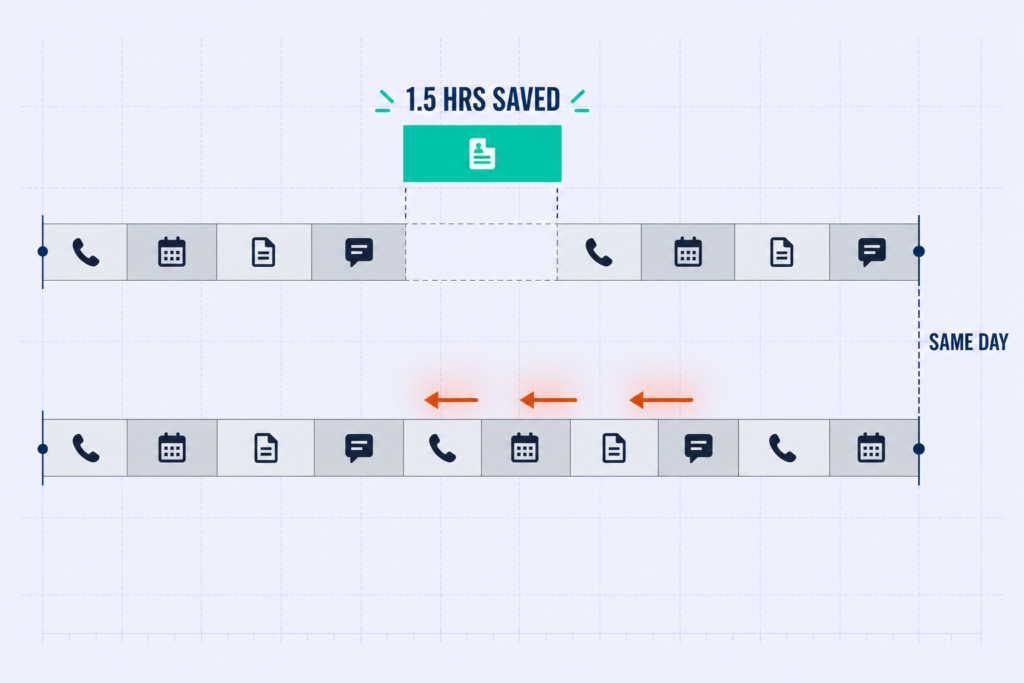
An hour given back to a recruiter who has no instruction about what to do with it is absorbed by the work already queued behind it. Nothing visible changes. The saving is genuine and invisible at the same time, which is precisely how a program produces real efficiency and zero demonstrable value.
Gartner put the scale of it on the record in the same study that produced the 88%.
7%
of organizations have given employees any guidance on how to use the time AI frees up.
Ninety-three percent of organizations returned time to their people and gave no direction about where it should go. The tool worked. The value evaporated between the saving and the reporting.
The fix is one decision, made before go-live: name the work the freed hour moves to, and measure that thing, not the hour. Mine has been the same for years. AI takes the high-volume logistics so recruiters move to high-touch relationship building.
That is a redeployment plan stated in a single sentence. It is more than 93% of organizations have written down.
◆ PRO TIP
The honest downside: a redeployment decision is a commitment your team can hold you to, and that is why it rarely gets written. Once the destination for the hours is on paper, somebody can ask in 90 days whether the recruiters are doing that work. Write it anyway. The discomfort is the mechanism.
Failure Mode Two: Automating A Broken Process
This one produces the most confident-looking dashboards in the organization. If the process was wrong before automation, AI makes it wrong faster and at greater volume. Throughput improves while the outcome degrades, and every number on the report is going the right way.
The performance-review binders earlier in this article are the canonical version. Completion was 98% and nobody could say what it bought.
My own version of this sits in Talent Acquisition, where I take a position most of the market disagrees with. More applications do not produce better hiring. The right five candidates beat 500 wrong ones, and a screening tool that processes 500 faster has optimized a variable that was never the constraint.
Automation does not fix a process. It commits you to it, faster.
How to execute:
Run the elimination question on every process before you automate it. If we stopped doing this entirely, what would employees notice? A process nobody would notice should be removed, not accelerated. Josh Bersin’s phrasing for the same discipline is worth borrowing: fix the plumbing first, then decide where AI goes.
⚠ WATCH OUT
Anti-pattern: picking the most time-consuming process and automating it because it is the most time-consuming. Time spent is a measure of cost, not of worth. The biggest consumer of hours in your function may be the strongest candidate for deletion, and automating it converts a removable cost into a permanent one with a license attached.
Failure Mode Three: Pilot Purgatory
A pilot launches. It produces mixed signals. It is neither scaled nor killed, and eighteen months later it is still running, consuming license cost and attention, and quietly serving as the reason nothing else gets tried.
The cause is precise and it is not indecision. No success criteria and no kill criteria were written before launch, so there is no defined moment at which the pilot has to justify itself. A program with no threshold cannot fail. It can only continue.
The structural fix is a scorecard and a dated decision point, both agreed in writing before procurement. The next section builds both.
Operating rhythm is the other half. I ran a 420-hire program on daily recruiter stand-ups, real-time tracker dashboards, weekly war-room calls with hiring managers, and SLA-based vendor tracking on submissions, shortlist ratio, and offer-to-join. An AI pilot deserves at least a weekly version of that. Most get a quarterly steering meeting and a slide.
◆ PRO TIP
Real talk: a pilot nobody will kill is usually a pilot somebody senior sponsored. Ending it feels like a verdict on them, so it drifts. The scorecard is what lets you end the program without ending the relationship, because the criteria did the deciding and both of you signed them.
How To Measure AI In HR: The Scorecard Before The Pilot
Almost nobody does this, and the research says so plainly. SHRM’s State of AI in HR 2026, drawing on more than 1,900 HR professionals, found that 56% of HR functions are not formally measuring the success of their AI initiatives, and only 16% use ROI as a metric.
Source: SHRM, The State of AI in HR 2026
Measurement is not the industry’s weak spot. It is the industry’s default.
Here’s how to build it:
1
Step 1: Baseline Before You Buy

Capture four numbers in the 60 days before procurement. Current cycle time for the process in question. Current cost to run it. Current volume. Current quality outcome, measured however your function already measures it.
This is not a data project. It is four numbers in a document with a date on it, and it takes an afternoon.
It cannot be done retrospectively, which is the part teams learn too late. Once the tool is live, the counterfactual is gone, and every number after that is an assertion you are asking someone to take on trust. Say this sentence to your vendor before you sign: we will baseline for 60 days before go-live, and the contract’s success criteria reference that baseline.
◆ FROM THE LAB
The Sofia test: I can tell you that cost per hire on senior engineering roles went from roughly $7,800 to $9,000 down to roughly $3,600 to $4,600, and that time to fill moved from 70 or 80 days to 45 or 50. Every one of those figures is only meaningful because the first number exists.
Had I started measuring after the change, I would have a set of respectable numbers and no evidence that anything improved. That is the position most AI programs are in when the CFO asks. Ask yourself the test question: if this tool went live on Monday, what four numbers would I wish I had written down on Friday?
2
Step 2: The Four-Metric Scorecard
Four metrics, each with a definition and a trap. Put them in front of a CFO and they survive the follow-up questions.
| Metric | Definition | Interval | The trap |
|---|---|---|---|
| Cycle time | The process end to end, not the automated step | Monthly | Halving screening time while the panel still takes three weeks to convene changes nothing the business can feel |
| Cost to serve | Fully loaded: license, integration, and internal hours spent administering the tool | Quarterly | The internal administration hours are the line vendors never include |
| Quality outcome | Defined before launch, measured at a fixed interval | 12 months for Quality of Hire, 90 days for retention on a volume program | Redefining the measure after you see the result |
| Adoption | Actual usage by the people it was bought for | Weekly | A tool used by two of nine recruiters is a license cost, not a capability |
There is a fifth metric everyone reports and nobody should: hours saved, unaccompanied by what the hours became. It is the number that produced the 88%.
◆ FROM THE LAB
Real implementation: this scorecard is not a framework I built for an article. It is the reporting line I ran a volume program on. The business needed somewhere between 350 and 500 people across customer support, operations analysts, junior engineers, and sales support, inside an 8 to 12 week ramp-up, with limited interviewer capacity and a serious risk of candidate drop-off at every stage.
We planned capacity backward from the business start date, mapping weekly hiring targets and forecasting recruiter bandwidth, interviewer availability, and sourcing throughput before committing to a number. Sourcing ran multi-channel. Screening ran on standardized pre-assessment criteria, interviews ran in batches against structured scorecards, and the whole thing ran on daily stand-ups and a real-time tracker.
We delivered 420-plus hires in 10 weeks. TAT came down from 32 days to 18 or 20. Offer-to-join held above 90%, 90-day retention landed between 85% and 88%, and recruiter productivity improved by roughly 35%.
Look at what that program reported and the four metrics are already there. TAT was cycle time. Recruiter productivity was cost to serve. Offer-to-join and 90-day retention were the quality outcome, measured at a fixed interval agreed in advance. Stand-up participation was adoption. The scorecard above is that reporting line, lifted off a hiring program and pointed at a tool.
Whatever you build, own the definitions yourself. Vendor dashboards report engagement metrics dressed as business metrics, and recruitment metrics your function did not define are metrics your function cannot defend.
⚠ WATCH OUT
Watch out: leave “employee satisfaction with the tool” off the scorecard. It is the metric vendors suggest because it is the one they always win, and a team can be delighted by software that moved no business number at all.
3
Step 3: Write The Kill Criteria First
This is the step that makes the scorecard enforceable. Before procurement, write down the result at which the pilot stops. A threshold and a date, not a review point.
Copy the shape of this sentence into your procurement document: if cycle time has not improved by at least 20% by day 90, and adoption is below 60% of the intended user group, the pilot ends and the license is not renewed.
Then the part that decides whether any of it holds. Agree the criteria with the sponsor at the start, when nobody is invested and the decision costs nothing emotionally. That is the only moment at which agreeing them is easy. SLA-based vendor tracking is the closest discipline I have run to this, and it worked for the same reason: the threshold existed before the relationship did.
◆ PRO TIP
Pro tip: kill criteria are not pessimism. They are what makes it safe to try more things. A program that can be ended cheaply can be started cheaply, and a function that has demonstrated it will stop something is the function that gets permission to start the next one.
The Challenges Of AI In HR Nobody Puts In The Brochure
The published material on this topic splits into two halves and neither is usable. Academic papers are rigorous and unreadable at the speed you need. Practitioner pages give each challenge a sentence and move on.
Four challenges below. Each one pairs the risk with the control that answers it.
Algorithmic Bias In AI Hiring Decisions
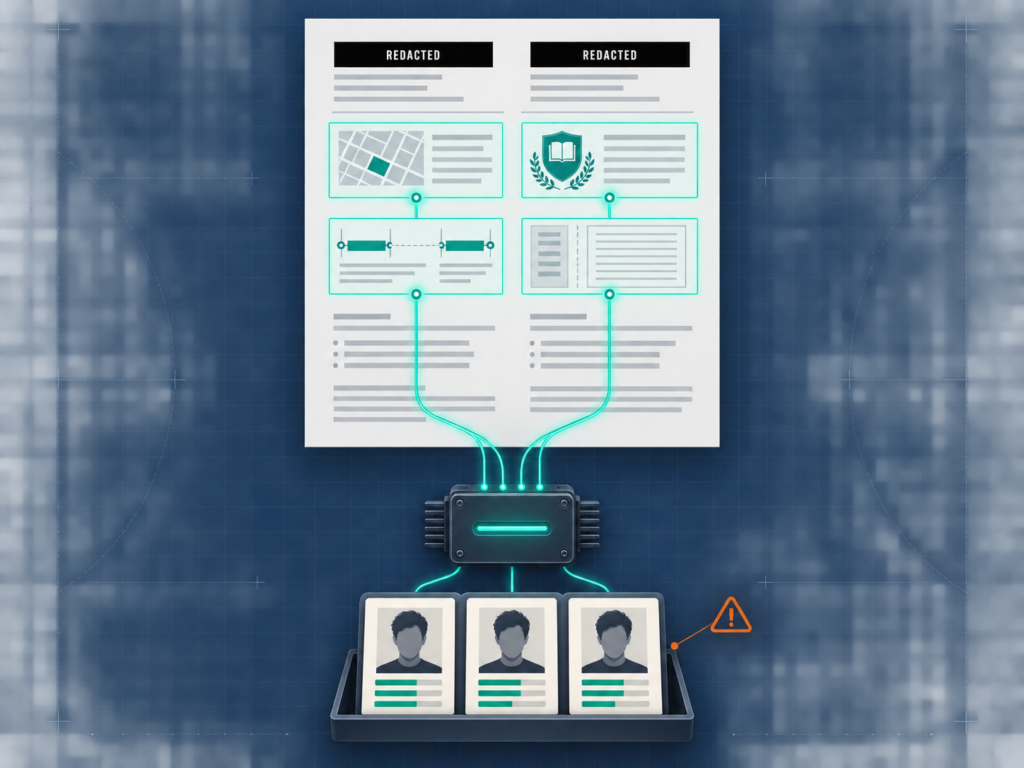
The mechanism matters more than the warning, because the mechanism makes the control obvious. A model trained on your organization’s historical hiring reproduces your organization’s historical hiring, including the parts of it you would not defend in a room.
Then there is the second-order version most pages miss. Strip out names and genders and the signal survives, because it was never carried by the name. It is carried by postal code, by university, by the length of a career gap, and by resume formatting.
⚠ WATCH OUT
Red flag: a vendor telling you their tool is bias-free because it does not see protected characteristics. Those four proxy fields are in your data and they are doing the work. Anonymization is a control on the human reviewer. It is not a control on the model.
Three controls close the gap. Run adverse impact testing on the model’s output at the same cadence you run it on human decisions. Keep a named human accountable for every rejection. Keep a documented record of what the system was permitted to decide.
Why this works:
There is a structural control that does not depend on the model behaving at all, and it is the one I trust most. Inverted Sourcing Funnels filter on capability signals: published work, project evidence, demonstrable skill. Filter on capability and the proxies lose their grip, because you stopped asking the questions the proxies answer.
I ran a diversity hiring initiative on that logic, widening sourcing channels through diverse job boards, referral drives aimed at underrepresented groups, and inclusive campus outreach. Diverse slate ratios at interview stage went up. Conversion to offer went up with them, and Quality of Hire did not move a point.
Here is the honest position, and it separates this from the vendor treatment. AI does not remove bias from hiring. It makes bias measurable, and measurable bias beats invisible bias, but only where somebody is doing the measuring.
Employee And Candidate Data Privacy
HR holds the most sensitive data in the organization, and AI tools open three exposures most risk registers have not mapped.
The first is where the data goes. Ask the contract question in these words: is our data used to train your models, and can we opt out in writing? The second is retention. Candidate data now sits in a vendor’s index as well as in your ATS, and a deletion request has to reach both.
The third is shadow usage, and it is the one already happening in your function today. Recruiters pasting candidate CVs into consumer AI tools is the most common real breach in HR, and it almost never appears on a risk register.
◆ PRO TIP
The catch: nobody doing this thinks they are breaching anything. They are drafting a summary faster on a Tuesday afternoon. That is why a policy written after the incident always arrives too late, and why the approved-tools list has to exist in week one of any rollout.
My verdict on the general-purpose assistants is that they are a genuine productivity multiplier and not a recruiter. That verdict is the shape of a usable policy, so publish it as one.
The never-paste list:
- Approved: drafting job descriptions, outreach, interview guides, and offer language
- Approved: Boolean string construction, role research, and DEI language checks
- Never: candidate evaluation or screening decisions
- Never: compliance-sensitive documentation
- Never: identifiable candidate or employee data pasted into any tool outside the approved list
Back it with a data processing agreement that addresses model training explicitly. Data protection obligations vary by jurisdiction and by where your people sit, so confirm the position for your own footprint with counsel before deployment.
The Regulatory Patchwork Around AI In Hiring
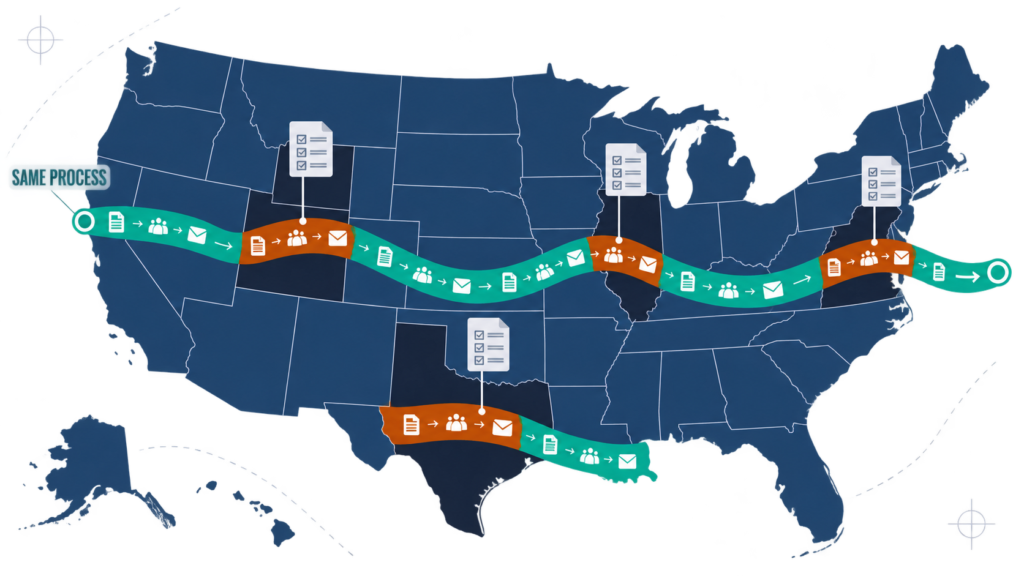
AI employment law in the United States is being written at state and city level. One national hiring process can therefore be compliant in one location and exposed in another, running on the same software, on the same day.
That is a structural problem, not an edge case, and the data says most of the profession has not met it yet.
SHRM’s State of AI in HR 2026 found that 57% of HR professionals are unaware of state-level AI regulations affecting employment, and only 12% report taking steps to ensure compliance, while 19 of the most populous US states now have AI employment laws in place.
Source: SHRM, The State of AI in HR 2026, survey of 1,900+ HR professionals
What follows is an agenda, not advice. Four items to put in front of employment counsel before an automated tool touches a hiring decision.
- New York City Local Law 144 and its bias-audit and candidate-notice requirements for automated employment decision tools. Ask counsel what applies to your hiring footprint.
- The Illinois Human Rights Act amendment covering AI in employment decisions. Ask counsel how it reads against your process.
- The Colorado AI Act and its obligations around consequential decisions. Ask counsel whether your use meets that threshold.
- The EEOC’s position that existing anti-discrimination law applies to algorithmic decisions regardless of who built the tool. Ask counsel what evidence you would need to produce.
I am not going to tell you whether you are compliant, and no blog should. Bring counsel in at design stage, where the answer changes what you build, and not at audit stage, where it only changes what you disclose.
⚠ WATCH OUT
Watch out: a vendor warranty is not a compliance position. The obligation sits with the employer making the employment decision, and “our vendor said it was audited” has never been a defense anyone wanted to run. Map your hiring footprint against the jurisdictions with AI employment rules before deployment, and treat HR compliance as a design input.
Trust, Transparency And The Experience Cost
The challenge with no technical fix. Candidates assume they are being read by a machine and behave accordingly, optimizing for the parser and not for the role, which degrades the signal the parser was bought to read.
Employees do a quieter version of the same thing. Asked to use an internal tool they were not consulted about, they disengage from it without announcing it. That is why adoption sits on the scorecard.
Three controls. Disclose where AI is used in your process and say it plainly on the careers site. Give candidates a route to a human. Involve the people who will use an internal tool in choosing it.
◆ FROM THE LAB
Real implementation: the human route is assumed to be impossible at volume, and the volume program I ran is where I stopped believing that. Mass communication templates carried clear timelines, every candidate batch had a single named point of contact, offers were released fast, and pre-joining engagement ran until the start date. That is a candidate experience design running across 420-plus hires in 10 weeks, and it is what kept offer-to-join above 90%.
There is a cost to getting this wrong that does not show up in a funnel report. MIT Sloan names it and no vendor page will: AI cannot work out why your high performers are quietly job hunting, and it cannot rebuild trust after a failed reorganization. A function that spends its credibility on tooling has less of it left for the work only people can do.
Who Owns AI In HR? The Governance Question That Decides Everything
HR absorbs the consequences of every AI decision made anywhere in the organization. Role redesign, redundancy, retraining, grievance, policy. All of it lands in the function, whoever signed the purchase order.
In more than half of organizations, HR is not in the room where those decisions are made.
52%
of organizations are not involving HR in their AI strategy. Only 28% report that HR leads upskilling efforts.
Source: SHRM, The State of AI in HR 2026
Why does this matter?
Because exclusion is not random, and it is not personal. It follows from the measurement gap this article has been building toward.
A function that cannot evidence value on its own tools does not get invited to govern anyone else’s.
That is the causal chain, and it is why the measurement section sits ahead of this one. Two moves change the position, and neither of them requires anybody’s goodwill.
First, arrive at the enterprise AI forum with a measured deployment result from your own function, not a concern about somebody else’s. I have found that the argument that gets a hearing is the one that comes with a number and a date attached. The recognition I received as a key enabler of transformation came from delivery, and delivery is the only currency that reliably converts into influence.
Second, claim the workforce-impact assessment as HR’s deliverable before somebody else defines it as a checkbox on a procurement form. Nobody else in the organization can produce it. That is leverage, and it expires the moment another function writes the template.
The Three-Seat Model For AI In HR Governance
A governance structure you can propose on Monday. Three named accountabilities, not a committee.
- Seat one, the business owner: names the outcome the tool must produce and signs the kill criteria. An HR leader, never IT.
- Seat two, the technical owner: owns integration, data flow, and the security review, and answers the question of where the data goes.
- Seat three, the risk owner: owns adverse impact testing, the jurisdictional map, and the audit record, with a standing route to employment counsel.
One rule makes it work. One named person per seat, written into the procurement document, and no tool is bought until all three exist.
I have run governance by name before, on a hiring program where specific people owned specific numbers in a weekly war-room call. Committees produce minutes. Named owners produce answers.
◆ PRO TIP
The catch: in a small function one person may hold two seats. Never all three. The point of the model is that nobody grades their own homework, and a single owner across business outcome, technical delivery, and risk has no one to answer to at the moment it matters.
The AI In HR Adoption Blueprint: A Phased Rollout That Survives Contact With Reality
Most adoption guidance describes what your organization should already be: data-ready, aligned, change-capable. None of that is a thing you can start on Monday morning.
Four steps. Each one produces an artifact you end up holding.
Here’s how to build it:
1
Step 1: Audit The Workflow, Not The Tools
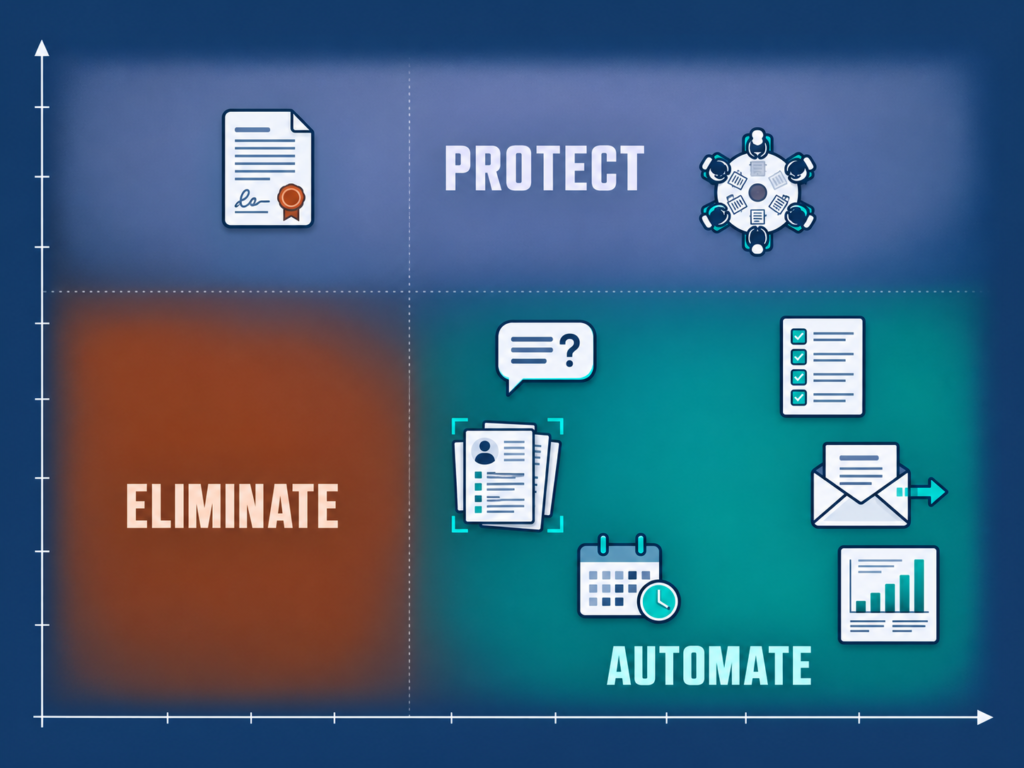
The first action involves no vendors at all. Map every recurring process in the function against two axes: volume and judgment.
High volume and low judgment is the automation candidate. Low volume and high judgment is what the function should be protecting.
Run it as a half-day with your team. Every recurring process on the wall, two columns, and an honest count of hours against each one. Then run the elimination pass from the failure modes above: if we stopped this entirely, what would employees notice?
What you end up holding is a one-page map with three zones. Automate, protect, eliminate. That map is the input to every decision that follows, including which vendors are worth a call.
The old way
- Book three vendor demos
- Pick the strongest product
- Find a process to apply it to
- Discover the fit problem in month four
The Lab Way
- Map volume against judgment in a half-day
- Run the elimination pass on every process
- Let the map disqualify two vendors before the calls
- Brief the remaining vendor against your zones
I have run the same discipline on a different problem. On a volume ramp-up, we modeled weekly hiring targets backward from the business start date and forecast recruiter bandwidth, interviewer availability, and sourcing throughput before committing to a plan. Model the work before you buy capacity for it. That holds whether the capacity is people or software.
2
Step 2: Pick One Process And Defend It
The selection rule, stated as a rule. Your first deployment scores high on volume, low on judgment, and high on measurability.
The third criterion is the one teams drop, which is how a function ends up piloting something genuinely useful that it cannot prove.
Three candidates are stronger than the rest. Employee service deflection, because the ticket volume is already logged. Talent rediscovery across your existing candidate database, because the database is paid for and the comparison against fresh sourcing is clean. Interview scheduling, because cycle time is trivially measurable. Rediscovery is the one no vendor pushes, for the obvious reason that it sells no new data, and it is where I would start a talent pipeline conversation.
What not to start with: anything touching an employment decision. Your first deployment sets the function’s credibility on this subject, and an adverse impact finding in month two ends the program and the two after it.
This is a deliberately unambitious first move. Defend it on those terms. A provable small win funds the next three.
⚠ WATCH OUT
Common mistake: letting the sponsor pick the flashiest use case for the first deployment. Visible and provable are different properties, and the visible one usually touches a decision. Start with the most measurable process, prove it, and spend that proof buying permission for the visible one.
3
Step 3: Run The Pilot Against The Scorecard
Baseline for 60 days, run for 90, review against the four metrics on the date already in the diary.
The operating rhythm matters more than the review. One weekly number, one named owner, a standing fifteen minutes. A monthly cadence means a problem is found four weeks after it started, and on a 90-day pilot that is a third of the evidence gone.
Two things go wrong mid-pilot and each has a specific answer. Adoption stalls, which is almost always a workflow-fit problem masquerading as a training problem. Sitting with three users while they work will tell you more than another guide ever will.
Or the numbers move the wrong way. That is information, not failure, and it should be reported as information. A pilot that proves a tool does not work has done its job at a fraction of the cost of finding out at scale.
I ran a 420-hire program on a daily cadence with a real-time tracker, and recruiter productivity came up roughly 35% on the back of it. The tooling did not produce that number on its own. The rhythm did.
◆ PRO TIP
Real talk: reporting a failed pilot is the hardest fifteen minutes in this whole sequence, and it is the one that buys you the most credit. A leader who has watched you stop something on evidence will believe you the next time you say something is working.
4
Step 4: Scale, Kill, Or Redeploy The Hours
On the decision date there are three honest outcomes. Plan for all three before you need any of them.
- Scale: the scorecard cleared, so extend the deployment and re-baseline for the new scope. A metric that held for one team does not transfer untested.
- Kill: the criteria were not met, so end it, write up what was learned in one page, and say publicly that the criteria were applied. That sentence is what makes the next pilot easy to authorize.
- Redeploy: the hours came back, and a named person decides in writing what they are now for.
The third outcome is the one nobody plans for, and it is the one that decides whether any of this produced value. Remember the 7%. Freed hours with no destination are how a successful pilot becomes an invisible one.
My answer to that decision has stayed the same through every deployment I have run. AI takes the high-volume logistics so recruiters move to high-touch relationship building, which turns them from process managers into talent advisors.
Here is the rule that closes the loop. The redeployment decision is part of the rollout, not a follow-up conversation, and a rollout that ends before it is made has not ended.
Human-AI Teaming In HR: What HR Should Never Hand Over To AI
Josh Bersin estimates AI can plausibly do 50% to 75% of the work HR does today. He does not specify which 50% to 75%, and that missing half is the only part your team is asking about.
Here is the line, drawn item by item.
Here’s the difference:
The AI side
- Scheduling and interview logistics
- CV parsing and document handling
- Talent rediscovery across the existing database
- Market mapping and competitor analysis
- Compliance workflow tracking
- First drafts: job descriptions, outreach, interview guides
- Boolean construction and market insight synthesis
The human side
- Relationship building with candidates and managers
- Nuanced judgment on incomplete evidence
- Culture and team fit assessment
- Influencing a hiring manager who is wrong
- Redesigning the system behind any pattern the analytics surface
- Every decision with a person’s employment attached to it
One principle holds that line in place, and without it the line drifts within a quarter. Human-led validation at every decision point. AI accelerates the thinking. Recruiters own the judgment, the context, and the final call.
Publish this once, for the whole function. Let each team work out its own boundary and you will have five different boundaries by the end of the year, and the Copilot for HR question will be answered differently in every one of them.
◆ FROM THE LAB
My experience: the work I led on AI in recruitment started as prompt engineering and turned into something structurally different. The early frameworks were about getting better outputs: role clarity and skill translation, inclusive job description drafting, structured interview questions, market insight synthesis. Useful, contained, and entirely dependent on a recruiter reading what came back.
Then the pilots moved. Systems stopped handing back inputs and started executing workflows, and the shape of the job changed with them. Sourcing co-pilots running semantic search inside the database surfaced people the team had already met and forgotten. Interview orchestration went past scheduling and took on the lifecycle. Skills-first hiring moved the emphasis onto verified competency. Predictive analytics stopped answering only what to hire and started indicating who was likely to leave.
I want to be precise about what this is. It is a shift I have piloted and watched closely, not a finished program with a return on investment attached, and anyone telling you their agentic recruiting deployment is mature is selling something.
What I took from it is the risk list. An automation arms race, where dependency compounds quietly as usage grows. Loss of personal touch at exactly the moment a candidate needed a person. Algorithmic bias, where flawed training data reinforces historical hiring prejudice and does it at speed. Every one of those risks is a reason to hold the validation step, not a reason to stay out.
AI doesn’t replace recruiters. It replaces the parts of the job that stopped recruiters from being effective in the first place.
◆ PRO TIP
The honest downside: the automation arms race is real and it moves slowly enough to miss. Each deployment makes the next one easier to justify, capability atrophies where the machine took over, and one day the fallback plan is a team that has not done the work manually in two years. Keep one process human on purpose.
The Three Decisions That Stay Human, Permanently
Three exclusions, written down once, with the reason attached to each. A boundary without a reason moves the first time somebody argues with it.
- The rejection decision. Somebody has to be answerable for it, to the candidate, to counsel, and to a regulator, and accountability cannot be assigned to a model.
- The termination or role-elimination decision. It carries the greatest legal exposure in the function and the least tolerance for an input nobody can explain.
- The judgment call that contradicts the data. The strong candidate who looks weak on paper, the team whose engagement scores are fine while something is plainly wrong.
◆ FROM THE LAB
The Sofia lens: I needed a manufacturing systems analyst once, and traditional sourcing returned 14 resumes. Inverted sourcing, filtering on capability signals, returned 62 candidates. We hired a former factory-floor supervisor who had taught himself Python, and he now leads digital transformation.
No screening model trained on that organization’s hiring history would have surfaced him. His resume was the wrong shape in every way a model learns to recognize. That hire is the argument for keeping the override human, and it carries more weight than any principle I could write.
One operating rule governs all three. A human may overrule the system without justifying it. The system may never overrule a human at all.
The Future Of AI In HR: What Changes By 2028
Almost everything published about the future of this category is speculation with a confident tone. Three shifts below are dated or evidenced, and each one carries a planning implication you can use this quarter.
Shift one: execution moves to agents.
The Tier 3 change arrives in production. HR’s governance job converts from approving outputs to defining permissions, which is a different skill and a different document. The planning implication: your AI policy needs a permissions section before your first agent goes live, not after.
Shift two: the job market turns in 2028.
Gartner’s research indicates AI will create more jobs than it eliminates beginning in 2028. In a December 2025 survey of 110 HR leaders, 40% of organizations had already eliminated outdated roles and nearly half had redesigned teams to be more cross-functional or agile.
Source: Gartner HR practice, May 2026
Read both halves of that finding. More jobs created than lost in aggregate, and a large number of individual careers broken on the way to the aggregate. The planning implication is specific: the disruption is front-loaded and the recovery is not, so your 2026 and 2027 workforce planning is managing a trough, not riding a trend.
Shift three: the skills half-life compresses.
Gartner estimates the half-life of technical skills falls to roughly two years by 2030. That converts reskilling from a project with a budget code into a standing operating cost.
It also converts pre-alignment from an efficiency play into the only workable model. Talent Market Pre-Alignment means engaging capability ahead of demand and confirming interest and availability before requisitions open. When the skill you need expires in two years, the requisition you open today was already late.
Will HR Be Replaced By AI? The Honest Answer
Your team is asking. They deserve better than reassurance, and the answer has three parts.
Yes, in part. Bersin’s 50% to 75% estimate is on the record, and the pharmaceutical L&D function supporting 6,000-plus staff with ten people is what that number looks like once it has been implemented. Softening this helps nobody who has to plan a career around it.
No, as a function. The three decisions above do not become automatable through better models, because their difficulty is accountability and accountability is not a capability problem.
And the real answer, which is more uncomfortable than either. The exposed roles are the transactional and process-administration roles inside HR. Saying “HR is safe” to a team full of those roles is a kindness that costs them the two years they had to move.
◆ PRO TIP
The honest downside: if you manage a coordinator whose work is scheduling, data entry, and document collection, that role is on the list. Say so, and then do the useful thing. Name the capability shift that moves them across the line, fund it, and give them the eighteen months while it is still a choice.
My own answer to will HR be replaced by AI comes from watching what happened to the recruiters on my teams. AI removed the administrative burden and they did the actual work: relationships, judgment, culture assessment, influencing hiring managers and candidates. The gains came from elevating the role, not from reducing the headcount, and what came out the other side was faster hiring, better Quality of Hire, and recruiters who were more engaged than before.
MIT Sloan frames the choice facing the function as a fork: lead this transformation or have it imposed on you. The difference between those two outcomes is whether HR can evidence value on its own tools first.
Frequently Asked Questions About AI In HR
What Is AI In Human Resources?
AI in human resources is software that reads, drafts, predicts, and increasingly executes inside HR workflows, shifting the function’s capacity from processing work to exercising judgment on it. The term now covers everything from resume parsing to autonomous agents. That range is why two HR leaders can both say they use AI and mean entirely different things.
What Are Some Examples Of AI In HR?
Adoption is concentrated in three places: recruiting at 27%, HR technology at 21%, and learning and development at 17%, per SHRM’s 2026 research. Inside each, the specific use matters more than the category. Talent rediscovery across an existing candidate database, employee service deflection, and learning operations administration are the three with the cleanest measurable outcomes.
Will AI Replace HR Jobs?
Parts of the job, yes: the transactional and process-administration roles are the exposed ones. Decisions requiring named accountability, including rejection, termination, and overriding the data, do not become automatable through better models, because the constraint is accountability and not capability. Gartner’s research points to 2028 as the year AI begins creating more jobs than it eliminates.
What Are The Biggest Challenges Of AI In HR?
Four, ordered by how often they actually bite. Algorithmic bias reproducing historical hiring patterns, including through proxy variables that survive anonymization. Data privacy, where shadow usage of consumer AI tools on candidate data is the most common real breach. The state-by-state US regulatory patchwork. And the trust cost with candidates and employees.
How Do You Measure ROI On AI In HR?
Baseline four numbers before procurement: cycle time, fully loaded cost to serve, quality outcome, and adoption. Then measure against those at a fixed interval with a dated decision point written in advance. SHRM found 56% of HR functions do not formally measure AI success at all, and only 16% use ROI as a metric.
Is It Legal To Use AI In Hiring In The US?
Generally yes, with jurisdiction-specific obligations that vary significantly. New York City, Illinois, and Colorado each impose requirements on automated employment decision tools, and the EEOC’s position is that existing anti-discrimination law applies regardless of who built the tool. The answer depends on your hiring footprint, and it is a question for employment counsel, not a blog.
The distance between the 12% and the 88% is not a technology gap. Both groups bought comparable tools, from a similar shortlist, in roughly the same eighteen months.
What separates them is four numbers, written down and dated, before anybody signed a contract. That is the whole difference and it costs nothing.
So do this. Pick one process from the automate zone of your map, the most measurable one and not the most visible. Write the four baselines and the kill criteria into the same document, and get the sponsor to sign it while nobody is invested. Run 90 days. Make the redeployment decision on the date already in your diary.
Every framework in this article started as something I needed and could not find published anywhere. The Lab newsletter is where the next ones land first, usually before I have finished arguing myself out of them.
And if you are building this scorecard inside your own function, I would like to hear what you put on it. The four metrics above are what worked in engineering and volume hiring, and I am certain they are wrong for somebody else’s context in ways I have not met yet. Connect with me on LinkedIn and tell me what you changed.
