

I have written, rewritten, and inherited HR policies across eight years in enterprise HR, and the broken ones are almost never the missing ones.
Almost every company has a handbook. Very few have a policy set that anyone can act on. The distance between a policy that is written and a policy that is operating is where the exposure sits.
A policy nobody can find is not a policy. It is a document.
The manager improvises because the clause that answers her question is three clicks past where she looked. The policy quietly contradicts state law in the two states you added last year. Nobody has re-read it since the person who drafted it left.
That is not a documentation problem. It is an operating problem, and it produces the same result as having no policy at all.
87%
of employees said they faced situations in the last 12 months where they didn’t know how to comply with rules and standards.
Translation: nearly nine in ten employees have hit a moment where the rule existed, they wanted to follow it, and they could not work out how. Those people were not being difficult. They were being failed by a document.
HR Insights Lab approach to this topic is narrow on purpose. Coverage is the easy half of policy work. Defensibility is the half everybody skips, and it is the half that gets tested.
Here’s what this guide gives you:
- The headcount thresholds at which US federal obligations attach, and what each one turns into on your policy list
- The core policy set grouped into three risk tiers, so you know what to write in week one and what can wait until quarter three
- A seven-step build sequence for writing a policy from a blank page
- A base-plus-addendum architecture for a workforce spread across several states
- The lifecycle discipline that keeps the set current: review cadence, version control, and acknowledgment that ties to a version
- Six ways policies fail in the field, and the signals that tell you which one is happening to you
What Are HR Policies? A Working Definition For US Employers
HR policies are formal written standards that set out how an employer handles recurring employment situations, so the same situation gets the same answer regardless of which manager handles it. For a US employer, that consistency is the operational point and the legal one at once: the policy is what shows a decision followed a standard.
Every definition on this topic stops there. The part worth saying out loud is what a policy is for, operationally.
A policy is the instruction a manager follows when you are not in the room. That is the whole job. Judge every clause you write by whether it survives that moment, at 6am, on a phone, with a person waiting for an answer.
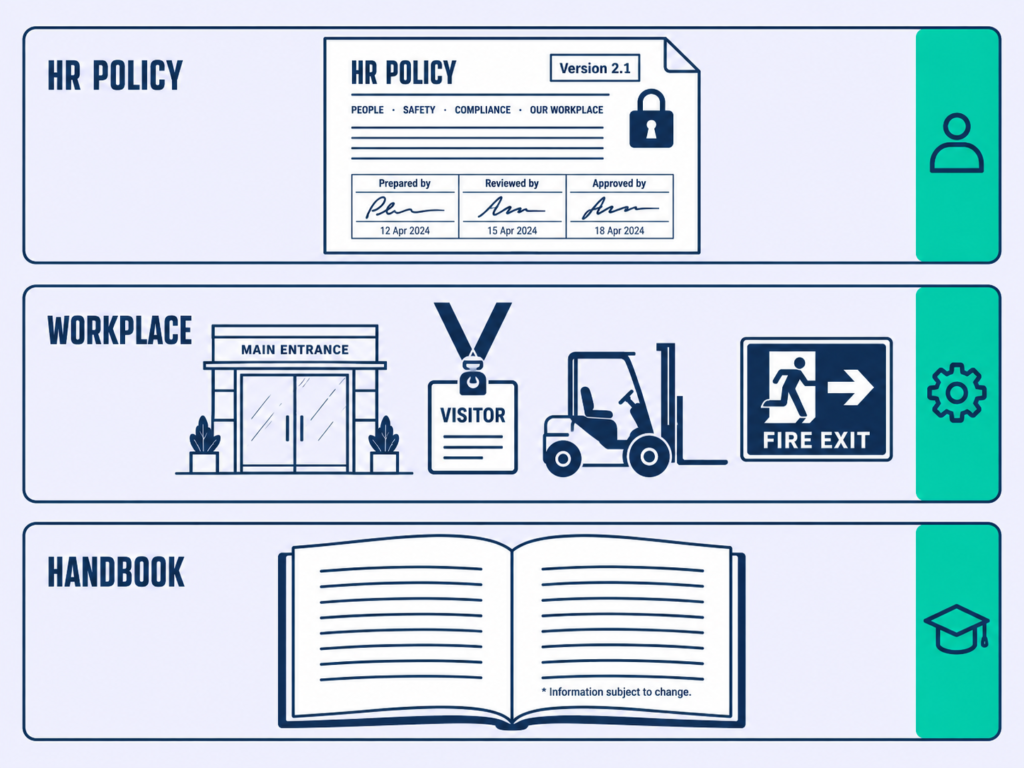
Some of what sits inside your handbook is not an HR policy at all. It belongs to the wider set of workplace policies that govern premises, equipment, and visitors, which is a distinction worth drawing carefully.
HR Policies Vs. HR Procedures: The Distinction That Decides Who Owns What
Here’s the difference:
The policy states the rule and the standard. The procedure states the executable steps.
Take leave. The leave policy states the entitlement, the eligibility standard, and the notice requirement. The leave procedure states who the employee tells, in which system, by when, and what HR does on receipt.
Now the part almost nobody makes explicit. The policy is the layer that gets produced when a decision is questioned, so it changes rarely and deliberately. The procedure is the layer you fix the moment the workflow breaks.
Fuse them into one document and you have tied a governed record to an operational workflow. Every time the HRIS changes a screen, you reopen a governed document and trigger a re-acknowledgment cycle nobody has bandwidth for.
The Old Way
- Write one document covering the rule and the steps
- Rewrite it whenever a tool, form, or approver changes
- Re-circulate the whole handbook for signature
- Watch the update cycle stall, then stop
The Lab Way
- Write a stable policy layer: scope, standard, exception, consequence
- Write a separate procedure layer owned by the function that runs it
- Edit the procedure freely without reopening the policy
- Reserve re-acknowledgment for a change in the standard itself
◆ PRO TIP
The catch: nearly every handbook I have inherited fused the two layers, and the tell is always the same. The document names a system by its product name. Once a policy names a tool, it has an expiry date nobody wrote down.
Why HR Policies Matter More In 2026: The Real Cost Of Getting Them Wrong

When a discrimination or harassment charge is filed, the enforcing agency asks the employer for the applicable written policy as part of the investigation.
Sit with what that means. The real audience for your policy is not the new hire skimming the handbook on day one. It is an investigator reading it two years later, line by line, with a specific allegation in hand.
A policy that is vague, undated, unacknowledged, or applied inconsistently does not simply fail to help in that moment. It becomes evidence of the inconsistency being alleged.
That reader is not hypothetical, and the volume is public.
88,201
new discrimination charges processed by the EEOC in fiscal year 2025, alongside $660 million recovered for 17,680 victims of employment discrimination.
Translation: roughly 88,000 files a year in which somebody reads an employer’s written policy adversarially, looking for the gap between what it says and what happened. Write for that reader and the day-one reader is covered anyway. Write only for day one and you have built a brochure.
Why this matters:
The second cost never reaches a board slide. Two managers, same situation, two different answers, because the policy left room for both.
Ambiguity does not stay inside the document. It walks out as two employees with two outcomes and a comparator argument sitting between them.
Then there is the drag. Every ambiguous clause becomes an escalation, and an HR Business Partner who spends the week adjudicating inherited ambiguity is not partnering with anybody. This is the real job of an hr management policy: it governs how managers use discretion, and its quality is measured by how little discretion it leaves in the places that matter.
If two competent managers can read a clause two ways, the clause is the defect. Not the managers.
◆ FROM THE LAB
My experience: the standard response to inconsistent application is to train managers harder. I have watched that fail more than once, and the reason is structural. When the same mistake repeats across different people in different teams, you are looking at a systems failure, not a people failure.
I apply the same lens to retention, where poor pipelines get blamed on salary bands long after the real defect sits in role design and internal mobility. Policy behaves identically. Fix the clause and the training problem disappears on its own.
⚠ WATCH OUT
Warning: an ambiguous clause that has never caused a problem has not been tested yet. It has been carried by managers who happened to interpret it the same way. That agreement is not a control, and it leaves with the next reorganisation.
HR Policies Vs. Workplace Policies Vs. The Employee Handbook: What Belongs Where
Three different objects get used as though they were one. That confusion is the reason handbooks grow to 90 pages and become unmaintainable.
Here’s the difference:
HR policies are the governing employment standards, owned by HR, and they are the layer produced when a decision comes under scrutiny. Workplace policies are the broader operational rule set covering conduct that is not purely employment: site safety, visitors, equipment, and premises. They are frequently co-owned with Facilities, Security, or IT, and they bind contractors and visitors who are not employees at all.
The employee handbook is neither of those. It is a communication vehicle: a curated, readable presentation of the subset employees need, carrying its at-will and non-contractual disclaimers.
| Object | What It Is | Who Owns It | What Happens When It Is Wrong |
|---|---|---|---|
| HR policy set | The governing employment standards and the record of them | HR, with employment counsel reviewing | The standard you relied on cannot be shown, or reads two ways |
| Workplace policies | Operational rules for premises, equipment, safety, and visitors | Co-owned with Facilities, Security, IT | People on your site are outside a rule you assumed covered them |
| Employee handbook | A curated presentation of what employees need to read | HR, as a communication product | Nobody reads it, and what does get read is out of date |
Handbook disclaimer language and the contractual status of any given document are legal determinations. Those belong with employment counsel, not with a template.
How to execute:
The payoff of the distinction is a decision rule for what gets pulled out of the handbook. Three questions settle it.
- Does it need to bind people who are not employees? Contractors, agency workers, and visitors are outside a handbook written for employees
- Does it change on a regulatory clock faster than once a year? A document on an annual revision cycle will be stale between cycles
- Does it carry its own signature or certification requirement? A separate signature implies a separate document
Anything that fails one of those three comes out and stands alone. State-specific addenda fail all three at once, which is why a national handbook that tries to absorb them ends up contradicting itself.
The Old Way
- Put everything in the handbook
- Revise the whole thing annually, in a panic
- Re-issue 90 pages to capture one change
- Discover contractors were never covered
The Lab Way
- Run three layers: policy, handbook, procedure
- Give each layer one owner and one cadence
- Apply the three-question test before anything goes in
- Keep binding documents outside the handbook
◆ PRO TIP
The catch: a handbook is deliberately written to disclaim contractual status. Anything you need to be binding is weakened by living inside a document whose opening page says it creates no obligations. The Sofia lens on this: if it matters enough to enforce, it is strong enough to stand on its own page.
Which HR Policies Are Legally Required? The US Headcount Trigger Map
Every reader arrives at this topic with one question that no list answers: which of these do I have to have?

US federal obligations attach at headcount thresholds. Cross a threshold and a set of obligations arrives whether or not anyone in the building noticed.
Here’s how to build it:
| Employee Count | What Comes Into Scope | What The Policy Or Record Has To Cover |
|---|---|---|
| 1+ | FLSA wage and hour, OSHA general duty, IRCA and Form I-9 work authorisation | Classification and overtime standards, pay practices, injury reporting and safety duties, I-9 completion and retention. Several states attach their own obligations at the first employee. |
| 15+ | Title VII, the ADA, the PWFA, and GINA | Equal employment opportunity, anti-harassment, reasonable accommodation and the interactive process, pregnancy-related accommodation, genetic information handling |
| 20+ | The ADEA and COBRA | Age discrimination standards in hiring, promotion, and separation; continuation-of-coverage notice practice |
| 50+ | FMLA, plus ACA employer shared responsibility at the applicable large employer threshold | Leave entitlement, eligibility, notice and certification standards; coverage offer and reporting practice |
| 100+ | EEO-1 reporting and WARN Act notification | Workforce demographic reporting, and notification obligations on qualifying layoffs and closures. Federal and state mini-WARN obligations should both be reviewed with counsel. |
Read the table as a planning instrument, not as an answer about your own company. It tells you which policy obligations arrive as you grow. Whether a specific law covers a specific employer is fact-specific, and that determination belongs with employment counsel.
⚠ WATCH OUT
Warning: state thresholds frequently sit below the federal ones, and some attach at a single employee. Planning your policy set against federal headcount triggers alone will leave gaps in exactly the states you expanded into most recently. Map the states you employ in, then take the deltas to counsel.
◆ FROM THE LAB
The Sofia lens: I have spent my career inside organisations where every one of these thresholds was crossed decades ago, which is precisely why the sequence is visible from where I sit. At that scale you inherit the finished set and can see which obligations arrived in which order. A company at 40 employees cannot see that, and it is why policy work there is nearly always reactive.
The Old Way
- Copy the policy set your peer company publishes
- Add a policy after an incident forces it
- Discover a threshold was crossed two quarters ago
The Lab Way
- Write the policies your current headcount has already triggered
- Pre-build the set the next threshold brings
- Put the threshold review on the workforce plan, not the HR calendar
Required Versus Expected: The Two HR Policy Lists Nobody Separates
Some policies are compelled, or effectively compelled, by statute. Others carry no direct legal mandate and are expected so strongly that their absence is itself a finding.
Three audiences create that second category: agencies during an investigation, enterprise customers during vendor due diligence, and insurers during underwriting. An anti-harassment policy is the clearest case. The practical expectation runs far ahead of the bare statutory floor, and a company without one will hear about it from all three.
Separating the two lists is the difference between a flat inventory and a work plan. It is the point where statutory obligation and professional expectation diverge, and good hrm guidelines tell you which side of that line each policy sits on. These are commercial and investigative realities, not legal advice; whether any given policy is required of your organisation is a question for counsel.
The Old Way
- Publish a flat list of 29 policies
- Call all 29 equally urgent
- Leave the reader to guess where to start
The Lab Way
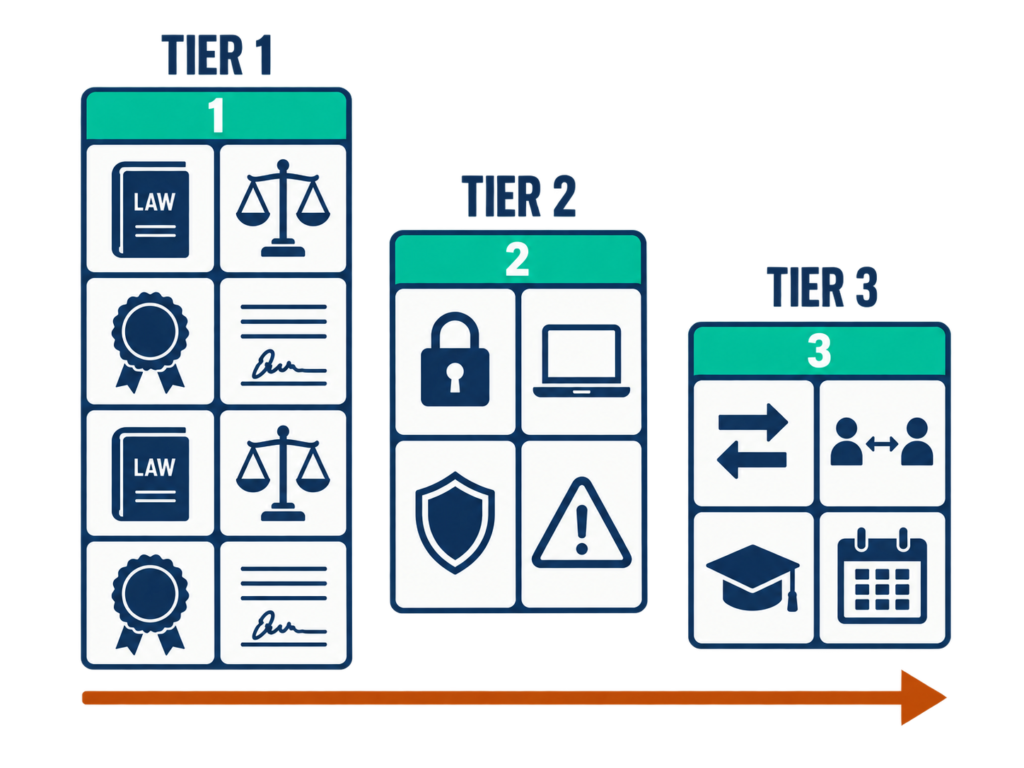
- Tier 1: legally anchored, written first
- Tier 2: practically expected, written next
- Tier 3: discretionary and high-leverage, designed deliberately
The Core HR Policies Every US Employer Needs (Grouped By Risk Tier)
A list in arbitrary order is a list you cannot act on with limited bandwidth.
Here’s the deal:
Grouping by risk tier converts a list into a sequence. Each entry below carries four things: what it governs, the law or driver behind it, the drafting failure that shows up most, and one line on what good looks like.
Tier 1 HR Policies: The Legally Anchored Set
These carry direct statutory drivers. They get written first, reviewed on the shortest cycle, and drafted with the most care.
- Equal employment opportunity and anti-discrimination
- Anti-harassment
- Anti-retaliation
- At-will employment
- Wage, hour, classification, and overtime
- Leave and time off
- Reasonable accommodation and the interactive process
- Workplace health, safety, and injury reporting
- Work authorisation and I-9 handling
Equal employment opportunity and anti-discrimination. Governs hiring, pay, promotion, discipline, and separation decisions against protected characteristics, driven by Title VII, the ADA, the ADEA, the PWFA, GINA, and state analogues. The recurring drafting failure is a protected-characteristic list copied from federal law that omits categories a state has added. Good looks like one policy, the full applicable list, and a named route for raising a concern.
Anti-harassment. Sets the conduct standard, the reporting channel, and the investigation commitment. The failure is a single reporting route that runs through the line manager, which collapses the moment the manager is the subject of the complaint. Good looks like two named channels, one of them outside the reporting line, and a stated commitment on what happens after a report lands.
Anti-retaliation. Protects anyone who raises a concern, participates in an investigation, or requests an accommodation. The failure is treating it as a clause buried in the harassment policy, which leaves retaliation unaddressed for wage complaints, safety reports, and accommodation requests. Good looks like a standalone policy naming the protected activities and the consequence for retaliating.
At-will employment. States the employment relationship and who has authority to vary it. The failure is structural: a handbook that promises progressive discipline in one section can undercut the at-will statement three pages earlier. Good looks like a single at-will statement, a named authority for any variation, and no language elsewhere that reads as a guarantee of process.
Wage, hour, classification, and overtime. Covers exempt and non-exempt classification, timekeeping, overtime authorisation, and off-the-clock work under the FLSA and state wage law. The failure is silence on off-the-clock work, which is where most wage exposure originates. Good looks like an explicit prohibition on unrecorded work, with the manager named as responsible for enforcing it.
Leave and time off. Sets entitlement, eligibility, notice, and certification across FMLA and the state leave patchwork. The failure is a single national entitlement written as though one rule applies everywhere. Good looks like a base entitlement plus governed state deltas, which is the architecture covered further down this guide.
Reasonable accommodation and the interactive process. Covers disability, pregnancy-related, and religious accommodation requests under the ADA, the PWFA, and Title VII. The failure is describing the outcome without describing the process, which leaves managers improvising the first conversation. Good looks like a named intake point, a stated interactive process, and a record requirement.
Workplace health, safety, and injury reporting. Sets hazard reporting, incident response, and recordkeeping obligations under OSHA and state plans. The failure is a policy written for a plant that never got adjusted when half the workforce moved to a home office. Good looks like coverage that names every work setting the organisation uses.
Work authorisation and I-9 handling. Governs verification, re-verification, retention, and the anti-discrimination constraints that sit alongside IRCA. The failure is over-documentation: asking for specific documents, which creates its own exposure. Good looks like a named responsible role, a retention rule, and a prohibition on specifying which documents a person presents.
Classification, coverage, and accommodation questions are fact-specific legal determinations. Draft the standard, then run it past employment counsel before it publishes.
⚠ WATCH OUT
Common mistake: writing a careful at-will statement on page four and a detailed progressive discipline sequence on page nineteen. The second one can erode the first by implying a process the employer has committed to follow. Cross-read the two sections together, every time either one changes.
Tier 2 HR Policies: The Risk-Reducing Set
These are not always directly compelled. Their absence reliably produces exposure, and they are the policies that go missing or sit a decade out of date.
- Code of conduct and ethics
- Data privacy and information security
- Acceptable use of company systems and devices
- Confidentiality and intellectual property
- Remote and hybrid work
- Social media and external communications
- Drug and alcohol
- Workplace violence prevention and threat reporting
- Performance management and progressive discipline
- Conflict of interest and nepotism
Code of conduct and ethics. Sets behavioural standards, gift and entertainment limits, and the reporting route for suspected breaches. The failure is aspirational language with no consequence attached, which makes it unusable in a disciplinary conversation. Good looks like conduct standards stated as requirements, with a named channel and a stated consequence.
Data privacy and information security. Covers employee-data handling, access control, breach reporting, and the growing state privacy layer that now reaches employee records. The failure is writing it for customer data and forgetting the workforce is a data subject too. Good looks like explicit coverage of employee data, with retention and access rules named.
Acceptable use of company systems and devices. Governs what people may do on company systems, on personal devices used for work, and what monitoring the employer conducts. The failure is monitoring without notice. Good looks like a plain statement of what is monitored and on which systems, written so a new starter understands it on first read.
Confidentiality and intellectual property. Defines confidential information, assigns work product, and states obligations that survive the end of employment. The failure is a definition so broad it covers public information, which weakens enforcement of the parts that matter. Good looks like a scoped definition and a stated post-employment duration.
Remote and hybrid work. Sets eligibility, expectations, equipment, expense, and the location rules that decide which jurisdiction governs a given employee. The failure is treating location as an administrative detail. Good looks like an approval requirement for a change of work state, before the move happens.
Social media and external communications. Covers who speaks for the organisation and what employees may post about work. The failure is drafting so wide that it reaches protected discussion of pay and working conditions. Good looks like narrow, specific restrictions on confidential information and impersonation of the employer.
Drug and alcohol. Sets impairment standards, testing practice where permitted, and the response to a positive result. The failure is a zero-tolerance clause written before lawful off-duty conduct protections existed in several states. Good looks like an impairment-at-work standard, with testing practice reviewed state by state.
Workplace violence prevention and threat reporting. Covers prohibited conduct, threat reporting, and the response protocol. The failure is a prohibition with no reporting mechanism, which means threats surface informally and late. Good looks like a named reporting route, a stated response process, and explicit protection for the reporter.
Performance management and progressive discipline. Sets the review cycle, documentation standard, and disciplinary sequence. The failure is committing to a fixed number of warnings, which interacts badly with the at-will statement elsewhere in the set. Good looks like a documented process with discretion reserved and stated plainly.
Conflict of interest and nepotism. Covers outside employment, personal relationships in the reporting line, and financial interests in suppliers. The failure is requiring disclosure without defining what a conflict is, so nobody discloses. Good looks like worked examples of what must be disclosed and a named person who receives disclosures.
Monitoring notices, off-duty conduct rules, and disciplinary language all carry state-specific legal constraints. Those belong with employment counsel before publication.
◆ FROM THE LAB
My experience: I have hired across multiple locations for most of my career, and the thing that surprises people is how fast a distributed hire changes which rules apply to that one person. It is not a phased transition. From the start date, the employee’s work location governs a set of entitlements the national policy never addressed.
Treat every hire into a new state as a compliance event on the offer date. The alternative is discovering the gap at the next annual review, which is months of operating outside a rule you did not know you had picked up.
Tier 3 HR Policies: The Discretionary, High-Leverage Set
Nobody requires these. They are the policies that shape how the organisation behaves, which makes them the ones where a deliberate choice beats the market default.
Here is the framing that separates this tier from the two above it. A Tier 1 policy is written to survive scrutiny. A Tier 3 policy is written to produce a behaviour, so it is judged on whether the behaviour changed.
- Internal mobility and internal-first posting
- Employee referral
- Recruiting and hiring
- Compensation philosophy and pay transparency practice
- Flexible work and schedule
- Learning, development, and tuition support
- Sabbatical
- Employee resource groups
- Bereavement and compassionate leave
Internal mobility and internal-first posting. Governs whether a role reaches the internal population before it goes external, and what a manager may do to block a move. The failure is a policy that encourages internal applications while leaving the releasing manager with an unqualified veto. Good looks like a defined internal window and a named escalation route when a release is refused.
◆ FROM THE LAB
Real implementation: we were paying twice for the same problem. External hiring costs were climbing, and every external hire then spent months getting to productive output while the team carried the gap.
So I wrote a First Look policy. One clause: every open role posts internally for 48 hours before any external channel sees it. The second half of the clause mattered more, because a posting window on its own does nothing. Recruiters were required to proactively approach internal candidates during that window, not wait for applications to arrive.
Over the following year, 23% of our hires came from internal moves. The ramp difference settled the argument on its own: Time-to-Productivity averaged 28 days for an internal move against 67 days for an external hire. Same roles, same teams, same standard.
The transferable lesson is not the 48 hours. It is that your best candidates are sometimes already on payroll, and a hiring policy that reaches the external market first has quietly decided they are not.
◆ PRO TIP
Real talk: this only works if managers are incentivised to release high performers to other teams. That is the part most internal mobility policies never address, and it is why most of them quietly fail. A manager measured purely on their own team’s delivery will block every move they can, and no posting window survives that.
Employee referral. Sets eligibility, bonus structure, timing, and what happens when two people refer the same candidate. The failure is a uniform bonus paid to everyone equally, which spreads budget across people who never refer anyone. Good looks like a structure that recognises the small group producing most successful referrals, which is covered in the measurement section further down.
Recruiting and hiring. Governs requisition approval, interview structure, assessment standards, and what the organisation requires by way of credentials. The failure is inheriting requirements from the last version of the job description without examining what they do to the pipeline. Good looks like requirements written against verifiable capability, reviewed before they are frozen.
The Credential Clause In Your Hiring Policy
One line in a hiring policy silently determines the size and shape of every pipeline underneath it: the degree or credential requirement.
It is almost always inherited, not chosen. Somebody wrote it into a job description years ago, it was copied forward, and no one has checked what it costs.
◆ FROM THE LAB
My experience: we needed a manufacturing systems analyst. Sourcing against the conventional credential requirement returned 14 qualified resumes, and the shortlist was thin enough that the role was going to sit open for months.
I dropped the credential keyword and sourced against capability signals: evidence of relevant project work, demonstrated systems knowledge, verifiable output. The same search returned 62 candidates.
We hired a former factory-floor supervisor who had taught himself Python. He now leads digital transformation work. Under the previous version of the hiring policy, his application would have been filtered out before a human ever read it.
Credential gatekeeping does not protect quality. It eliminates your best candidates before anyone reads their name.
Compensation philosophy and pay transparency practice. States how pay is set, reviewed, and communicated, and what appears in a job posting. The failure is an unwritten philosophy, which produces inconsistent offers and a pay equity problem two years later. Good looks like a stated structure, a review cadence, and a posting practice that matches what the organisation does in every state it hires in.
Flexible work and schedule. Covers core hours, schedule change requests, and compressed or shifted arrangements. The failure is manager-by-manager discretion with no written standard, which becomes a fairness complaint. Good looks like a stated default, a request route, and named grounds for declining.
Learning, development, and tuition support. Sets eligibility, approval, funding limits, and any repayment condition. The failure is a repayment clause written without checking how it interacts with state wage deduction rules. Good looks like clear eligibility, a named approver, and repayment terms reviewed with counsel.
Sabbatical. Covers eligibility tenure, duration, pay status, and the return-to-role commitment. The failure is silence on what happens to the role during the absence, which makes people afraid to take it. Good looks like an explicit role-protection statement and a stated backfill approach.
Employee resource groups. Governs formation, sponsorship, funding, and how time spent is treated. The failure is treating leadership of a group as unpaid volunteer work performed on top of a full job. Good looks like recognised time, a named executive sponsor, and a funding route that does not depend on goodwill.
Bereavement and compassionate leave. Sets duration, relationship scope, and evidence expectations beyond any statutory floor. The failure is a narrow relationship definition that excludes the people employees grieve. Good looks like a broad definition, a stated minimum, and manager discretion to extend without an approval chain.
The Old Way
- Post externally by default
- Pay the same referral bonus to everyone
- Require the degree because the last version did
- Copy the market default and call it policy
The Lab Way
- Name the behaviour you want before drafting the clause
- Design the incentive around who produces the outcome
- Write requirements against verifiable capability
- Measure whether the behaviour changed, then redesign
How To Create An HR Policy: A Seven-Step Build Sequence
Most guidance on how to create an hr policy collapses into four words: draft, review, approve, communicate. That is a description of a workflow, not a method, and it abandons you at the blank page.
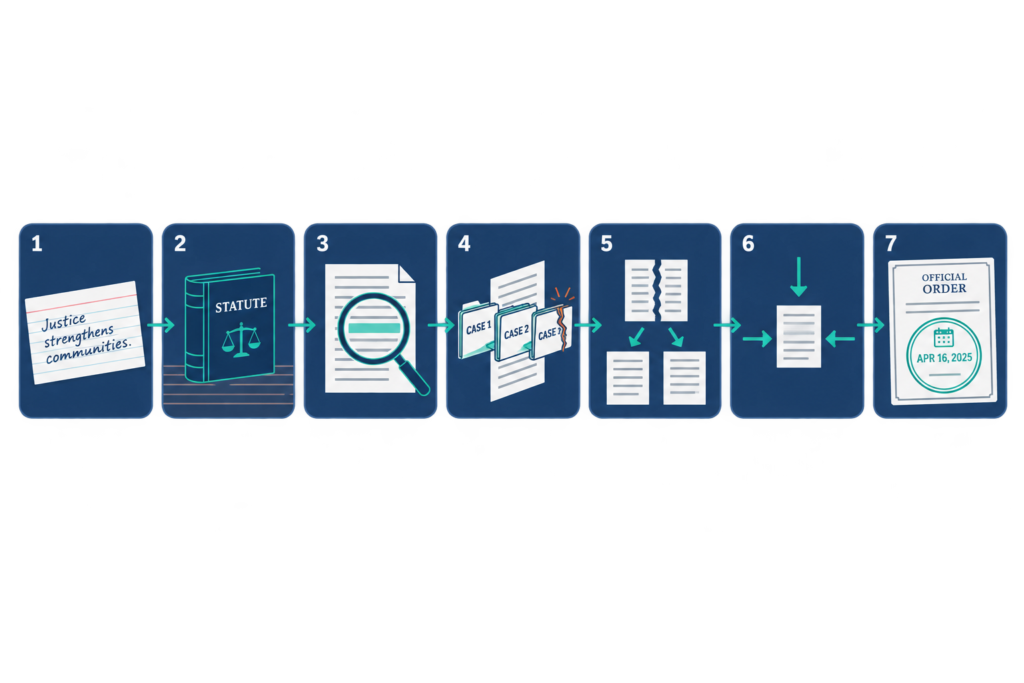
Seven steps.
Each one does a discrete job, and three of them are the difference between a policy that holds and a policy that looks fine until it is tested.
Here’s how to build it:
1
Step 1: Define The Decision The HR Policy Removes
Every policy exists to stop a recurring decision being made from scratch. Write that decision down in one sentence before you draft anything.
If you cannot state it, you do not need a policy. You need a one-off answer to a one-off question, and writing a policy to cover it adds a governed document nobody will maintain. This step kills more unnecessary policies than any review process.
What you have at the end: a single sentence naming the decision, which becomes the test for every clause that follows.
2
Step 2: Establish The Legal Floor For The HR Policy
Identify the federal, state, and local obligations that constrain the policy before you draft it.
Doing this after drafting means legal review sends the whole thing back, and you rewrite around constraints you could have designed within. The floor differs by state and by headcount, so the trigger map and the addendum architecture in this guide both feed this step. Establishing that floor is a legal determination and belongs with employment counsel.
What you have at the end: the non-negotiable boundary inside which your organisation’s own choices get made.
3
Step 3: Draft The HR Policy Against The Investigator
Write for the person who reads it adversarially in two years with a specific allegation in hand, not for the new hire skimming it on day one.
State four things explicitly: scope, standard, exception handling, and consequence. A clause that admits two readings will be read both ways, and the reading you did not intend is the one that shows up in the file.
What you have at the end: a draft where every sentence answers a question somebody might one day ask under pressure.
4
Step 4: Pressure-Test The HR Policy Against Three Real Scenarios
Take three situations that have happened in your organisation and run them through the draft.
Pick them deliberately: one straightforward, one contested, one that ended badly. Most drafts survive the first and collapse on the third, which is the point. Nobody does this step, and it is the cheapest quality gate available.
What you have at the end: a list of the clauses that could not answer a real question, before anyone had to rely on them.
◆ FROM THE LAB
The Sofia test: I have watched well-drafted policies sail through the obvious scenario and fall apart on the awkward one, and the awkward one is never exotic. It is the employee who is half eligible. The request that arrives two days after the deadline for a reason everybody agrees is fair.
Those are the situations a manager escalates, and the escalation is the signal that the clause left the decision unmade. I would rather find that in a room with three past cases on the table than find it in an investigation file.
5
Step 5: Separate The Procedure From The HR Policy
Pull every operational instruction out of the draft and into a companion procedure document.
The policy states the standard. The procedure states the steps, the systems, and the named approvers. This split is what lets you fix a broken workflow next quarter without reopening a governed document and triggering a re-acknowledgment cycle across the whole workforce.
What you have at the end: two documents with two owners and two update cadences.
6
Step 6: Run Legal And Stakeholder Review Concurrently
Three parties review the draft at the same time, against a stated deadline.
Employment counsel reviews the legal position. The function that owns the operational reality reviews feasibility: IT for acceptable use, Facilities for safety, Finance for expense. Two frontline managers who will have to apply it review whether they can. Sequential review is where policies go to die, one inbox at a time.
What you have at the end: three sets of comments in one week, not three months.
◆ PRO TIP
Real talk: parallel review only works with a deadline attached and a named person who reconciles conflicting comments. Without that, you get three contradictory redlines and a draft that stalls while you negotiate between reviewers. Send it out with the date already in the calendar invite.
7
Step 7: Set The HR Policy Review Date Before You Publish
A policy published without a next-review date is a policy somebody else will find out of date, at the worst possible moment.
Assign an owner and a date in the same action that publishes it. Not afterwards, because afterwards never arrives. The lifecycle section of this guide sets the cadence by policy type.
What you have at the end: a policy with a name and a date attached to it, which is what makes the set maintainable at all.
The Old Way
- Draft it
- Send it to legal
- Publish it
- Forget it
The Lab Way
- Name the decision the policy removes
- Establish the legal floor before drafting
- Write for the adversarial reader
- Pressure-test against three real cases
- Date it and name its owner before it ships
The Anatomy Of An HR Policy Document: HRM Guidelines For Structure And Language
Structure is the part everyone covers. Language is the part nobody does, and it is where usable policies separate from decorative ones.
Start with the anatomy. Good hrm guidelines treat a policy as a structured record with named fields, not a page of prose with a title on top. Each field below earns its place by what breaks when it is missing.
- Policy title and unique identifier. Without an identifier, two versions of the same policy circulate under one name and nobody can tell which is in force
- Version number and effective date. An undated policy cannot be proven current, which is the single most common gap in an inherited set
- Owner and approver. An unowned policy ages quietly until something tests it
- Scope. An unscoped policy gets applied to contractors and interns it was never written to cover, and that misapplication is its own exposure
- Purpose statement in plain language. Without it, managers apply the letter of a clause in situations it was never meant to reach
- The policy statement itself, carrying the standard
- Definitions for any term that carries a consequence. Undefined terms are where two managers find two readings
- Exceptions, and how an exception is requested and granted. An exception process that exists informally becomes the inconsistency somebody later points to
- Consequence of a breach. A standard with no stated consequence is advice
- Related documents and next review date, as closing fields
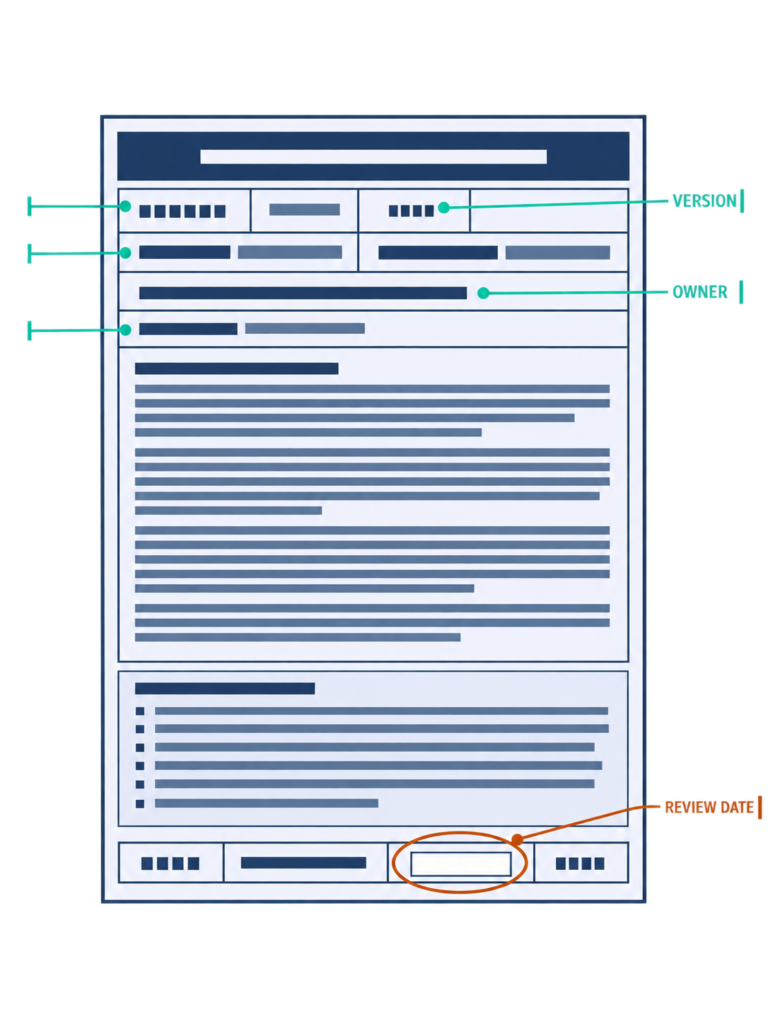
Run your existing policies against that list. The audit takes an afternoon. The result is uncomfortable.
⚠ WATCH OUT
Watch out: a policy that cannot be shown to have been current at the relevant time is difficult to rely on when it matters. The question asked later is never what your policy says today. It is what it said on the date in question, and whether the employee had been told.
How to execute:
Now the language layer. Four rules decide whether a policy is usable by the person holding it at 6am.
Use must, should, and may deliberately, and never inside the same clause. Must is a requirement. Should is a strong expectation with room for judgment. May is permission. Mix two of them in one sentence and a mandatory standard quietly becomes advisory.
Write in active voice with a named actor. “The manager approves the request within five working days” tells somebody what to do. “Approval will be obtained” tells nobody anything.
One rule per sentence. Define every term that carries a consequence. Keep the policy statement at a reading level a frontline employee can parse without help, because a policy nobody can parse produces the same result as a policy nobody has.
◆ PRO TIP
The Sofia test: hand the draft to somebody who was not in the room. Give them a specific situation and ask what they would do. If they hesitate, or ask you a clarifying question, the clause is the defect. Fix it before publication, because in production that hesitation arrives as an escalation on your desk.
Multi-State HR Policies: The Base-Plus-Addendum Architecture
Any company that has hired remotely in the last five years is a multi-state employer, most of them without ever deciding to become one.

A single national policy has to resolve to one answer. The obligations underneath it do not cooperate. Sick leave accrual and use, meal and rest breaks, final paycheck timing, pay transparency in postings, leave entitlements, lawful off-duty conduct, and notice requirements all vary by state.
Which produces the standard workaround: write to the strictest state and apply it everywhere. It feels conservative. It is expensive, because you have just granted the most generous version of every entitlement to your entire workforce by accident, permanently, without anyone deciding to. Writing to the loosest state is worse.
⚠ WATCH OUT
Warning: a remote hire in a new state is a compliance event on the start date, not at the next handbook review. The gap between those two dates is the period you spent operating under rules you had not read. Which deltas apply in which state is a legal determination for employment counsel.
Here’s how to build it:
The architecture has four parts, and it scales as you add states without a handbook rewrite each time.
A base policy carries the standards that hold everywhere, written to the federal floor plus your organisation’s own choices. A state addendum per jurisdiction carries only the deltas, versioned and owned separately from the base. These state-level workplace policies stay thin on purpose, because the thinner the addendum, the easier it is to keep accurate.
Then the two parts people skip. A precedence rule stated inside the base policy itself: where an addendum conflicts with the base, the addendum governs. No manager should have to work out which document wins.
And a trigger rule: a hire in a new state opens an addendum review before the start date. Attach it to the offer stage, where somebody is already doing paperwork.
One more rule holds the whole thing together. One named person owns the addendum set. Unowned addenda are how a company ends up accurate in the three states somebody happened to remember.
◆ FROM THE LAB
The Sofia lens: I have spent years in environments where the same role is governed differently depending on where the person sits, and the lesson transfers directly. The organisations that cope are not the ones with the most detailed handbook. They are the ones where somebody owns the deltas and reviews them on a trigger, not on a calendar.
The Old Way
- One national handbook
- Write to the strictest state and call it conservative
- Annual revision
- Hope
The Lab Way
- One base policy, thin state addenda
- Precedence rule stated in the base
- Addendum review triggered on hire
- One named owner for the addendum set
AI And HR Policies: You Need Two, Not One
Two entirely different policies sit underneath the phrase “our AI policy,” and most organisations have written only the first one.
The first governs what employees may do with AI tools. The second governs what the employer does with automated tools in employment decisions, and that one is where the regulatory movement is happening.
The gap between the two is measurable.
42%
of workers say their organizations aren’t evaluating AI’s impact on people.
Translation: the tools went in, and the governance did not follow. That is the half of the AI question this section is built around.
HR Policies For Employee Use Of AI
Here’s the deal:
Four things belong in this policy, and a fifth that most versions leave out.
Permitted and prohibited tools, named. A data classification rule stated in language people can apply without calling IT: if it identifies a person, a customer, or unreleased work, it does not go into a tool. The points where AI-assisted output requires named human review before it has any effect. And a disclosure expectation, so nobody has to guess whether to flag AI assistance.
The fifth is a review cadence short enough to survive the pace of tool change. A two-year-old AI policy is a fiction.
◆ FROM THE LAB
My experience: I led AI-driven prompt engineering work inside a large recruitment function, and the operating principle we landed on became the first line of the policy. AI as co-pilot, not decision-maker, with human-led validation at every decision point.
In practice that meant drawing a hard line down the middle of the work. On one side, the high-volume logistics: scheduling, parsing, talent rediscovery, market mapping, role clarity and skill translation, inclusive job description drafting, structured interview question sets. AI absorbed those, and recruiter capacity went into relationship building and judgment, which is where it belongs.
On the other side, the decisions. Candidate evaluation, compliance-sensitive documentation, anything requiring full business or cultural context. Those stayed with named humans, and the policy said so explicitly.
The three risks we wrote into the same document: over-dependence on automation, loss of the personal touch when high-volume work runs unattended, and algorithmic bias where training data carries historical hiring prejudice forward. Naming the risks in the policy is what gives anyone grounds to raise them later.
That principle converts cleanly into permitted-use language. Drafting job descriptions, outreach, interview guides, and inclusive language checks sits on the permitted side. Candidate evaluation, compliance-sensitive documentation, and anything needing full business or cultural context sits on the prohibited side. Write both lists down, because a policy that names only the prohibitions gets read as a ban and quietly ignored.
◆ PRO TIP
The honest downside: the productivity gain is real, and so is the drift. Teams that automate the high-volume layer completely lose the incidental contact that used to surface problems early. Build a deliberate human touchpoint back into the process, because the policy will not create one on its own.
HR Policies Governing Employer Use Of AI In Employment Decisions
Your ATS vendor shipped AI features in the last release. Somebody switched them on. Nobody asked who is accountable for the decisions those features now influence.
Six things this policy has to establish.
- An inventory of which automated tools touch which employment decisions, maintained as tools change
- A stated notice position for candidates and employees
- A named human reviewer with real authority to override an automated output
- Retention of inputs, outputs, and the decision record
- A bias-testing and audit posture, with a stated frequency
- Vendor obligations flowed through to any third-party tool in the stack
The audit posture exists because of one specific risk: where training data carries historical hiring prejudice, the tool reproduces it at speed and at scale. A human reviewer with override authority is the control. An inventory is what tells you where controls are needed.
⚠ WATCH OUT
Red flag: automated employment decision tools are increasingly regulated at state and city level. New York City’s Local Law 144 bias-audit and notice requirements, Illinois HB 3773 amending the Illinois Human Rights Act effective January 2026, California’s FEHA automated-decision-system regulations effective October 2025, and the Colorado AI Act with implementation postponed to June 2026 are all now in the picture.
Employers using these tools should involve employment counsel to determine what applies to them. This is the position of the law, not advice about your organisation.
One more point worth stating plainly, because the discussion around it gets this backwards. AI is not replacing the recruiter or the HR Business Partner. It removes the administrative weight that stopped both of them being effective, and the policy’s job is to make sure the judgment stays where it was.
How To Communicate Rules & Regulations For Employees So They Get Followed
A policy nobody follows gets communicated again. An all-hands mention, an email, a line in the newsletter. Six weeks later, managers are still improvising.
The failure is almost never awareness. It is retrieval at the moment of decision.
The manager knows a policy exists. She cannot locate the clause that answers the question standing in front of her, and the person waiting for an answer is not going to wait while she searches an intranet.
Why this works:
Change the test. The measure of a policy communication programme is not how many people saw the announcement. It is how fast somebody finds the right answer under pressure.
That reframes the work into four practical measures. A single canonical location, so there is one place and everybody knows it. Search that returns the clause, not the document. Policies findable by the question a person is asking, not only by the title somebody gave the file. And a pushed subset for managers: the two or three clauses they apply, not the full set they will never read.
Treat a policy launch as a change programme, because it is one whether or not anybody runs it that way.
27%
Only 27% of leaders say their organizations manage change well.
Translation: roughly three in four organisations are weak at exactly the discipline a policy rollout depends on. Which means the drafting was never the weak link in your process. The rollout was.
The Old Way
- Send the handbook link to all staff
- Mention it at the all-hands
- Announce it again when compliance stalls
- Chase stragglers for a month
The Lab Way
- One canonical location, indexed by question
- Push the frontline subset to the people who apply it
- Templated message, one named owner per cohort
- Stated effective date, short acknowledgment window
Rolling a policy out to several hundred people at once is a different problem again. Onboarding cohorts, seasonal ramps, an acquired team joining on one date. Four mechanics hold rules & regulations for employees together at that scale.
- Standardised mass communication templates, so the message does not drift between senders
- A single named point of contact per cohort, not a shared inbox nobody owns
- Clearly stated timelines, so people know when something takes effect
- A short acknowledgment window while attention is still on it
◆ FROM THE LAB
Real implementation: I ran a bulk hiring programme that delivered more than 420 hires in 10 weeks, across a mix of support, operations, and junior engineering roles. The sourcing and the interview capacity were the visible problems. Communication was the one that would have sunk it.
What held it together was unglamorous. Mass communication templates so every batch heard the same thing in the same words. One named point of contact per batch, so nobody’s question fell into a shared inbox. Timelines stated up front and then met.
We finished with an offer-to-join ratio above 90%, in a market where drop-off at that volume is normal. The transferable point has nothing to do with hiring: communication discipline is what holds any programme together at volume, and a policy rollout to 400 people is the same programme wearing different clothes.
⚠ WATCH OUT
Common mistake: responding to low compliance by communicating harder. If the policy is unfindable at the moment somebody needs it, a fourth announcement changes nothing. Test retrieval before you schedule another email.
The HR Policy Lifecycle: Review Cadence, Version Control And Acknowledgment
Coverage gets all the attention. Lifecycle is what decides whether the set holds up when somebody tests it.
How Often HR Policies Should Be Reviewed
“Review your policies annually” is the whole of the internet’s advice on this, and it is wrong in a specific way. A statutory-driven policy and a discretionary one do not age at the same rate.
How to execute:
Set the cadence by tier. Tier 1 legally anchored policies get an annual review as a floor, with legislative monitoring running in between. Tier 2 risk-reducing policies go annual too, with one exception: technology and AI policies need a shorter cycle, because the tools change faster than your calendar does.
Tier 3 discretionary policies get reviewed against their outcome, not the clock. If the behaviour you designed for has not appeared, the policy has failed and the review is a redesign conversation, not a refresh.
Then the part that matters more than any of it. Six events override the calendar entirely.
- A hire in a new state
- A change in law that touches the policy’s subject
- A merger or acquisition bringing another workforce and another rule set
- A material change in how the work gets done
- An incident the policy handled badly
- A finding from an audit or investigation
Every one of those is a signal that the ground under a policy has moved. The annual cycle catches none of them in time.
Version Control For HR Policies
Policies live in a shared drive. Somebody edits one in place and saves it. Eighteen months later nobody can reconstruct what it said.
Five fields fix that, and none of them require buying anything.
- A version number and effective date on every policy
- A superseded-version archive that is retained, never overwritten
- A change log recording what changed, when, and why
- A named owner per policy
- A next-review date carried on the document itself
The reason is plain once you see the question that gets asked. Nobody asks what your policy says today. They ask what it said on the date in question, and whether the employee had been told. An overwritten document cannot answer either half.
Retention periods for employment records are governed by law and vary. Retention schedules belong with counsel or records management.
⚠ WATCH OUT
Anti-pattern: editing the live document and saving over it. It feels tidy. It destroys the only record that could have shown the standard in force at the time, and it is the most common version-control failure in an inherited policy set.
Acknowledgment: Capturing It, And Re-Capturing It On Material Change
You can tell me everyone signed the handbook on their first day. Can you tell me which version they signed?
That question is where most acknowledgment practice falls apart, because acknowledgment gets captured once at onboarding and never again.
Good practice has four parts. Acknowledgment captured at onboarding with the version acknowledged recorded, not only the date. Re-acknowledgment triggered by any material change, not by an annual cycle. A completion rate that is tracked and chased, because a 60% acknowledgment rate means four in ten people are outside the policy. And the acknowledgment record retained alongside the version it refers to.
◆ PRO TIP
The catch: an acknowledgment record that does not say which version was acknowledged is close to useless at the moment it matters. A signature against “the handbook” proves somebody signed something. It does not prove they were told the clause that is now in dispute.
Acknowledgment at scale stops being a drafting problem and becomes a distribution problem. Which is the point where most teams start looking for the top platform for formatting and distributing hr policy documents, and it is worth knowing what to look for before you start taking demos.
Four criteria, treated as a category question and not a product shortlist.
- Version-aware distribution, so people receive the version in force
- Per-version acknowledgment capture, not a single lifetime signature
- Search that works for a frontline user, tested by a frontline user
- An exportable audit trail you can produce without vendor assistance
What constitutes adequate notice and acknowledgment can carry legal weight, and that question belongs with employment counsel.
Where HR Policies Fail: Six Failure Modes From The Field
Every article on this topic is written as though policies work once you have them. They do not.
Here’s the deal:
Six failure modes account for nearly everything I have watched go wrong with a policy set. Read them as a diagnostic. You will recognise at least three.
1. The policy nobody can find. It exists, it is correct, and it is three clicks past where anyone looks. The mechanism is retrieval, not awareness. The fix: one canonical location, indexed by the question people ask, with the frontline subset pushed to managers directly.
2. The policy two managers read two ways. Ambiguity at the drafting stage becomes inconsistency in application, which becomes a comparator argument between two employees. The fix: run the clause past somebody who was not in the room and watch for the hesitation.
3. The policy that contradicts another policy. Two documents written two years apart by two owners, and nobody cross-read them. Progressive discipline against at-will is the classic pairing. The fix: cross-read related policies whenever either one changes, and list the related documents on each.
4. The policy applied selectively. Enforced with the difficult employee, waived for the high performer. This is the single most expensive thing an organisation can do with a policy, because it converts a well-drafted document into evidence of the disparity being alleged. The fix: review outcomes for comparable cases, at whatever cadence you can sustain.
A policy you enforce selectively is worse than no policy at all. You have documented the standard, then created the record of departing from it.
5. The policy that outlived its context. Written for one office in one state, still in force across nine. Nothing failed. The ground moved underneath a document that had no trigger for noticing. The fix: the six event triggers from the lifecycle section.
6. The policy with no owner. HR assumes the function owns it, the function assumes HR owns it, and it ages quietly until something tests it. An hr management policy without a named owner has no mechanism for staying current, whatever its review date says. The fix: a name on every policy, and a handover step when that person changes role.
◆ FROM THE LAB
My experience: I hold a view on this that runs against most of what gets written about HR failures, and it applies to policy exactly as it applies to retention. When the same failure repeats across different people, different teams, and different managers, you are looking at a systems failure, not a people failure.
Every one of the six above is structural. Not one of them is solved by finding better managers. They are solved by fixing a clause, naming an owner, or changing where a document lives.
⚠ WATCH OUT
Warning: failure mode 4 is the one that gets organisations into serious trouble, and it almost always starts as kindness. Somebody makes an exception for a good reason, nobody records it as an exception, and the precedent sits there unlabelled. Build a real exception process, then use it.
How To Measure Whether Your HR Policies Are Working
Ask most HR functions whether their policy set is working and the answer is that nobody has complained. That is not a measurement. It is the absence of one.
Why this matters:
Six signals tell you what is happening, and most of them are already sitting in systems you own.
- Acknowledgment completion rate by version. The baseline hygiene measure, and the one you can pull today
- Policy-related escalations to HR, tracked per policy. A rising count on one policy points precisely at the clause that needs rewriting
- Time to find an answer, tested by asking a manager to locate the clause governing a real situation
- Consistency of outcome for comparable cases, reviewed at whatever cadence you can sustain
- Exception volume. A policy generating constant exceptions is describing a reality the organisation no longer has
- For Tier 3 policies, the behaviour the policy was designed to produce, measured directly
Treat the escalation count as a defect report. It is the closest thing policy work has to a bug tracker, and it names the specific clause that failed.
◆ FROM THE LAB
Real implementation: our referral policy was textbook democratic. Open to everyone, uniform bonus, equal treatment. It underperformed for two years and nobody could say why, because nobody was measuring anything beyond total referrals received.
So I measured who was producing successful referrals, not who was submitting them. The distribution was nothing like the policy assumed. A small group of people, 5 to 10% of participants, were driving the majority of hires that stuck.
We redesigned the policy around them. Recognised Talent Scout status, genuine perks, quarterly sessions with the TA team so they understood what we were hiring for and why.
One senior engineer referred 11 people that year. Nine were hired. Eight were still with the company at the end of it. His conversion rate ran at 82% against a company average of 31%, and the roles he filled would otherwise have gone to agencies at roughly $48,000 in fees.
Here is the part that belongs in this section and not in a referral article. The policy did not change because somebody had an opinion about it. It changed because a signal said it was not working, and we had finally bothered to look at one.
◆ PRO TIP
The catch: do not reach for an employee survey as your primary measure. The escalation count and the acknowledgment rate are already in your systems, they cost nothing to pull, and they describe behaviour, not opinion.
Close on the principle that separates the tiers. A Tier 1 policy is measured by whether it holds up. A Tier 3 policy is measured by whether anything changed.
HR Policies FAQ
Are Employers Legally Required To Have Written HR Policies?
There is no single federal law requiring a written employee handbook, but a number of specific policies and notices are required or effectively required depending on headcount, state, and industry. The practical expectation from agencies, customers, and insurers runs well ahead of the bare statutory floor. The headcount trigger map earlier in this guide shows which federal obligations attach at which size. Whether a specific law covers your organisation is a legal determination for employment counsel.
What Is The Difference Between An HR Policy And An HR Procedure?
The HR policy states the rule and the standard. The HR procedure states the executable steps. The operational consequence is what makes the distinction worth keeping: the policy is the layer produced when a decision comes under scrutiny, so it changes rarely and deliberately. The procedure is the layer you fix the moment a workflow breaks, without reopening a governed document.
How Often Should HR Policies Be Reviewed And Updated?
Annual review is the floor for legally anchored policies, technology and AI policies need a shorter cycle, and discretionary policies should be reviewed against their outcome, not the calendar. The event triggers matter more than the cadence. A hire in a new state, a change in law, or an incident the policy handled badly should each open a review immediately, whatever the review date says.
Who Is Responsible For Writing HR Policies?
HR owns the policy layer and its governance, but a policy drafted without the function that owns the operational reality will fail on contact. Three parties belong in the review: employment counsel, the owning function (IT for acceptable use, Facilities for safety, Finance for expense), and two frontline managers who will have to apply it. Counsel reviews the policy. It does not draft it, and it should not be asked to.
What Should Be Included In An HR Policy Document?
Title and unique identifier, version number and effective date, owner and approver, scope, purpose, the policy statement, definitions, exceptions and how they are granted, consequence of breach, and the next review date. The review date is the field that goes missing most, and its absence is what turns a policy set into an archive. Without it, nothing tells you the document has aged until somebody else points it out.
Eight years in, the thing I would tell a younger version of myself is that the policies which failed were never the ones we forgot to write.
They were the ones we wrote once, filed, and never tested. Undated. Unowned. Correct on paper and unusable at 6am on a Tuesday, when a manager needed an answer and got silence.
The organisations whose policies hold up are not the ones with the most policies. They are the ones whose policies are findable, unambiguous, owned, and dated.
Most readers will finish this, agree with it, and change nothing. Policy work carries no deadline until something attaches one for you, and by then you are writing under pressure with a file already open.
So make the first step small enough to do this week. Pull your existing policy set. Run it against the anatomy checklist in this guide. Count how many have no review date and no named owner, and start there.
That set is about to carry more weight than it was built for. The AI tools are already inside the hiring process, the regulation is arriving state by state, and the governance is trailing both.
65%
of organizations believe their culture needs significant change because of AI.
A change of that size gets expressed through the policy set or it does not get expressed at all. Which makes the audit above less like housekeeping and more like preparation.
If you are rebuilding a policy set in your own organisation, I would like to hear how it goes. Come and connect with me on LinkedIn, tell me which of the six failure modes you found first, and I will tell you what worked when I hit the same one.
