
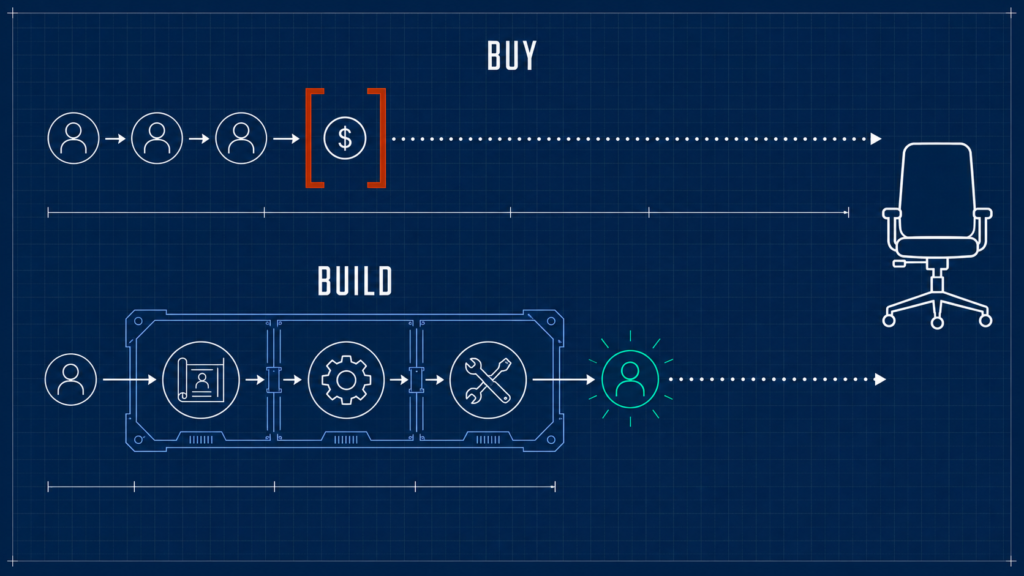
I have spent eight years running Talent management at enterprise scale, 250-plus hires a year. In all of that time, I have never once seen a role get filled because of an employee development plan.
The documents existed. The conversations happened. Nobody could name a single vacancy that closed because of one.
Most organisations file development plans under engagement. They belong under supply.
A development plan is not a morale exercise. It is a manufacturing instruction for capability you would otherwise have to buy on the open market.
Buying it has a price, and the price is knowable. Agency fees on senior engineering roles run 18 to 22% of CTC, which on a Rs 45 to 50 LPA role is Rs 8 to 10 lakh per hire, before you count the 70 to 80 days the seat sits empty.
When I moved that hiring toward internal sourcing and referrals, cost per hire fell from Rs 6.5 to 7.5 lakh down to Rs 3 to 3.8 lakh. Time-to-Fill went from 70 to 80 days to 45 to 50. Same roles, same market, different supply decision.
59%
of CHROs said in the first quarter of 2025 that development is the part of the employee experience their organisation struggles with most. That is up 16 percentage points in a single year.
Source: Gallup, Addressing the Barriers Blocking Employee Development (2025)
Translation: the failure you are living with is systemic, not personal incompetence. Almost nobody has solved this. The number is moving in the wrong direction.
Here’s what this guide contains:
- The seven-step build process, including the three steps no competing guide writes
- Five worked plans from real situations, including a 400-person frontline cohort and a recruiter whose job is being rewritten by AI
- A one-page template you can copy straight into a document, ungated, no email wall
- The five signals worth measuring, and the four you should retire this quarter
- The honest version of what these plans cannot fix
The HR Insights Lab approach: every claim here is backed either by my own operating numbers or by a cited source. Where no data exists, I give you the argument and say so.
What is an Employee Development Plan?
An employee development plan is a written agreement that names the specific capabilities a person will gain, the method that will produce them, and the evidence that will prove they exist. It commits the manager as well as the employee. Unlike a training calendar, it specifies outcomes rather than activities.
Here’s the difference:
A development plan is not a training calendar. A calendar is a list of events. A plan is a list of capabilities, and the two are not related by anything except optimism.
It is not a performance improvement plan either. One is forward-looking and builds capability the person does not yet have. The other is remedial and closes a gap against expectations they are already missing.
And it is not a promotion promise. That is the fastest way I know to destroy trust in the artefact, because the promotion depends on a vacancy neither of you controls.
⚠ WATCH OUT
Common mistake: Running development plans and performance improvement plans through the same template. Do that once and every employee in the building learns that “development plan” means “you are in trouble.” You will never recover the word.
There is a legal edge too. In some jurisdictions a plan that reads as a promotion commitment can create contractual expectation, so state plainly in the document that capability development does not guarantee a role.
The old way
- Collect a plan from every employee once a year
- File it in a shared drive
- Describe what the employee will do
- Review it at appraisal time, if at all
The Lab Way
- Write a capability specification, not a document
- Name what the person will be able to do that they cannot do today
- Describe what the organisation will do to make it possible
- Agree the evidence before the learning starts
The logic is the same one I apply to external hiring under my Inverted Sourcing Funnels framework. I filter candidates on capability signals rather than resume keywords, and a development plan should specify the same class of evidence. You specify the capability, never the course. That principle sits underneath everything in skills-based hiring, and it transfers cleanly to the people already on payroll.
The Seven Components Every Plan Must Contain
| Component | The question it answers | Failure mode |
|---|---|---|
| 1. Capability target | What will they be able to do? | Names a course, not a capability |
| 2. Current baseline | Evidenced how? | Assumed from the job title |
| 3. Business reason | Which role, project, or gap does this feed? | No named destination, so no urgency |
| 4. Development method | Experience, exposure, or education? | Defaults to education because it is procurable |
| 5. Verification method | What artefact proves it? | Defined after the fact, so the review becomes a negotiation |
| 6. Timeline with two checkpoints | When do we correct, and when do we verify? | One checkpoint, at the end, when it is too late to correct |
| 7. The manager’s named commitments | What is being released, reassigned, or opened up? | Omitted entirely, which is why the plan dies in a busy quarter |
Why this works:
Components one through six describe what the employee will do. Component seven describes what the organisation will do, and the employee was never the constraint. Retention problems are mostly systems failures, not compensation failures, and this is the same pattern wearing a different coat.
◆ PRO TIP
Real talk: component seven is the one every competing guide omits and the only one that decides whether the plan survives a busy quarter. If you write nothing else from this list, write the hours the manager is releasing and the work that moves off the person’s plate to create them.
One more note on component three. A development plan that feeds a named destination inside an internal mobility programme gets reviewed. One that feeds nothing gets filed.
Development Plan vs. IDP vs. Growth Plan vs. Career Plan vs. PIP
Employee development plan, individual development plan, and employee growth plan are used interchangeably in practice. Arguing about the labels is a waste of a meeting. Two distinctions carry real operational weight, and the rest is vocabulary.
| Term | Who owns it | Time horizon | What triggers it | Remedial? |
|---|---|---|---|---|
| Employee development plan | Employee, manager, and HR jointly | 6 to 12 months | A capability gap against current or near-future work | No |
| Individual development plan (IDP) | Same, different label | 6 to 12 months | Same | No |
| Employee growth plan | Same, different label | 6 to 18 months | Same, sometimes framed around trajectory | No |
| Career plan | Employee, with HR support | 2 to 5 years | A named future role or level | No |
| Performance improvement plan (PIP) | Manager, with HR governance | 30 to 90 days | Performance below an agreed standard | Yes |
The two that matter: development versus career plan, which is capability now against a named future role. And development versus performance improvement plan, which is growth against remediation. Never the same document, and in many jurisdictions a PIP forms part of a documented performance trail with legal weight attached.
Pick one term. Define it in your handbook. Spend the recovered energy on component seven.
Related Read: Employee Development Strategies: 9 That Work at Scale
Why most Employee Development Plans Quietly Fail
Almost every guide on this topic moves from what a development plan is straight to why it is good. You already know that framing is false, because your own plans are sitting in a drive nobody has opened since the meeting that produced them.
Naming the failure first is what earns the right to give the method. So here are the three failure modes I see most.
Your Development Plan is a Compliance Calendar

Ask senior HR leaders which capabilities their organisation most needs and you get leadership and technical skills. Look at what people actually completed last year and you get role-specific training, compliance, and harassment prevention.
That gap is not hypocrisy. It is scheduling.
Here’s the deal:
Compliance training has a mandate, an owner, and a deadline. Development training has none of the three. Put them in the same calendar and development loses every conflict it enters, every time, without anyone deciding it should.
The numbers back the mechanism. CHROs name leadership and management skills as their top development need at 84%, and technical or digital skills at 74%, while the most commonly completed trainings last year were role-specific skills, compliance, and harassment awareness and prevention.
Source: Gallup, Addressing the Barriers Blocking Employee Development (2025)
The old way
- Measure learning and development by training hours completed
- Book the courses the LMS makes easy to book
- Report activity to a leadership team that does not act on it
The Lab Way
- Attach every plan to a named business deliverable with a date
- Give it an owner, so it competes with the mandate instead of losing to it
- Report capability the business asked for and got
I run something on the hiring side I call Talent Market Pre-Alignment. It means identifying and engaging talent ahead of demand, through targeted competitions, challenges, and pre-warmed pools, rather than reacting to a requisition. Development planning is the same move pointed inward, which is why it belongs inside your workforce planning cycle rather than beside it.
The Manager is the Failure Point, and The Data is Brutal About It

Every guide tells you to get manager buy-in and then moves on. That advice has never once released an hour of anyone’s time.
Picture the manager who has now cancelled the development one-to-one three quarters running. Nobody escalated it. The employee stopped raising it around month four and started answering recruiter messages around month seven.
58%
more likely to be watching for or actively searching for a new job: employees whose supervisor is perceived as getting in the way of their growth. It is the strongest predictor of turnover intent in the dataset, ahead of financial constraints and ahead of time pressure. Lack of learning opportunities comes second at 47%.
Source: Gallup, Addressing the Barriers Blocking Employee Development (2025)
Translation: the manager is not a supporting actor in development. The manager is the primary variable, ahead of budget and ahead of the employee’s own motivation.
Managers block for two reasons that have nothing to do with attitude. They are measured on this quarter’s output and development pays out next quarter. And most of them were never developed themselves, so they are improvising a skill nobody taught them.
⚠ WATCH OUT
Common mistake: asking managers to support development without removing anything from their plate. That is a request to absorb a cost, and it will be declined quietly, in the calendar, where you cannot see it happen.
The fix is structural, not motivational. The manager’s release commitment goes into the plan as a named line item, and it appears again in the manager’s own review. Incentives before intentions, every time.
You are Measuring Completion, Which Measures Nothing
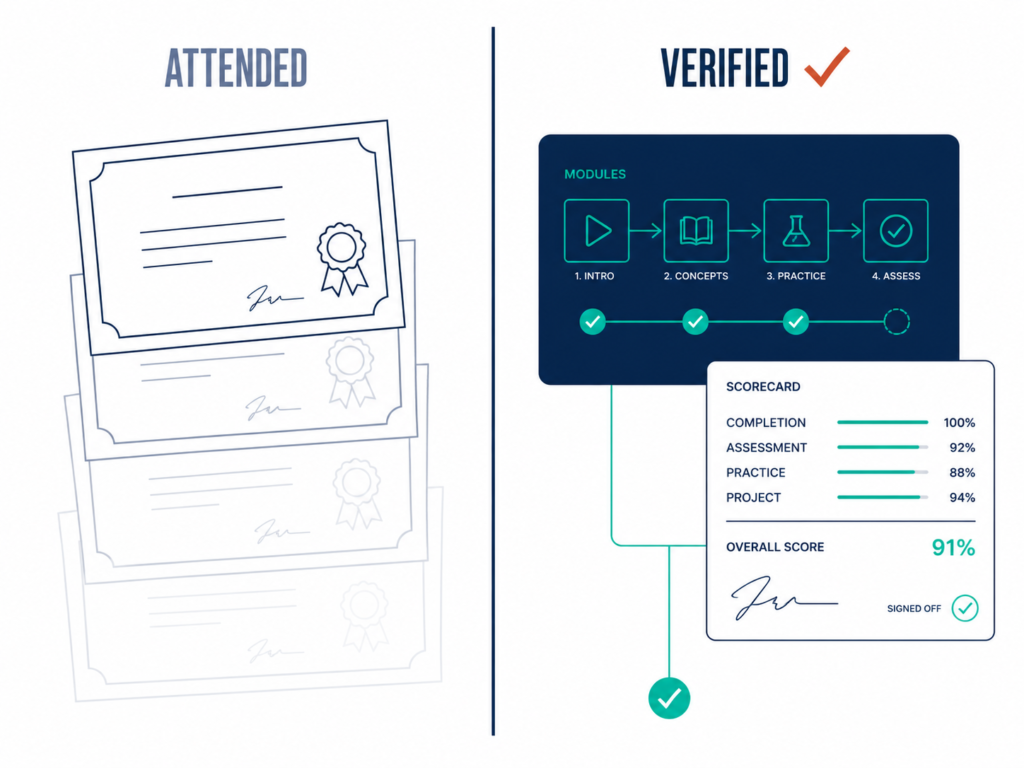
Course completion rates, training hours, and satisfaction scores are attendance data. None of them survives the only question a business leader asks, which is whether this person can now do the thing.
Why this works:
Substitute the evidence. Every capability target gets a verification artefact defined before the learning starts: a shipped piece of work, a module owned end to end, a review passed, a session taught to peers who can then do the thing themselves.
I hold internal development to the same evidentiary standard I hold external hiring to. The strongest hire I ever made on capability evidence was a former factory-floor supervisor who had taught himself Python, and no credential filter would have surfaced him. Step 5 and the measurement section later in this guide give you the mechanics, and the same logic drives how I calculate Quality of Hire.
What a Development Plan is Worth (The Money Argument)
Every competing article runs a benefits section that is a list of adjectives. Engagement. Retention. Innovation. Culture.
Not one of them puts a currency figure on a development plan, which is why no HRBP has ever won a budget argument holding one.
A Development Plan is a Sourcing Channel with a Price Tag
Here’s the difference:
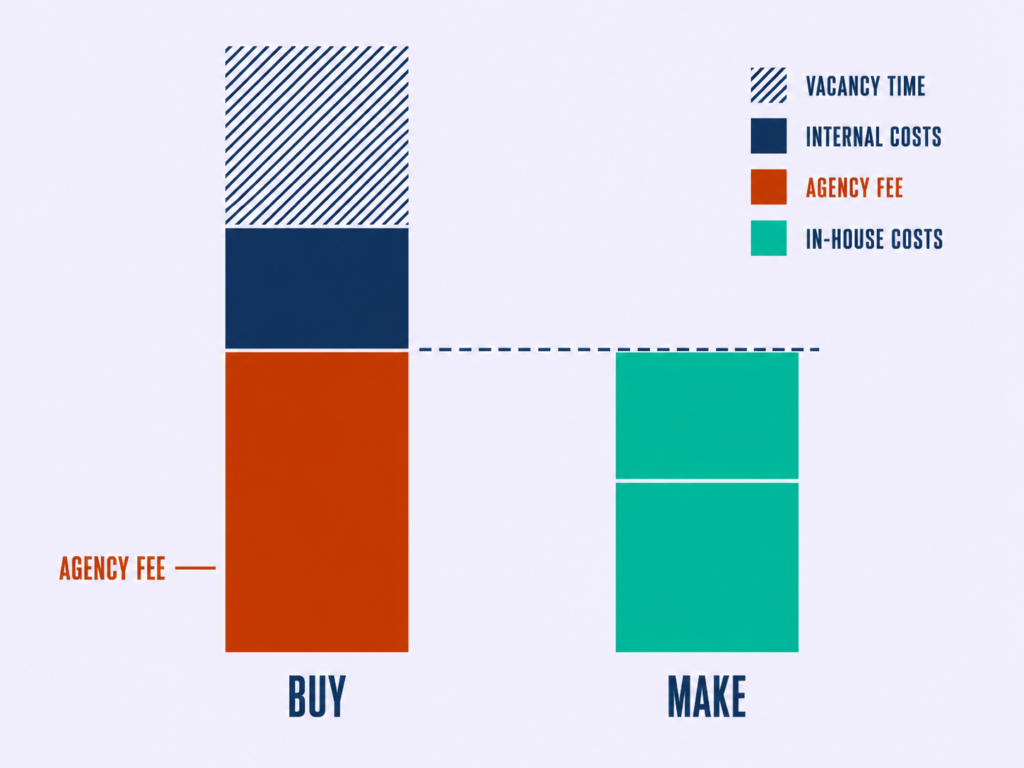
Every capability you develop internally is a capability you do not buy externally. The external price is not a mystery. Agency fees run 18 to 22% of CTC, which on a Rs 45 to 50 LPA senior engineering role is Rs 8 to 10 lakh a hire.
Walk the arithmetic for one role. External: Rs 8 to 10 lakh in fees, 70 to 80 days to fill, and someone who needs a quarter to learn the business. Internal: the cost of released hours and a named piece of stretch work, spread over two quarters, producing someone who already knows the stakeholders.
Here is the sentence to take into the budget conversation. This development plan costs less than one agency placement and produces someone who already knows the business.
◆ FROM THE LAB
The Sofia lens: at one point in my career I owned end-to-end hiring for a business that was paying agency fees on roles we could plausibly have filled from two floors down. The external cost was visible on every requisition. The internal capability was invisible, because nobody had ever specified it.
So we changed the sequence rather than the budget. Every open role went to an internal audience first, with a 48-hour window before external release, and recruiters were expected to go and tap named internal candidates instead of waiting for applications to arrive.
The first quarter was slow. Managers hoarded their best people, which is the reaction you should plan for. Then the numbers moved.
23% of hires that year were internal moves. The part that surprised everyone was ramp: internal moves reached productivity in roughly 28 days, against 67 for external hires doing comparable work.
Those are my numbers from my environment, not a benchmark you can borrow. Measure your own delta before you quote anyone else’s.
The lesson: your best candidates are sometimes already on payroll. But only if somebody built the capability before the requisition opened. The 48-hour window is what made the policy real. Everything before that was a stated preference.
| Metric (senior engineering, India) | Before | After |
|---|---|---|
| Cost per hire | Rs 6.5 to 7.5 lakh | Rs 3 to 3.8 lakh |
| Time-to-Fill | 70 to 80 days | 45 to 50 days |
| Primary cost driver | Agency fees, longer cycle time | Internal sourcing, referrals |
| Agency reliance | Baseline | Down 60 to 70% |
Four of six senior roles that would have gone to an agency did not. That is roughly a 45 to 55% reduction in cost per hire and 20 to 30 days faster closure on critical roles.
The old way
- Treat development as a cost centre
- Defend it on morale grounds
- Lose the argument in a cost-controlled year
The Lab Way
- Treat development as internal manufacturing
- Benchmark it against the buy price
- Turn the conversation into a make-or-buy decision finance already understands
One boundary, because the argument breaks without it. Development replaces a defined slice of external hiring, not all of it. Net-new capability that exists nowhere in your organisation still has to be bought.
The Time-to-Productivity Argument
The cost case lands with finance. This one lands with operations, and operations is usually the party refusing to release anyone’s time.
An internal move reached productivity in roughly 28 days in my environment. An external hire took 67. That is 39 days of output per role, before you count the ramp risk of somebody who does not know the systems, the stakeholders, or the unwritten rules.
Convert it into money they already track. An unfilled senior engineering role drains around $500 a day in operational terms, so a 60-day vacancy is roughly $30,000 in lost productivity.
The development plan is what shortens that window. Which means it has to exist before the vacancy does.
This is the Talent Supply Chain framework applied to people you already employ. A supply chain holds inventory ahead of demand. Development plans are how you hold it, and Time-to-Productivity is the number that proves the inventory was real.
◆ PRO TIP
The catch: every internal move creates a second vacancy. The net gain is real, but it is smaller than the headline suggests, and it is often one level more junior and easier to fill. Model the backfill before you present the saving, or the first sharp CFO in the room will do it for you.
What the research says the upside is worth
Now the external number, deliberately last, because it supports the case rather than making it. Gallup projects an 18% increase in profit and a 14% increase in productivity from doubling the proportion of employees who feel they have opportunities at work to learn and grow.
Why this matters:
Read what it measures. That is a perception figure, not a training-spend figure, which means the mechanism is not the size of your budget. It is whether the employee can see a route.
A written, resourced plan produces that perception. An unwritten intention does not, no matter how sincerely it was meant in the room.
The next Lab blueprint covers the capability verification methods referenced in Step 5 below. It goes out to the Lab list first, so if you want it before it is public, that is where to be.
How to Build an Employee Development Plan (7 steps)
Most guides run three steps, or five, and all of them stop at set goals, run training, evaluate. That sequence produces the documents already sitting in your drive.
Here’s how to build it:
Seven steps. Three of them appear in no competing guide I have read, and those three are Steps 2, 5, and 7. If you are short on time, those are the ones that change the outcome.
1
Step 1: Run the gap analysis against two futures
A gap analysis run once, against the current job description, produces remedial training. Run it twice instead: once against the role as it exists, and once against the role as your 18-month business plan will require it.
The delta between those two passes is the development agenda. The first pass alone is just catch-up.
Practical method: pull the capability list from the last three requisitions your organisation opened in that function. A job you recently paid money to hire for is the most honest statement of what the business needs that you will ever get.
Output: a ranked capability gap list. Not a training wishlist.
I point an external instrument inward here. I run skill-wise and industry-wise market analysis to see how competitors structure their teams before a requisition exists, and that same map tells me which internal capabilities are about to become scarce. Building a skills-based pipeline off the back of that analysis improved my Quality of Hire by 30%.
2
Step 2: Separate aspiration from capability
Ask what the person wants. Then, separately, ask what the evidence currently supports. Those are two different conversations and collapsing them is how fiction gets written down.
Three scenarios, three openers you can use as written:
- Achievable and supported: “The evidence backs this. Here is the shortest route and what I need from your manager to make it real.”
- Achievable, but not on their timeline: “You will get there. Not in twelve months, and I would rather tell you that now than manage your disappointment in Q4.”
- Not supported by the evidence: “I do not see the evidence for that route yet. Here is what would have to be true, and here is what I think is a stronger use of the next year.”
Output: an agreed target that neither party is quietly discounting.
◆ PRO TIP
Real talk: the third conversation is the one everybody avoids, and it is the only one that preserves trust. Skipping it produces a plan both parties privately know is theatre, and the employee works that out faster than you think.
3
Step 3: Write capability targets, not course targets
A capability target completes this sentence: by [date], this person will be able to [do the thing] without support. A course target completes a different one: this person will have attended [thing].
One is testable. The other is attendance.
Convert them in front of the person. “Complete the advanced PLC programming course” becomes “commission a line-level PLC change independently, with QA sign-off, by Q2.” “Improve stakeholder management” becomes “run the quarterly business review for the operations account unaided.”
Cap it at three capability targets per cycle. Beyond three, none of them get the manager’s attention.
Output: three sentences that can each be marked true or false.
This is Inverted Sourcing Funnels turned inward. When I source externally, I filter on capability signals such as shipped work, portfolios, and published projects, rather than resume keywords. A development plan should specify the same class of evidence. And if you are wondering where SMART fits: specific and measurable still permit “attend the course,” which is precisely the problem.
4
Step 4: Choose the method honestly
Development happens through experience, exposure, or education, and the three are not interchangeable. Education transfers frameworks. Exposure transfers judgment. Experience transfers capability.
Most plans over-index on education because it is the easiest to procure and the easiest to evidence on a report.
Force the allocation out loud. Which target is served by a stretch assignment, which by shadowing or a cross-functional secondment, and which genuinely needs a course.
Output: every capability target has a named method and a named owner.
| Method | What it transfers | What it costs you | Use it when |
|---|---|---|---|
| Experience (stretch work, secondment, ownership) | Capability | Manager time and a redistributed workload | The target is a doing capability that must survive scrutiny |
| Exposure (shadowing, forums, panel observation) | Judgment and context | Access and someone’s calendar | The target is a decision-quality capability |
| Education (course, certification, reading) | Frameworks and vocabulary | Budget, which is why it wins by default | The person lacks the underlying model, not the practice |
Be candid that the experience route is the most effective and the hardest to schedule. That is exactly why it loses by default, and why Step 6 exists.
The same matching discipline applies to tools. My verdict on ChatGPT and Copilot is that they are a genuine productivity multiplier for drafting, research, and role clarity, and a poor choice for evaluation decisions. Match the method to what it can actually do.
⚠ WATCH OUT
Anti-pattern: building the method around learning styles. Visual, auditory, kinesthetic, reader-writer has no empirical support, and repeating it in a development plan costs you credibility with every reader who knows the literature. Retire it.
5
Step 5: Define verification before learning starts
This is the step nobody writes. Before any development activity begins, agree the artefact that will prove the capability exists.
A module shipped and running in production. A hiring panel chaired unaided. A client escalation resolved without the manager in the room. A session taught to peers who can then do the thing themselves.
Written down at the start, the artefact turns the review into an observation. Written afterwards, it becomes a negotiation about whether the course counted.
Output: one verification artefact per capability target, agreed and dated.
◆ FROM THE LAB
My experience: this is the internal version of the philosophy that has driven every good hire I have made. Verify capability, do not infer it from credentials.
The hire I still point to is a former factory-floor supervisor who taught himself Python and went on to lead a digital transformation programme. Traditional sourcing had returned 14 resumes for that role. Filtering on evidence of work instead of job titles returned 62 candidates, and he was in the second group, not the first.
Development deserves the same standard. If you would not hire someone on a certificate alone, do not sign off a capability on one either.
6
Step 6: Write the manager’s commitments into the plan
The plan is not finished when the employee’s actions are listed. Add the manager’s, in writing, with numbers attached.
Hours released per week and from which work. Which task moves off the person’s plate to create the room. Which introductions get made, and by when. Which meeting the person now attends.
Then the enforcement mechanism, because a commitment with no consequence is a preference. The manager’s release commitments appear in the manager’s own review.
Output: a plan with two signatories and two sets of obligations.
Unfunded time is the single most common cause of plan failure, and every party in the organisation names it independently. Time away from job responsibilities is cited as the top obstacle by 89% of CHROs and 41% of employees, with 37% of managers agreeing. When three groups who agree on very little all name the same barrier, that is the one to fund.
Source: Gallup, Addressing the Barriers Blocking Employee Development (2025)
The employee owns the ambition. The manager owns the conditions. HR owns the structure and the verification standard. All three go in writing, which is where real manager enablement starts and where buy-in conversations stop.
⚠ WATCH OUT
Anti-pattern: the unfunded plan. It assumes the employee has spare capacity they demonstrably do not have, and it is invisible until the quarter gets busy. By the time you notice, two checkpoints have already been missed.
7
Step 7: Set review cadence to skill volatility
Annual review cycles set the default cadence for development plans, and for fast-moving capability areas that default is simply wrong.
Tie cadence to how quickly the skill set underneath the role is changing. Stable craft capabilities can run six-monthly. Anything touching AI tooling, data, or automation needs a quarterly re-plan, because the target moves inside the plan’s own lifetime.
The practical rule: two checkpoints minimum per capability target. One at the midpoint to correct, one at the end to verify.
Output: a dated review schedule that is not simply a copy of the performance calendar.
The trend data supports the rule rather than leading it. Gallup reports Lightcast findings that 32% of the skills required for the average job changed between 2021 and 2024, and cites the World Economic Forum projection that 59% of the global workforce will need to upskill by 2030.
Source: Gallup (2025), citing Lightcast and the WEF Future of Jobs Report 2025
My own function is the worked example. AI is absorbing high-volume, low-judgment recruiting work, which means the recruiter capability target I would have written twelve months ago is no longer the right one.
◆ PRO TIP
The catch: quarterly re-planning only works if the plan is one page. Try it on a six-page form and the cadence collapses back to annual within two cycles, and you will blame the managers rather than the artefact.
The Employee Development Plan Template (copy-paste)

Here is the template, ungated and on the page. No email wall, no form, no download gate. Copy it into a document and use it this week.
It maps one to one onto the seven components and the seven steps above, so you can see the method inside the artefact rather than taking it on trust.
| Field | What goes here |
|---|---|
| Employee / Role / Review cycle | Name, current role, and whether this plan runs quarterly or six-monthly (see Step 7) |
| Capability target 1 | By [date], this person will be able to [capability] without support |
| Current baseline and evidence | What they can do today, and what proves it |
| Business reason | The role, project, or gap this feeds |
| Method | Experience / exposure / education, plus the named owner |
| Verification artefact | The specific output that will prove it, agreed now |
| Midpoint date / End date | Two dates. One to correct, one to verify |
| Capability target 2 | Same six fields |
| Capability target 3 | Same six fields. Stop at three |
| Manager commitments | Hours released per week, work reassigned, introductions made, access granted, with dates |
| Checkpoint 1 notes | What changed, what is off track, what gets adjusted |
| Checkpoint 2 outcome | Verified / partially verified / not verified, and why |
| Signatures | Employee and manager. Two signatories, two sets of obligations |
◆ PRO TIP
Pro tip: if it does not fit on one page, it will not be used. That is not a design preference, it is an operating rule I learned running 250-plus hires a year. Anything that needs chasing at 20 people is dead at 200.
Notice what is missing. No free-text box inviting prose, no competency framework appendix, no six-page form for HR to chase. One page, two signatories, three capability targets.
Employee Development Plan Examples (5 worked plans)
Format examples are easy to find. Filled-in plans for a named situation with a real constraint are not, which is the gap this section closes.
Five situations you will recognise from your own caseload. Two of them appear in no competing article: the plateau with no vacancy above, and the frontline cohort.
Example 1: The automation engineer with no promotion available
A strong automation engineer, no open role above them, and realistically eighteen months before one might exist. The manager wants to keep them and has nothing to offer but sympathy.
The plan builds depth and market value rather than a title. Capability target: “By Q3, own the migration standard for the legacy control layer end to end, with no escalation to the principal engineer.” Verification artefact: the published internal standard, plus one migration run against it by someone else. Manager commitment: six hours a week released by moving two maintenance tickets to the wider team, plus an introduction to the architecture forum.
| Field | Filled in |
|---|---|
| Capability target | Own the migration standard for the legacy control layer, unaided, by Q3 |
| Method | Experience, with exposure via the architecture forum |
| Verification artefact | Published standard, plus one third-party migration run against it |
| Manager commitment | 6 hrs/week released, two maintenance tickets reassigned, forum introduction by month 2 |
◆ FROM THE LAB
The Sofia lens: earlier in my career I was asked to scale an automation engineering team faster than the market would allow. The instinct in the room was to post the roles and wait.
I did the opposite. Before a single job description was written, I mapped the talent structures of 12 companies across the industrial IoT space: how they organised their teams, which titles carried which responsibilities, and where the depth sat.
That exercise pre-identified 37 qualified candidates before the requisition existed. When the roles opened, Time-to-Offer fell from 68 days to 34.
Here is the part relevant to development planning, and the part I did not expect. The same map told me which internal capabilities were about to become scarce. Two of the specialisations that competitors were building teams around were specialisations we had one person in, and no plan behind.
Proactive mapping beats reactive posting. It also beats reactive development planning, because the map tells you what to build before the vacancy tells you what you are missing.
◆ PRO TIP
The catch: be honest with yourself about what this plan is. It is retention through capability and market value, not a promotion promise. It also makes the person more attractive to your competitors, and that is the trade you are choosing to make.
Example 2: The high performer becoming a first-time manager
Your best individual contributor has just been promoted, and leadership is the capability gap senior HR leaders name most often. The instinct is to book a management course.
Leadership is not one capability. Separate it into three that can each be verified: running a one-to-one that surfaces a problem before it escalates, giving corrective feedback without damaging the relationship, and making a hiring decision.
The third is the most testable thing on the list. Capability target: “By Q4, chair a hiring panel unaided and produce a defensible written recommendation.” Verification artefact: the scorecard and recommendation, reviewed by the hiring manager after the decision, not during it. Manager commitment: two live panels observed first, then the handover, and a named IC project moved off their plate.
That last commitment is the one that decides everything. It is also the one most organisations skip.
My position on AI in recruitment applies directly here, because it is the same argument in a different setting. Automation absorbs the administrative load so that people can do relationship work and exercise judgment, and judgment is precisely what this plan is building.
◆ PRO TIP
The catch: most first-time manager plans fail because the person keeps their full individual contributor workload. They are now doing two jobs, and the one with the immediate deadline wins. Write the reduction into the plan or expect the plan to lose.
Example 3: The mid-career plateau who wants a lateral move
Eight to twelve years in one function, entirely competent, visibly bored, and starting to take recruiter calls. You have maybe two quarters before this becomes a resignation conversation.
The plan is a bridge, not a transfer. Identify the two or three capabilities that transfer, name the one that does not, and structure a secondment or cross-functional project as the test before either side commits.
Capability target: “By the end of Q2, deliver one workstream inside the receiving function to that function’s standard, assessed by the receiving manager.” Verification artefact: the receiving manager’s written assessment against their own bar, not yours. Manager commitment: the hardest one in this article, which is releasing a good performer to another function.
Structure makes this possible where goodwill does not. The 48-hour internal-first window I described earlier is what turned internal movement from an exception into a route, and it is the reason 23% of hires that year were internal moves rather than a handful of negotiated favours.
◆ PRO TIP
The catch: lateral moves take two to three quarters to set up properly. Rush one and you get a failed transfer that burns the sending team, the receiving team, and the person in the middle.
Example 4: The frontline cohort plan (when you have 400 of them, not one)
Every other guide assumes a bespoke one-to-one plan for a knowledge worker. That assumption does not survive contact with 400 frontline or entry-level employees and a manager population carrying thirty reports each.
Cohort plans work differently. Three standard capability tiers with one common verification standard, batch checkpoints instead of individual one-to-ones, and a designated progression route out of the cohort for the top decile.
The operating detail is what makes or breaks it. Verification sits with a designated assessor rather than the line manager, checkpoints run as scheduled batches on a fixed calendar, and a single tracker carries the whole cohort so that drift is visible in a week rather than a quarter.
◆ FROM THE LAB
Real implementation: at one point I was handed a bulk hiring mandate of roughly 350 to 500 people across customer support, operations analysts, junior engineers, and sales support, against an eight to twelve week business ramp-up. Interviewer capacity was limited, drop-off risk was high, and quality could not slip.
What made it work was not effort. It was mechanism. We mapped weekly targets backward from the business start date, standardised the pre-assessment criteria so screening decisions were comparable across recruiters, ran batch interviews against structured scorecards, and held daily stand-ups against a real-time tracker.
We delivered 420-plus hires in 10 weeks. Turnaround Time dropped from 32 days to roughly 18 to 20, offer-to-join held above 90%, and 90-day retention landed at 85 to 88%, in line with historical benchmarks. Recruiter productivity improved by around 35%.
Every one of those mechanisms transfers directly to cohort development planning. Batch checkpoints, standardised criteria, daily visibility, and a single tracker are exactly how a 400-person development plan stays alive when nobody has time for 400 conversations.
One compliance note on the route out. If you are selecting a top decile for progression, document the selection criteria and apply them consistently, because uneven access to development opportunity is an equity exposure before it is anything else.
◆ PRO TIP
The catch: cohort plans collapse into attendance registers faster than individual ones, because the verification step is the easiest thing to drop at scale. If you cut anything, cut a tier. Never cut the artefact.
Example 5: The recruiter whose job is being rewritten by AI
The capability set that defined a good recruiter three years ago was Boolean strings, high-volume screening, and scheduling. That is the set being absorbed first, and fastest.
So the plan moves the person up rather than sideways. Capability target: “By Q3, produce and defend a talent market read that changes a hiring manager’s role definition.” Verification artefact: the market read itself, plus the revised job architecture that came out of the conversation. Manager commitment: two hiring manager relationships handed over, and the screening volume that funded the time.
◆ FROM THE LAB
The Sofia lens: I have moved from experimenting with AI in recruitment to running pilots where systems execute workflows rather than surface inputs. Sourcing co-pilots run semantic search across the database. Interview orchestration now handles more of the lifecycle than scheduling alone. Skills-first matching cuts a measurable amount of unconscious bias out of shortlisting, and predictive models point at who is likely to leave, not just who to hire.
I use all of it as a co-pilot, never as a decision-maker. Human-led validation sits at every decision point, and the prompt frameworks I have built are for role clarity, inclusive job description drafting, structured interview questions, and market synthesis. AI accelerates the thinking. The recruiter still owns judgment, context, and the final call.
The risks are real and I name them in the same breath. An automation arms race where dependency grows faster than capability. The loss of personal contact that made the function work. And algorithmic bias, because flawed training data will reproduce historical hiring prejudice at speed and at scale.
That is the capability set worth building: the judgment layer the tool cannot replace, and the discipline to validate what it produces.
◆ PRO TIP
The catch: this plan’s own target will shift inside twelve months. The tool list will change again before the plan closes, which is Step 7 stated as a live problem rather than a principle.
Employee Growth Plan vs. Employee Development Plan: Does The Distinction Matter?
In practice, no. The terms are used interchangeably across most organisations, and the sensible move is to pick one, define it in your handbook, and standardise. An employee growth plan and an employee development plan describe the same artefact in almost every company that uses both.
Here’s the difference:
If you want to preserve a distinction, this is the only one worth keeping. “Growth plan” tends to signal breadth and trajectory, meaning where this person is going. “Development plan” tends to signal specific capability now.
| Employee growth plan | Employee development plan | |
|---|---|---|
| Signals | Breadth and trajectory | Specific capability now |
| Horizon | 6 to 18 months | 6 to 12 months |
| Anchored to | Where the person is heading | What the business needs them able to do |
If your organisation runs both, write down which is which and stop re-litigating it in meetings. If you are mapping longer horizons, a career development plan is the artefact you want, and the distinction there is genuine.
The template above serves either label without modification.
How to Measure Whether The Plan Actually Worked
If development is supply, then the metrics are supply metrics. That single reframe changes what you report and who reads it.
How to execute:
| Signal | How to calculate it | Cadence |
|---|---|---|
| Verification rate | Capability targets verified against the artefact agreed at the start, divided by targets set. This is the primary measure | Quarterly |
| Internal fill rate | Roles filled internally, divided by roles filled. Where development converts to supply | Quarterly |
| Time-to-Productivity delta | Median days to full productivity for internal moves against external hires in comparable roles | Half-yearly |
| Manager commitment completion | Named manager commitments delivered, divided by commitments made. Track it honestly, because it predicts everything else | Per checkpoint |
| 12-month retention with an active plan | Retention of people holding a verified active plan, against those without one | Annually |
◆ FROM THE LAB
My experience: the numbers I have run these against are a 23% internal hire rate, Time-to-Productivity of 28 days internal against 67 external, a best 12-month cohort retention of 89%, and a 90% offer acceptance high-water mark.
Do not adopt those as targets. They came out of one operating environment with its own market, its own managers, and its own constraints. Establish your own baseline for two quarters first, then set a target against your own line.
Borrowed precision is worse than no precision, because it survives one leadership meeting and then falls apart in the second one.
What to stop measuring
Course completion rate measures attendance. Training hours per employee measures spend. Training satisfaction measures the trainer. Number of plans on file measures HR’s filing.
Each one survives because it is easy to collect. That is also why nobody outside HR reads the report.
| Retire | Replace with |
|---|---|
| Course completion rate | Verification rate |
| Training hours per employee | Capability targets verified per function |
| Training satisfaction score | Manager commitment completion |
| Number of plans on file | Internal fill rate |
⚠ WATCH OUT
Red flag: if completion rate is the headline number on your learning and development dashboard, your dashboard is reporting activity to people who are trying to make a resourcing decision. That is why they stopped asking questions about it.
The old way
- Measure what is easy to collect
- Report training hours delivered
- Defend the function with survey scores
The Lab Way
- Measure what would change a decision
- Report capability verified and roles filled without going to market
- Defend the function with supply and cost
One deliberate omission. Employee satisfaction with the development programme is a diagnostic, not an outcome, and the moment you make it a headline you have handed leadership a reason to treat the whole thing as sentiment. The same discipline governs every one of the HR metrics that matter in a leadership deck.
The Plan for the Employee Who Will Leave Anyway
Here is the objection that kills development budgets, usually said quietly by a hiring manager after the meeting. Why would I develop someone who is going to leave?
Take it seriously, because it is partly correct. Some people you develop will leave, and a good development plan can accelerate that by making them more marketable. Pretending otherwise loses the room.
But here is the catch:
The alternative is an organisation staffed by people who stayed because they had no options. I have inherited teams like that. They are a worse asset than a strong alumni network, and the damage they do is invisible on every dashboard you own.
Developed leavers refer, return, and buy. Undeveloped stayers quietly cap the capability ceiling of every team they sit in.
◆ FROM THE LAB
The Sofia test: I have run this arithmetic in both directions and the relationship side wins every time it is maintained deliberately.
My Silver Medalist Re-Engagement Loop systematically goes back to strong runner-up candidates at 3, 6, 9, and 12 months. Over two years it produced four hires. One became a team lead. Another referred three external hires on top of their own arrival.
The referral data points the same way. One senior engineer I worked with referred 11 people, 9 were hired, and 8 were still there when I last checked, at an 82% conversion rate against a 31% company average and roughly Rs 40 lakh in agency fees never spent.
Individual relationships carry disproportionate hiring value. A leaver you developed is one of those relationships, if somebody maintains it after the exit interview.
◆ PRO TIP
The honest downside: this argument has a boundary and the section loses credibility without it. Sequence high-cost development behind demonstrated commitment, and do not fund an expensive external qualification for someone who has already given notice in every way except writing.
The old way
- Develop only the people you are confident will stay
- Which means developing the least ambitious people you have
- Treat the exit as the end of the relationship
The Lab Way
- Develop for capability, and sequence the expensive parts
- Treat the alumni network as an asset with a named owner
- Re-engage strong leavers on a schedule, not a whim
Why Your 12-month Development Plan is Already Out of Date
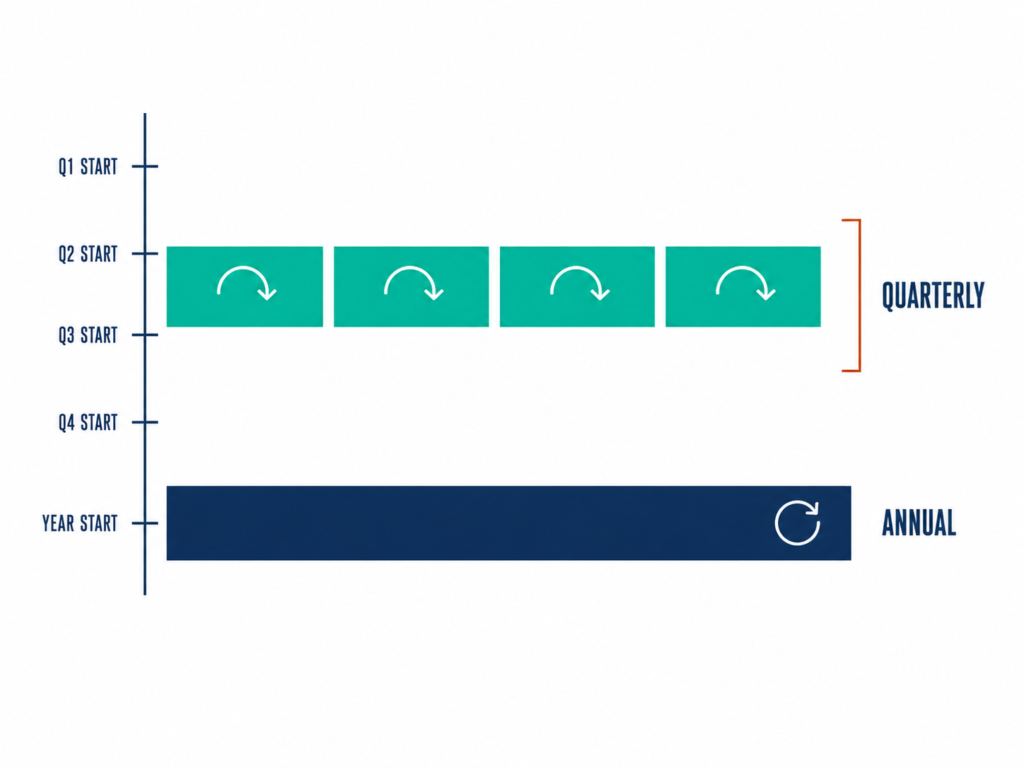
Skill requirements are now changing faster than annual planning cycles can absorb, and roles touching AI tooling change fastest of all. A plan built around a fixed twelve-month capability list is a bet that the target holds still.
In some functions that bet is fine. In others it is already lost by the second checkpoint.
Here’s what changed everything:
Stop writing one flat plan. Split every plan into two layers and treat them differently.
The durable layer
- Judgment and decision quality
- Domain knowledge
- Stakeholder capability
- Review annually. Leave it alone in between
The volatile layer
- Tools and platforms
- Specific technical methods
- Anything downstream of an AI product roadmap
- Re-cut it every quarter
This is how I have structured my own function’s capability under AI adoption. The tools move constantly. The judgment layer does not, which is why I use AI as a co-pilot with human-led validation at every decision point, and why my prompt frameworks target role clarity, inclusive job description drafting, structured interview questions, and market synthesis rather than decisions. The volatility rule from Step 7 is what sets the re-cut cadence, and anyone building capability around AI in recruitment is planning against a target that moves inside the plan’s own lifetime.
One regulatory line, and only one, because this is not a compliance article. AI can support development planning, but automated capability scoring that feeds promotion or termination decisions carries real exposure under emerging AI-in-employment rules, including the EU AI Act’s high-risk classification for employment decisions and New York City’s Local Law 144.
◆ PRO TIP
The catch: the two-layer split only works if the plan is short enough to revise in twenty minutes. Quarterly re-planning on a long form is a commitment nobody keeps past the second cycle, and then the split gets blamed rather than the form.
Seven Mistakes that Kill Employee Development Plans
These are the questions I ask when someone hands me a plan to review. Run them against one of yours before you read the conclusion.
⚠ WATCH OUT
- The plan has no manager commitments. Unfunded time kills more plans than badly written goals ever have. Fix it at Step 6.
- The capability target names a course instead of a capability. Rewrite it so it can be marked true or false, using the conversion pattern in Step 3.
- Verification was never defined. The review then becomes a negotiation about whether the training counted, which Step 5 prevents by agreeing the artefact up front.
- The plan doubles as a promotion promise. Nobody can keep it, because it depends on a vacancy neither party controls. State plainly that capability development does not guarantee a role.
- The plan and the performance improvement plan share a template. Now “development plan” means “you are in trouble,” and in many jurisdictions you have also mixed a legal performance trail into a growth document. Separate them permanently.
- Review cadence is the appraisal calendar. Set it to the rate the skill decays instead, with two checkpoints minimum per target, as in Step 7.
- The plan is longer than a page. Nobody reads it after the meeting that produced it, which makes every other fix on this list irrelevant.
Most plans I review fail on one, three, and seven together. That combination is not a coincidence, because a document nobody funds and nobody can grade has no reason to stay short.
Conclusion- Start with One Plan
For the first few years of my career I wrote development plans the way I had been taught to write them. Goals, courses, an annual review, a signature at the bottom.
The results were predictable. Nothing was verified. Nobody was funded. Not one role got filled because of one.
Here’s what changed everything: I stopped treating the plan as an engagement artefact and started treating it as a supply decision. Specify the capability. Name the evidence before the learning starts. Write down what the organisation is giving up to make it possible, and review it at the rate the skill decays rather than the rate the calendar turns.
This isn’t theoretical. It is the same logic that moved cost per hire from Rs 6.5 to 7.5 lakh down to Rs 3 to 3.8 lakh, and it works because capability you build is capability you never have to bid for against everyone else in your market.
The difference between organisations where development works and organisations where it does not is neither budget nor intent. It is whether the manager’s contribution is written down, and whether anyone agreed in advance what proof would look like. Both of those are free.
So do one thing this week. Open one development plan currently sitting on file, and check whether it names a verification artefact. Most will not. That gap is your starting point, and the template above is the shortest route out of it.
The next Lab blueprint goes deeper into capability verification methods by role type, and it reaches the Lab list before it reaches anyone else. And if you are rebuilding development planning in your own organisation, I would like to hear what is working, so come and find me on LinkedIn.
