
After eight years building Talent Acquisition systems, 250+ hires a year, half of them niche technical roles, I can tell you exactly which recruitment assessment tools earn their seat and which ones quietly waste your budget.
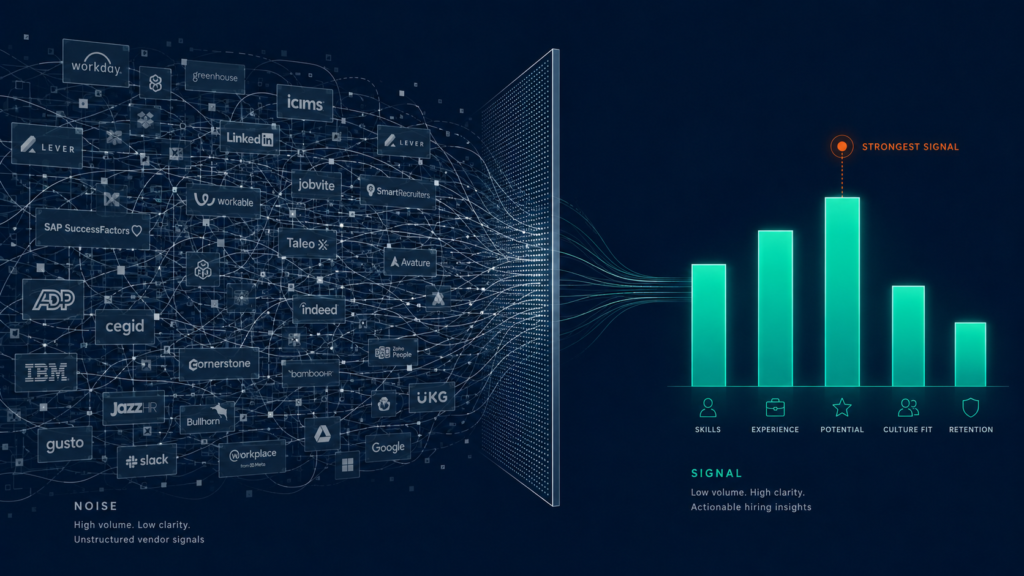
Recruitment assessment tools were supposed to fix gut-feel hiring. In 2026, half of them are broken by GenAI and the other half are buried under vendor noise.
Most articles will hand you a list of 50 tools. That is not the problem. The problem is that nobody tells you which 9 of those 50 are worth your budget, what each one measures, and which ones will fail an EEOC audit when you’re not looking.
89% vs 25%
89% of TA professionals agree Quality of Hire matters more each year. Only 25% trust their own ability to measure it. That gap is where good assessment tools earn their seat, and where the bad ones drain budget invisibly. For a senior engineering vacancy, the drain runs $500 a day. Sixty days open is $30,000 in lost productivity, before you count the cost of the wrong hire.
Source: LinkedIn Talent Solutions, The Future of Recruiting 2025
Here is what this guide contains:
- The validity hierarchy: which test types predict on-the-job performance, with the coefficients
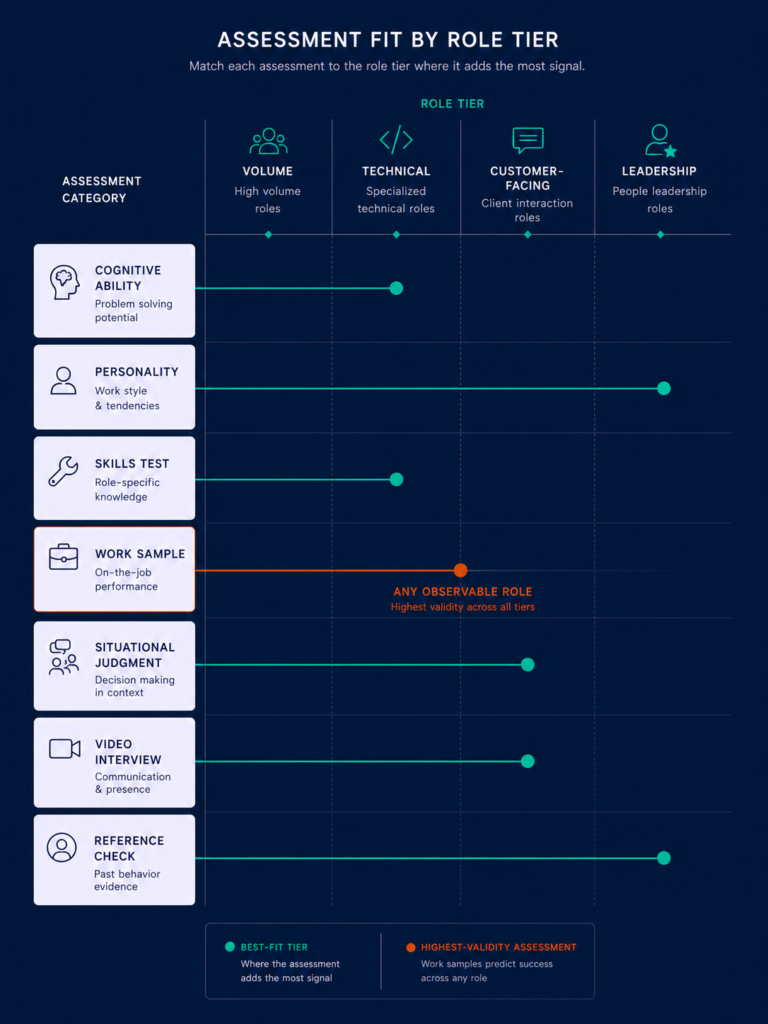
- The 7 categories of assessment tools and which role tier each one serves
- A curated list of 8 tools with honest verdicts and explicit “when not to use” guidance
- A 5-question recruitment and selection framework you can take into your next vendor demo
- The EEOC, GDPR, and adverse-impact compliance layer most articles skip
Most organisations call this “hiring.” I call it expensive hope. The Lab approach replaces hope with validated signal.
What is a Recruitment Assessment Tool?
Here’s the working definition:
A recruitment assessment tool is a structured testing platform that evaluates a candidate’s cognitive ability, personality, skills, or judgment against the demands of a specific role. It replaces unstructured interview impressions with measurable, repeatable signals that predict on-the-job performance, and when properly validated, it holds up under EEOC and GDPR scrutiny.
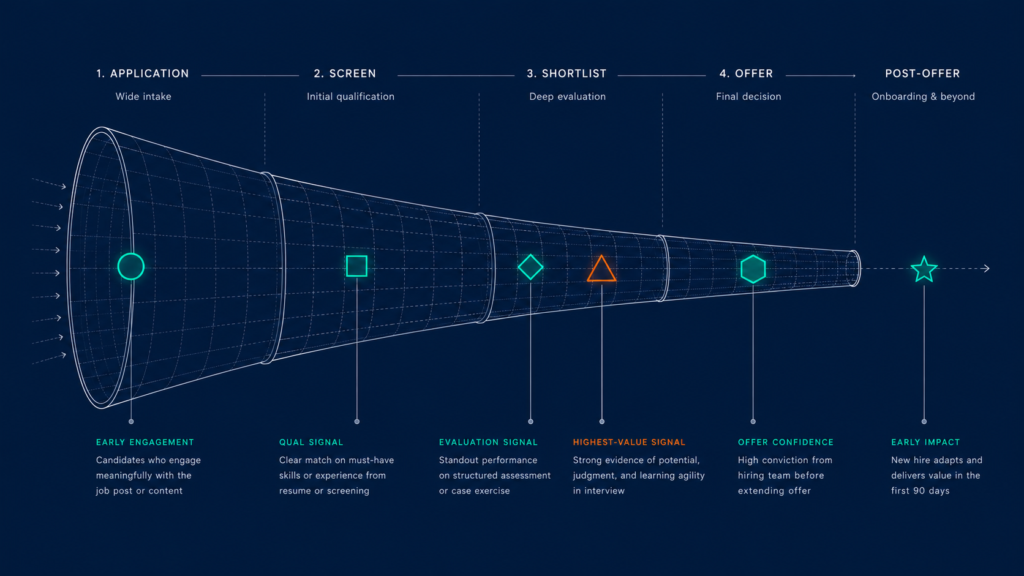
The signals these tools produce fall into five operational types: skills (can the candidate do the task?), cognitive (can they reason and learn?), behavioural (how do they show up under stress?), situational (how do they decide?), and work-sample (what do they produce when asked to do the job?). Each signal lives in a different place in your funnel. Cognitive and skills tests usually sit at the application gate. Work samples sit post-shortlist. Personality assessments belong post-offer. They inform onboarding, not the hiring call.
The mistake most teams make is treating these signal types as interchangeable. They aren’t. A cognitive test predicts something a personality test cannot, and a work sample beats both, but only for roles where the job is observable in a short focused task. That hierarchy is the spine of the rest of this HR Insight Lab’s guide. Master it, and your tool selection becomes a structured decision instead of a vendor pitch competition.
The 8 Recruitment Assessment Tools Worth Your Budget in 2026
Most listicles will hand you 50 tools and let you sort it out. That works for the SEO algorithm, not the buyer. Below are the nine tools that earn their seat in 2026, each with the verdict, the use case it fits, and the use case it does not.
1. HackerRank: Technical Skills Assessment
◆ FROM THE LAB
The Sofia verdict: a strong signal for core technical skills when used correctly, and damaging when overused or misaligned. The platform is good. The way teams deploy it is often not. Where it earns its seat is in calibrated backend and core engineering hiring, where the test maps to skills used on the job, and where the team running it has trained eyes for reading the output.
Where to recommend HackerRank: backend and core engineering roles, graduate or early-career hiring with calibrated benchmarks set against your own historical hires, and teams trained to interpret test results in context. Where to avoid it: senior or staff-level engineering roles where architectural judgment matters more than speed-of-coding, frontend and product or design-heavy positions where the test does not map to the actual work, and any hiring scenario where candidate experience and speed are critical and you cannot afford the friction of a timed coding session.
2. Codility: Engineering Code Assessment
Codility sits in the same category as HackerRank and covers the same engineering use case. The practical difference: Codility ships with a slightly stronger proctoring story, which matters more in 2026 than it did in 2022. Pick Codility when stricter anti-cheat depth matters, especially for enterprise teams running a lot of remote assessments. Pick HackerRank when the breadth of the challenge library wins over proctoring rigor. The truth is, your interviewers’ trained eye matters more than the platform either way. Both tools are commodity-level if your scoring rubric is wrong.
TestGorilla: Multi-Type Skills and Cognitive Library
TestGorilla is a strong all-rounder. The breadth of the library is its main argument: skills, cognitive, personality, work samples, all in one place. The trade-off is depth. You will not match a specialist tool in any single category. Recommend it for cross-functional hiring teams without budget for multiple specialist platforms. Avoid it when high-volume engineering is the dominant use case (HackerRank or Codility will out-predict), or when enterprise-scale TA needs the validation depth of SHL or Korn Ferry.
3. Criteria Corp: Validated Cognitive, Personality, and Skills suite
Criteria Corp is the boring, validated, sound pick. The science is legitimate and the cognitive heritage is real. What it gives up is feature glamour: lighter on AI bells and integration novelty than the newer platforms. The trade is depth-of-science over slickness, and for a buyer whose leadership wants documentation before they approve a tool, that trade is the right one. Recommend it for organisations that need a paper trail of validation evidence for boardroom review. Avoid it when a lean TA team needs rapid deployment and is willing to swap some validation depth for speed.
4. SHL: Enterprise Talent Assessment Suite
SHL has the deepest validation library on the market. Cognitive, personality, SJTs, leadership assessments, all backed by decades of research. The trade-offs are the ones you expect at this tier: slow to deploy, expensive, and no public pricing. Pick SHL when your scale and use cases justify the implementation cost, which usually means enterprise TA running multi-role global hiring and treating assessment as a strategic capability rather than a tactical filter. At enterprise-tier validity earns its keep. At mid-market scale, it usually does not.
5. Korn Ferry Assess: Leadership and Senior Assessment
Korn Ferry leads the market for leadership prediction. Multi-rater, structured behavioural, and cognitive, all tuned for executive-level decisions and succession planning. It is expensive and slow, and right exactly when those costs are dwarfed by the stakes. Recommend it for any role above Director with material business impact, especially when the hire will run a P&L or shape strategy. Avoid it for anything that is not a leadership hire. A VP-grade assessment battery on an IC role is wasted budget on both sides of the table.
6. Predictive Index: Behavioural and Cognitive
Predictive Index works best when it lives in two places: the hiring funnel as a fit signal and the manager-development programme as a coaching input. Teams that use PI in both contexts get more out of it than teams that use it only for hiring. Fast to deploy, strong community, sensible price point.
◆ PRO TIP
Real talk: PI is a fit signal, not a screen. Use it for development and team design, not as a pass/fail gate on a finalist. The teams that get bad outcomes from PI are usually the ones treating a behavioural fit profile as a hard cutoff. That is not what the science supports.
7. HireVue: Video Assessment and Game-Based
HireVue is a solid rubric-based video assessment platform with a strong proctored async product for the GenAI era. The historical issue is well known: the facial-coding AI product was deprecated for cause. Before you sign a contract, get it in writing from the vendor that what you are buying is rubric-scored structured response analysis, not emotion or expression scoring.
⚠ WATCH OUT
Watch out: any video assessment platform that markets “AI candidate intuition” or “personality detection from voice” is selling you regulatory exposure. Multiple US states and the EU AI Act treat facial and vocal AI inference as restricted or high-risk. Use rubric-based scoring, with human reviewers in the loop, full stop.
8. Crosschq — Structured Reference Assessment
Crosschq replaces gut-feel reference calls with structured, scoreable data. Peer, manager, and self ratings against role-relevant criteria, collected through a candidate-driven flow. It is not a selection gate. It is a confirmation layer. Recommend it for senior or leadership hires where a structured signal from past colleagues adds real information. Avoid it on high-volume hiring where it bloats the funnel without paying you back.
How to Choose Recruitment Assessment Tools: A 5-Question Selection Framework
Here is how to build it. Five questions in this order, every time, in every vendor demo. If a vendor cannot answer all five with specifics, the demo is over.
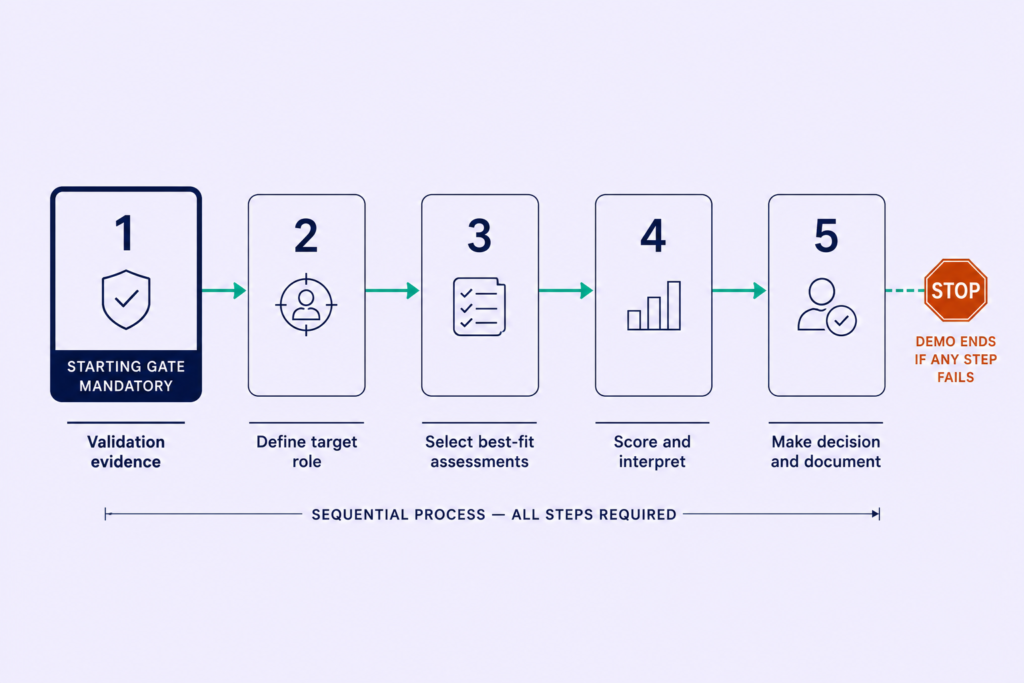
- What is the validation evidence?
- Does it predict for our specific role tier?
- What is the candidate-experience cost?
- Does it integrate with our ATS and HRIS?
- What is the compliance and adverse-impact story?
1
What is the Validation Evidence?
Ask for the validation study summary. Look for three things: criterion-related validity (the correlation between the assessment score and on-the-job performance), construct validity (the test measures what it claims to measure), and adverse-impact study results across protected groups. Disqualify any vendor who cannot produce a validity report and will not walk you through the methodology. The validity report is the first ask, not the third.
2
Does it Predict for Our Specific Role Tier?
A test validated on entry-level sales does not predict for enterprise software engineering. Ask for validation evidence in roles matching yours. If they do not have it, ask whether they will run a local validation study on your data. “Validated across thousands of roles” is not a sufficient answer. The roles need to match yours in tier, function, and complexity.
3
What is the Candidate-Experience Cost?
Long assessments drop candidates. Ask the vendor for completion rate by role tier, recommended maximum time, and how the platform feels on mobile. A reasonable decision rule: under 30 minutes for early careers, under 60 for mid-level, under 120 for senior IC paired with a paid work sample.
The best offer-acceptance rate I have personally landed is 90%, and a meaningful chunk of that signal was the candidate experience around assessment. Every minute you ask for is a tax on the funnel. Spend it deliberately.
4
Does it Integrate with our ATS and HRIS?
A standalone assessment platform is operationally fragile. Ask: native ATS integrations (yours specifically, by name), API depth, data sync behaviour, candidate single sign-on, and whether scores write back into the ATS scorecard. Disqualify vendors who only offer “you can export CSV.” That is a data leak waiting to happen, and your security team will catch it later when it costs more to unwind.
5
What is the Compliance and Adverse-Impact Story?
Ask the vendor whether they run adverse-impact studies, whether they will share them, and what their stance is on the EEOC’s algorithmic-decision-making guidance, NYC Local Law 144, the Illinois AI Video Interview Act, the Colorado AI Act, and the EU AI Act. Disqualify vendors who shrug at this list. “EEOC-compliant” as a marketing claim is meaningless; it is not a certification. Evidence of bias auditing is what you are buying.
The 7 Categories of Recruitment Assessment Tools (and which role each one solves for)
Categories matter because the tool that fits a graduate cohort will not fit a VP search, and the one that scales for volume will buckle on senior leadership hiring. Here are the seven categories worth your attention, with the role tier each one was built for.
Cognitive Ability Tests
Cognitive tests measure reasoning, pattern recognition, and numerical aptitude. They predict learning speed and complex problem-solving capacity. They work best at volume, in early-career hiring, and in training-heavy roles where new hires have to absorb a lot fast. They work poorly as a single gate for senior IC or executive hiring, where role-specific work samples out-predict any cognitive battery. Vendor anchors: Criteria Corp and Wonderlic.
Personality Assessments
The Big Five model has the science. DISC has the popularity. They are not the same thing. Personality assessments work as a fit signal and an onboarding input, not as a selection gate. Vendor anchors: Predictive Index, Traitify, and Big Five platforms.
⚠ WATCH OUT
MBTI is not a hiring tool. The Myers-Briggs Type Indicator lacks the predictive validity required for selection use, and its test-retest reliability is poor enough that the same candidate often produces different types on different days. Use it for team development if you must. Do not use it as a hiring signal. The validity literature has been clear about this for two decades.
Skills and Job-Knowledge Tests
Skills tests cover Excel, SQL, Python, customer service scripts, sales role-play, copy editing, and more. They work for any role with a verifiable hard skill at the centre of the job. They do not work for ambiguous leadership or strategy roles, where the relevant skill is judgment under uncertainty. Vendor anchors: HackerRank, Codility, TestGorilla, and iMocha.
◆ FROM THE LAB
The Sofia test: calibrate test difficulty to the role tier, not the platform default. Senior ICs do not need a timed coding test that asks them to invert a binary tree. They need a code-review work sample where they show how they think. Same platform, different question design, completely different signal quality.
Work Sample Tests (job simulations)
The highest-validity test type available. The candidate completes a sample of the actual job: write a memo, design a slide, build a small feature, conduct a mock call, draft a 90-day plan. Work samples win because they measure the work. They do not work for roles that need weeks of context before any output is meaningful, like executive strategy roles. Vendor anchors: TestGorilla work-sample modules, Vervoe, and custom-built simulations.
The factory-floor analyst hire mentioned above? That happened because a work sample surfaced a candidate the resume gate would have rejected. The lift to design a work sample is four to eight hours per role. It pays back across every hire for that role forever.
Situational Judgment Tests (SJTs)
SJTs present the candidate with a realistic workplace scenario and ask what they would do. Multiple-choice or video format. The choice signals judgment, decision style, and priorities. SJTs work for customer-facing roles, frontline operations, and the leadership pipeline. They do not work as a pure technical screen.
One operational angle worth flagging now: SJTs hold up better against GenAI than traditional take-homes. There is no single right answer for an AI to look up. We come back to this in the GenAI section. Vendor anchors: SHL, Korn Ferry, and Aon.
Video and One-way Interview Assessments
The candidate records timed answers to structured questions. Reviewers score against a rubric. Modern platforms add an async candidate experience, geographic flexibility, and real recruiter time savings. They work for volume hiring, early careers, and globally distributed pipelines. They do not work for senior or relationship-driven roles where chemistry carries weight.
⚠ WATCH OUT
Red flag: AI scoring of facial expressions or vocal tone has been deprecated by serious vendors and restricted by regulators in multiple jurisdictions. If a video assessment vendor is selling you on “emotional intelligence detection” or “candidate energy scoring,” walk away. Only platforms scoring on rubric-based structured responses belong in your funnel. Vendor anchors: HireVue (rubric-based), Spark Hire, and Truffle.
Reference and Background Assessment Tools
Structured reference platforms collect peer, manager, and self ratings against role-relevant criteria. Background checks verify what the candidate says they did. Both belong post-offer or mid-funnel on senior hires, never as a primary selection gate. Vendor anchors: Crosschq for structured references, HireRight for background. Read the EEOC’s criminal-background guidance before you build a blanket policy: not every role needs one, and overreach creates adverse-impact exposure of its own.
Where Recruitment Assessments Live in Your Hiring Funnel
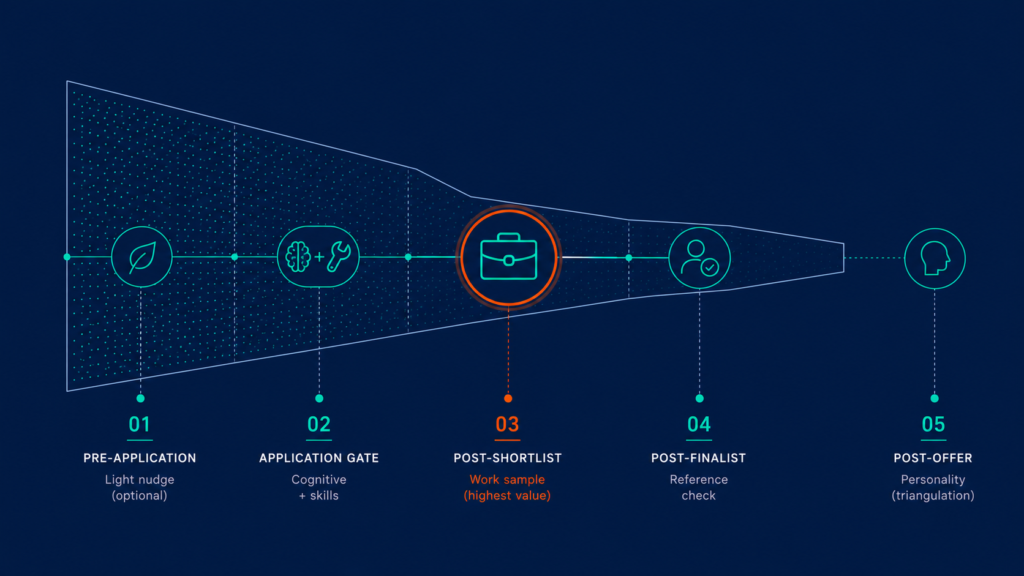
Most articles tell you to use an assessment after CV screening. That sentence is the whole answer they give. The truth is, placement matters as much as which tool you pick. Wrong placement creates candidate drop-off, wasted recruiter time, and validity erosion.
The old way
- Single assessment gate, sometime after the CV screen
- Same battery used for every role tier
- Stack all assessment time in one stage to “be thorough”
- Personality test used to disqualify finalists
The Lab Way
- Placement varies by role tier and test type
- Multiple light gates, each with a defined signal
- Work samples post-shortlist, personality post-offer
- Personality used to inform onboarding, not selection
Pre-application:
A light SJT or candidate self-fit quiz, no scoring, optional. The signal here is candidate self-selection, not screening.
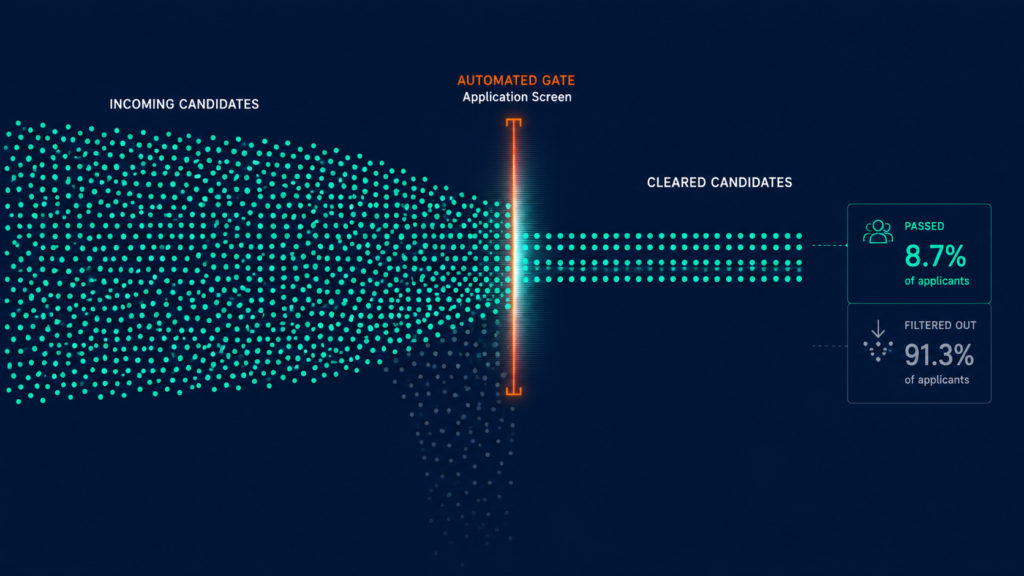
Application gate:
Cognitive plus a brief skills test, but only for high-volume roles where the funnel needs to be narrowed before recruiters touch it. For executive hiring, skip the gate entirely; you do not have the volume problem.
Post-shortlist:
This is where work samples and structured interview prep live. Your highest-validity signal goes here, on the smallest qualified pool.
Post-finalist:
Structured reference assessment and, for leadership hires, a behavioural deep-dive. The function is triangulation, not gatekeeping.
Post-offer:
Personality assessment, used to personalise onboarding, manager pairing, and the first 90 days of role design. Not, ever, to revisit the hire decision.
The Validity Hierarchy: What Predicts Job Performance
Vendors will sell you on integrations, dashboards, and AI features. None of that matters if the test doesn’t predict who will do the job well. Validity, in this context, is the correlation between an assessment score and real on-the-job performance. It is measured as a coefficient on a 0 to 1 scale.
The number that matters:
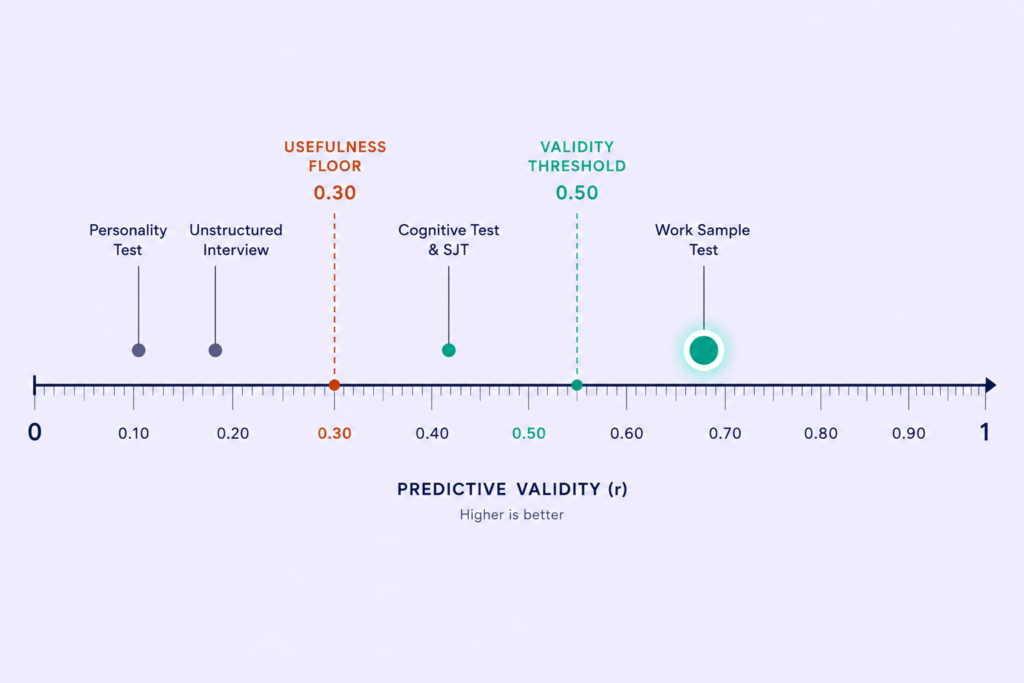
Anything above 0.30 is useful for selection. Anything above 0.50 is strong. Most personality tests sit at 0.10 to 0.20. Work samples regularly clear 0.50. The spec sheet matters less than the coefficient, and only one vendor in ten will tell you theirs without being asked.
Here is the deal: TA pros already know this. Over nine out of ten say accurately assessing a candidate’s skills is the lever for Quality of Hire. The disconnect is between what they say and what they buy.
Source: LinkedIn Talent Solutions, The Future of Recruiting 2025
Buy on validation evidence and predictive coefficient. Not on integrations, not on dashboards, not on AI features.
The old way
- Compare vendors on feature lists
- Buy on integrations and price
- Treat all test types as interchangeable
- Trust the vendor’s marketing claims on accuracy
The Lab Way
- Ask for the validity coefficient first
- Buy on validation evidence and adverse-impact study results
- Build a tiered stack: work sample, then cognitive, then personality
- Reject any vendor who cannot produce a validation study
Tier 1 (validity coefficient r ≈ 0.5+): Work Samples and Structured Interviews

Work sample tests ask the candidate to do a focused version of the actual job. Code a feature. Draft a recruiter outreach. Run a mock customer call. Build a one-slide narrative for an imaginary VP. The reason they win is unembarrassing: they measure exactly what they predict. Pair them with structured interviews scored against a written rubric, and you have the two highest-validity inputs available to your team.
How to deploy work samples:
Place them post-shortlist, pre-final-interview. Keep them tight: 60 to 90 minutes for non-engineering, two to three hours for engineering paired tasks. Score them blind, with a two-reviewer minimum, against a rubric written before any candidate touches the task. That last rule sounds bureaucratic. It is the single biggest jump in scoring quality you will get from any process change.
◆ FROM THE LAB
My experience: We needed a manufacturing systems analyst, and traditional sourcing handed us 14 qualified resumes. Fourteen. For a role that mattered. I scrapped the resume gate and ran an inverted sourcing pass instead, filtering against capability signals like PLC programming projects and lean manufacturing case studies. The pool jumped to 62 candidates.
The hire who came out of that process was a former factory-floor supervisor who had taught himself Python on weekends. He had no formal degree path that the resume gate would have respected. He now leads digital transformation for that business unit. The work sample saw what the credential filter could not. That is the entire argument for Tier 1 in one hire. When you score for capability instead of pedigree, the candidates the resume gate would have rejected start surfacing. Some of them are your best hires.
Tier 2 (validity coefficient r ≈ 0.35 to 0.45): Cognitive Ability and Situational Judgment
Cognitive ability tests, sometimes called general mental ability or GMA, are one of the best single predictors of training performance and complex-role success. Situational judgment tests measure how a candidate decides under realistic workplace scenarios. Both scale, both run fast, and both hold up when you source them from a serious vendor.
Where Tier 2 fits:
Volume hiring is where these tests pay rent. Early careers, training-heavy roles, and any place where work samples don’t scale to the funnel volume. Fifteen to thirty minutes of candidate time, scored automatically, with coefficients that beat almost everything else in that time budget.
⚠ WATCH OUT
Common mistake: using cognitive tests as a hard cutoff. That is where adverse-impact problems start. Cognitive scores belong inside a multi-signal framework, not as a single gate. We cover the compliance reasons in the EEOC section below.
◆ FROM THE LAB
The Sofia lens: On a bulk hire programme last year, we needed 350 to 500 people across customer support, operations analysts, junior engineers, and sales support, all in a 10-week window. Tight timeline, limited interviewer capacity, real risk of candidate drop-off if the funnel slowed. The first gate was a standardised pre-assessment, cognitive plus a short SJT, scored automatically.
The numbers held. 420+ hires in 10 weeks. Average TAT dropped from 32 days to roughly 18 to 20. Offer-to-join above 90%. 90-day retention between 85% and 88%. Recruiter productivity went up around 35%, because the assessment was filtering the funnel cleanly enough that recruiters spent their time on the candidates who could clear the role. Less triage, more selection. That is the operational role of a Tier 2 gate. It does not pick the hire. It clears the noise so the people doing the picking can pick well.
Tier 3 (validity coefficient r ≈ 0.10 to 0.30): Personality, References, Unstructured Interviews
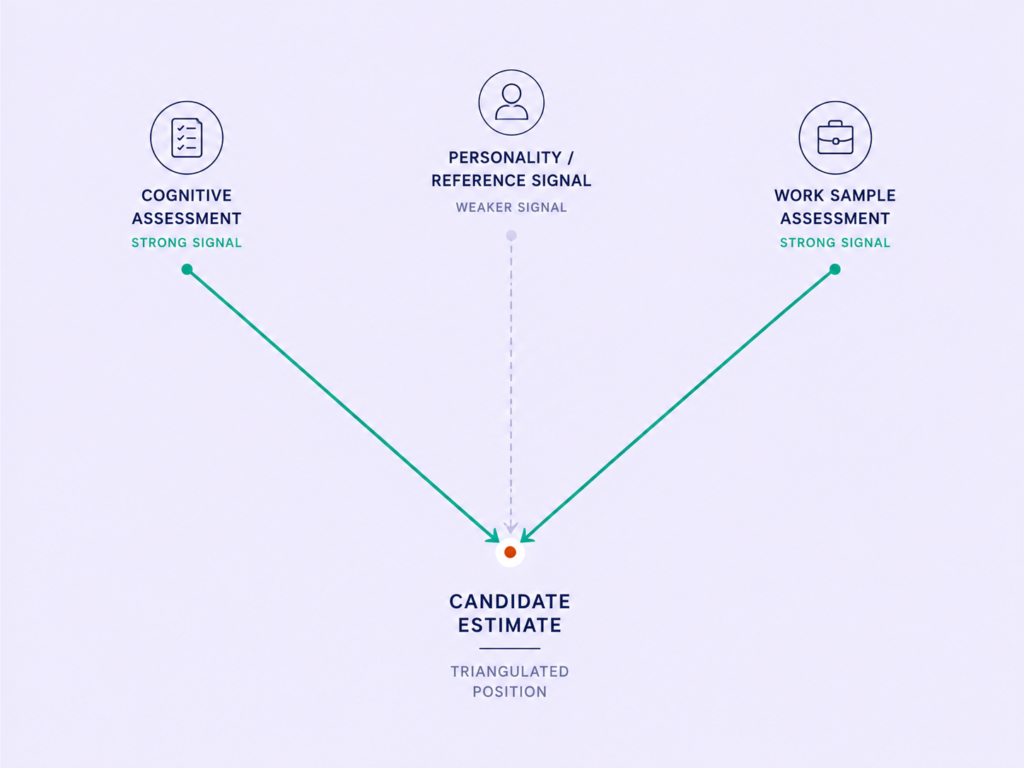
Personality assessments grounded in the Big Five (OCEAN) model have a place. Conscientiousness correlates with performance across many roles. Emotional stability correlates with retention. But the coefficient is modest, and personality works as a triangulation signal, not a primary gate.
Unstructured interviews are the lowest-validity input in mainstream use. Their predictive power is barely above chance. Reference checks, in the form most teams run them, are gut-feel phone calls dressed in formality.
Where personality fits in the stack:
Post-offer. Use it to shape onboarding, manager pairing, and the first 90 days of role design. Do not use it to disqualify a finalist who has already cleared a work sample and a structured interview. That is where personality testing earns its bad name.
◆ PRO TIP
Real talk: AI does not replace recruiters, and personality tests do not tell you who to hire. Both are co-pilots, not decision-makers. The recruiters who treat them that way produce better outcomes than the ones who let either drive the call.
So how does the hierarchy change how you buy? Build your assessment stack from the top down. Anchor on one or two high-validity gates, usually a work sample and a structured interview. Supplement with mid-validity scalable signals like cognitive and SJT for volume. Treat personality and references as triangulation, never as gatekeepers. Don’t buy on features. Buy on validation evidence and predictive coefficient.
EEOC, GDPR, and Adverse Impact: The Compliance Layer
Compliance is buyer power. The vendors who can produce adverse-impact studies make your TA team defensible. The ones who cannot are a future legal problem. Here is what you need to know in plain language, with the citations you can hand to your CHRO.
The US compliance Stack (EEOC and state AI hiring laws)
The EEOC’s Uniform Guidelines on Employee Selection Procedures (UGESP) require validated, job-related assessments for any selection device with material impact on hiring decisions. The four-fifths rule is the operational test: if a protected group’s selection rate is less than 80% of the highest-selected group’s rate, you have a signal of potential adverse impact. That is not a guilty verdict; it is a trigger for further analysis.
The EEOC’s guidance on AI and algorithmic hiring made vendor validation evidence non-optional for any platform that affects selection decisions. At the state layer: NYC Local Law 144 requires bias audits and candidate notice for Automated Employment Decision Tools. Illinois AI Video Interview Act requires consent and restricts AI use in video interviews. Colorado’s AI Act treats high-risk hiring systems as needing disclosure. The pattern across all of these is the same: validation, transparency, human oversight.
Disparate impact liability is part of Title VII. Plaintiffs can still pursue disparate impact claims in court even after federal enforcement priorities shifted in 2025. Translation: federal politics changes; the private plaintiff bar does not stop, and the four-fifths rule still applies.
Source: U.S. EEOC, Employment Tests and Selection Procedures; SHRM, EEOC Issues Job Applicant Testing and Screening Fact Sheet
⚠ WATCH OUT
Common mistake: running adverse-impact analysis only when an issue is flagged. By then you are reacting under pressure. Bake an annual adverse-impact review into your hiring operating cadence, the way you would a budget review. It costs less to fix a four-fifths failure quietly in May than to defend it publicly in November.
The EU Compliance Stack (GDPR and the EU AI Act)
GDPR Article 22 prohibits decisions based solely on automated processing that significantly affect a person. An AI assessment cannot be the only decision-maker; a human has to be in the loop on selection. Special category data, which can include biometric data inferred from facial or voice analysis, is restricted.
The EU AI Act classifies most recruitment AI as high-risk. That triggers conformity assessment requirements, transparency obligations to candidates, human oversight in the decision flow, and post-market monitoring. The operational read is straightforward: AI emotion-detection scoring is a non-starter in the EU. Rubric-based, human-in-the-loop scoring is the safe path, and the right one for the rest of the world too.
If you are hiring across jurisdictions, design your assessment process to clear the strictest one. Downward compatibility is far easier than retrofit.
Source: EU Artificial Intelligence Act; GDPR Article 22 (Regulation (EU) 2016/679)
The 2026 GenAI cheating problem (and what to do about it)
Gartner is blunt about it: AI and cost pressure are the two forces driving the top four trends for Talent Acquisition in 2026. Half of that shift sits on the candidate side of the table, and most assessment vendors haven’t caught up.
Source: Gartner, AI Revolution and Cost Pressures Drive Top Four Trends for TA in 2026 (October 2025)
The problem in 2026:
GenAI tools can now complete most traditional take-home coding tests, writing samples, and case studies at near-human level. Result: take-homes have lost most of their predictive validity for candidates who use AI assistance, and the candidates who do not are at a relative disadvantage. The signal is broken.
Why traditional take-homes are now compromised:
Not because candidates are dishonest. Because the tool is freely available, the policy is unenforceable, and asking a candidate to handicap themselves while their competition does not is a losing rule. The assessment design is what needs to change, not the candidate behaviour.
The AI-resistant alternatives:
Three operational responses. First, shift to proctored, time-boxed assessments where the live signal matters. Second, shift to SJTs and live work simulations where there is no single right answer for an AI to look up. Third, for take-homes you keep, redesign them around judgment and explanation, not output. Ask the candidate to build something AND record a 15-minute walkthrough of their trade-offs. The judgment is what you are hiring for. The judgment is the part the AI cannot fake.
◆ FROM THE LAB
The Sofia lens: AI is a co-pilot, not a decision-maker. That principle applies to recruiters using AI to screen, and it applies symmetrically to candidates using AI to complete take-homes. Hire for the judgment that survives when the AI is on the table. Design the assessment so that judgment is what you are testing.
How to communicate the change to candidates:
Be honest about why the design changed. Tell candidates the assessment is built around judgment because GenAI changed what hard-skill output proves. Most strong candidates respect the framing, and it lifts your offer-acceptance rate at the senior end of the funnel.
The ROI math: Building Your Business Case
88% of HR leaders report their organisations have not realised significant business value from AI tools. The reason is rarely the tool. The reason is that the buyer did not build the math first. You can be the 12% who do. Start by measuring.
Here are the five inputs to an assessment ROI calculation worth taking to your CFO:
- Cost per hire delta. Replacing recruiter and agency hours with assessment-driven shortlists.
- Time-to-fill delta. Faster shortlist conversion driven by better signal earlier.
- Quality of Hire delta. 12-month retention and performance against role.
- Bad-hire avoidance. The cost of one wrong senior hire is roughly 50 to 200% of annual comp.
- Recruiter productivity delta. Hours saved per requisition that the team can redeploy to harder roles.
◆ FROM THE LAB
The Sofia test: On automation engineering scale-up, we ran talent mapping across 12 competitors in the industrial IoT space, paired the pre-identified pool with a calibrated work sample at the post-shortlist gate, and rebuilt the structured interview rubric end-to-end. Time-to-Offer fell from 68 days to 34 days. Cost per hire for senior engineering roles in India moved from ₹6.5 to ₹7.5 lakh down to ₹3 to ₹3.8 lakh, a 45 to 55% reduction. Time-to-fill on critical roles closed 20 to 30 days faster.
The math is the case. Faster fills, lower agency dependence, and a measurable improvement in Quality of Hire at 12 months. That is the level of evidence your CFO will fund a tool purchase against. If your vendor cannot help you build that math from their own data, build it from yours.
Every assessment investment has a math story. If your vendor cannot show it, you build it from your own funnel data. Otherwise you are guessing.
Where this leaves you
Recruitment assessment tools were never about the tools. They are about the validity of the signal you build into your hiring funnel. The teams winning in 2026 aren’t the ones with the biggest stack. They are the ones with the cleanest decision logic, the most boring documentation, and the discipline to ask for a validity coefficient before they ask for a price.
Pick two tools. Not nine. One from the high-validity tier (a work sample platform or a serious structured-interview rubric), and one from the mid-validity tier for volume coverage (a cognitive plus SJT pairing). Implement them across the next 90 days. Run an adverse-impact review at day 60. Measure cost per hire and Time-to-Offer against your current baseline. The math will tell you what to keep.
