

Eight years in Talent Management have taught me to read a resignation letter as a review of the manager, not the job.
The pattern repeats with almost no variation. The strongest individual contributor on a team gets promoted into a role nobody trains them for, and twelve months later they are appraised against a capability the organisation never gave them.
Most organisations treat people management as a temperament. It is a set of eight learnable behaviours, and a single quarter is long enough to identify which ones a manager is missing.
That distinction carries a price. Earlier in my career, before we rebuilt the process, replacing a senior engineering hire cost between 6.5 and 7.5 lakh rupees (roughly USD 7,800 to 9,000), and an unfilled senior engineering role drained about $500 a day in lost output. Sixty days vacant is $30,000 gone.
Now apply that to one manager with twelve reports who loses three good people a year. The replacement cost alone runs past seven figures in rupees before anyone counts the vacancy drag. It never appears on a dashboard as a management problem, because it gets logged as a recruitment cost.
The reflex is to blame the individual manager. That reading is wrong, and the numbers say so.
22%
Manager engagement globally, down from 27% a year earlier and nine points since 2022. No other worker category fell that far.
Translation: the job got harder, and the people doing it are disengaging faster than the people they manage. Your managers are not uniquely failing. The role changed underneath them, and almost nobody adjusted the job description, the time budget, or the training that came with it.
Here’s what this guide gives you:
- The eight people management skills that move measurable team performance, each with a behavioural definition, an execution method, a failure mode, and a way to tell whether it is present
- An eight-question diagnostic and four outcome metrics for working out whether a specific manager has them
- A 90-day build sequence ordered by dependency rather than by preference
- A cost model that expresses manager capability in a currency your finance team already tracks
HR Insights Lab approach: every skill below carries a detection signal, because a capability nobody can observe is a capability nobody can develop. That is the difference between this guide and the advice telling managers to communicate clearly and often.
What are People Management Skills?

People management skills are the behavioural capabilities a manager uses to direct, develop, and retain a team: setting expectations, delegating, coaching, resolving conflict, and recognising contribution. They are distinct from technical skill and from leadership. They are learnable, observable, and they decide whether a team performs above or below the sum of its people.
The observable part matters more than it sounds. A trait cannot be trained, rated fairly, or built into a development plan, which is why a competency framework entry reading “people-oriented” produces nothing usable in calibration. A behaviour can be described, watched, and corrected.
Every skill in this guide passes one test. Two people watching the same manager for a month would agree on whether the behaviour happened. Warmth fails that test, and a written definition of done for recurring work does not.
Here’s the difference:
People management is operational. It covers the daily mechanics of getting work done through other people. Leadership is directional, and HR management is systemic: the policies, processes, and compliance architecture both of the others operate inside.
Put all three against the same scenario. A team loses its most experienced engineer.
People management is the conversation that should have happened six weeks earlier, when that engineer stopped volunteering for work they used to chase. Leadership is the decision about what the team is now for, and whether the roadmap survives without that person. HR management is the retention analysis, the backfill approval, and the exit data that shows whether this is a pattern or an event.
Those three layers fail separately and for different reasons. This is why sending a struggling manager on a leadership course so rarely changes anything, and it is the argument HR business partnering teams end up making to senior stakeholders every single review cycle.
The old way
- Use “leadership” as an umbrella term for everything a manager does
- Buy leadership training when a team starts losing people
- Rate “people-oriented” on the annual form and move on
- Assume a manager either has the instinct or does not
The Lab Way
- Name which of the three layers broke before spending anything
- Separate leadership competencies from people management behaviours in the framework
- Rate observable behaviours, each with a defined failure signal
- Treat all eight skills as buildable, in a set sequence
⚠ WATCH OUT
Common mistake: buying leadership development for a people management failure.
I hold an unpopular view on retention, which is that it is mostly a systems failure rather than a compensation failure. The same logic applies one level down. Most “bad manager” problems are mis-diagnosed layer problems, and the development budget pays for the misdiagnosis rather than the fix.
Why People Management Skills are Failing Right Now
Almost every article on this topic writes as though the manager’s job has been static for a decade. It has not. Three things changed at once, and together they explain why the training that worked in 2019 produces nothing measurable now.
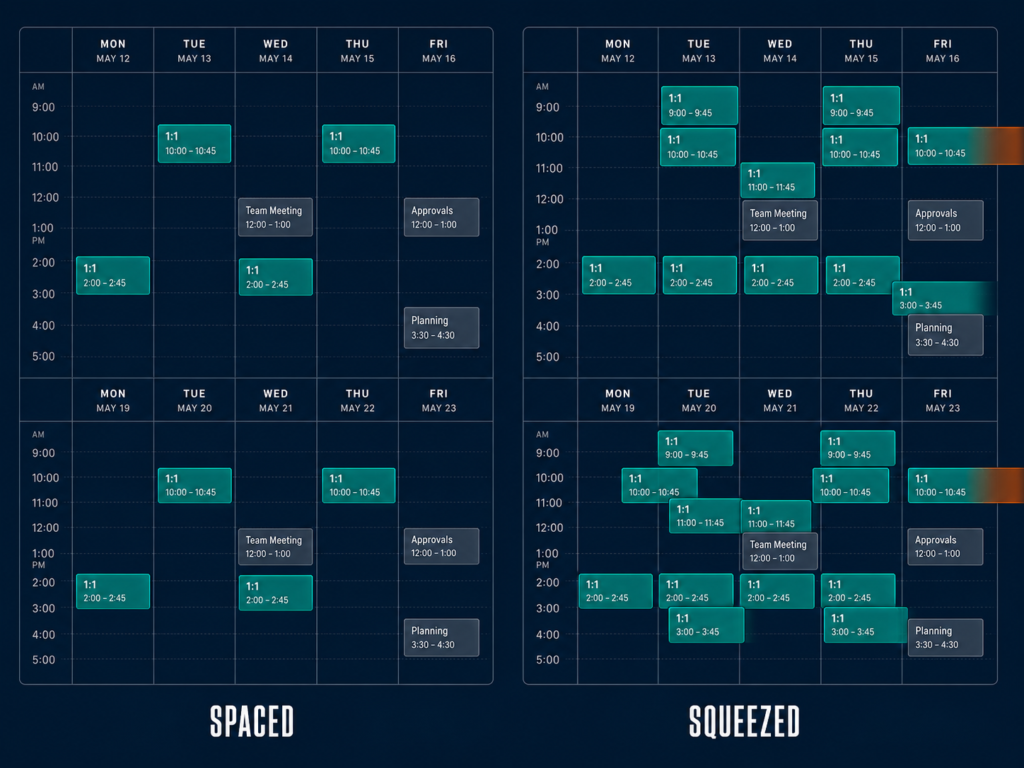
Start with the mechanical reality. Managers have more direct reports than they did two years ago, because middle layers were consolidated and the work did not go anywhere.
Here’s the arithmetic:
Thirty minutes of genuine one-to-one time per report per fortnight is a modest standard. At eight reports that is four hours a fortnight. At twelve it is six, before preparation, before follow-up, and before any of those conversations turns into an action the manager then has to carry.
10.9 to 12.1
The average number of people reporting to a manager, in a single year. Team sizes have grown by close to half since 2013, and manager engagement falls as span of control widens.
Source: Gallup, Span of Control: What’s the Optimal Team Size for Managers?
Translation: a cadence built for eight does not survive at twelve. Coaching depth goes first, because it is the only one of the eight skills with no external deadline forcing it to happen. Conflict gets noticed later, when resolving it costs considerably more.
◆ PRO TIP
Real talk: span of control is a design decision, and it is usually made by someone who will never run one of those one-to-ones. Widening it is a choice about which conversations stop happening.
Make that choice deliberately, with capacity planning attached to it, or the calendar will make it for you and nobody will be able to name the quarter it happened.
Earlier in my career I ran a high-volume hiring campaign where recruiter productivity improved by roughly 35%. Nobody worked harder or longer. We changed how the work was batched and scheduled, and the capacity appeared. Manager capability behaves the same way: redesign the time budget first, then train.
Then there is the question of where the week goes.
Approvals. Status reporting that informs rather than decides. Tool administration. Meetings that exist because they have always existed. None of it is illegitimate, and all of it is displacement.
Under 30%
The share of a manager’s time spent on people leadership. Roughly three quarters goes to individual execution or administration, and administrative work alone takes about a quarter of the week, close to a full day.
Source: McKinsey & Company, Stop Wasting Your Most Precious Resource: Middle Managers
Translation: your managers are managing people for one day in five, and you are appraising them as though it were five in five.
You cannot develop a skill you never get to practise.
That single line answers the question every HR Business Partner keeps being asked, which is why manager training never seems to stick. A manager with four hours a week of people work will not become good at people work, whatever the training budget says. Workflow optimisation is a prerequisite here, not an adjacent project for next year.
Underneath both problems sits the oldest unfixed assumption in the discipline. Organisations still promote the strongest individual contributor, and still provide no formal transition into a job that shares almost no skills with the previous one.
The missing training is the obvious half of that. The sharper half is that promotion is frequently the only reward mechanism available, so organisations manufacture managers they do not need in order to keep people they cannot otherwise progress.
Fewer than half of managers worldwide have received any management training at all, and only around three in ten managers of hybrid teams have been trained to lead one. Sit with the absurdity of that for a moment. The organisation declines to teach the capability, then rates people against it annually.
Source: Gallup, Manager Development Strategy: A Practical Guide
The old way
- Promote your best engineer
- Lose a great engineer
- Gain a struggling manager
- Call it a career path
The Lab Way
- Separate the reward from the role
- Build a technical track with real seniority and real pay
- Select managers on demonstrated people behaviours, not output
- Make internal mobility a genuine alternative to the management ladder
◆ FROM THE LAB
My experience: in one of the organisations I worked with, external hiring was expensive and slow while the internal talent market barely functioned. Roles went straight to job boards. People who wanted to move usually found out about the opening from a colleague, after it had already been advertised outside.
We introduced a 48-hour internal posting window before anything went external, and asked recruiters to actively tap internal candidates rather than wait for applications to arrive. The window was deliberately short. Long enough to be real, short enough that hiring managers stopped treating it as a delay tactic.
Twenty-three percent of hires that year were internal moves. The number that changed the argument, though, was Time-to-Productivity: 28 days for an internal hire against 67 days for an external one.
The lesson transfers straight onto the promotion problem. Not everyone who deserves progression needs a team. When career pathing runs only through management, an organisation keeps converting good engineers into struggling managers, because management is the only door anyone built.
Widened spans. A displaced week. No transition training. That is the environment the eight skills have to survive in, which is why a list of virtues is close to useless here.
What follows is not a list of virtues. Each skill below carries a definition you can watch someone perform, a method for executing it, the way it usually fails, and a signal that tells you whether it is present in a specific manager on a specific team.
The 8 People Management Skills That Move Performance
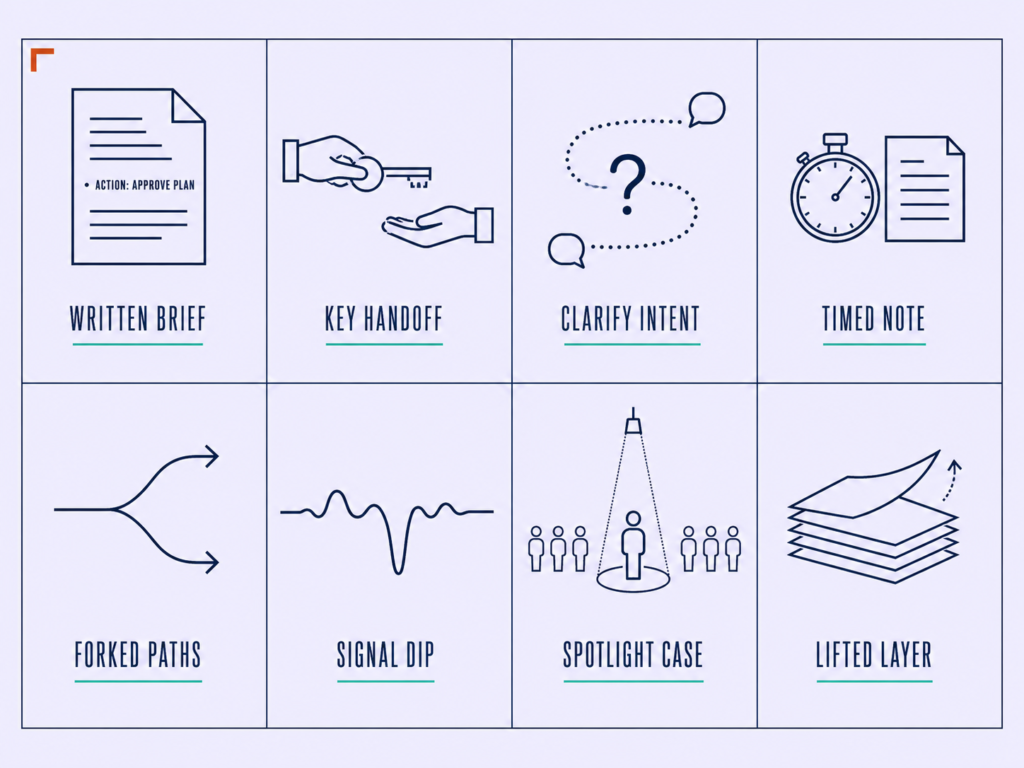
Eight, not ten. Most lists inflate to a round number by counting patience, empathy, and emotional intelligence as three separate skills. Eight is what survives de-duplication, and each one below has a definition you can watch, a method, a failure mode, and a detection signal.
1. Setting Expectations
Making it unambiguous what good looks like, by when, and how it will be judged, before the work starts rather than after. This is the foundational skill, and it is the one everyone else files under “communication.”
How to execute:
Write role clarity down for every direct report, covering their three to five actual accountabilities rather than their job advert. Agree a definition of done for recurring work. Document a decision-rights map so people know what they are allowed to settle alone.
⚠ WATCH OUT
The failure mode: expectations that live only in the manager’s head and surface for the first time during performance management season. Most of the performance problems an HRBP is asked to help with are expectation failures wearing a performance-problem costume.
How you’d know:
Ask two people on the same team what their top priority is this quarter. If the answers differ, the skill is absent. I learned the same discipline upstream, running structured interview scorecards across a campaign of more than 420 hires. Defining the standard before you evaluate against it is what produced an offer-to-join ratio above 90%.
2. Delegating with Real Authority
Handing over responsibility for an outcome together with the authority to make the decisions that outcome requires, while keeping the accountability yourself. The distinguishing variable is authority, not task volume.
How to execute:
Name the outcome rather than the task. State explicitly which decisions the person owns outright, which need a heads-up, and which need approval. Set the check-in cadence at the start, so follow-up is not experienced as surveillance later.
⚠ WATCH OUT
The failure mode: delegating the work but withholding the decisions. It produces a queue at the manager’s desk and teaches a team that ownership is theatre. The manager reads the resulting bottleneck as a workload problem and asks for headcount.
How you’d know:
Count how many decisions in a week route through the manager that could have been settled two levels down. Publishing the decision rights boundary is what makes this auditable. Do not tell a manager to trust their team, because trust is the output of a working delegation structure rather than the input to one.
3. Coaching Conversations
Helping someone reach their own answer through structured questions instead of supplying yours. Coaching is question-led and forward-facing. Feedback is statement-led and backward-facing, and treating them as one activity is why most manager development programmes deliver neither.
The three questions:
- What are you stuck on that you have not raised?
- What would you do if this were entirely your call?
- What do you need from me that you have not asked for?
Run it fortnightly, 25 to 30 minutes, in a slot that is not the status update. Write down what the person commits to and open the next session with it. My position on AI is that it accelerates thinking while the human owns judgment and the final call, and coaching runs on exactly the same rule: the manager is not there to supply the answer.
◆ PRO TIP
The honest downside: this is the first skill to collapse under workload pressure, and it collapses quietly. The meeting stays in the diary and turns into a status review within about six weeks.
Detection signal: ask a report what they decided in their last one-to-one. If they describe what they reported rather than what they decided, it is a status meeting with a friendlier tone.
4. Continuous Feedback
Naming a specific observed behaviour and its effect, close enough to the event that the person can still remember the detail. Everyone lists this skill. Nobody addresses the decay in frequency that makes it worthless.
How to execute:
Within 72 hours. Behaviour and effect rather than trait and judgement: “the spec landed two days after the sprint started, so two engineers built against the old version” instead of “you are disorganised.” Hold positive feedback to the identical standard, which is where most managers are far weaker.
Skip the feedback sandwich. It is discredited, it still appears in most of the articles ranking for this topic, and it teaches people to hear praise as packaging for the criticism that follows.
Nothing in a performance review should be new information.
⚠ WATCH OUT
The failure mode: saving everything for the review cycle, where the feedback becomes unfalsifiable and lands as an ambush. If a manager’s review contains anything the report is hearing for the first time, the skill is absent. That is the cleanest binary test in this whole guide.
The best 12-month cohort retention I have recorded was 89%, and I want to be honest about the mechanism. That came from expectations set correctly at hire and reinforced continuously, not from any single feedback technique. Quality of Hire and feedback discipline compound; neither works alone.
5. Conflict Resolution
Surfacing a disagreement early enough that it is still about the work, then structuring it so it resolves instead of submerging. Every competitor list says “address conflict early.” The reader is almost never early.
The four conflict types:
- Facts: the two people hold different information. Resolvable in one conversation.
- Methods: they agree on the goal and disagree on the route. Resolvable with a decision owner.
- Goals: they are optimising for different outcomes. Needs escalation, not mediation.
- Values: they disagree about what matters. Usually not resolvable, and pretending otherwise wastes months.
Get both accounts separately before any joint conversation, because the joint conversation is where positions harden. Separate the stated position from the underlying interest. Classify the type before choosing the intervention.
⚠ WATCH OUT
The failure mode: mediating a values conflict as though it were a facts conflict. That produces a truce rather than a resolution, and it guarantees recurrence at higher cost. Employee relations cases that reach HR after six weeks are almost always mislabelled conflicts, not escalated ones.
How you’d know:
Track how long the average team disagreement takes to reach the manager. A long lag means people have learned that raising things does not help. On a high-pressure hiring campaign I ran weekly war-room calls with hiring managers for exactly this reason, and misalignment surfaced while it was still cheap. The transferable principle is cadence, not courage.
6. Reading Signals
Noticing a change in someone’s engagement or capacity early enough to act while the intervention is still small. This is what emotional intelligence looks like once you convert it from a personality attribute into something a manager can do on a Tuesday.
The signals worth watching:
- A normally vocal person going quiet in reviews
- Response latency changing without an explanation
- Leave patterns shifting, including leave stopping altogether
- Someone withdrawing from work they used to volunteer for
Then the action rule, which is what makes this a skill rather than an observation. A noticed signal must produce a conversation within a week. Otherwise it was not noticed, it was filed.
Earlier in my career, traditional sourcing for a manufacturing systems analyst produced 14 usable resumes. Filtering on capability signals instead of credentials produced 62, and the person we hired had taught himself Python on a factory floor. Credential gatekeeping eliminates your best candidates because you were reading the wrong signal. Managers make the identical error internally, assessing hours and visible presence instead of employee engagement and contribution.
◆ PRO TIP
Real talk: noticing is not therapy, and the boundary matters more than the noticing. A manager’s job is to see the change and open one honest conversation. It is not to diagnose, counsel, or carry it.
Detection signal: ask a manager to name, for each report, the last thing that visibly changed for that person. A manager who cannot answer is not reading signals, whatever their engagement score says.
7. Recognition that Registers
Attaching acknowledgement to a specific act, close to the event, in the form the recipient values. Specificity beats frequency every time. “Thank you for spotting the spec mismatch before the sprint started” does more than a weekly generic shout-out ever will.
How to execute:
Match the channel to the person, because public recognition is a cost rather than a reward for a meaningful minority of people. Separate recognition from compensation events entirely. When the two arrive together, the recognition reads as a substitute for money.
◆ FROM THE LAB
My experience: the employee referral programme I inherited was democratic and underperforming. Everyone got the same email, the same bonus structure, and the same silence in response. When I pulled the data, the distribution was not even close to even. Between 5% and 10% of employees were generating 60% to 70% of successful referrals.
So we stopped treating referrals as a company-wide campaign and built something for the few who were doing it. We identified the top referrers, gave them a named “Talent Scout” status, quarterly sessions with the hiring team, and genuine early visibility of upcoming roles. The reward was standing, not a voucher.
One senior engineer referred 11 people. Nine were hired, and eight were still with the business when I last checked. His conversion rate was 82% against a company average of 31%, and the agency fees we avoided came to roughly 40 lakh rupees (approximately USD 48,000).
The lesson is about recognition design, not referrals. He did not do it for the money, because the money had always been on offer. He did it once the contribution was named, visible, and attached to something he cared about. Employee recognition works when it is built around the actual distribution of contribution rather than around fairness optics.
⚠ WATCH OUT
The failure mode: schemes that reward visibility rather than contribution. They reliably demotivate the people doing unglamorous critical work. Detection signal: look at who has been recognised across two quarters. If it is the same three visible people, the scheme is measuring proximity to the manager.
8. Protecting The Workload
Deciding what the team will not do, and absorbing the organisational cost of that decision instead of passing it down. This skill appears in none of the articles currently ranking for this term, and it is the one that makes the difference in a widened span.
How to execute:
- Keep a visible “not doing” list alongside the priority list, because unstated deprioritisation is just silent overload
- Write an escalation script for declining work that arrives from outside the reporting line
- Measure the workload signal instead of feeling it: after-hours activity, leave not taken, meeting load per report
Detection signal: ask a manager what their team stopped doing this quarter. No answer means nothing was prioritised, only added. Employee burnout on a team is usually a prioritisation failure one level up, diagnosed as a resilience problem in the person carrying it.
◆ PRO TIP
The honest downside: this skill carries a political cost the manager absorbs personally. Saying no to a senior stakeholder is a career transaction, and the manager pays for it while the team gets the benefit.
Which is why the failure mode looks like heroism. The manager protects the team by absorbing everything themselves, it works for about two quarters, and then the organisation experiences their resignation as sudden.
Eight skills, four of which most organisations have never named. Which brings us to the more uncomfortable question: what is wrong with the list everybody else publishes?
What Every Other List Gets Wrong
I have read sixteen of the pages ranking for this term. Three claims appear on nearly all of them, and all three are analytically useless as written.
Here’s what nobody will tell you:
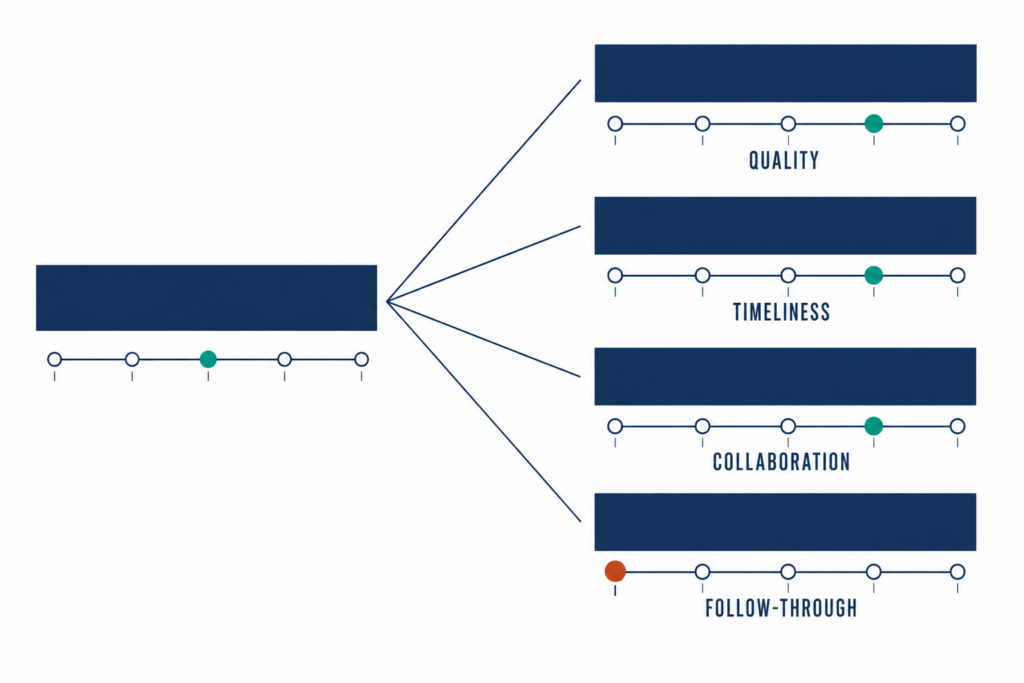
“Communication” is not a skill. It is a category containing at least four separately trainable ones.
Expectation setting, feedback, difficult conversations, and written clarity are four different capabilities. A manager can be strong at three and catastrophic at the fourth. Telling that manager to “improve your communication” gives them no information about which one.
The practical consequence lands in competency framework design. A framework with communication as a single rated line item cannot produce a usable development plan, because the rating averages a strength and a failure into a three. You cannot assess a construct. You can only assess a behaviour.
The old way
- Rate communication one to five on the annual form
- Average a strength and a failure into a middling score
- Send everyone rated below three to the same workshop
The Lab Way
- Split communication into four separately rated behaviours
- Attach the detection signal from each skill above to each one
- Build the development plan against the specific failing behaviour
The second claim is subtler and more damaging. Five years of workplace wellbeing content has quietly loaded clinical expectations onto managers who have no training, no supervision, and no boundary.
Where the line sits:
⚠ WATCH OUT
A manager’s job is to notice a change, have one honest conversation, and route the person to professional support. It is not to assess a health condition, counsel, or carry the situation personally. Managers are not qualified to do the second thing and should never be asked to.
Publish the routes before anyone needs them, so the manager knows exactly where the handoff goes. The second-order harm of getting this wrong is that managers who absorb the role burn out at higher rates, and the organisation then loses the manager as well as failing the employee.
None of this is indifference to employee wellbeing. It is the opposite. Scope and routing are what make support reliable, and a manager improvising outside their competence is not support.
The third claim is the one people argue with most. The most-liked manager and the most effective manager are not reliably the same person.
Engagement surveys asking about satisfaction with one’s manager conflate the two, which is why a manager can post excellent scores while their team has not produced a promotion in three years. Likeability is an unreliable proxy for effectiveness. It is not a negative signal, and it is not evidence of anything on its own.
◆ FROM THE LAB
The Sofia lens: look at development outcomes instead of sentiment. Promotion rate out of the team, internal mobility into other parts of the business, and the split between regrettable and non-regrettable attrition tell you more in one afternoon than a year of survey data.
When 23% of our hires came from internal moves under the First Look policy, that number was doing double duty. It was a sourcing metric, and it was a manager quality signal, because those moves only happen when managers release good people instead of hoarding them.
A healthy manager is a net exporter of talent into the rest of the business.
A manager whose people leave for better roles elsewhere in the organisation is succeeding, and any attrition analysis that treats those exits as losses will tell you the opposite. A manager whose people stay comfortably and never progress may not be succeeding at all.
People Management Skills For New vs. Experienced Managers
Every list on this topic is flat, as though a first-time manager and a fifteen-year manager should build the same things in the same order. They should not. The eight skills have dependencies, and ignoring them is why new manager onboarding programmes produce so little.
The First 90 days: Which Three Skills Come First
A new manager cannot build eight skills at once and should not try. Three come first, and the order is not a preference.
1
Setting expectations
Everything else depends on a shared standard. Feedback without an agreed standard is opinion, and conflict resolution without one is arbitration against a rule nobody wrote down.
2
Continuous feedback
Second because it prevents the debt that makes month six unmanageable. A new manager who says nothing for a quarter inherits a backlog of unsaid things that then has to be delivered all at once.
3
Delegating with real authority
Third because a new manager’s instinct is to keep doing the work they were promoted for. Left unaddressed for two quarters, that instinct hardens into a permanent bottleneck.
◆ PRO TIP
Defer coaching, conflict resolution, signal reading, recognition design, and workload protection to months four through twelve. Deferring is not dropping. Put a date on each one.
The honest reason: those five require standing a new manager does not have yet. Structured ramp beats comprehensive ramp, which is the same reason an internal hire reaches full productivity in 28 days while an external one takes 67. Sequence against dependency, not against the wish list.
The Mid-Career Plateau: What Stops Improving on its own
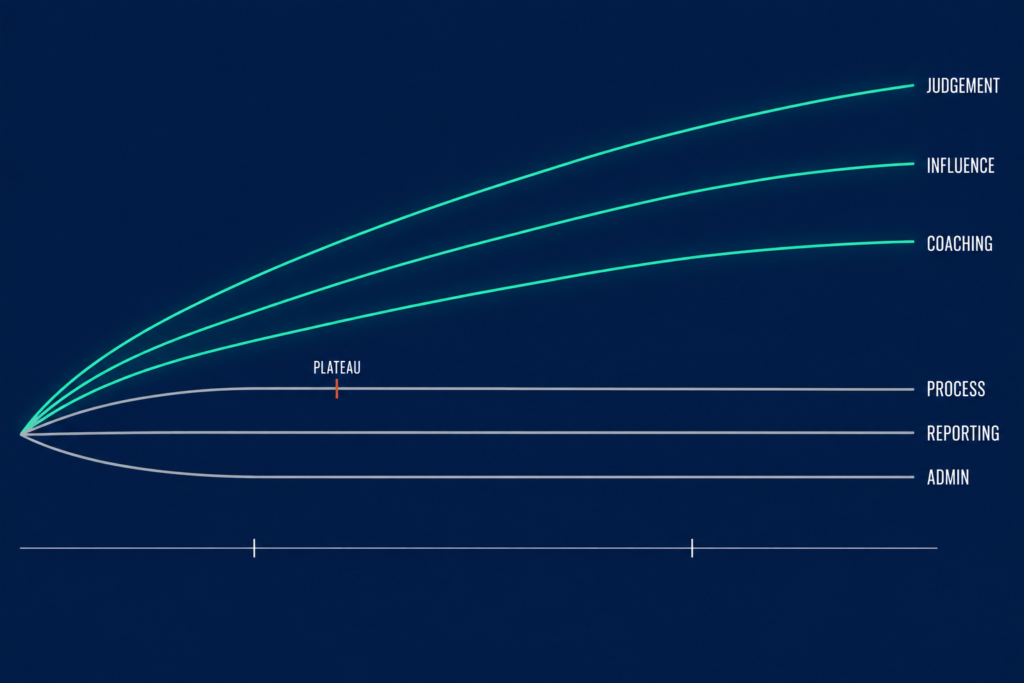
Three of the eight skills improve with repetition alone. Expectation setting, feedback, and delegation get better simply by being done, because the consequences of doing them badly arrive quickly and visibly.
Three do not. Coaching, conflict resolution, and signal reading plateau early and stay there, sometimes for a decade.
Why this happens:
Nobody tells a fifteen-year manager that their one-to-ones have quietly become status meetings. The role structurally withholds corrective feedback on exactly the skills that need it most, and seniority makes the silence worse rather than better.
The old way
- Send tenured managers to advanced leadership development
- Treat the plateau as a knowledge gap
- Measure completion, not behaviour change
The Lab Way
- Give them a feedback source: peer observation, skip-level input, or a coach
- Treat the plateau as a feedback problem, because that is what it is
- Report on two named behaviours, on a fixed cadence
External reference points beat internal effort. Our Quality of Hire improved by 12% after we analysed how competitors were hiring, and by a further 14% after mapping the wider talent market. Neither gain came from working harder inside our own process. Manager development obeys the same rule.
⚠ WATCH OUT
Common mistake: reading tenure as capability. A manager with fifteen years of experience may have fifteen years of practice at three of these skills and almost none at the other five, and their track record will not reveal which.
All of which raises the question the entire ranking page set avoids. Sixteen articles tell you which skills matter. Not one tells you how to work out whether a specific manager has them.
How to Assess People Management Skills
Assessment is where manager development usually falls apart. Most HRBPs walk into a development conversation carrying an engagement score and an anecdote, which is not enough to change anyone’s behaviour.
Here’s the instrument:
One question per skill, collected from the detection signals above. Two things make this usable that competitor advice never supplies: who answers each question, and what a failing answer sounds like when you hear it.

| Skill | The question (and who answers) | What a red flag sounds like |
|---|---|---|
| Setting expectations | What is this team’s top priority this quarter? (Two reports, separately) | Two different answers, both delivered confidently |
| Delegating | Which decisions can you make without checking? (Reports) | “I usually just run things past her first” |
| Coaching | What did you decide in your last one-to-one? (Reports) | A description of what they reported, not what they decided |
| Feedback | When did you last hear something specific about your work? (Reports) | Anything longer ago than a month, or “at my review” |
| Conflict resolution | How long does a disagreement take to reach you? (Manager, checked against reports) | “We don’t really have conflict on this team” |
| Reading signals | What has visibly changed for each of your reports recently? (Manager) | Hesitation, or an answer covering only the two most visible people |
| Recognition | Who has been recognised in the last two quarters? (System data) | The same three names, all in visible roles |
| Protecting the workload | What did your team stop doing this quarter? (Manager) | No answer, or a list of things that were added |
⚠ WATCH OUT
This is a development instrument, not a performance rating. The moment it feeds a rating, the honesty it depends on disappears and you are left with a survey nobody answers truthfully.
Run it quarterly, decoupled from calibration. On 360s specifically: they work in larger teams with reasonable trust, and they collect politics in small or low-trust ones. Below about six reports you are gathering noise and calling it data.
I built structured interview scorecards for the same reason across a campaign of 420 hires. Structured beat intuitive at that volume, and it beats intuitive at eight managers. The instrument is what removes the assessor’s mood from the assessment.
Then there is the quantitative half, which is the part that speaks a language the business already accepts. Four signals, each with its confound named, because a metric list without confounds is how an HRBP ends up defending a wrong conclusion in a talent review.
| Metric | What it reveals | The confound |
|---|---|---|
| Regrettable attrition by manager | The strongest single signal of people management capability | Useless unless non-regrettable exits are stripped out first, and it must be normalised for team size and tenure |
| Internal mobility out of the team | Whether the manager develops and releases people | Most organisations read this backwards and treat it as a retention failure |
| Time-to-Productivity for new joiners | Directly measures expectation setting | Role complexity varies; compare like roles or the number means nothing |
| Spread of performance ratings across two cycles | No spread usually means no differentiation, which means no real feedback | Small teams produce small spreads legitimately; needs two cycles minimum |
◆ FROM THE LAB
The Sofia test: healthy numbers are worth seeing, so here are mine. Best 12-month cohort retention of 89%. Internal hire rate of 23%. Time-to-Productivity of 28 days internal against 67 external. Offer acceptance at a high-water mark of 90%.
Those are hiring numbers rather than manager numbers, and the point is the shape rather than the value. Each one has a before, an after, and an intervention in between. Manager capability metrics should look the same, and if yours have no before, you are not measuring, you are reporting.
◆ PRO TIP
Real talk: none of these four metrics read reliably below about eight reports. One resignation on a team of five moves regrettable attrition by 20 points and tells you nothing about the manager.
One compliance note. Manager-level metrics used to inform employment decisions may require consultation or disclosure depending on jurisdiction, and works councils in several European markets will want sight of the methodology before it runs.
A diagnostic without a build plan is just a more precise complaint. The next section is the sequence.
How to Build People Management Skills: The 90-day Blueprint
Most articles on this topic close with four bullets: take a course, ask for feedback, listen more, be patient. Here is the version that produces a measurable delta instead.
Here’s the build:
1
Step 1: Run the diagnostic (Week 1)
Run the eight questions and pull the four metrics for this specific manager. The output is a ranked list of their two weakest skills, which is the only thing that should drive what you buy next. Do not skip to training, because a development plan built on assumption is why most manager programmes produce nothing you can point at during the next talent review.
21% to 28%
Lower turnover among managers who receive coaching-focused development, alongside 10% to 22% higher engagement in the managers themselves and 8% to 18% higher engagement across their teams. The intervention studied is coaching-focused development with follow-through, not a one-off workshop.
Source: Gallup, Manager Development Strategy: A Practical Guide
Translation: the turnover figure is the line that survives contact with a CFO. It is also the reason the remaining five steps are worth the operational friction they cause.
2
Step 2: Fix capacity before capability (Weeks 1 to 2)
Audit the manager’s calendar against the benchmark from earlier: under 30% of time on people leadership means something has to come out before anything goes in. The three likeliest candidates are status meetings that could be written updates, approvals that belong one level down, and reporting nobody reads. Name what is being removed and who absorbs it, because workflow optimisation that nobody owns quietly reverses within a month.
⚠ WATCH OUT
Skipping this step is the single most common reason manager training fails to change behaviour. Development layered onto an unchanged workload is theatre with a completion certificate attached.
3
Step 3: Pick two skills, not eight (Week 2)
Take the two weakest skills from Step 1 and defer the rest explicitly, with a date attached to each. Two is the maximum anyone can deliberately practise while also doing the job. One rule overrides severity: if expectation setting is on the list, it goes first, because the other seven depend on it.
4
Step 4: Change a structure, not an intention (Weeks 3 to 4)
For each selected skill, change something structural. Expectation setting becomes a written accountability artifact per report. Coaching becomes a separate fortnightly meeting in a different slot from status. Feedback becomes a 72-hour rule with a visible tracker, and the process design work here is what carries the result.
Structures survive a busy week. Intentions do not.
◆ FROM THE LAB
Real implementation: the hardest delivery pressure I have worked under was a bulk hiring ramp-up. Around 350 to 500 hires across customer support, operations analysts, junior engineers, and sales support, with a business start date that was not moving and interviewer capacity that could not stretch.
The obvious move would have been to ask everyone to work harder. We did the opposite. Weekly targets were mapped backward from the business date, recruiter bandwidth and interviewer availability were forecast rather than assumed, and the process was rebuilt around structure: standardised pre-assessment criteria, batch interviews, structured scorecards, daily stand-ups, and a real-time tracker everyone could see.
Governance ran on cadence too. Weekly war-room calls with hiring managers, SLA-based vendor tracking, a single point of contact per candidate batch, and accelerated offer releases to cut drop-outs.
We delivered 420 hires in 10 weeks. Turnaround Time fell from 32 days to somewhere between 18 and 20, the offer-to-join ratio held above 90%, 90-day retention landed at 85% to 88%, and recruiter productivity improved by about 35%.
Not one of those gains came from effort. They came from changes to how the work was organised, and they held at maximum pressure, which is the whole argument for building manager capability through structure rather than willpower. Willpower is the first thing a hard quarter takes.
5
Step 5: Install a feedback source (Weeks 4 to 8)
The manager needs someone who will tell them the truth about the two chosen skills: a peer observer sitting in on a one-to-one, a skip-level conversation with two reports, or a coach. Fortnightly for the first eight weeks, monthly after that, reporting on those two named behaviours and nothing else. Without this, the manager is practising without knowing whether they are practising correctly, which is how a coaching culture stalls at the intention stage.
◆ PRO TIP
The honest downside: this is the step organisations cut first, because it costs time from someone senior and produces nothing visible in month one. It is also the step carrying the result. A programme that keeps Steps 1 through 4 and drops Step 5 will report high satisfaction and change almost nothing.
6
Step 6: Re-run the diagnostic (Day 90)
Re-run the eight questions and pull the four metrics again. Document the delta, select the next two skills, and schedule the next cycle before this one closes. Every initiative in my own record has a measured before and after, from Time-to-Offer at 68 days down to 34, to Turnaround Time at 32 days down to 18, and HR metrics without a baseline are decoration.
⚠ WATCH OUT
Expect movement on the qualitative signals within 90 days and on the metrics within two to three quarters. Regrettable attrition and internal mobility are lagging indicators, and reading them at day 90 produces a false negative.
That false negative is how good programmes get cancelled one quarter before they would have shown a return. Agree the measurement window with your sponsor in week one, in writing.
People Management Skills in the AI Era
The most significant change to the manager’s job in twenty years is happening right now, and almost every article ranking for this term was last updated before it started. Two positions dominate the conversation. AI will replace managers, or AI changes nothing. Both are wrong.
Here’s the split:
Genuinely assisted by AI
- Status aggregation and meeting summarisation
- Drafting written expectations and accountability artifacts
- Surfacing workload signals from calendar and activity data
- Preparing feedback notes from observed events
Irreducibly human
- Conflict resolution, particularly the classification step
- Judgement calls under genuine ambiguity
- Deciding what the team stops doing, and carrying that cost
- Any conversation where the person needs to believe the manager means it
Notice what that split does. AI is dissolving the administrative quarter of the manager’s week, which is precisely the capacity Step 2 of the blueprint was fighting to recover.

◆ FROM THE LAB
My experience: I led AI and prompt engineering work inside a recruitment function, and the shift I watched was not automation replacing people. It was the work splitting into two piles.
Screening tools became sourcing co-pilots running semantic search across the database. Interview orchestration moved past scheduling into managing the lifecycle. Skills-first assessment cut a measurable amount of unconscious bias out of shortlisting, and predictive models started flagging not just who to hire but who was likely to leave.
I want to be honest about what goes wrong, because the risks are real and mostly unreported. There is an automation arms race, where dependency grows faster than judgement. There is the loss of personal contact that made the function work. And there is algorithmic bias, where flawed training data reinforces exactly the historical prejudices the technology was sold as fixing.
My rule throughout was that AI is a co-pilot and not a decision-maker, with human validation at every decision point. If you are running predictive retention analytics on employee data, establish your lawful basis for processing before you build the model, not after legal asks.
AI does not replace managers. It replaces the parts of the job that stopped managers from being effective in the first place.
The open question is what happens to the capacity that gets released. It can flow into people work, or the span can simply widen again and absorb it. That is an organisational decision, and treating it as a technology outcome is how organisations sleepwalk into the second option.
Hierarchies are flattening. AI in HR is accelerating that, and workforce planning conversations in most organisations now include some version of removing a management layer. Whatever the eventual scale of that, the operative question for a manager changes shape entirely.
Here’s the difference:
Span of control asks how many people a manager can supervise. Span of value asks how much a manager adds per person. The second question is the one worth answering, and it has an uncomfortable implication most org design advice avoids.
◆ PRO TIP
The honest downside: at fourteen reports a manager cannot coach everyone, and pretending the fortnightly-one-to-one-for-everyone model survives is how the entire cadence collapses instead of just part of it.
Structure covers the baseline for the whole team. Deliberate coaching depth goes to the two or three people at a genuine inflection point. Someone gets less of the manager, and the manager should say that out loud rather than let people work it out from the calendar.
The distribution logic is the same one that runs through my referral data. Between 5% and 10% of employees generated 60% to 70% of successful referrals, and treating the population as uniform wasted most of the effort. Uniform effort against non-uniform opportunity is how capacity gets burned.
The Business Case: What Manager Capability is worth
None of the sixteen articles ranking for this term put a number on any of it. That omission is why manager development loses budget conversations to things with a spreadsheet attached.
Here’s the model:
Take a team of twelve. Compare a manager at the median with one in the bottom quartile across three lines your finance function already tracks, using my real figures as the inputs. Substitute your own where they differ.
| Line item | Median manager | Bottom-quartile manager | Annual delta |
|---|---|---|---|
| Regrettable exits per year | 1 | 3 | 2 additional exits |
| Replacement cost at 7 lakh rupees (approx. USD 8,400) per senior hire | 7 lakh (approx. USD 8,400) | 21 lakh (approx. USD 25,300) | 14 lakh (approx. USD 16,900) |
| Vacancy cost at $500 per day, 60-day time-to-fill | $30,000 | $90,000 | $60,000 |
| Productivity drag: 39 extra days to full productivity per external replacement, at half output | approx. $9,750 | approx. $29,250 | approx. $19,500 |
~$96,000
The annual delta between a median manager and a bottom-quartile manager on a single team of twelve, or roughly 80 lakh rupees. Multiply by the number of managers in the bottom quartile of your own organisation.
◆ FROM THE LAB
The Sofia lens: those inputs are not benchmarks I read somewhere. Cost per hire for a senior engineering role ran between 6.5 and 7.5 lakh rupees (roughly USD 7,800 to 9,000) before we rebuilt the process, and between 3 and 3.8 lakh after. Time-to-fill went from 70 to 80 days down to 45 to 50.
Agency fees ran at 18% to 22% of CTC, which is 8 to 10 lakh rupees (approximately USD 9,500 to 12,000) on a single senior hire. The $500 per day operational drain on an unfilled senior engineering role is the figure I have used in every business case I have written.
Swap in your own cost per hire, your own time-to-fill, and your own ramp curve. The model holds. What matters is that three of the four lines already exist in your finance system, which means nobody has to accept a new metric to accept the argument.
Then there is the objection you will meet in the room. Most HR leaders have funded manager training before and watched nothing move, which makes them a difficult audience for a manager enablement pitch, and reasonably so.
⚠ WATCH OUT
Manager development underperforms for three reasons, all of them structural. No diagnosis, so the training addresses a gap nobody confirmed. No capacity created, so there is no room to practise. No feedback source, so the manager never learns whether the practice is correct.
Steps 1, 2, and 5. They are the three most commonly cut and the three that carry the outcome. Failed manager development is a systems failure, not a motivation failure, exactly as retention usually is.
The old way
- A two-day manager workshop for everyone
- A completion certificate
- No measurement, and no way to defend next year’s budget
The Lab Way
- Diagnose, create capacity, then pick two skills
- Change a structure and install a feedback source
- Re-measure at day 90 with the next cycle already booked
Be precise when you present the evidence. The Gallup research showing lower turnover and higher engagement studied coaching-focused development with follow-through, not a workshop. Overstating it in an argument about rigour costs more than it gains.
If you want the frameworks, cost models, and diagnostics from the Lab as they get built, the newsletter is where they land first. It goes to HR practitioners who would rather have a working instrument than another list.
Four Anti-Patterns to Retire
Four practices that appear in most manager training and underperform in every organisation we have seen run them. Each one has a replacement, named in the same breath.
⚠ WATCH OUT
The open-door policy. It sounds generous and it offloads the entire cost of raising a problem onto the person with the least power in the room. Replace it with a scheduled channel the manager owns: a standing fortnightly slot nobody has to request.
⚠ WATCH OUT
The feedback sandwich. Discredited, and still sitting in most of the articles ranking for this topic. It teaches people to hear praise as packaging. Replace it with behaviour, effect, and a specific request, delivered separately from any positive feedback.
⚠ WATCH OUT
Skip-levels used as surveillance. They are genuinely useful and they collapse the moment they become a check on the manager rather than a channel to the team. State the purpose before the first one, and never carry anything back down as unattributed criticism.
⚠ WATCH OUT
Treating tenure as capability. The most expensive assumption on this page. Fifteen years in the job can mean fifteen years of practice at three skills and none at the other five. Assess, do not assume.
Frequently Asked Questions
What are the most important people management skills?
Setting expectations, because every other skill depends on a shared standard. The full eight are setting expectations, delegating with real authority, coaching conversations, continuous feedback, conflict resolution, reading signals, recognition that registers, and protecting the workload. Which two matter most for a given manager depends entirely on what their diagnostic shows, not on the order of any published list.
What is the difference between people management and leadership?
People management is operational: the daily mechanics of delivering work through a team. Leadership is directional: setting a destination and creating the will to reach it. A person can be strong at one and weak at the other, and the development interventions are completely different. Buying leadership training for a people management gap is the most common and most expensive version of this mistake.
How do you improve people management skills?
Diagnose the specific gap, create the capacity to practise, pick two skills rather than eight, change a structure rather than an intention, install a feedback source, and re-measure at day 90. The full sequence with timings sits in the 90-day blueprint above. Skipping the diagnosis is why generic training produces no measurable change.
How long does it take to improve people management skills?
Qualitative signals move within 90 days. Outcome metrics such as regrettable attrition and internal mobility lag by two to three quarters, because they measure decisions people made months earlier. Reading those lagging metrics at day 90 produces a false negative, and that false negative is how good programmes get cancelled one quarter before they would have shown a return.
How do you assess whether a manager has good people management skills?
Use eight behavioural questions with defined respondents, then four outcome metrics: regrettable attrition by manager, internal mobility out of the team, Time-to-Productivity for new joiners, and the spread of performance ratings across two cycles. Each metric has a confound that must be named before you read it. Treat the whole thing as a development instrument, never as a rating tool.
Where This Leaves You
One number is worth carrying out of this. Manager engagement sits at 22% globally, and inside organisations that do manager development properly it sits at 79%.
Source: Gallup, State of the Global Workplace 2026
That gap is not a talent gap. Those organisations are not recruiting from a different species of human being.
The organisations getting this right do not have better people. They stopped treating people management as a personality and started treating it as a system, with a diagnostic, a build sequence, and a number attached to the cost of getting it wrong.
What separates them from everyone else comes down to two habits. They run the diagnostic before they buy the training. And they take work off a manager’s plate before they add development onto it.
So pick two skills. Not eight. One from the three that improve with repetition, one from the three that never improve without an outside voice. Change a structure for each, install someone who will tell the manager the truth, and re-run the eight questions on day 90.
Then do it again with the next two. That is the whole method, and it works because it is boring enough to survive a bad quarter.
If you are rebuilding manager capability in your own organisation, I would like to hear what is holding and what is not. Connect with me on LinkedIn and tell me which of the eight your managers are weakest on. I read every one of those messages, and the patterns across them tend to end up in the newsletter.
