
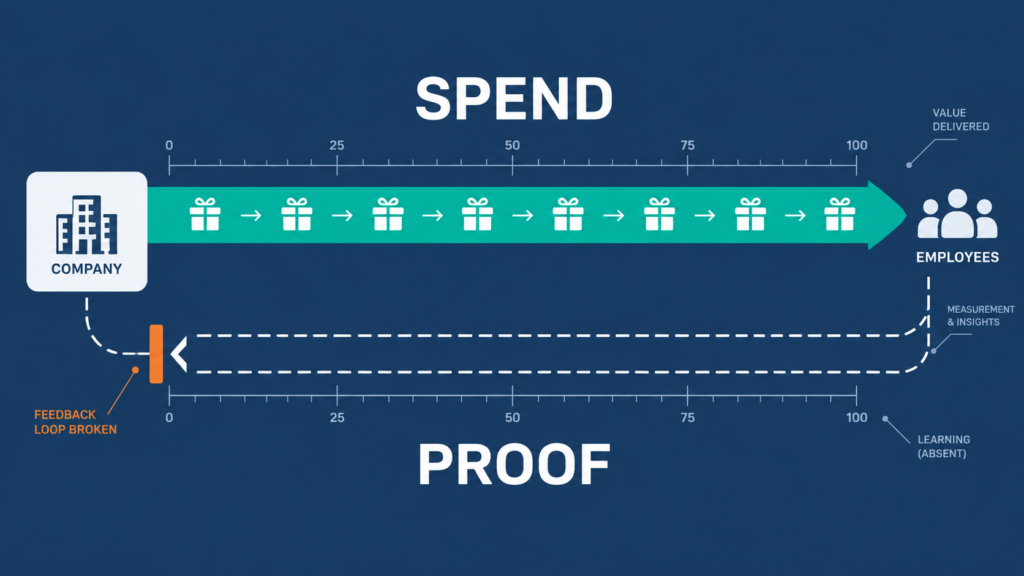
I have sat through 8 years of budget reviews where the employee gifting line was renewed without anyone asking what it returned.
The spend is real. Branded water bottles that go straight into a drawer, a gift card that arrived as a deduction on a paycheck and irritated the person who received it, a holiday hamper delivered to the home address of someone who resigned in March. Every one of those came out of a funded budget line.
Nobody in the room can say what any of it bought.
Most organisations treat employee gifting as a morale expense. It is not. It is an unaudited recognition channel, and those two things carry completely different risks.
Two of those risks have a price attached. Gift cards are never tax-free at any amount, which means a team that assumed otherwise has been under-reporting wages. And recognition that lands cuts two-year turnover by 45%, while replacing a technical employee costs roughly 80% of their salary, so a gifting programme that quietly fails is not a neutral outcome.
22%
of employees say they get the right amount of recognition.
Source: Gallup, Employee Retention Depends on Getting Recognition Right, 2024
Translation: roughly four in five of the people you are buying gifts for do not feel adequately recognised. The money is moving. The perception is not.
Here’s what this guide contains:
- The working line between gifting, recognition, incentives, and compensation
- A moments map that tells you which occasions to fund, which to delegate, and which to skip
- A three-pool budget architecture you can defend to finance
- The US federal tax rules in plain language, including the $400 and $1,600 achievement award limits
- An honest read on experiences against physical gifts, including who they exclude
- Four measurement signals and a stated kill criterion
HR Insights Lab approach: This guide treats gifting as a system with an owner, a budget logic, a tax treatment, and a reporting line. Not as a catalogue of ideas. Every framework here has been pressure-tested against the operational reality of running people programmes at enterprise scale.
What is Employee Gifting? (And How it Differs From Recognition and Compensation)
Employee gifting is the practice of giving employees non-contractual items, experiences, or cash-equivalents to mark an occasion or acknowledge work, funded from a people or department budget rather than through payroll. It is company- or manager-initiated and tied to a moment, not to contractual terms. It is also the most common and least measured form of recognition in US organisations.
That definition is deliberately operational. You can put it in a policy document, a budget memo, or a procurement brief without it sounding soft. Definitions that cannot be operationalised are decoration.
Here’s the difference:
Employee gifting vs. recognition vs. incentive vs. compensation
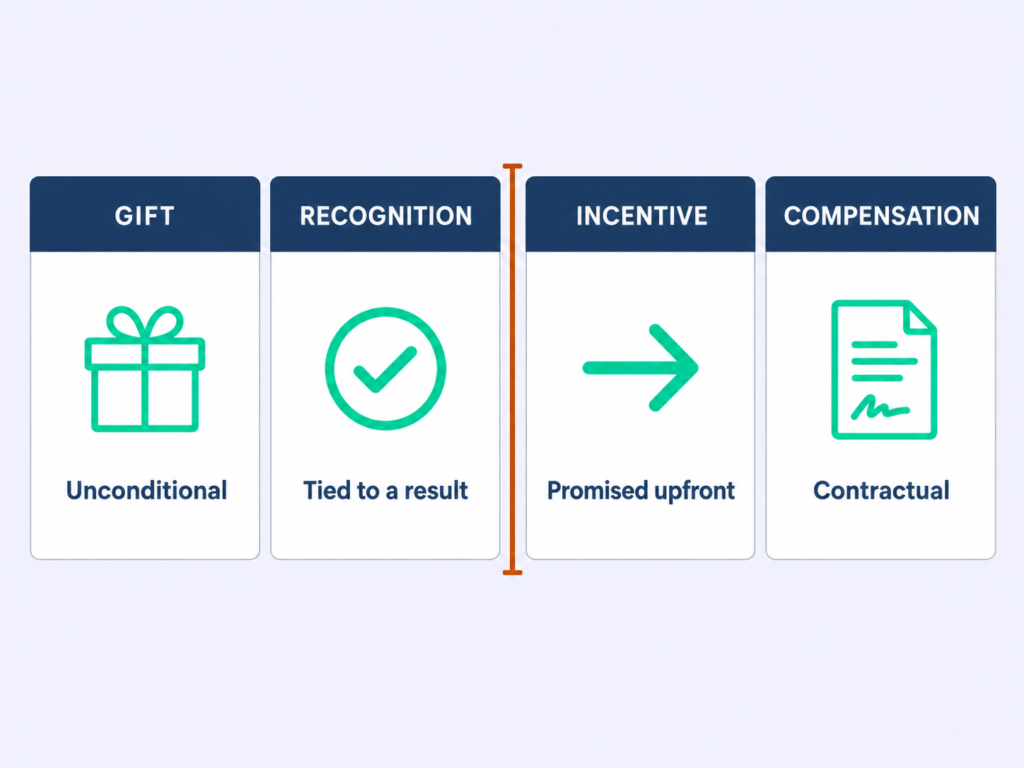
Four things get conflated in budget conversations, and they behave differently. A gift is unconditional and relational. Recognition is tied to a named behaviour or a named result.
An incentive is promised in advance to change behaviour. Compensation is contractual and it is the only one of the four the employee can plan their life around.
The distinction is not academic. The moment a gift is asked to do compensation’s job, employees price it, and the arithmetic never favours you.
A $75 hamper sent in the same quarter a merit increase was skipped is not a $75 gift. It is a $75 insult.
The four forms an employee gift can take
Tangible: physical goods, merchandise, hampers, hardware. Experiential: events, activities, travel, subscriptions, learning. Cash-equivalent: gift cards, prepaid cards, points, catalogue credits. Time: extra paid leave, a half-day, a recharge day.
These four are worth separating because each carries a different tax treatment, a different logistics burden, and a different perceived value in the hands of the recipient. Classify first. The rest of this guide runs on that classification, and a well-run employee recognition programme uses all four deliberately rather than defaulting to whichever one the incumbent vendor sells.
The compensation-substitution trap
The most expensive mistake in employee gifting is not overspending. It is deploying a gift into a moment that called for money, a title, or a decision.
⚠ WATCH OUT
Common mistake: sending a gift in the same quarter a merit cycle was skipped. Sending one to a team that has just absorbed a departed colleague’s workload with no backfill approved. Sending a tenure award to someone whose promotion case has been deferred twice.
In all three, the gift does not land as neutral. It lands as an answer to a question the employee already asked about pay or progression, and the answer reads as no.
The Sofia test:
If the employee could reasonably read this gift as a response to a compensation or career request, I do not send it. I answer the request instead, or I say plainly that I cannot.
Withholding a gift is a legitimate programme decision. It is also the one most gifting owners have never been told they are allowed to make, which is why the same mistake shows up in every employee retention strategy post-mortem I have read.
Why Most Employee Gifting Programmes Fail

Every article on this topic writes the benefits case. Almost none write the failure case, which is the more useful document, because a gifting programme rarely dies from one bad decision. It dies from one of five repeatable failure modes.
The old way
- Choose a vendor
- Choose a catalogue
- Ship on the calendar dates
- Report spend against budget
- Renew next year at the same number
The Lab Way
- Name the owner and the approver
- Design against the five known failure modes
- Set the tax treatment before the gift form
- Instrument it before the first gift ships
- Report signals, not activity
Procurement gets you delivery. Systems design gets you effect.
Here’s the deal:
Failure mode one, generic at scale. One gift for 4,000 people is a logistics decision wearing a recognition costume, and employees read it correctly within about four seconds of opening the box.
Failure mode two, the tax surprise. A $100 gift card arrives, payroll grosses it into wages, and the employee nets less than expected on the next run. They remember the deduction, not the gift.
⚠ WATCH OUT
Warning: this is the only failure mode on the list that carries legal exposure rather than reputational cost. If your team has been issuing gift cards on the assumption that small amounts are tax-free, the problem is not that the gesture underperformed. It is that wages have been under-reported. The rules are in the tax section below and they are not ambiguous.
Failure mode three, manager non-adoption. A discretionary budget exists, managers never spend it, and the unspent pool gets read upward as proof that employees did not want recognition in the first place.
Failure mode four, inequity across teams. One director spends the full allowance and another spends nothing, and the delta becomes visible at the coffee machine long before it becomes visible in a report.
Failure mode five, no baseline. Nobody measured anything before launch, so the programme can never be defended and can never be honestly killed. It just persists.
Each of the five has a fix later in this guide. Generic at scale is answered by the moments map and the choice-versus-curation section. The tax surprise is answered by the tax section. Manager non-adoption and inequity are answered by the budget architecture and the operating model. No baseline is answered by the measurement section, and it is the one you have to fix first because it cannot be reconstructed afterwards.
Why this works:
There is a pattern underneath all five, and I first ran into it somewhere else entirely. When I rebuilt a referral programme earlier in my career, the data said something uncomfortable about even distribution: between 5% and 10% of employees generated 60% to 70% of every successful referral. The programme had been designed for everyone and was being carried by almost nobody.
Gifting programmes are built the same way and break the same way. They optimise for the optics of fairness rather than for effect, which produces a gift that is defensible to everyone and meaningful to no one. That is a design choice, not an accident, and it is worth checking against your own employee engagement survey data before the next cycle is funded.
The object is doing almost none of the work here. Being known is what employees are responding to, and the object is only the delivery mechanism. The research is blunt about the gap: only 13% of workers cite tangible rewards as their core motivation at work, and just 33% strongly believe their managers understand what motivates them.
Source: Deloitte, 2025 Global Human Capital Trends, What moves your people? Tapping into motivation
Translation: the thing in the box is close to irrelevant, and two-thirds of your managers are guessing about what would land. Buying a better object does not fix either half of that sentence.
The Business Case: What Employee Gifting Moves (and What it Doesn’t)
You will eventually have to defend this line item in a room where nobody is sentimental about it. The defence that survives is short, mechanical, and honest about its own limits.
Why this works:
Three claims hold up under a follow-up question, and each one holds up because it has a mechanism rather than a correlation behind it.
The first is retention among recognised employees. The mechanism is specific: a well-executed gift is a recognition event, a recognition event registers as being seen, and being seen lowers job-search intent before it becomes a resignation conversation.
The second is perceived fairness of the people function. A gifting programme with visible, consistent rules is one of the very few HR artefacts that every employee experiences directly, which makes it a proxy for whether the function is competent.
The third is moment completion. Gifting reliably marks the transitions that otherwise pass unacknowledged, and unmarked transitions are where attachment leaks quietly and cheaply.
The evidence supports the first claim at scale. Well-recognised employees are 45% less likely to have turned over after two years, and employees receiving high-quality recognition are 65% less likely to be actively looking for another job. Replacing them costs roughly 40% of salary for frontline workers, 80% for technical roles, and up to 200% for leaders and managers.
Source: Gallup, Employee Retention Depends on Getting Recognition Right, 2024
Read that precisely, because the precision is what protects you in the meeting. The evidence supports recognition quality, not gift spend. A gift is one delivery mechanism for recognition, and claiming the 45% as a return on your gifting budget will get you correctly challenged by anyone who reads the source.
◆ FROM THE LAB
My experience: the comparison frame I use in budget conversations is the one I already had to build for hiring. An unfilled senior engineering role drains roughly $500 a day in lost productivity, so a 60-day vacancy costs about $30,000 before anyone has paid an agency fee.
An entire annual gifting envelope for a large team usually sits below that number. I am not claiming the gifts prevent the exit. I am pointing out that the spend being questioned is a rounding error against the event it is hedging, and that finance understands hedges far better than it understands morale.
The other figure I bring is my own benchmark rather than a published one: the best 12-month retention I have held for a single cohort is 89%. That is the kind of number a recognition programme should be measured against, and it is the same discipline I apply to cost per hire.
What gifting does not fix
Four things will not move regardless of how well the programme is run: a pay problem, a bad manager, an unclear career path, and burnout caused by the operating model.
This matters practically, not philosophically. When gifting is deployed against any of the four, it fails, and the post-mortem blames the gifting programme rather than the cause. The budget gets cut and the actual problem survives untouched.
◆ PRO TIP
Real talk: here is the sentence to use when leadership responds to a weak engagement survey by asking for a recognition push. “If engagement is down and pay, manager capability, career pathing, and workload are unresolved, the gifting budget is not the intervention.” Say it once, name which of the four you think it is, and offer to work on that instead.
That answer gets you into the diagnosis rather than the delivery, which is a materially better place to be sitting.
My position on retention has been consistent for years and it applies directly here. Retention problems are mostly systems failures, not compensation failures, and the fixes are unglamorous: manager capability, visible skill progression, role design that matches how work happens, and easy internal mobility.
The inverse is equally true and less often said. If a raise cannot patch a systems failure, a gift certainly cannot.
The Employee Gifting Moments Map: Which Occasions Earn a Gift
Most gifting programmes run on a calendar. A calendar tells you when to spend. It does not tell you when not to, which is the more expensive half of the decision.
The old way
- Inherit last year’s date list
- Fund the holiday gift and the tenure catalogue
- Add a moment whenever someone complains
- Apply the same gift form to every occasion
The Lab Way
- Name an initiator and a funding source per moment
- Match the gift form to the moment, not the vendor
- Write an explicit skip condition for every row
- Fund the moments with downstream value, not the loudest ones
How to execute:
Build the map as a decision table before you build a calendar. Four columns are enough, and the fourth is the one that does the work.
| Moment | Who initiates | Funding source | Gift form that fits | Skip if |
|---|---|---|---|---|
| Pre-boarding and first day | Company | Central pool | Tangible or time | Start date is not confirmed in writing |
| Work anniversaries and service milestones | Company | Central pool | Tangible, within award limits | You cannot apply the same rule to every tenure band |
| Performance and project wins | Manager | Manager discretionary | Experiential or cash-equivalent | The result is not named and dated in the message |
| Promotions and internal moves | Manager | Manager discretionary | Experiential or time | The move is lateral and unwanted |
| Birthdays | Company | Central pool | Low-value tangible | You cannot execute it consistently for everyone |
| Life events outside work | Manager or HRBP | Programme reserve | Tangible or time | The employee did not volunteer the information |
| Exits and alumni | Manager | Programme reserve | Tangible, work-specific | The exit is performance-managed |
The skip conditions are the asset. They are also the column every organisation leaves blank, which is why gifting programmes accumulate moments and never shed any.
- Skip the birthday programme entirely if you cannot run it for every employee, every year, without exception. An inconsistently applied birthday programme is worse than no birthday programme.
- Skip the performance gift if the message cannot name the specific result. A gift attached to a generic thank-you is a gift attached to nothing.
- Skip the life-event gift if the information reached you through anyone other than the employee.
Pre-boarding and first day

The highest-leverage moment on the map, and the one most often missed, because it happens before the person exists in any HR system. The window between a signed offer and a first login is where offer-to-join drop-off occurs. A tangible item that arrives at home before day one, or a confirmed half-day of onboarding breathing room, both work. What ruins it is arriving after the start date, which converts a welcome into an administrative artefact. Your employee onboarding checklist should own this moment explicitly, not the gifting vendor.
Work anniversaries and service milestones
The moment with the most specific US tax treatment attached, because length-of-service awards sit inside the employee achievement award rules with hard dollar ceilings. That makes this the one moment where the gift form has to be decided by the tax section before anything is ordered. Tangible items work; cash-equivalents defeat the entire exclusion. What ruins it is a tenure ladder nobody published, so employees compare their five-year gift to a colleague’s and find the logic missing.
Performance and project wins
Distinct from a tenure award in every operational respect: tied to a named result, time-bound, and almost always manager-initiated. This is the one moment where gifting and recognition genuinely overlap, which is why it belongs in a discretionary pool rather than a central one. Speed is the whole value. What ruins it is delay, because a gift for work that closed 11 weeks ago reads as a filing exercise rather than an acknowledgement.
Promotions and internal moves
Almost entirely absent from competitor coverage, and the only transition where the organisation keeps the person and still gets to mark a beginning. Internal movers get a title change in a system and nothing else, which is a strange way to treat the cheapest hire you will make that quarter. Experiential or time-based gifts fit best. What ruins it is marking the promotion and ignoring the lateral move, because lateral movers are the population most likely to be quietly testing whether the organisation noticed.
Birthdays
Include it, then be honest about what it is. A birthday gift is a relationship gesture, not a recognition event, and conflating the two is why birthday programmes are first in the shredder during a budget review. Keep it low-value, keep it automated, and do not ask it to carry any weight. What ruins it is inconsistency, which converts a pleasant nothing into visible evidence that some people are tracked and others are not.
Life events outside work
Marriage, a new child, a bereavement, a house move. The highest emotional return on the map and the highest risk of getting it wrong, because acting requires information the employee may not have volunteered. The rule that keeps this safe is simple: the employee tells you, or the moment does not exist. What ruins it is a manager acting on something they heard secondhand, which turns a kind gesture into evidence that personal information travels.
Exits and alumni
The moment nobody funds, and the one with the clearest downstream return. The last week of employment is when a person is most likely to be asked what it was like to work there, and the organisation has usually chosen that week to deactivate their accounts and ask for the laptop back. A work-specific tangible gift from the manager fits. What ruins it is HR sending it, which makes it feel processed.
Why the exit moment earns more than it costs:
A well-marked exit produces three assets that appear on a later budget line. A boomerang candidate who is faster and cheaper to hire than a stranger. A referral source who now has no internal politics to navigate. And a public employer-brand signal delivered at the exact moment it is most likely to be requested.
The execution rule is narrow. The manager gives it, not HR, and it references specific work rather than length of service. Tenure is what the system knows; the work is what the person will remember being seen for.
Every alumnus is a pipeline you already paid to build. Most organisations write it off on the last day.
I have watched this compound in a different context. Systematic re-engagement of silver medalist candidates, the people who came second and were told no, produced four hires over two years from a group everyone else had closed the file on. One became a team lead. Another referred three external hires who were also hired.
The principle transfers cleanly. Relationships maintained after a no generate returns on a delay, and a resignation is just another kind of no. That is a lesson from candidate re-engagement rather than gifting data, and I flag it as such.
◆ PRO TIP
The catch: none of this applies to a performance-managed exit. Marking that departure with a gift is not generous, it is confusing, and everyone who watches it happen learns that the programme is decorative. Write the exclusion into the policy so no manager has to make that judgement alone at 5pm on a Friday.
◆ FROM THE LAB
My experience: earlier in my career I was handed a ramp-up that needed somewhere between 350 and 500 hires across customer support, operations analysts, junior engineers, and sales support. The window was 8 to 12 weeks against a fixed business start date.
Everyone in the room was focused on the top of the funnel. I was worried about the bottom, because at that volume the loss does not happen at screening. It happens between offer and start date, in the three weeks nobody owns.
So we built specifically for that window. Accelerated offer releases, a single point of contact per batch, timelines sent before candidates thought to ask for them, and deliberate pre-joining engagement for every accepted offer rather than only the ones we were nervous about.
We delivered more than 420 hires in 10 weeks. Average Turnaround Time (TAT) came down from 32 days to roughly 18 to 20, the offer-to-join ratio held above 90%, and 90-day retention landed between 85% and 88%.
The transferable lesson has nothing to do with volume. Attachment is won or lost before day one, which is exactly why the first gifting moment belongs in the pre-start window and not on the desk of someone who has already arrived.
The same logic runs through internal moves, which is the other underfunded row in the table. A “First Look” internal posting policy I ran produced a 23% internal hire rate, and those internal movers reached full productivity in 28 days against 67 days for external hires. An internal move is a business event with a measurable return, not an administrative transfer, and the map should fund it like one.
How Much Should You Spend? The Employee Gifting Budget Architecture
Ask any gifting owner where their number came from and you get the same answer. It came down from finance, or it came from last year, and nobody attached a logic to it either time.
That is why the number cannot be defended when it is challenged. It also cannot be diagnosed, because a budget with no internal structure gives you no way to tell whether it is too small, badly distributed, or both.
The old way
- Hold one undifferentiated pot
- Spend it on a holiday gift and a tenure catalogue
- Top it up when someone complains loudly enough
- Treat leftover money as a saving
The Lab Way
- Split the envelope into three pools
- Give each pool an owner and a trigger
- Size the envelope against replacement cost
- Read leftover money as a management signal
Here’s how to build it:

1
The Moments Pool: Centrally funded, automated, roughly 60%
This pool covers the non-negotiable lifecycle moments from the map: pre-boarding, service milestones, and whichever universal moment your organisation has committed to. It is predictable, it is the largest share, and it must never depend on a manager remembering.
The trigger is a system event, not a human one. A confirmed start date fires the pre-boarding gift; a tenure date fires the service award. If a moment in this pool requires someone to notice, it belongs in a different pool.
The success signal is coverage. If 100% of eligible employees did not receive it, the automation is broken and that is an execution defect rather than a budget question.
2
The Manager Discretionary Pool: Per-head, rules-bound, roughly 30%
A small per-head amount managers can spend without approval, inside published rules. This pool produces the highest-quality recognition in the whole architecture, because it is specific, timely, and attached to work the manager watched happen.
It is also the pool that goes unspent without enablement. The trigger is a result landing, not a quarter ending, which means the prompt has to reach the manager in the tool they already have open.
The success signal is utilisation spread across managers, not utilisation in total. One director spending the whole pool is not a healthy number.
3
The Programme Reserve: Unallocated, roughly 10%
For the unplanned. A crisis, a surprise win, a team that absorbed something unreasonable and held it together, a life event nobody could have forecast.
The trigger is a judgement call, which is exactly why it needs a named approver and a two-line written rationale each time it is used. A reserve with no paper trail becomes a favours budget within two quarters.
The success signal here is different from the other two. If the reserve is fully spent every year, it is not a reserve, it is an under-declared fourth pool.
Publish the split internally. The reason is not transparency for its own sake: a published split is what stops the manager pool from being quietly reallocated to the holiday gift when central procurement runs over.
Set the size of the envelope by benchmarking against replacement cost for your own population, not against what competitors spend. Competitor spend tells you what other people guessed. Replacement cost tells you what the risk is worth, and it is a number your finance team already maintains.
Worked illustration, and read the label carefully: this is an illustration to calibrate against your own numbers, not a benchmark. On a $200 annual per-employee envelope, the split lands at roughly $120 in the Moments Pool, $60 in the Manager Discretionary Pool, and $20 in the Programme Reserve. Run the same three-way split against whatever envelope your own replacement-cost arithmetic supports.
⚠ WATCH OUT
Warning: unspent discretionary budget is not a saving. It is a management-enablement failure that has been misfiled as good news, and reporting it as an underspend teaches finance that the pool was never needed.
Report it as a utilisation gap with a named list of managers instead. That framing survives the meeting and gets you the pool again next year.
◆ FROM THE LAB
The Sofia lens: the only way I have ever made a people-programme envelope feel small in a finance meeting is to put it next to a hiring number, because hiring numbers are already believed.
Here is the arithmetic I use. Cost per hire for senior engineering roles in one part of my career ran at roughly $7,800 to $9,000, and a direct-sourcing and referral initiative brought it down to about $3,600 to $4,600. Agency fees alone sat at 18% to 22% of package, roughly $9,500 to $12,000 on a single senior hire, before we cut agency reliance by 60% to 70%.
The full annual gifting envelope for a large team is usually smaller than one avoided agency placement. That sentence does more work in a budget review than any engagement statistic I have ever brought into the room, and it is the same discipline I apply when defending a recruitment budget.
How to defend the number to finance
The gifting line is first out in a tight quarter, and the reason is almost never the amount. It is that the person defending it walked in with activity data and no argument.
There are four moves, in this order.
- Reframe the ask. This is not a morale line, it is a retention-cost hedge, and hedges are a category finance already funds without emotion.
- Size the risk it hedges. Use replacement cost for the specific population: roughly 40% of salary for frontline, 80% for technical, up to 200% for leaders. Now the envelope is being compared against something real.
- Concede the weak claim before finance does. Nobody can attribute a retention outcome to a single gift, and pretending otherwise loses the room permanently. Offer the defensible version instead: recognition quality is measurable, gifting is one input to it, and the programme will report on quality rather than on gift volume.
- Name the kill criteria. State in advance what result would make you cut the programme yourself.
The fourth move is the one that wins the second year of funding. Finance funds people who name their own failure conditions, because it transfers the burden of scepticism from them to you and they know it.
Bring one comparison number and one benchmark. The comparison: a senior engineering vacancy drains about $500 a day, so 60 days open costs roughly $30,000. The benchmark: the best 12-month cohort retention I have personally held is 89%, and that is the standard I would hold a recognised cohort to rather than a vendor’s average. Those two figures belong in your list of HR metrics that matter to the CFO.
◆ PRO TIP
The honest downside: there is no credible published ROI multiplier for employee gifting. None. Any calculator promising that every dollar returns some tidy figure is selling something, and quoting one in a finance meeting will cost you the credibility you need for the rest of the conversation.
Are Employee Gifts Taxable? The US Rules You Cannot Get Wrong
Under US federal rules, a gift from an employer to an employee is generally taxable wages, not a gift, unless a specific exclusion applies. Two exclusions do most of the practical work: de minimis fringe benefits for low-value, infrequent items, and employee achievement awards within stated dollar limits. Everything else is compensation.
This is general information on US federal treatment. State treatment and individual circumstances vary, so confirm anything you plan to operationalise with your own tax or payroll advisor.
The default rule: Gifts are wages
IRC section 102(c) settles the question before it starts. A transfer from an employer to an employee is treated as compensation, not as a gift, regardless of the employer’s intent or how the item was described in the announcement email.
Every other rule in this section is an exception to that one sentence. Read it that way and the section becomes simple: you are not asking whether something is a gift, you are asking which exclusion it qualifies for.
De minimis fringe benefits: What qualifies
The de minimis exclusion turns on three tests rather than on a price tag. The value must be small, the benefit must be infrequent, and accounting for it must be administratively impracticable.
That covers the flowers, the occasional event tickets, the team meal, the branded water bottle. It does not cover anything you could easily attach a per-employee value to and run through a system, which is the test most gifting programmes fail without noticing.
The IRS does not publish a dollar threshold for de minimis treatment. Any figure you have been quoted as one came from a vendor, a blog, or an internal assumption that has hardened into folklore.
Why gift cards are never tax-free
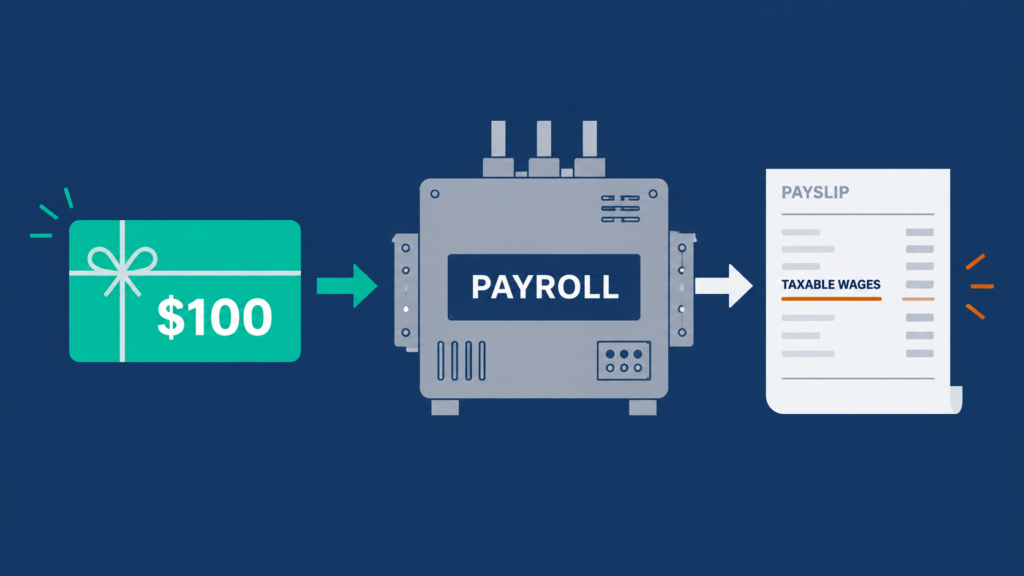
This is the rule HR teams most often get wrong, and it is the one with real exposure attached. It is also the rule most vendor pages quietly avoid, because it makes the easiest product harder to sell.
⚠ WATCH OUT
“Cash and cash equivalent fringe benefits (for example, gift certificates, gift cards, and the use of a charge card or credit card), no matter how little, are never excludable as a de minimis benefit.”
Source: IRS Publication 15-B, Employer’s Tax Guide to Fringe Benefits
There is no small-amount carve-out. A $10 coffee card and a $500 prepaid card sit in the same category, differing only in how much wage income you are reporting.
Points and catalogue redemptions deserve a second look for the same reason. If the employee can convert the award into something of their choosing at a stated value, treat it as a cash equivalent until your advisor tells you otherwise.
Service and safety awards: The $400 and $1,600 limits
Employee achievement awards are the one place a meaningful non-cash gift can be excluded from wages. The ceiling depends on whether the award sits inside a qualified plan.
The excludable annual amount is $1,600, or $400 for awards that are not qualified plan awards. Those are hard ceilings, and the IRS updates Publication 15-B annually, so confirm the figures against the edition current when you publish your own policy.
Source: IRS Publication 15-B, Employer’s Tax Guide to Fringe Benefits
This is why the service-milestone row on the moments map has to be decided by tax treatment first. A tangible award inside the limit can land clean. A gift card of the same value cannot, no matter how the announcement is worded, and that single distinction is worth writing into your employee benefits compliance documentation.
The payroll handoff: Gross up or let it hit the paycheck
Nobody writes about this decision and every gifting programme makes it, usually by default. If a gift is taxable, someone has to decide whether the company absorbs the tax through a gross-up or the employee sees the deduction.
That decision determines how the gift is remembered, which makes it a recognition decision wearing a payroll costume. A $100 gift card that arrives with a visible deduction is remembered as a $100 gift card that cost the employee money.
Make the call at design time, write it into the HR policy formulation document, and tell employees plainly which way it went. Surprise is the only outcome here that is guaranteed to be worse than either option.
Here’s the difference:
| Gift form | Typical US federal treatment | The test that decides it | What the employee sees |
|---|---|---|---|
| Branded merchandise, low-value goods | Usually excludable | De minimis: small value, infrequent, impracticable to account for | Nothing on the payslip |
| Flowers, fruit, occasional tickets | Usually excludable | De minimis, on the same three tests | Nothing on the payslip |
| Team meals and celebrations | Usually excludable | De minimis, occasional and group-based | Nothing on the payslip |
| Gift cards and prepaid cards | Taxable wages, always | Cash equivalent, excluded from de minimis at any amount | Added wages, withholding on the next run |
| Points and catalogue redemptions | Usually taxable wages | Whether the award functions as a cash equivalent | Added wages unless a specific exclusion applies |
| Length-of-service and safety awards | Excludable within limits | Employee achievement award rules, $400 or $1,600 ceiling | Nothing, if inside the limit and non-cash |
| Experiences, trips, event tickets | Depends on value and frequency | De minimis for occasional low-value; wages once substantial | Varies, confirm before ordering |
| Extra paid time off | Paid as normal wages | It is paid time, so it runs through payroll as pay | Normal pay, no separate deduction |
The decision rule is one sentence. Choose the gift form after you know the tax treatment, never before, because the treatment decides whether the gesture survives contact with payroll.
A $75 item that lands clean beats a $100 gift card that lands as a deduction. That is not a tax argument. That is a recognition argument that happens to be settled by tax rules.
If this section is the one you forward internally, forward it to payroll before you forward it to your vendor. And if you want the next blueprint like this one before it circulates, the Lab newsletter is where these go first: field-tested frameworks, real metrics, no vendor content.
Employee Gifting Experiences: When They Beat Physical Gifts (and When they Exclude People)
Experiential gifting is sold as the premium upgrade. Sometimes it is. The rest of the time it quietly transfers the cost of the gift from the company to the recipient, in a currency the recipient never agreed to spend.
What counts as an experiential gift
Four categories, and they are not interchangeable. Events and activities. Subscriptions and memberships. Learning and travel. Time itself, which is the most underrated of the four and the only one with no logistics attached.
One distinction drives every trade-off below: whether the employee schedules the experience or the company does. Self-scheduled experiences are gifts. Company-scheduled experiences are events, and events have attendance lists.
Where experiences genuinely outperform objects
The case is real and worth making properly before it gets qualified. An experience produces a memory with a longer half-life than an object, and it does not compete for shelf space in a home the company has never seen.
Objects also carry a storage problem that nobody accounts for at purchase. The branded jacket, the desk item, the third water bottle: each one arrives as a small obligation to find somewhere to put it.
And a shared experience carries a status signal an object cannot replicate. Access reads as trust. That is the mechanism doing the work, and it is why the argument holds when the experience is genuinely chosen.
The access problem nobody writes about
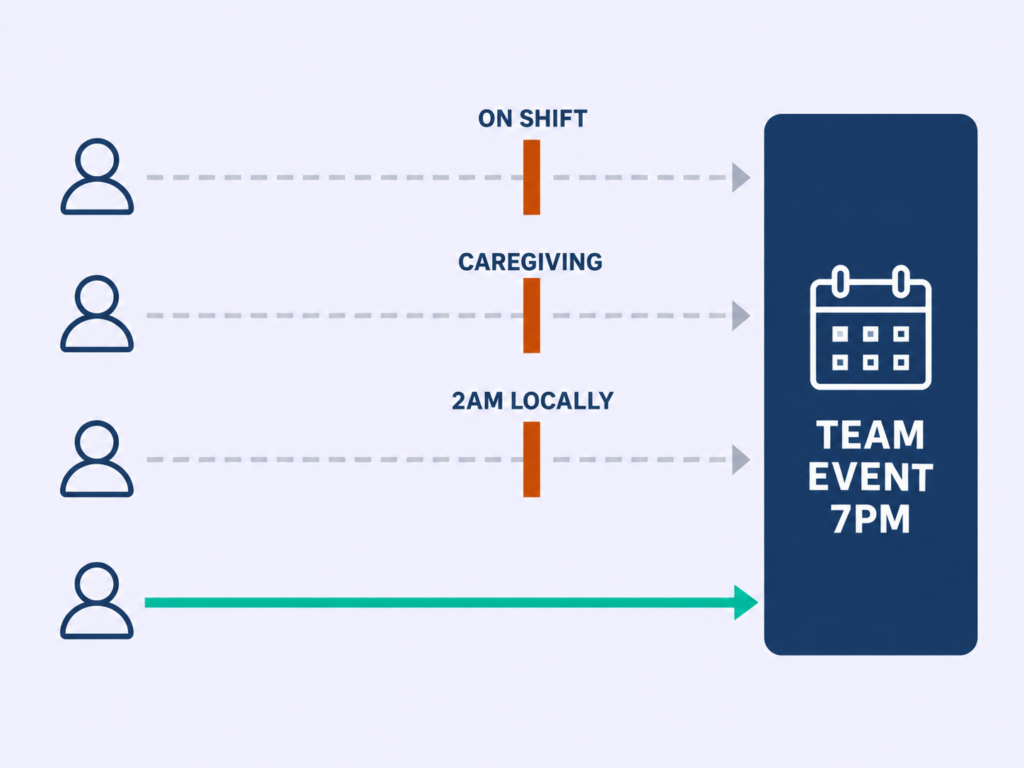
Shift workers who cannot attend an evening event without giving up a shift. Caregivers who cannot commit a weeknight three weeks out. Employees with mobility, sensory, dietary, or medical constraints that the venue was never checked against. Distributed teams in a time zone where the celebration starts at 2am.
An experience that half the recipient group cannot use is not a gift. It is a sorting mechanism, and the people it sorts out learn something specific about who the programme was designed around.
Design against these as constraints on the gift, never as eligibility questions about the person. You are checking whether the experience works for everyone, not checking who qualifies, and you should not be collecting personal characteristics to answer it. Getting this right is the same discipline that separates competent remote employee engagement from a calendar of events the head office enjoys.
Tax, scheduling burden, and the hidden cost
Experiences carry administrative weight that objects do not. Coordination, attendance tracking, rescheduling, and a per-recipient cost that grows with personalisation rather than shrinking with volume.
The tax position also differs from low-value goods, and it turns on value and frequency rather than on the fact that it was an experience. Take that question back to the tax section rather than assuming an experience is treated more leniently than an object of the same value.
The old way
- Assume experiences beat objects
- Book the group activity
- Announce it as a reward
- Read low attendance as low engagement
The Lab Way
- Run the four-question test first
- Give the recipient control of the timing
- Price the administrative load per recipient
- Read low uptake as a design defect
But here is the catch:
Four questions decide it, and you answer all four before you look at a single option.
- Can every person in the recipient group use this, without negotiating their schedule, their care responsibilities, or their access needs?
- Does the employee choose when and whether to use it, or does the company decide for them?
- What is the administrative cost per recipient, and who absorbs it?
- What is the tax treatment, and who pays it?
The outcome is not ambiguous. Experiences win decisively for individual, self-scheduled, choice-based rewards. They lose badly for mandatory group events sold as gifts.
⚠ WATCH OUT
Anti-pattern: a compulsory team activity held during or adjacent to work hours is not a gift. Calling it one is the fastest way to make the entire programme untrustworthy, because employees can tell the difference between a reward and an obligation with a buffet.
◆ PRO TIP
The honest downside: experiences do not scale on the same curve as objects. Every additional recipient adds coordination rather than absorbing it, so the administrative load per person stays flat while your team’s capacity does not. Budget the coordination hours explicitly or the programme will be quietly rationed by whoever is doing the booking.
◆ FROM THE LAB
My experience: I inherited a referral programme that was doing what most referral programmes do, which is generate a respectable number of submissions and almost no hires. The standing advice was to raise the cash bounty.
I looked at who was referring instead. A very small group was carrying the whole thing, so rather than paying everyone more, we built something for them: a named “Talent Scout” designation, genuine perks, and a standing quarterly session with leadership where their view of the market was asked for and used.
One senior engineer in that group produced 11 referrals. Nine were hired. Eight were still with the company when I last checked. Conversion across the power-user cohort ran at 82% against a company average of 31%, and the avoided agency fees came to roughly $48,000.
Not one of those people was moved by an object. They were moved by access, by status, and by being asked. That is an experiential reward in everything but name, and it is the closest evidence I have that the experience category earns its premium when the experience is being trusted with something rather than booked for you.
Which is the useful test to carry into any list of employee recognition ideas you are handed. Ask what the recipient gets to decide, not what the recipient gets.
Choice vs. Curation: Who Should Pick the Gift
Choice solves the relevance problem at scale. It guarantees the recipient ends up with something they want, and it removes the company’s taste from an equation where the company’s taste was never an asset.
What it costs is the signal. A catalogue link says we allocated you a budget. A specific, well-chosen item says we know you, and those are different sentences.
Choice
- Guaranteed relevance at any scale
- Works across geographies and preferences
- Low administrative load per recipient
- Fails as: a points economy priced like compensation
Curation
- Carries a specificity signal choice cannot
- Best for manager-initiated recognition of named work
- High administrative load per recipient
- Fails as: the branded-merchandise drawer
Why this works:
The allocation rule follows the moments map rather than the vendor’s pitch. Use choice for large, heterogeneous groups and for moments the company initiates centrally. Use curation for individual, manager-initiated recognition of a specific result, where the specificity is the entire point of sending anything at all.
Never let a choice platform carry a moment that needed to feel personal. That is the single misallocation that produces the most disappointed recipients per dollar spent.
Which brings back the Deloitte finding from earlier: if the object is doing almost none of the motivational work and two-thirds of managers are guessing about what would land, then the gift’s real job is to demonstrate the understanding.
That makes the attached message the load-bearing element, not the item. In a choice model the note is the only part the company authored, so it has to name the specific work, the specific date, and the specific person who noticed. Any employee recognition platform that treats the message field as an optional afterthought has misunderstood which half of the transaction matters.
⚠ WATCH OUT
Common mistake: letting a points-based choice system run long enough that employees start converting points to dollars in their heads and comparing balances. Once that happens you are not running a recognition programme, you are running a shadow compensation scheme with worse tax treatment and no band structure.
The Employee Gifting Market: What the Numbers Are Good for (and What They Aren’t)
At some point a vendor will send you a market-size figure, and it will be large. The question is not whether the number is real. The question is whether it can carry any weight in your business case.
Here’s the deal:
Published estimates for corporate gifting diverge by an order of magnitude, and the divergence is not a rounding issue. It comes from scope. Some reports include client gifting, channel gifting, promotional products, and gift cards sold through corporate channels; others count only employee-directed spend; very few publish a methodology either way.
One of the most widely circulated figures in this category traces back to a 2021 business-press column rather than to a primary study. It has been quoted ever since as though it were research, which is how a number acquires authority without ever earning it.
The scale of the problem is visible inside a single report. The Business Research Company puts the global corporate gifting market at $886.56 billion in 2025, growing to $956.93 billion in 2026 at a 7.9% CAGR and $1,312.85 billion by 2030 at an 8.2% CAGR. The same report’s own forecast table lists a conflicting 2026 figure of $124.1 billion.
Source: The Business Research Company, Corporate Gifting Global Market Report, 2026 edition. Cited here as an illustration of the methodology problem, not as supporting evidence.
A report that cannot agree with itself about a single year cannot tell you anything about your programme. Put that number in a slide and the first person to check the source has permission to discount everything else on the page.
Citing a number you cannot defend is worse than citing none at all. One looks unprepared. The other looks unreliable.
◆ PRO TIP
Real talk: market-size figures are good for exactly three things. Establishing that the category is large enough to have a competitive vendor market. Supporting a procurement argument that pricing should be negotiable. Giving a budget conversation directional context.
They are useless for four things. Benchmarking your own spend. Forecasting your programme’s return. Justifying a budget increase. Claiming a trend.
There is a defensible substitute if what you want to show is that recognition is rising up the agenda. Gallup tracks the share of senior leaders and managers calling employee recognition a major strategic priority, and it moved from 19% in 2022 to 42% in 2024. That is a tracked measurement of behaviour, not a projection of spend, and it survives a follow-up question.
Source: Gallup, Employee Retention Depends on Getting Recognition Right, 2024
I learned where market data does earn its keep in a completely different negotiation. Agency fees in one part of my career ran at 18% to 22% of package, and the only thing that moved them was walking into the conversation already knowing what the market paid and where the supply was. Once we had that context, agency reliance dropped 60% to 70%.
The transferable lesson is narrow and worth stating plainly. Market data belongs at the negotiating table, not in the business case, and that is an analogy from vendor negotiation rather than gifting evidence.
The vendor market, read by category rather than by name
You are about to run a procurement process in a category you have never bought in, against four vendor archetypes whose business models are genuinely different. Naming companies would date this section within a year and would not help you anyway. The archetypes will outlast the logos.
Choice-based gifting platforms optimise for recipient satisfaction and catalogue breadth, and their pricing pressure sits in the margin between the stated gift value and what they pay for the item. Ask what percentage of the face value reaches the recipient.
Curated catalogue and fulfilment providers optimise for logistics and presentation, and their pricing pressure sits in shipping, packaging, and minimum order volumes. Ask what happens to unshipped or returned items and who pays for them.
Recognition platforms with gifting bolted on optimise for platform seats and adoption metrics, and gifting is usually the least mature module. Ask to see the gifting reporting, not the recognition reporting.
Promotional-products suppliers optimise for unit cost at volume, which makes them excellent at merchandise and structurally unsuited to individual moments. Ask what their minimum order quantity is before you ask anything else.
- Choice platform: what share of the stated value reaches the recipient?
- Curated fulfilment: who absorbs the cost of failed and returned deliveries?
- Recognition platform: show me a gifting participation report split by manager.
- Promotional supplier: what is the minimum order quantity, and what happens to the surplus?
⚠ WATCH OUT
Red flag: the integration question most buyers forget is whether the platform writes back to the HRIS. A gifting tool that cannot report participation by team and by manager makes the entire measurement section below impossible to run, and you will not discover that until your first quarterly review.
Put it in the requirements document, not the demo conversation. This is the same question that separates a functional HR tech stack from a collection of tools that each report on themselves.
None of the four archetypes is the right answer in general. They are right for different moments in your map, which is why classifying them by model is the first step in any serious HR vendor evaluation, and shortlisting the three that came up in search is not.
Running Employee Gifting at Scale: Operating Model, Manager Enablement, and Global Logistics
Gifting programmes rarely die from a bad gift. They die from an operating model nobody wrote down.
The old way
- Announce the budget
- Send a quarterly reminder email
- Report spend against budget
- Design centrally, ask local teams to cope
The Lab Way
- Publish the rules on one page
- Put the prompt where the work happens
- Model it visibly from the top
- Design against the five delivery constraints first
Who owns the programme
Three named roles, and the names go in a document rather than in someone’s head. An owner who is accountable for the outcome and reports on it. An approver who signs off on the reserve and on policy exceptions. An operator who runs the vendor, the data, and the calendar.
Gifting dies in organisations where it is everyone’s nice-to-have and nobody’s objective. If it does not appear in a single person’s goals, it will be the first thing dropped when that person’s quarter gets difficult.
Manager enablement: Why the discretionary pool goes unspent
This is the highest-leverage fix in the entire guide. Managers do not spend the pool because they do not know the rules, they fear doing it wrong in a visible way, or nothing prompts them at the moment it would have mattered.
How to execute:
1
Publish the rules on one page
The per-head amount, what qualifies, what does not, the approval threshold, and the tax treatment in one sentence. One page, no appendices, no policy portal login.
The most common reason a manager does not spend is not indifference. It is uncertainty about whether they are allowed to, and an unanswered question always resolves as inaction.
2
Put the prompt at the moment
A trigger inside the tool managers already have open, fired when a result lands. Not a quarterly reminder email, which arrives weeks after the work it was meant to recognise and turns a specific gesture into an administrative task.
Timeliness is most of the value in manager-initiated recognition. A gift for something that closed last quarter is a different gift.

3
Model it visibly from the top
Senior leaders using the pool in public, naming specific work rather than generic effort. Managers copy what they see rewarded, not what they are told in an enablement deck.
Two or three visible examples from people with authority does more for adoption than a training module, and costs a fraction of one. Build it into your manager enablement rhythm rather than treating it as a launch activity.
Then take the uncomfortable step. Pool utilisation by manager is a management-capability signal, not a finance variance, and the managers who never spend it are usually the managers whose teams are already showing other warning signs.
That data belongs in management development conversations, not only in a programme report. It is one of the few objective, low-cost signals you will get about which managers are noticing their people.
◆ FROM THE LAB
The Sofia lens: the operating cadence I described earlier for that high-volume campaign is the part people skip when they copy the approach, and it is the part that made it work.
Daily stand-ups with the recruiting team. A real-time tracker everyone could see rather than a weekly deck. A war-room call with hiring managers once a week. Vendor performance tracked against stated service levels, reviewed on the same cadence.
None of that is clever. It is just instrumented and reviewed on a rhythm, which is the entire difference between a plan and a result at scale. A gifting programme with a named owner, a published rule set, and a monthly review of utilisation by manager is running the same machinery, and a programme without it is running on goodwill and a calendar reminder.
Distributed and global delivery
A programme designed for the head-office population breaks the moment it is extended, and you find out which constraint bit you after the order has shipped. Five of them determine what is even possible.
- Shipping lead times. A December gift is decided in October, which means the budget conversation happens in September.
- Customs, duties, and import restrictions. Identical physical gifts across borders are usually not achievable, and some items simply cannot cross.
- Country-level tax treatment. The US federal rules above do not travel, and each country’s treatment has to be checked locally before a form is chosen.
- Value parity. An equal dollar amount is not an equal gift across cost-of-living differences, and employees compare.
- The home-address problem. Shipping to a residence requires data the employee may not want held, and it goes stale the moment they move.
Design against all five and the surviving set is small: locally fulfilled choice, digital and subscription items where legally permitted, and time. That is a narrower menu than any vendor will present, and it is the honest one.
◆ PRO TIP
The catch: most global gifting programmes quietly fragment into country-level improvisation within two years, and the programme owner is usually the last to know. Name the fragmentation instead of defending a global standard that stopped existing. Global parity means parity of gesture, not parity of object, and saying so in the policy is what stops local teams from feeling they are breaking a rule they cannot follow.
Data, consent, and the information you should not hold
Personalisation requires information, and information carries obligations. Home addresses, dietary requirements, family details, and religious observance are all personal data with retention, access, and accuracy duties attached.
The design rule is to collect the minimum, collect it directly from the employee, and delete it on a stated schedule. If a field exists only because it might be useful someday, it is a liability with a gift-shaped justification.
Do not build gift logic on protected characteristics. Accessibility, dietary, and scheduling constraints are design inputs for the gift, not screening categories for the person, and that distinction belongs in your global HR governance position before a vendor asks you to upload a spreadsheet.
How to measure employee gifting: the signals that prove it worked
You will be asked whether it worked. The honest answer for most programmes is that nobody can tell, because nothing was captured before the first gift shipped.
The old way
- Report gifts sent
- Report budget consumed
- Quote a post-delivery sentiment score
- Imply causation and hope nobody asks
The Lab Way
- Capture a baseline before launch
- Track four signals, one page
- State the causality caveat out loud
- Publish the kill criterion in advance
Set the baseline before you launch
Four things, captured before the first gift ships, because none of them can be reconstructed afterwards.
- Current recognition-quality question scores, by team, from whatever survey instrument you already run.
- Current 12-month retention by team and by manager.
- Current recognition spend per employee, including everything already happening informally.
- Which managers are already recognising their teams without a programme, since they are your control group and your first advocates.
The four signals worth tracking
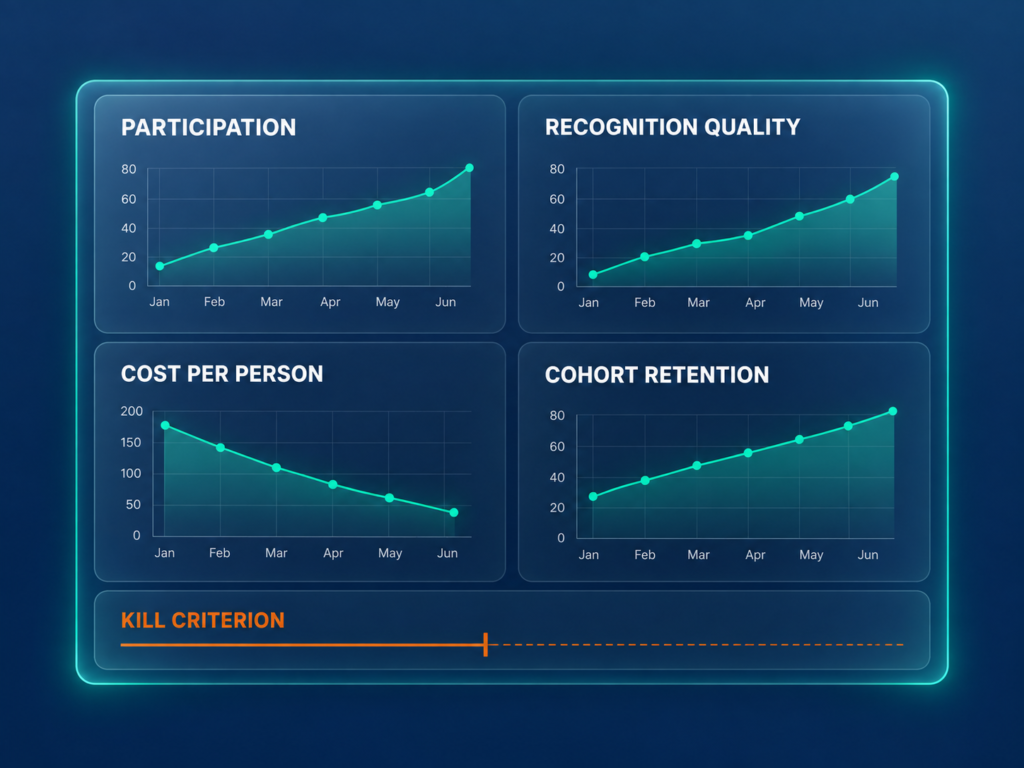
Why this works:
Four, because that is what the available data can honestly support. A framework with nine signals is a framework that has never survived a quarterly review.
1
Participation and redemption
The share of eligible employees who received a gift and redeemed it, split by team and by manager. Capture it from the platform monthly.
This is an execution signal and it surfaces manager non-adoption earlier than anything else on the list. The decision it informs is where to spend your enablement time next month.
2
Recognition quality
A short, stable question set asked on your existing survey cycle, reported as a trend line rather than as a score. Do not add a new survey for this.
Quality is the mechanism the external evidence supports, which makes this the signal closest to the outcome you claimed in the budget meeting. The decision it informs is whether the programme design is working or only the logistics are.
3
Retention of the recognised cohort
Twelve-month retention among recognised employees against a comparable unrecognised group. Reviewed annually, never monthly, because the numbers move too slowly to be useful more often.
The decision it informs is whether the programme continues at its current size. The benchmark I would hold it to is a real one: the best 12-month cohort retention I have personally held is 89%.
4
Cost per recognised employee
Not cost per gift. The denominator should be people reached, not units shipped, because units shipped is a procurement metric that tells you nothing about coverage.
Report it quarterly alongside participation. The decision it informs is how to rebalance the three pools at the next planning cycle, and it belongs on the same HR metrics dashboard as your other people-programme unit costs.
⚠ WATCH OUT
Warning: signal three is correlational and you must say so before anyone else does. Recognised employees may retain better because they were already performing, already engaged, or already working for a good manager, and the gift may be a marker rather than a cause.
This is the claim that will be challenged in the room. Stating the caveat yourself is what makes the other three signals believable, and it costs you nothing you were entitled to keep.
What not to measure (and why it gets measured anyway)
Gift volume. Spend against budget. Sentiment collected in a survey run the week after the gifts arrived.
Each of the three is easy to produce, each gets reported upward, and none of them says anything about whether the programme worked. The post-delivery sentiment survey is the worst of them, because it measures the novelty of receiving something rather than whether recognition landed.
They persist because they are available. Availability is not a reason to report a number, and a report full of available numbers is how a programme reaches year three without anyone knowing whether to keep it.
The reporting rule: one page, four signals, a trend line each, and the kill criterion you already promised finance in the budget conversation.
◆ FROM THE LAB
My experience: I do not assert that an intervention worked. I measure it against a baseline, and I have been wrong often enough to keep doing it that way.
Three examples from my own hiring work, each measured the same way. Competitive analysis lifted Quality of Hire by 12%. Talent landscape work on adjacent industries lifted it by 14%. A skills-based pipeline built after proper market analysis lifted it by 30%.
None of those numbers would exist if I had not captured the baseline first, and none of them would have survived a challenge if I had claimed more than the method supported. That is the same discipline this section is asking you to apply to recognition, and it is the reason I treat quality of hire and recognition quality as the same class of measurement problem.
Employee gifting FAQ
What is employee gifting?
Employee gifting is the practice of giving employees non-contractual items, experiences, or cash-equivalents to mark an occasion or acknowledge work, funded from a people or department budget rather than through payroll. It differs from recognition, which is tied to a named behaviour or result, and from compensation, which is contractual and can be planned around.
Are employee gifts taxable in the US?
Under US federal rules an employer-to-employee gift is generally taxable wages unless a specific exclusion applies. Two exclusions do most of the practical work: de minimis fringe benefits for low-value, infrequent items, and employee achievement awards within the $400 or $1,600 limits set out in IRS Publication 15-B. Confirm your own position with a tax or payroll advisor.
Are gift cards to employees tax-free if the amount is small?
No, and the amount makes no difference. Gift cards and other cash equivalents are never excludable as a de minimis benefit, regardless of how small the value is. The practical consequence is that the value is reportable wages, so the employee will see the effect on their next paycheck.
How much should a company spend on employee gifts per year?
There is no credible published benchmark, and any figure quoted as one is a vendor estimate. Use the method instead: size the annual envelope against replacement cost for your own population, split it across a Moments Pool, a Manager Discretionary Pool, and a Programme Reserve, and calibrate the total from your own cost-per-hire figures.
What are good employee gifting experiences?
The experiences that work are self-scheduled, individually chosen, accessible to shift workers and caregivers, and never mandatory. Learning, subscriptions, and additional paid time meet those criteria most reliably. Run the four-question access test before choosing an experience over a physical gift, because a compulsory group event is not a gift.
What separates the organisations that get this right
Employee gifting is not a morale expense. It is the most widely deployed and least instrumented recognition channel in most organisations, and the ones getting value from it are not the ones spending more. They are the ones who know what they bought.
Four things separate the organisations that execute from the ones that renew the line item and hope. A named owner. Published rules. A tax-aware selection process. And a baseline captured before the first gift ships.
Three of those four cost nothing.
The timing matters more than it did two years ago. The share of senior leaders and managers calling employee recognition a major strategic priority rose from 19% in 2022 to 42% in 2024, while the share of employees saying they get the right amount of recognition stayed flat at 22%.
Source: Gallup, Employee Retention Depends on Getting Recognition Right, 2024
Leadership attention more than doubled and the employee experience did not move at all. That gap is the execution layer, and everything in this guide sits inside it. Getting the operating model right now is cheaper than explaining after the next budget review why the attention did not convert.
Pick two moments from the map. Not all seven. One the company initiates centrally, one a manager initiates directly. Publish the rules for the pool that funds them, capture the baseline before the next gift ships, and review the four signals in 90 days.
Blueprints like this one go out to the Lab newsletter before they circulate anywhere else: field-tested frameworks, real metrics, no vendor content. And if you are rebuilding a gifting or recognition programme in your own organisation this year, I want to hear what you are running into. Connect with me on LinkedIn and tell me which of the five failure modes you are dealing with.
