
In 2025 I won a company-wide transformation award, which put me on the receiving end of enterprise recognition instead of the designing end.
The trophy was forgettable. What I still remember is the two sentences that named exactly what I had changed and why it mattered to the business.
That gap is the subject of this guide. Most HR Business Partners can define employee recognition without pausing. Far fewer can say who their programme is reaching, or defend its budget line in a review.
Ask an organisation to describe its recognition programme and it will name the platform it bought. That is not a programme. That is a place to put recognition.
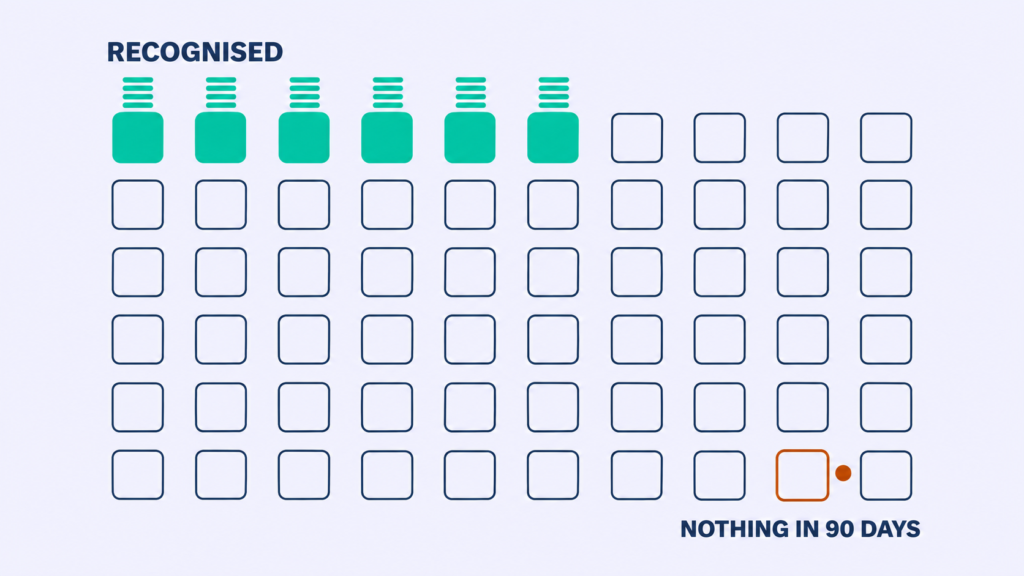
1 in 3
Workers who strongly agree they received recognition or praise for good work in the past seven days.
Source: Gallup, The Importance of Employee Recognition: Low Cost, High Impact
Translation: two thirds of your workforce spent a week doing good work that nobody named. Gallup also finds that employees who are not adequately recognised are twice as likely to say they will quit within the year.
Recognition budgets are among the first cut in a tightening year, because almost nobody has modelled them against replacement cost. The programme dies. The attrition it was quietly suppressing does not.
Here's what this guide contains:
- A definition of employee recognition that survives a leadership review
- The taxonomy that resolves the contradictory "types of recognition" lists
- A five-day audit of the programme you already have
- Four metrics that expose decay before an engagement survey does
- A seven-step build, with the artefact each step produces
- The honest list of what recognition cannot fix
HR Insights Lab approach: recognition treated as a signalling system with an owner, a trigger, a cadence, and a measurable output. Not a morale initiative, and not a tool procurement.
What is Employee Recognition?
Employee recognition is the deliberate acknowledgment of something an employee did, delivered by someone whose opinion carries weight with them. It works by making one specific contribution visible and attaching value to it. Run as a system rather than a gesture, it is the cheapest retention lever most HR teams still leave informal.
Here's the definition that survives a leadership review:
Three words in that sentence are load-bearing, and each one becomes a design constraint later in this guide. Deliberate rules out the accidental thank-you, because a system you cannot schedule is a system you cannot measure.
Specific rules out "great work this quarter," which the recipient cannot connect to anything they chose to do. And someone whose opinion carries weight rules out the automated badge, because the sender is half the signal.
A gesture is something you do. A system is something you can audit.
That distinction is why recognition sits alongside employee engagement rather than inside it. Engagement is the outcome you are trying to move. Recognition is one of the instruments that moves it.
The old way
- Define recognition as "saying thank you"
- Treat it as a tone, not a process
- Measure it once a year in a survey question
The Lab Way
- Define it as an operating system with an owner
- Specify the trigger, the source, and the cadence
- Report coverage every month to the people who can change it
I hold an unpopular position on retention, and it decides how I scope every recognition brief I am handed: retention problems are mostly systems failures, not compensation failures. Recognition is one system among several, and it cannot carry the others.
So it helps to name what recognition is not, before anyone starts building.
Recognition is not compensation. It does not fix a pay-band problem, and deploying it against one buys resentment rather than goodwill, because people can tell the difference between being seen and being managed.
Recognition is not performance management. It carries no rating and no calibration, and the moment it does, people start managing to it and the signal degrades within a quarter.
Recognition is not a platform. Buying a tool creates a place to recognise, never an occasion to, which is why adoption curves collapse in week three. If you want to know why employees leave, the answer is rarely a missing recognition feed.
⚠ WATCH OUT
Common mistake: Recognition cannot fix a pay-band problem. If your exit interviews name compensation, fix compensation. A recognition programme layered over a pay gap reads to employees as an organisation that knows and has chosen the cheaper option.
The rest of this guide is the build.
Recognition, appreciation, rewards, and incentives: the distinction that decides your design
These four words get used as one phrase, funded from one budget, and delivered through one platform. Then leadership judges the recognition programme against reward-programme metrics and concludes it failed.
Here's the difference:
| Recognition | Appreciation | Rewards | Incentives | |
|---|---|---|---|---|
| What it acknowledges | A behaviour or a result | The person's inherent value | A completed outcome | A future behaviour |
| What triggers it | A specific act | Nothing. No trigger required | Clearing a defined bar | Promised in advance |
| Who can give it | Anyone | Anyone | The organisation | The organisation |
| What it costs | Mostly attention | Nothing | Budget | Budget |
| What it moves | Discretionary effort and retention | Psychological safety and belonging | Repetition of one behaviour | Short-term output |
| How it fails | Becomes untargeted noise | Used as a substitute for recognition | Crowds out intrinsic motivation | Gaming and cliff effects |
Recognition responds to something a person did. Appreciation acknowledges the person regardless of output. Rewards pay out against a defined bar after the fact, and incentives promise a payout in advance to shape behaviour that has not happened yet. Four instruments, four different jobs, and only one of them belongs in a total rewards strategy conversation.
Here is why the distinction is not terminology trivia. I have sat in the meeting where a leadership team asks for "a recognition programme to fix attrition in the support centre," and the request arrives as a solution rather than a problem.
Re-diagnose it against the four instruments before anyone shortlists a vendor. If reps genuinely do not know what good looks like, the answer is recognition, because the gap is a signalling gap.
If reps feel invisible to leadership, the answer is appreciation, and it costs nothing but presence. If one specific behaviour needs repeating, such as a QA score, the answer is a reward with a published bar.
And if the business needs a short-term volume push, the answer is an incentive. It will work, and it will stop working the day it stops, which is a decision worth making deliberately rather than discovering later. That single re-diagnosis is the most useful thing an HR business partnering framework gives you in that room.
◆ PRO TIP
The catch: name the instrument before you name the budget. Get this wrong and you will spend a rewards budget on an appreciation problem, then be asked in twelve months why turnover did not move.
Why Employee Recognition Works, and What The Data Says

Most articles open this section with a benefits list and prop each item up with a vendor statistic. That order is backwards. A CFO does not ask whether recognition helps, they ask how it works, and they ask it in the second minute.
Why this works:
A specific contribution gets made visible. Visibility signals what the organisation genuinely values, as distinct from what the values poster says. People repeat what gets signalled.
That is the whole mechanism. Recognition is a signalling system, and yours is signalling something right now whether anyone designed it or not.
Most programmes do not fail because they signal nothing. They fail because they signal tenure and volume, and then leadership wonders why behaviour has not moved.
The scale of the deficit says the same thing. Gallup and Workhuman found that 55% of U.S. employees receive either no recognition at all or recognition that meets none of the five quality pillars, and only 22% report recognition that is adequate. That number did not move between 2022 and 2024.
Source: Gallup and Workhuman, Employee Retention Depends on Getting Recognition Right (2024)
Translation: this is a design failure, not an effort failure. Organisations are recognising, and it is landing on nobody. Which is also the answer to why company values that survive contact with the org chart are so rare.
Now the arithmetic, because the culture argument alone has never once won me a budget line.
How to execute:
- Take annual voluntary attrition headcount for the population in scope
- Apply your own replacement cost per hire, not a published benchmark
- Apply the research turnover effect to a deliberately conservative slice, 10% to 15%
- Compare against total programme cost, including manager time
45%
Well-recognised employees were 45% less likely to have turned over two years later. Where recognition met four or more of the five pillars, employees were 65% less likely to be actively watching for another job.
Source: Gallup and Workhuman, Employee Retention Depends on Getting Recognition Right (2024)
Discount that figure before it reaches a slide. It is an observed association across a research panel, not a guaranteed return on your programme, and you will not get a whole population to well-recognised status in year one.
You need your own replacement cost for the model to mean anything. Earlier in my career, in a senior engineering population, ours ran at roughly ₹6.5 to ₹7.5 lakh per hire before we changed anything, and fell to ₹3 to ₹3.8 lakh once direct sourcing and referrals displaced agency spend. Time-to-Fill moved from 70 to 80 days down to 45 to 50 in the same period.
Those are my numbers, in my market, for my roles. Do not borrow them. Run the same calculation on your own population and you will have a figure you can defend, which is the point of cost per hire, calculated properly.
◆ PRO TIP
Real talk: haircut the research effect before it reaches a slide. A 12% model that holds up beats a 45% model that gets torn apart, and you only get one first meeting with that finance team.
Now the part almost nobody writes down.
◆ FROM THE LAB
The Sofia lens: I have watched four things drive people out of organisations, and recognition is not on the list. Unclear career paths. Poor manager capability. No role clarity or meaningful work. Burnout produced by an operating model nobody has fixed.
Recognition is a supporting fix against all four and the primary fix against none of them. Pay attention to that sentence if you are about to be handed a recognition programme as the answer to an attrition problem.
So here is the diagnostic. If your exit interview themes are pay, progression, or manager, recognition is a supporting fix and not the fix, and you should say so before you own the outcome.
There is exactly one condition under which recognition is the primary lever. People are doing good work that nobody sees, and your engagement data shows a visibility gap rather than a fairness gap or a growth gap.
In that case, build. In the other three, route the problem to the system that owns it, and start with manager capability.
The old way
- Prescribe recognition for any people problem
- Quote a vendor's ROI figure in the business case
- Accept accountability for attrition it cannot move
The Lab Way
- Scope recognition to the one failure mode it treats
- Model your own attrition against your own replacement cost
- Name the other three drivers out loud and route them
The Types of Employee Recognition
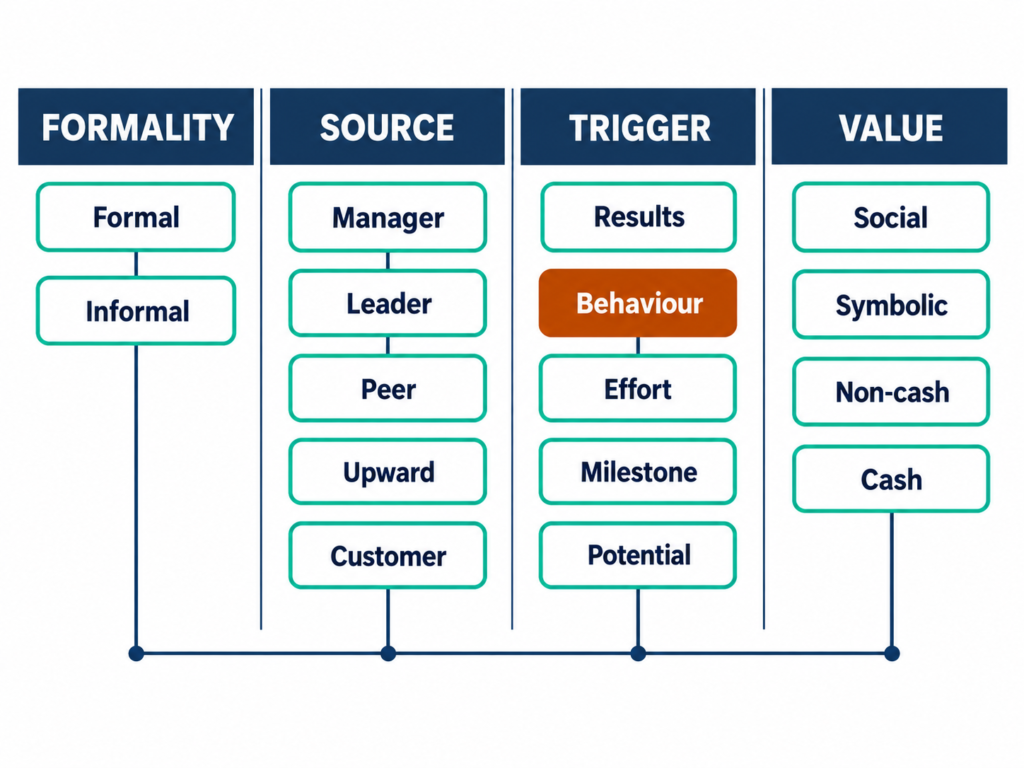
Every published list of recognition types contradicts the next one. Four types here, five there, six somewhere else, and none of them overlap cleanly.
That is not sloppiness. It happens because three genuinely independent dimensions are being flattened into a single list, and any flattening produces a different answer depending on where you cut. Recognition varies along four dimensions, and a programme is the combination you choose across all of them.
Formal vs informal recognition
Formal recognition is documented, budgeted, gated by criteria and an approval path, and it produces a record. Awards, service programmes, and spot bonuses live here.
Informal recognition is unrecorded and immediate. A message, a mention in stand-up, a note that nobody files anywhere.
Here is the operating point, and it is the reason the distinction matters at all. Formal recognition sets the standard. Informal recognition sets the frequency.
A programme with only the formal layer produces recognition once a quarter for a handful of people. A programme with only the informal layer produces warmth that nobody can point to at promotion time, which is a real cost to the person receiving it. The informal layer is the engine, and it is the one you instrument.
Do not copy a ratio from anywhere. Derive it: count the recognition-worthy acts your population produces in a typical month, then ask how many of those the formal path could realistically process. The gap is what the informal layer has to carry, and the same logic applies to performance conversations that aren't status updates.
The old way
- Run one annual awards night
- Keep an employee-of-the-month board
- Leave everything else to individual manager temperament
The Lab Way
- Build the informal layer as the engine
- Use the formal layer to amplify, not to originate
- Instrument the informal layer from week one
One warning on employee of the month. It concentrates by design, and a monthly single-winner format guarantees that most of your population will never win one in their entire tenure.
Recognition by source: Who gives it
Who delivers recognition changes what the recipient reads into it, entirely independently of what triggered it. Five sources, five different jobs.
| Source | What it uniquely does | Failure mode |
|---|---|---|
| Manager | Carries career weight. The recipient reads it as a signal about their standing | Becomes routine and loses meaning if it is the only channel |
| Senior leader | Carries reach. It travels beyond the team | Lands on whoever was in the room, not whoever did the work |
| Peer | Carries credibility. Peers know what the work actually took | Degenerates into a reciprocity cluster |
| Upward or reverse | A high-signal indicator of manager behaviour | Almost never built, and unsafe without anonymity |
| Customer | External proof. The strongest single item in a performance file | Arrives at random and rarely gets routed anywhere |
Gallup asked employees where their most memorable recognition came from. Managers led at 28%, senior leaders or the CEO at 24%, the manager's manager at 12%, customers at 10%, and peers at 9%.
Source: Gallup and Workhuman, Employee Retention Depends on Getting Recognition Right (2024)
Translation: managers matter most, and the long tail is more than half. A single-channel programme, which is what most organisations buy, leaves the majority of the available value unbuilt.
Peer channels also concentrate, sharply. In employee referral programmes I have run, 5% to 10% of employees generated 60% to 70% of successful referrals, and the same shape shows up in peer recognition volume once you look.
Recognition by trigger: What you reward
This is the dimension competitors omit entirely, and it is the one that determines what your programme is teaching people. Five triggers, each signalling something different.
- Results. Signals that outcomes matter. Fails when outcomes depend on territory or luck, so you end up rewarding circumstance
- Behaviour. Signals that how we work matters. The highest-leverage trigger and by far the least used, because it requires a manager to have been paying attention
- Effort. Signals that invisible work is seen. Risky alone, because it can reward inefficiency if it is never paired with an outcome
- Milestone and tenure. Signals that continuity is valued, and simultaneously that time served is the path
- Potential. Signals investment in the person. Delivered well as a stretch assignment or an internal move, and badly as an award
⚠ WATCH OUT
Watch out: a 25-year service plaque handed out on stage tells the two-year high performer in row four exactly what the path looks like here. That is a signal, and it is not the one you meant to send. Tenure recognition is worth keeping. It is not worth being your loudest recognition moment of the year.
Potential is the trigger most organisations treat ceremonially. It works when it is a mechanism with a rule attached.
◆ FROM THE LAB
My experience: in one of the organisations I worked with, we had an expensive habit. Every open role went straight to the external market, ramp times were long, and nobody could explain why we kept hiring strangers into jobs our own people were already half-doing.
So we wrote a rule and called it First Look. Every requisition posted internally for 48 hours before it reached a single external channel, and recruiters were expected to actively tap internal candidates inside that window rather than wait for applications.
Within the year, 23% of our hires were internal moves. Time-to-Productivity for those moves ran at 28 days, against 67 days for an external hire into the same kind of role. The cost case wrote itself.
But the part I did not anticipate was what the policy signalled. An internal move is the most substantive recognition an organisation can give, because it costs the giving manager something real and it changes the recipient's life rather than their week. A plaque says we noticed you. A promotion says we bet on you.
The transferable lesson is smaller than the numbers suggest: your best candidates are sometimes already on payroll, and the recognition they want is a job, not a certificate.
That is internal mobility as a sourcing channel and a recognition instrument at the same time, which is why it survives budget scrutiny better than most recognition spend.
The design rule for this dimension: pick the two triggers that match your strategy, over-weight them deliberately, then audit whether your actual recognition volume matches the intended mix. It usually does not.
Monetary vs non-monetary recognition
The usual binary is not useful, because it puts a public thank-you and a ₹50,000 spot bonus on the same axis with nothing in between. Four bands works better, and each band buys a different effect.
Band 1: Pure social
A message, a public mention, a named credit in a review. Effectively unlimited frequency, which makes this the only band that can ever move a coverage number.
Band 2: Symbolic
A badge, a certificate, points carrying no cash value. Low cost, high frequency, and the band that quietly does the most damage when leaderboards get attached to it.
Band 3: Tangible non-cash
A gift, an experience, a day off. This is where trophy value lives, because a non-cash award gets remembered and retold while cash is absorbed into the household budget inside a month.
Band 4: Cash and spot bonus
The practitioner rule across all four bands: use cash when the contribution had a measurable financial outcome, and use non-cash when you want the story retold. Tax treatment of non-cash awards varies by country and by value threshold, so route it through payroll and local finance before launch rather than after the first award.
Cash is not useless. It is just the wrong instrument for sustaining a voluntary behaviour over time, and I have the numbers to show it.
◆ FROM THE LAB
Real implementation: earlier in my career I inherited a referral programme that was democratic, well-communicated, paid a decent cash bonus, and underperformed relentlessly. Everyone was invited. Almost nobody participated twice.
So I stopped treating it as a company-wide campaign and pulled the data on who was referring. A small group, 5% to 10% of the population, was carrying nearly all of it. We named them Talent Scouts.
They got no additional cash. They got status, a set of visible perks, and a quarterly session with Talent Acquisition leadership where we told them what we were hiring for and why, and asked what they were seeing in the market.
One senior engineer in that group referred 11 people over the following period. Nine were hired. Eight were still with the company when I last checked. Across the Talent Scout group, referral conversion ran at 82% against a company average of 31%, and the agency fees we avoided came to roughly ₹40 lakh.
The lesson took me a while to accept. The currency that sustained that behaviour was not money. It was status and access, given consistently to the few people who had already shown they would carry the channel.
The same principle governs employee referral programme design and peer recognition equally. Activate the few. Do not campaign at the many.
Building your recognition mix
Four dimensions are only useful if they end up on a page somebody signed. Here is the assembly instruction.
- Name your top two strategic priorities for the next 12 months
- For each one, specify the trigger, the primary source, the formality layer, and the reward band
- State what you are deliberately not recognising
- Get it signed by the executive sponsor, then publish it
Here is one line filled in. Priority: cross-team collaboration. Trigger: behaviour. Source: peer. Layer: informal, weekly. Band: symbolic, with quarterly formal amplification.
Most programmes have an implicit mix that nobody has ever written down, which is precisely why nobody can say whether it is working. Publishing it is what turns a platform into a programme, in the same way HR strategy on one page beats a strategy deck nobody reopens.
The Five-pillar Quality Standard: How to tell real recognition from noise
"Improve recognition quality" is unactionable feedback. You cannot assign it, budget it, or tell whether it happened.
The Gallup and Workhuman research identifies five properties that separate recognition that lands from recognition that does not. Most content cites them as adjectives and moves on. Below they are written as testable properties, each with a test you can run this week.
- Fulfilling. The recognition matched what the recipient wanted. Test: have you ever asked them?
- Authentic. It came from a person with a reason, not a system on a schedule. Test: could the giver name the specific act without looking it up?
- Equitable. Comparable contributions earn comparable recognition across teams. Test: does recognition per head vary by more than 2x between teams doing similar work?
- Embedded in culture. It references the organisation's real values and shows up in how work runs. Test: does it appear in any team ritual, or only in the tool?
- Personalised. The form matched the person. Test: does your programme offer more than one form at all?
These are not aspirations. They are failure points, and the engagement data behaves like a step function rather than a gradient.
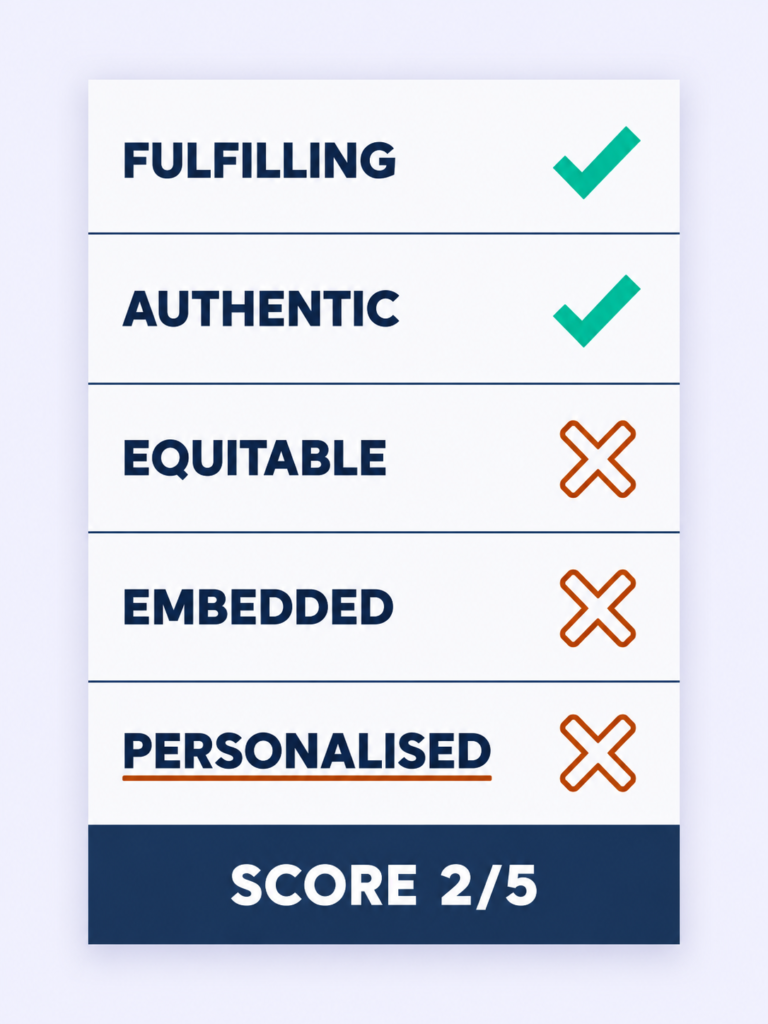
Employees whose recognition meets four or five pillars are nine times as likely to be engaged as those whose recognition meets none. Recognition meeting a single pillar still makes an employee 2.9 times as likely to be engaged.
Source: Gallup and Workhuman, Employee Retention Depends on Getting Recognition Right (2024)
Translation: the 2.9x is the number that matters if you have no budget. Fixing one pillar is worth doing on its own, which makes the first pillar the cheapest win in this entire guide.
How to execute:
1
Day 1: Pull 90 days of records
Export everything from the platform. If there is no platform, pull it from manager one-to-one notes and team channels, because informal recognition is still recognition and it still leaves a trace.
2
Day 2: Compute coverage and concentration
Coverage is the percentage of headcount who received any recognition. Concentration is the share of total recognitions going to the top 10% of recipients. Two numbers, one spreadsheet, no analytics team required.
3
Day 3: Score 20 events against the pillars
Sample 20 recognition events at random. Score each one yes or no against all five pillars. No partial credit, because partial credit is how a failing programme scores 3 out of 5 on everything.
4
Day 4: Interview ten people
Five recipients and five people who received nothing. Two questions each: what recognition do you remember, and what would have meant more. The second group tells you more than the first.
5
Day 5: Score out of five and name the defect
Score the programme, name the single lowest pillar, and stop there. Fix one pillar per quarter, not five at once, because five simultaneous changes produce no attributable result.
That is a week of work and it produces a named, ranked, evidenced defect. It is also the version of people analytics without a data team that most HR functions can run.
One pillar deserves separate treatment, because it is the least-discussed failure in the whole category.
Recognition flows to visible work. Visible work flows to customer-facing and project-lead roles. And those roles are not distributed evenly by tenure, function, shift, or demographic, which means a recognition programme can encode existing visibility bias and then amplify it.
Two causes do most of the damage. Managers recognise the people they talk to most, and platform leaderboards reward the already-visible.
◆ FROM THE LAB
The Sofia lens: when I ran a diversity initiative on the hiring pipeline, the aggregate numbers looked acceptable and told me nothing. So I stopped reporting the average and started measuring diverse slate ratios at each individual interview stage.
The spread was the finding. The average had been hiding a stage where the drop-off was happening, and once I could see it, it was fixable within a quarter. Apply exactly that method to recognition data. Look at the spread, never the average.
Measure recognition per head by team, by shift, by tenure band, and by any demographic dimension already sitting in your reporting. Then look at the distribution, not the mean.
The fix is unglamorous and effective. Send every people manager a monthly coverage report showing exactly who on their team has received nothing in 90 days. It is the same discipline that makes DEI measurement that survives scrutiny work.
⚠ WATCH OUT
Red flag: a recognition distribution that correlates with a protected characteristic is a cultural and legal risk, and it is one you would very much rather find yourself than have found for you. Measure it before someone else does. This is not legal advice, and anything you find here should be routed through your employment counsel and your data governance owner.
Employee Recognition Examples That Hold up in Practice
Most example lists are message libraries or idea dumps of 30 items with no cost, no owner, and no failure mode attached. They are pleasant to read and impossible to implement.
Here's how to build it:
Every example below carries four fields: what it costs, how often it can run, who owns it, and how it fails. They are organised against the taxonomy above, so you can pick by channel rather than by inspiration.
Manager-to-employee recognition examples
The specific-act message inside 48 hours. The highest-frequency, lowest-cost instrument in this entire guide, and the one most managers skip because they are waiting for a reason big enough to justify it. Owner: the manager. Fails when it becomes a weekly habit with no specific act attached, at which point the team learns to discount it.
Recognition in the team's own working forum. Post it where the work happens, not in a recognition portal nobody opens. Cadence: as often as the act occurs. Owner: the manager. Fails when the forum is a channel the team has already muted.
The skip-level nomination. The manager writes to their own manager and copies the employee, which converts a private thank-you into a career-relevant record. Cadence: monthly at most. Owner: the manager. Fails if the skip-level never responds, which turns it into a broadcast.
The constraint gift. An hour of protected focus time, or the removal of a low-value recurring meeting, given explicitly as recognition rather than quietly. Cadence: quarterly. Owner: the manager. Fails when it is given without naming why, at which point it reads as calendar admin.
The story retold at the team meeting. Name the specific decision the person made, not the outcome they produced, because outcomes are often luck and decisions rarely are. Cadence: weekly. Owner: the manager. Fails when the same person is the subject three weeks running.
Three of those five cost nothing but attention, which is the entire argument for running one-to-ones that aren't status updates.
Peer-to-peer recognition examples
The standing agenda slot. Three minutes at the start of a weekly team meeting where anyone names someone outside the team who unblocked them. The cross-team version is the one nobody builds and the one that pays. Owner: the meeting chair. Fails when it becomes internal-only and turns into mutual appreciation.
The nomination with a budget attached. Peers can award a small fixed-value item without approval. That single feature is what separates a real peer programme from a comment feed. Owner: the programme owner sets the limit. Fails without a published spend cap.
The handover thank-you at the project retro. Name the person whose work made someone else's work possible. Cadence: per project. Owner: the retro facilitator. Fails when retros get cancelled under delivery pressure, which is when it is needed most.
A status tier for the concentrated few. Identify the 5% to 10% who carry the channel, then give them status and access rather than cash, and the channel compounds. Owner: the programme owner. Fails if the tier is awarded on volume rather than on quality.
⚠ WATCH OUT
Anti-pattern: peer recognition degenerates into a reciprocity ring where the same cluster thanks each other in rotation. The tell is healthy volume with flat coverage, which looks like success on every dashboard a vendor will show you. Put a concentration metric on the peer layer from day one.
Milestone and career recognition examples
The tenure milestone reframed as a choice. The employee picks between a development budget, an experience, or time off. This fixes the personalisation pillar for the one programme almost every company already funds, at no additional cost. Owner: HR operations. Fails when the choice list is three variations of the same thing.
The internal move made explicit. When someone moves internally, say publicly why they were chosen. That converts a routine transfer into recognition of potential, and the First Look policy above produced a 23% internal hire rate on exactly that logic. Owner: the receiving manager. Fails when the announcement is a one-line org chart update.
The first-90-days moments. Covered in depth later in this guide, because early tenure is where recognition has its highest marginal return. Owner: the hiring manager.
The departure acknowledgment. Recognising a leaver's contribution properly is what makes a boomerang hire possible eighteen months later, and it is the cheapest input into silver medalist re-engagement you will ever find. Owner: the manager. Fails when it is done only for people leaving on good terms with senior sponsors.
◆ PRO TIP
Pro tip: the choice reframe costs nothing and fixes the weakest pillar in the standard. You are not asking finance for money. You are asking them to let you spend money they have already approved in a different shape.
Frontline, shift, and deskless recognition examples

I hire into this population. Engineering and manufacturing is my specialisation, and a large share of the roles I have filled belong to people with no laptop, no company email address, and no reliable shift overlap with their own manager.
Shift-handover recognition. The outgoing supervisor names one thing in the handover log. Often the only cross-shift channel that reliably exists. Owner: the supervisor. Fails when the log is treated purely as an incident record.
Physical artefacts at the point of work. A board on the floor, not a portal, because digital recognition is invisible to someone who never logs in. Owner: the site lead. Fails when nobody owns updating it.
Recognition routed through the manager-of-record. Where shift patterns mean the nominal manager rarely sees the work, route it through whoever does. Owner: the programme owner. Fails when the org chart is treated as the source of truth about who observes the work.
The messaging channel the workforce uses. Where SMS or a messaging app is genuinely the medium, use it, and get consent and data handling signed off first. Owner: HR operations with data governance. Fails when it is deployed without consent.
⚠ WATCH OUT
Warning: recognition platforms are sold on engagement metrics computed over logged-in users. That makes deskless populations statistically invisible and lets a failing programme report success indefinitely. Compute adoption over headcount, not over logins. Your numbers will get worse and your programme will get better, and the same arithmetic problem shows up across high-volume hiring.
Recognition wording that isn't hollow
Managers freeze at the blank message box and default to "great job team," which trains everyone reading it to discount recognition entirely. A library of fifty templates does not fix that. A formula does.
Name the specific act. Name what became possible because of it. Name what it says about how they work.
Three parts, thirty seconds, and it sounds like the manager rather than like a platform. The specificity test is simple: if the message could have been sent to anyone else on the team, it fails.
The old way
- Manager to individual: "Great work on the launch."
- Peer to peer: "Thanks for all your help this week."
- Leader to team: "Proud of what this team achieved."
- Customer-sourced: "A client said nice things about you."
The Lab Way
- "You caught the pricing error on Tuesday before it reached the customer. That saved us a credit note and a difficult call. You check things nobody asked you to check."
- "You rewrote the handover doc so I could pick up your queue on Thursday. I lost no time at all. You hand work over the way you would want to receive it."
- "This team moved the migration date forward by two weeks by cutting scope rather than cutting testing. That was a hard call and you made the right one."
- "The client named you specifically in their review call, for staying on the line until their integration worked. I have added the transcript to your file."
Six openers that cover the highest-frequency situations, for managers who want a starting point rather than a blank box:
- "You did X on [day]. It meant Y. That tells me Z about how you work."
- "I want to name a decision, not a result. You chose to..."
- "Nobody asked you to do this, which is why I am mentioning it."
- "This is the second time you have caught something like this. It is a pattern now."
- "Your work made [named colleague]'s work possible. They asked me to pass that on."
- "I am copying [skip-level] because this belongs on a record, not just in a message."
Two words to delete from every recognition message: "just" and "always." The first shrinks the contribution and the second makes it generic, and between them they neutralise most well-intentioned praise. That is also the shortest possible definition of feedback that changes behaviour.
How to Build an Employee Recognition Programme
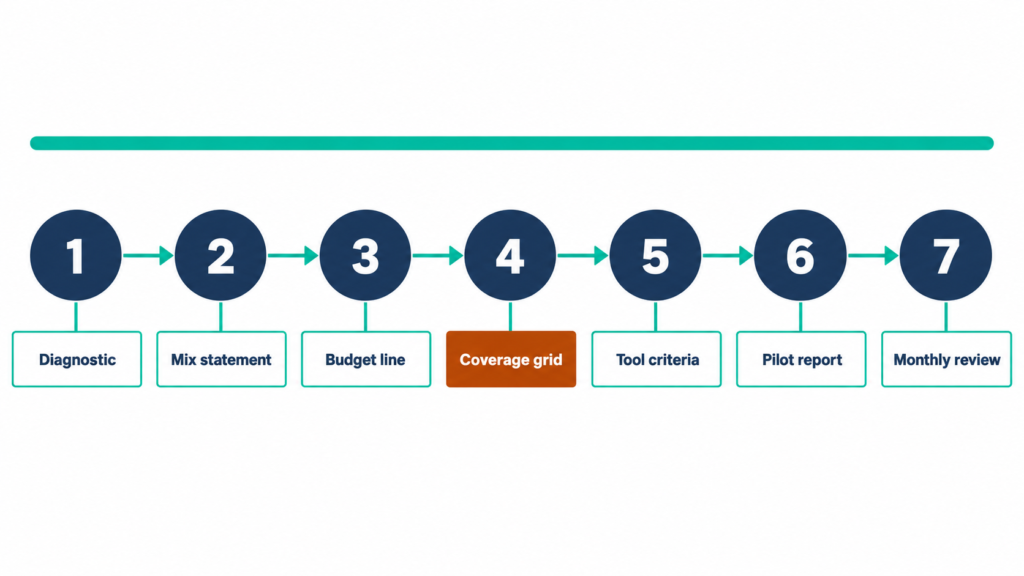
Most published build guides run to five steps: set goals, choose a platform, launch, promote, measure. No artefact, no duration, no owner. You cannot work from that.
The old way
- Book vendor demos in week one
- Design the programme around the winning tool
- Launch company-wide with a CEO email
- Report activity, then wonder why it faded
The Lab Way
- Baseline three numbers before designing anything
- Publish a signed mix statement as the requirements document
- Pilot one population for a quarter
- Report coverage monthly to the people who can change it
Here's how to build it:
1
Step 1: Diagnose before you design
Two weeks. Run the pillar audit against whatever exists today, including when what exists is nothing formal, because informal recognition still leaves a trace in team channels and one-to-one notes.
My own operating habit transfers directly here. In Talent Acquisition I use Talent Market Pre-Alignment, which means mapping the market before a requisition is ever opened rather than reacting once the vacancy exists. Diagnose the terrain before you build the process.
Artefact produced: a one-page diagnostic naming the lowest pillar, the current coverage percentage, and the current concentration percentage.
- Lowest-scoring pillar, named
- Coverage: percentage of headcount recognised in 90 days
- Concentration: share of recognitions going to the top 10%
Launch without a baseline and you can never prove the programme worked. That is exactly how recognition budgets die in year two. If you need the method, it is people analytics without a data team and it takes a spreadsheet.
2
Step 2: Write the mix statement
One week. Convert the four dimensions into a published one-pager: your two strategic priorities, and for each one the trigger, the source, the formality layer, and the reward band.
Then add the line no competitor mentions. State what you are deliberately not recognising, because a programme that recognises everything signals nothing.
Artefact produced: the one-page mix statement, signed by the sponsor. Treat it the way you would treat HR strategy on one page, which is to say as a document that gets referenced rather than filed.
3
Step 3: Name the owner and the budget line
One week. Recognition without a named owner is a project. With one, it is a programme. Four things constitute it, and "buy-in" is not one of them.
- A single accountable owner, usually the HR Business Partner for that population, never "HR" as an entity
- A named executive sponsor
- A budget line that is not a discretionary pool inside someone else's budget
- Delegated manager spend authority, with a published limit
Set the budget as a percentage of payroll for the population in scope, then split it across the four bands. The clear majority should sit in the social and symbolic bands, which cost time rather than money.
On winning the argument: the only people-programme budget case I have ever won cleanly was the agency-fee one, where reliance dropped 60% to 70%, roughly ₹8 to ₹10 lakh was avoided per senior hire, and four of six senior roles closed without an agency. It worked because the baseline was recorded first. That is building the business case for a people programme in one sentence.
⚠ WATCH OUT
Warning: a discretionary pool sitting inside an engagement or L&D budget is not a budget line. It is the first thing raided when either of those comes under pressure, and you will not be in the room when it happens.
4
Step 4: Train managers on what they get wrong
Two weeks. Most recognition training covers why recognition matters. Managers already believe it matters. That is not the gap.
Three specific things go wrong. They wait for a reason big enough to justify saying something. They recognise outcomes they can see rather than behaviour they would have to ask about. And they recognise the same three people.
How to execute:
- Write a specific-act message for someone on your team, now, in the room
- List every direct report and mark who you last recognised and when
- Pick one behaviour from the mix statement and commit to recognising it twice this month
Ninety minutes, three exercises. The second one is where the concentration problem stops being abstract, because a manager staring at their own grid cannot unsee it.
Artefact produced: every manager leaves with a completed coverage grid for their own team. This is the single highest-leverage step in the list, and as the data in the next section shows, it is also the one most organisations skip. It works best where manager capability is already being developed rather than assumed.
5
Step 5: Choose the mechanism last
Two weeks, and deliberately fifth rather than first. The mix statement is your requirements document, so the tool either serves it or it does not.
I hold one position on tools that has never let me down: a tool amplifies a capability, it never substitutes for one. My verdict on sourcing platforms is that the tool does not replace sourcing skill, and recognition platforms sit in exactly the same category. Five criteria separate them.
- Does it support all five sources, or only manager-to-employee?
- Does it expose coverage and concentration, or only volume?
- Does it work for users with no corporate login?
- What does the raw data export look like, given you need it quarterly?
- What happens to accrued points if you change vendor in year three?
Ask the fifth question in the first demo. The answer tells you how the commercial relationship is designed, and it is the question vendors least expect. Apply the same discipline you would to any HR tech evaluation.
◆ PRO TIP
The honest downside: for smaller populations the correct answer is no platform at all. A channel, a shared board, and a manager cadence will outperform a tool nobody logs into, and it will cost you nothing to reverse if you are wrong.
6
Step 6: Launch to one population, not the company
Four to six weeks to set up, then a full quarter to run. Pick one population of 100 to 400 with a manager group that will genuinely engage, and instrument it from day one on coverage, concentration, latency, and manager adoption.
The pilot exists to answer two questions. Which source channel does this population use, and do managers sustain the cadence past week three?
My high-volume hiring governance transfers here without modification: daily recruiter stand-ups, a real-time tracker everyone can see, and a weekly war-room call with the managers who own the numbers. The programmes that survive are the ones with a weekly number somebody is accountable for, which is also why high-volume hiring either runs on a cadence or does not run at all.
Artefact produced: a pilot report with the four metrics and a go or no-go recommendation.
⚠ WATCH OUT
Watch out: week three is where recognition programmes die. The launch energy has gone, the novelty has gone, and nothing has replaced them yet. Put a named checkpoint in the calendar at week three before you launch, not after you notice the drop.
7
Step 7: Run the review that keeps it alive
Ongoing, and this is the step where the title of this guide gets earned. Three separate rhythms, each with an owner.
- Monthly: a coverage report to each people manager, naming who on their team has received nothing in 90 days
- Quarterly: a pillar re-score using the Day 3 sampling method from the audit
- Annually: a mix statement review against current strategic priorities
Report one number upward, and make it coverage rather than volume.
Volume is the number that stays healthy while the programme dies.
Volume is what a vendor dashboard is built to optimise, and it will look fine for a year after the informal layer has stopped. Coverage will not. That is also why an engagement survey design question is a confirmation of decay, never an early warning of it.
If this is the section you came for, the rest of the Lab works the same way. Field-tested frameworks, real metrics, and the honest version of what each one costs, delivered weekly to people who have to make this work on Monday. The newsletter is where the next blueprint lands first.
How to Measure Employee Recognition
Your platform dashboard reports messages sent and points redeemed. Neither one tells you whether the programme is working, or who it is failing.
This is the same substitution I spent years arguing about in Talent Acquisition. I report Time-to-Offer and Quality of Hire rather than requisitions closed, because activity metrics reliably hide outcome failures and they do it while looking green.
| Metric | Formula | What bad looks like | Likely cause |
|---|---|---|---|
| Coverage rate | Headcount receiving at least one recognition in 90 days, divided by total headcount | Below 50% | Manager-only channel, or a deskless population with no route in |
| Concentration | Share of total recognitions received by the top 10% of recipients | Above 50% | Leaderboards, visibility bias, reciprocity clusters |
| Latency | Median days between the act and the recognition | Rising month on month | Managers batching recognition into a review cycle |
| Manager adoption | People managers recognising at least half their team in 90 days, divided by all people managers | Below 40% | No training, no cadence, no coverage report |
Four metrics, not the twenty a platform will offer you. These four answer the only questions that matter: does recognition reach people, does it reach them fairly, and does it reach them fast.
Why this works:
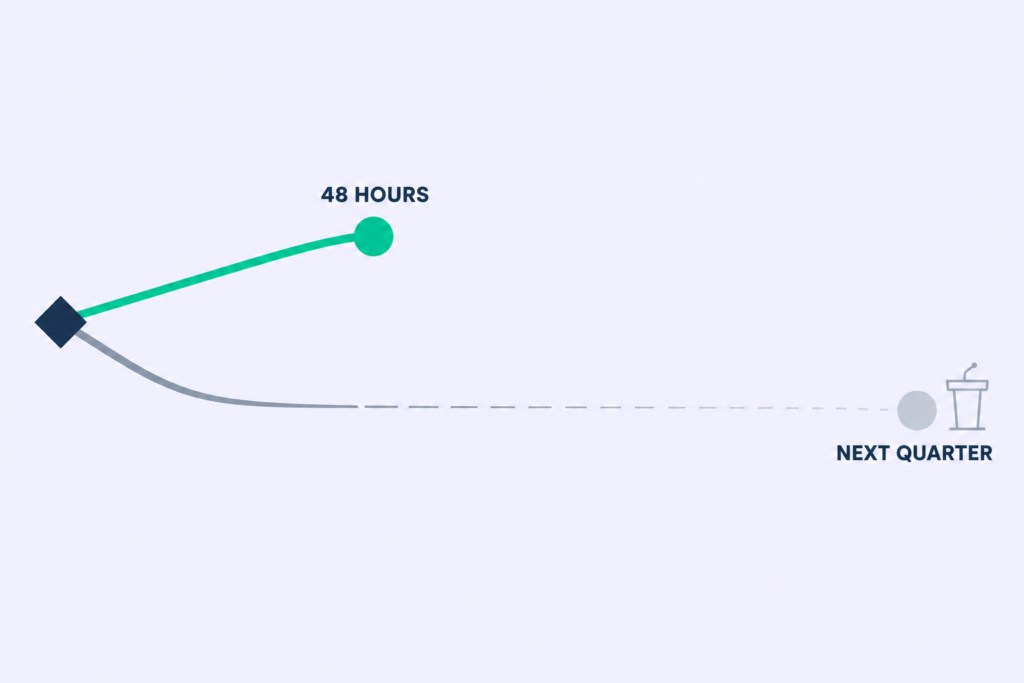
Latency is the one nobody tracks and the one that predicts decay. It behaves the way Time-to-Fill does, degrading quietly, and it is a leading indicator rather than a lagging one.
Recognition delivered inside 48 hours is a signal about the act. Recognition delivered at the quarterly awards is a signal about the process. Those are different messages and employees read them correctly.
A rising median tells you something specific: managers have started batching recognition into a review cycle, which means the informal engine has stopped and only the formal layer is still running. I watched the same pattern in hiring when Time-to-Offer sat at 68 days, and pulling it down to 34 exposed every broken handoff in the process before any outcome metric moved. If you want the method, it is the same one behind reducing time-to-offer.
◆ PRO TIP
Pro tip: most platforms record the recognition date and not the act date, which makes latency look uncomputable. Sample it instead. Take 20 events a month, ask the giver when the act happened, and track the median. Twenty data points beat an unmeasured metric.
Then there is the question you will be asked directly: does this reduce attrition here, in this company. External research is the weakest possible answer in that room.
Join your recognition records to your exit dataset for the last twelve months. Compare recognition coverage in the six months before exit for leavers against matched stayers, matched on function, tenure band, and manager where you can.
Lead with the delta rather than the level. A drop in recognition in the 90 days before a resignation is a far more interesting signal than a low absolute level, and it is the version of attrition analysis that changes what a manager does next month.
⚠ WATCH OUT
Warning: this analysis is correlational and you must say so out loud. High performers are both recognised more and leave less, for reasons that have nothing to do with each other, and the direction of causation is genuinely ambiguous. Individual-level analysis of recognition records is employee personal data, so route it through whoever owns your data governance before you run it.
What goes in front of the executive committee is one slide, and it contains four things.
- Coverage rate trend over 12 months
- Concentration trend over the same period
- The current lowest pillar and its score
- One named story from the quarter with a business outcome attached
The story belongs on the data slide for a practical reason. The number gets the budget renewed, and the story gets the managers to participate, and you need both.
Leave off points issued, messages sent, platform logins, and any vendor-supplied engagement index. That discipline is what separates HR reporting for the board from a dashboard screenshot.
Where Recognition Programmes Break, and How to Fix Them
Four structural failure modes account for most of what goes wrong. Each one has a symptom you can observe, a diagnostic you can run, and a fix you can execute.
Here's the deal:
Failure 1: Leadership treats it as a nice-to-have
Three symptoms, all unambiguous. No budget line. No manager training. No executive who owns it.
If you recognise all three, the obstacle is structural rather than personal, and the data says so plainly.
27%
Organisations providing manager training on how to recognise well. Only 19% of leaders call recognition a strategic priority, and only 34% allocate a budget for it. On the pillars themselves, 10% of employees strongly agree their recognition is personalised and 19% that it is embedded in the culture.
Source: SHRM, Is Your Employee Recognition Program Falling Flat?, reporting the Gallup and Workhuman survey of 7,636 U.S. employees, fielded 2022.
Those figures come from a 2022 survey, and the direction has since moved: senior leaders strongly agreeing that recognition matters rose from 28% in 2022 to 42% by 2024. Translation: your under-resourced programme is the norm rather than your local failure, and you are pushing on a door that has started to open.
The counter-move is to stop arguing recognition as a value and start arguing it as a retention line item, using the arithmetic from earlier in this guide. Culture arrives as the bonus, never as the pitch. That reframe is the core of building the business case for a people programme.
Failure 2: The programme runs on volume, so it optimises for noise
The mechanism runs end to end and you will recognise your own programme in it. Platforms report volume. Leaders reward the volume number. Managers respond by producing volume.
And recognition becomes background noise that recipients learn to discount, which is worse than having no programme at all, because you have now trained the discount.
◆ FROM THE LAB
My experience: I spent years being told that more applications meant better hiring. They never did. The right five candidates beat five hundred wrong ones, every single time, and the five hundred cost more to process.
More recognition does not mean better recognition. It is the same error wearing different clothes, and it is just as expensive.
The diagnostic is precise: rising volume with flat or falling coverage. The fix is equally precise. Change the number you report upward to coverage, and switch the leaderboards off. The parallel to quality over volume in sourcing is exact.
The old way
- Run leaderboards
- Report monthly volume
- Celebrate when the number goes up
The Lab Way
- Switch leaderboards off
- Make coverage the headline number
- Report a smaller number that means something
Failure 3: Recognition concentrates and nobody measures it
The pattern in practice: the same three names appear in every round, while the quiet high performer in a back-office function has appeared in none. Nobody has complained, so nobody has looked.
The diagnostic is the concentration metric. The fix is the monthly manager coverage report. Both are covered above and neither takes more than an hour a month once it is set up.
⚠ WATCH OUT
Red flag: recognition data is people data. A distribution pattern that correlates with a protected characteristic is a finding you would very much rather discover yourself than have discovered for you in a grievance, and the same measurement logic applies as in DEI measurement that survives scrutiny.
Failure 4: It was launched as a platform, not a practice
You have lived through this one. A tool gets bought, a comms campaign runs, usage spikes for three weeks and then decays to a small core of enthusiasts who would have recognised people anyway.
The reason is precise. The tool created a place to recognise and never created an occasion to.
So attach every recognition practice to something that already happens. A standing agenda slot in a meeting that already runs. A line in a handover log that is already written. A prompt in a one-to-one that is already in the calendar. That is a cheaper fix than any HR tech evaluation will produce.
◆ PRO TIP
The catch: new rituals decay and existing ones do not. If your recognition practice needs a new meeting to survive, it will not survive the first quarter where that meeting gets cancelled for delivery pressure.
The old way
- Launch a tool
- Run an adoption campaign to compensate
- Blame low engagement on communication
The Lab Way
- Attach recognition to three rituals that already run
- Let the tool do nothing but record it
- Measure the occasion, not the login
Recognition Across Borders: What Changes When You Run It In Multiple Markets
Global mobility is part of my remit, and I have watched more than one multi-market people programme stall between announcement and launch. Never on the design. Always on something nobody thought to check.
Four variables change by market, and each one carries a practical consequence.
- Public versus private preference. In several markets, individual praise in front of peers is genuinely uncomfortable and team-level recognition lands better. Do not assume in either direction. Ask, and record the answer
- Tax and benefit treatment of non-cash awards. Varies by country and by value threshold, which changes what you can offer and at what value. Route it through payroll and local finance before launch
- Works councils and employee representative bodies. In parts of Europe they may require consultation on programmes that collect behavioural data or rank employees against each other
- Local calendar and holiday alignment. Milestone timing that works in one market lands during a public holiday in another
⚠ WATCH OUT
Warning: tax treatment and works council consultation are the two things that stop a launch after the comms have already gone out. Both are checkable in a fortnight and neither is checkable retrospectively. Recognition platform data is also employee personal data, so GDPR and equivalent regimes apply to behavioural data collection, profiling, and cross-border transfer. None of this is legal advice, and all of it should go past your employment counsel and your global HR governance owner before launch.
But here is the catch: neither a single global template nor fourteen unrelated local programmes works. You need one global mix statement with a local implementation annex.
The five pillars are the right thing to standardise globally, and the reason is structural. The pillars are properties of quality rather than of form, so they survive translation intact.
Form is precisely the thing that should vary. Public or private, cash or non-cash, ceremony or message, all of it is local judgment about local people.
The old way
- Design in headquarters, translate the comms
- Roll out on a single global date
- Or devolve entirely and lose all comparability
The Lab Way
- Global owns the mix statement, the pillar standard, and the metric definitions
- Local owns channel, form, value, and calendar
- Compliance check before the announcement, not after it
When Employee Recognition Backfires

Almost nothing published on this topic admits that recognition can do harm. It can, in three specific ways, and the managers doing the damage will usually never hear about it.
Here's the deal:
Public recognition can single someone out in a team whose norm is collective credit, which converts a reward into a social cost the recipient pays quietly for weeks.
It can publicly expose that a person worked a weekend, which reads to everyone in the room as an endorsement of the behaviour that caused it. You have just told the team what the price of visibility is here.
And it can create resentment when the recognised work visibly depended on invisible contributions from other people, none of whom were named.
⚠ WATCH OUT
Anti-pattern: "praise in public, criticise in private" as a universal rule. Recognise the outcome and name the contributors, or recognise privately. And never publicly recognise a sacrifice you do not want repeated, because the team will read it as policy. One question solves almost all of it: "would you be comfortable if I shared this with the team?" Ask it before, not after. It also catches most of the workload and burnout signals you would otherwise reinforce.
The second failure is bigger, and it is the one I feel most strongly about.
An organisation that cannot promote, cannot pay market rate, or cannot fix a workload problem responds by increasing recognition activity instead. Everyone can see the substitution. Recognition rises and nothing changes.
◆ FROM THE LAB
Real talk: recognition used to paper over a systems failure does not delay the exit. It accelerates it, because it tells people the organisation knows and has chosen not to act. That is a worse message than silence, and it is a message you paid for.
The diagnostic is easy to run and uncomfortable to look at: recognition volume up, engagement flat or falling, and free-text comments referencing pay or progression. If you are seeing all three, stop the campaign.
Recognition delivered alongside an honest statement about what cannot change this year keeps its credibility. Recognition delivered as a distraction from it destroys the programme and some of the trust around it.
The fix is uncomfortable and correct. Name the constraint out loud, then recognise honestly within it, which is the only version of this that survives contact with people who already know why employees leave.
The third failure is subtler and it takes months to show up. When a behaviour people were doing for their own reasons starts attracting a payment, some of them begin doing it for the payment, and stop when the payment stops.
The at-risk cases are identifiable in advance. Voluntary discretionary behaviours: mentoring, knowledge sharing, helping other teams, maintaining internal documentation that nobody is assigned to own.
The design rule follows directly. Pay for output, recognise for discretionary behaviour, and never convert a thriving voluntary behaviour into a paid one without expecting the volunteers to reprice it. The Talent Scout programme above is the counter-example that proves the rule: status and access, not cash, is what made that channel compound, which is the whole argument behind sensible employee referral programme design.
◆ PRO TIP
Real talk on the evidence: this effect is context-dependent, not a law. It shows up reliably in some settings and not at all in others, and anyone telling you that money never motivates people is overselling it. Treat it as a risk to design around, not a certainty to plan on.
Employee Recognition in the First 90 Days
A new joiner has no track record inside your organisation, no internal reputation, and no evidence yet that they made the right decision leaving their last job.
Recognition inside that window does something it cannot do at any later point. It confirms the choice.
And early-tenure attrition is the most expensive attrition there is, because the entire acquisition cost has been spent and none of the productivity has come back. My internal mobility data sizes the window precisely: an internal move reached productivity in 28 days, an external hire in 67. That gap is how long a new joiner goes with no evidence they are succeeding.
Here's what changed everything:
Three named moments, owned by the manager, sitting on the onboarding checklist alongside the laptop and the system access.
- The first contribution shipped, whatever "shipped" means in that role. Named specifically, within 48 hours
- The first question that improved something. This recognises the outsider's perspective before it erodes, which it does within about a quarter
- The 90-day mark, with a specific named summary of what they have added. Not a generic welcome, and not a form

Most onboarding programmes cover process, access, and paperwork thoroughly, then stop before anyone tells the new joiner they are doing well. That is the gap, and it is the cheapest one on this list to close. It belongs in the same design as onboarding that survives week two.
Then there is the cohort problem, which is where this gets genuinely hard.
When a large cohort onboards at once, individual recognition does not scale and generic cohort messaging reads as automated, which is worse than silence. Three mechanisms do scale, and only one of them is centralised.
◆ FROM THE LAB
Real implementation: earlier in my career I was handed a ramp-up of roughly 350 to 500 hires across customer support, operations analysts, junior engineers, and sales support, against an 8 to 12 week window driven by a business start date nobody was willing to move.
We planned capacity backwards from that date, ran multi-channel sourcing, moved to batch interviews with structured scorecards, and held daily recruiter stand-ups against a real-time tracker. We delivered 420-plus hires in 10 weeks. Turnaround Time fell from 32 days to 18 to 20, recruiter productivity rose by around 35%, and offer-to-join held above 90%. The cohort's 90-day retention landed at 85% to 88%, in line with historical benchmarks.
To be clear about what that last number is and is not: we ran no formal recognition programme in that campaign, and I will not claim the retention figure for one. What we did run was acknowledgment design. A single named point of contact per batch, so there was always a human to ask. Committed communication dates that we met, which sounds trivial until you count how many organisations quietly miss them. And pre-joining engagement, so the offer period was not silence.
The transferable lesson is an arithmetic one. Talent Acquisition can own the dates. It cannot own the words, and every attempt to centralise individual acknowledgment produces exactly the automated tone it was trying to avoid.
So distribute it. One specific individual acknowledgment per person from their actual manager inside the first 30 days is a manageable ask even at cohort scale, precisely because it is spread across managers rather than concentrated in HR. Anyone running high-volume hiring already has the batch structure to make that assignable.
◆ PRO TIP
The honest downside: this only works if managers of new cohorts are told it is their job, in writing, with a date. Left as an encouragement, it will be done by the managers who were already doing it and by nobody else.
What AI Changes about Recognition in 2026, and What it doesn't
Every renewal conversation now includes an AI recognition feature, and almost none of them are described in a way that lets you evaluate the claim.
Here's the difference:
Three uses are real, in ascending order of how loudly they are marketed and descending order of how much they are worth.
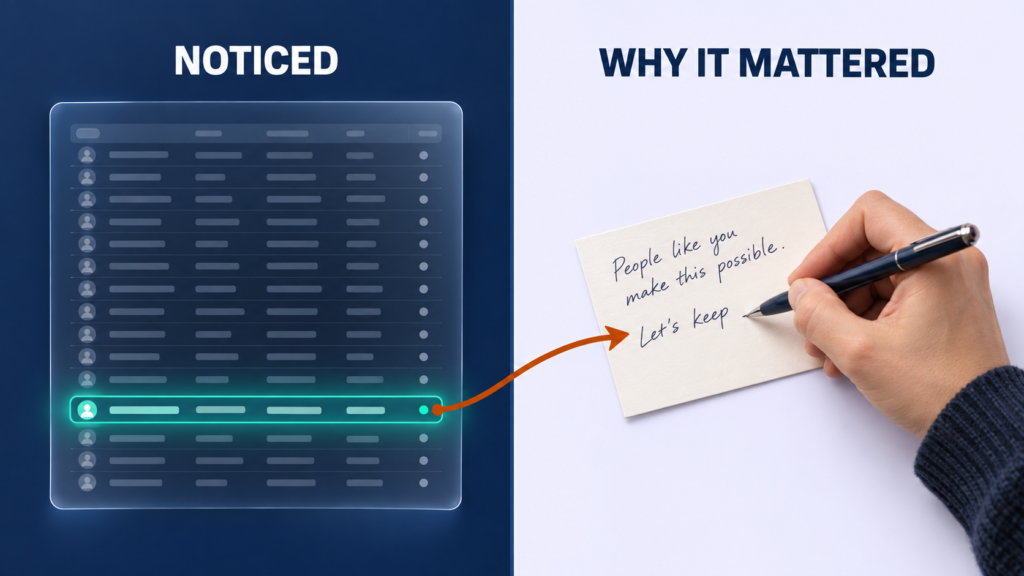
Detecting coverage and concentration gaps automatically, then prompting the specific manager whose team has someone sitting at 90 days with nothing. This is the highest-value application in the category and almost nobody sells it, because it makes the buyer's numbers look worse before they look better.
Surfacing contributions that are structurally invisible to a manager. Work logged in another team's system, a documentation fix, a handover that prevented an incident nobody ever heard about.
And drafting assistance for the manager who freezes at the blank box, with one hard constraint: the manager supplies the specific act. Without that, you have automated the exact thing that made recognition worth having.
◆ FROM THE LAB
The Sofia lens: I led AI-driven prompt engineering and digital transformation inside a recruitment function, and my position has not shifted since. AI is a co-pilot, never a decision-maker.
It earns its place by absorbing high-volume, low-judgment work so people can do the high-touch work that only they can do. Human-led validation at every decision point, without exception. Applied to recognition, that means AI is good at detection and weak at meaning.
Which is why the old framing has it backwards. AI writing the recognition message so managers do not have to is the wrong trade. AI finding the person nobody noticed, and the human saying why it mattered, is the right one. That is the same test I apply to any tool in AI in HR without the hype.
Two failures are structural rather than fixable with a better model.
Recognition the recipient can tell was generated is worse than no recognition at all. It converts a signal of attention into a signal of automation, which is the precise inverse of the authenticity pillar, and it is unrecoverable once noticed.
The second is less obvious. Algorithmic detection inherits the visibility bias already sitting in your historical data, so a system that learns what recognition looks like from your existing records will surface the same already-visible people. Your concentration problem gets worse while wearing the appearance of objectivity.
⚠ WATCH OUT
Warning: three risks I track on every AI deployment map straight onto recognition. Algorithmic bias, where flawed training data reinforces historical prejudice. Loss of the personal touch, which is the entire product here. And the automation arms race, where dependency grows simply because everyone else is automating. The third is the one nobody budgets for. See also algorithmic bias in HR systems.
◆ PRO TIP
Pro tip: the governance rule is three lines. AI may suggest who. A human must supply why. And the concentration metric gets re-run 90 days after any AI feature is switched on, against the number you recorded before you switched it on.
Employee Recognition FAQ
What is employee recognition?
Employee recognition is the deliberate acknowledgment of an employee's behaviour, effort, or results by someone whose opinion carries weight with them. It works by making a specific contribution visible and attaching value to it. Run as a system rather than a gesture, it is one of the lowest-cost retention levers available to an HR team.
What are the main types of employee recognition?
Employee recognition varies along four dimensions rather than falling into a fixed list. Formality: formal or informal. Source: manager, senior leader, peer, upward, or customer. Trigger: results, behaviour, effort, milestone, or potential. Value: social, symbolic, tangible non-cash, or cash. Most published "types" lists present one of these dimensions as if it were all of them.
What is the difference between employee recognition and employee appreciation?
Recognition responds to something a person did, whether a behaviour, an effort, or a result. Appreciation acknowledges the person's value regardless of output. Both matter and they do different jobs: recognition tells people what to repeat, appreciation tells people they belong. Substituting one for the other is the most common design error in the category.
How do you measure employee recognition?
Track four metrics rather than volume. Coverage: the share of headcount receiving any recognition in 90 days. Concentration: the share of all recognitions going to the top 10% of recipients. Latency: median days between the act and the recognition. Manager adoption: the share of managers recognising at least half their team in 90 days.
Does employee recognition reduce employee turnover?
The research shows a strong association. Gallup and Workhuman found well-recognised employees 45% less likely to have left two years later. But it is an association, not a guarantee, and recognition cannot offset below-market pay, a blocked career path, or a poor manager. Treat it as one retention lever among several.
Start with the system you already have
You already run a recognition system. Every organisation does. The only question is whether anyone designed it, and what it has quietly been teaching people to value.
The organisations that get a return on recognition are not the ones spending most. They are the ones reporting coverage instead of volume, and re-scoring one pillar a quarter instead of relaunching the whole thing every two years.
That distinction is about to matter more, not less. Gartner predicts that more than 20% of digital workplace applications will use AI-driven personalisation algorithms by 2028. Detection is getting cheaper fast.
Which is the argument for doing the design work now rather than waiting for the tooling. A better detector pointed at an undesigned programme just finds the same three people faster.
So pick one population. Run the five-day audit. Name the single lowest pillar, fix that one over the next 90 days, and re-score it. Not all five. One, with a before-number you wrote down.
The Lab newsletter carries the next blueprint before it goes anywhere else, and it is written for people who have to make this work on a Monday. If you are building or repairing a recognition programme in your own organisation, or you have run the pillar audit and found something you did not expect, connect with me on LinkedIn and tell me what the spread looked like. That is the conversation I want to be having.
