
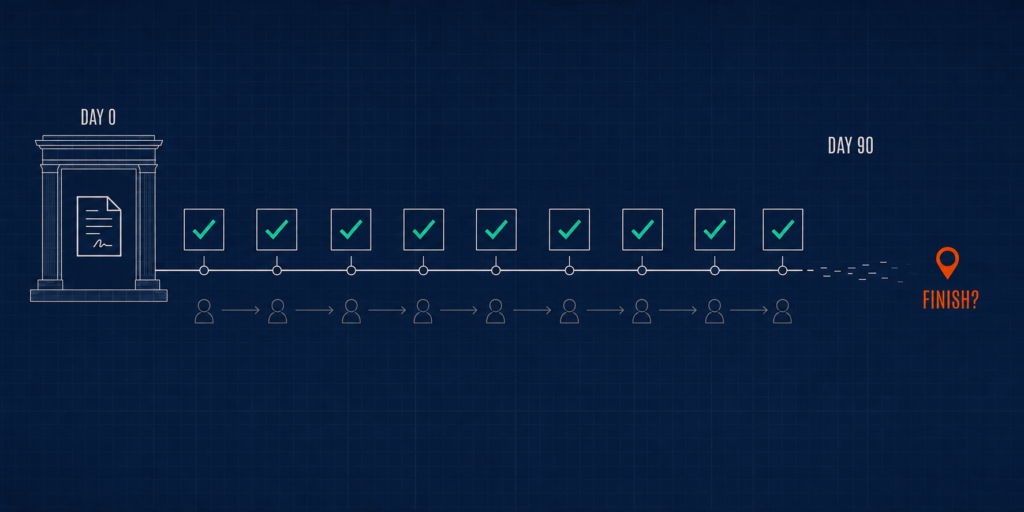
Eight years of running high-volume hiring taught me that the moment a requisition closes is the least reliable moment in the entire process.
You already have employee onboarding process. It is documented. There is a checklist, a welcome email template, and a buddy assignment.
And your new hires are still taking four months to become useful. They are still asking who to go to about an approval in week six, and roughly one in six of them is gone before the probation review.
A process has a finish line. Yours has a start date and a list of tasks, and no answer to the question every one of those tasks is supposed to serve: how do we know this person is onboarded?
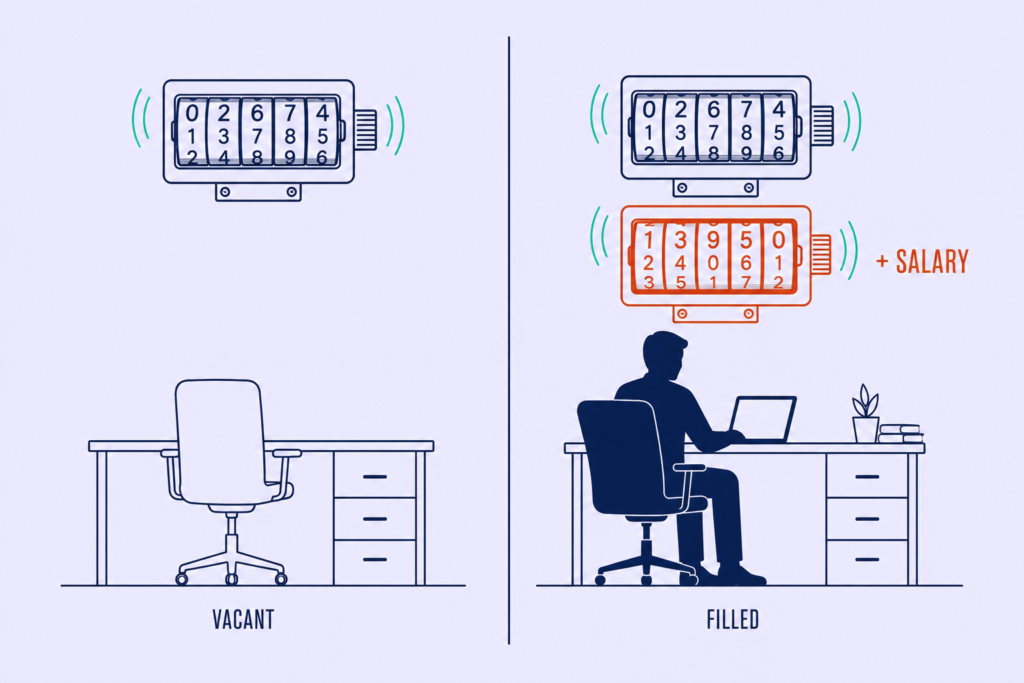
Here is what that costs. An unfilled senior engineering role drains roughly $500 a day in lost output, so a 60-day vacancy is $30,000 the business never recovers.
Now apply the same meter after the seat is filled. A hire who takes 120 days to reach productivity costs the business about what the vacancy did, except there is now also a salary leaving the account every month.
The recruiter closed the requisition. The business did not get an employee.
Here’s what this guide contains:
- The four-stage architecture, with a written exit condition printed on every stage gate
- The 12-step process, with a named owner on every single step
- Two process flow models, plus the swimlane version that makes the handoffs visible
- The three metrics that tell you whether any of it worked
It also contains the version for volume hiring and the version for internal movers. Those are the two cases every other guide on this topic leaves out.
HR Insights Lab approach: every step in this blueprint carries an owner and an exit condition. Nothing here is a state of mind.
What is the Employee Onboarding Process?
The employee onboarding process is the structured sequence that moves a person from signed offer to independent contribution. It covers documentation, orientation, role training, relationship-building, and performance calibration. It is finished when the employee can complete their core role responsibilities without supervisory input.
Why this matters:
That last sentence is the part almost every published definition drops, and it is the part that turns a task list into a process. A process has an entry condition, an exit condition, and a measurable duration between the two.
Most onboarding “processes” have only the first one. Signed offer in, tasks completed, and then silence.
◆ PRO TIP
Here’s the difference: if you cannot state the exit condition for a role before the employee starts, you do not have a process, you have a task list. Write it down as one sentence. In most professional roles the exit condition lands at around 90 days; in complex engineering roles it is closer to 120 to 180.
The problem in this space is not awareness. Every organisation of any size runs something it calls onboarding, and has done for years. Only 12% of employees strongly agree their organisation does a great job of onboarding new people, according to Gallup.
Source: Gallup, Why the Onboarding Experience Is Key for Retention
Translation: this is an execution gap, not a knowledge gap. The processes exist and they do not produce competent employees.
◆ FROM THE LAB
The Sofia test: I have measured Time-to-Productivity across two populations hiring into the same roles. Internal movers reached independent contribution in 28 days. External hires took 67.
Same roles, same standard, same managers. Time-to-Productivity is not an abstraction, it is a number you can move by 39 days.
Onboarding vs. Orientation vs. Training: Why the Confusion Costs money
Three of the pages currently ranking for this topic use “orientation” and “onboarding” in the same paragraph as though they were interchangeable. That is not a vocabulary problem. It is the reason organisations build a one-day event and then wonder why the 90-day outcome never shifts.
Here’s the difference:
| Orientation | Training | Onboarding | |
|---|---|---|---|
| Duration | 1 to 3 days | Role-specific and recurring | 90 to 180 days |
| Owner | HR Operations | The function | Joint: HR owns the system, the hiring manager owns the outcome |
| What it produces | A compliant, equipped employee | A demonstrated skill | An independently contributing employee |
| How you know it’s done | Paperwork and system access are complete | The skill is performed on real work | The exit condition is met |
Read the bottom two rows again, because that is where the money sits. When a company treats the three as one thing, it staffs and budgets onboarding the way it budgets orientation: a fixed-cost event with a room booking and a catering line.
Then it allocates manager time to match. Two days instead of two hours a week for twelve weeks.
⚠ WATCH OUT
Common mistake: presenting onboarding to your leadership team as an event with a per-head cost. Once it is priced as an event, it gets resourced as an event, and no amount of process design survives that. Price it as 90 days of manager time and system support, or expect the same four-month ramp next year.
Orientation is one morning inside the process. The structured onboarding checklist at the end of this guide separates the two explicitly, so you can show a business leader which items belong to which.
The Real Cost of a Broken Onboarding Process
Every onboarding business case I have watched fail, failed the same way. It walked into the room carrying engagement scores and sentiment data, and met a budget conversation that only recognises money.
There are three separate costs in a broken onboarding process. Most HR functions report one of them.
Here’s how to calculate it:
- Replacement cost. The visible one. Re-running the hire, sourcing through offer, plus whatever agency exposure comes with it.
- Ramp cost. Salary paid across the period the employee is not yet productive. Fully calculable: (annual salary ÷ 260) × ramp days, then multiplied by your annual hire volume.
- Drag cost. The hours the manager and the surrounding team spend answering questions a documented process would have answered. Nobody bills it, so nobody sees it.
Run the middle one on your own headcount before your next budget conversation. A $120,000 role with a 120-day ramp is roughly $55,000 of salary spent on output that has not arrived yet. Twenty hires a year and you are discussing seven figures.
You are not asking for new money. You are asking to stop spending money that has already been approved on nothing.
The old way
- Open with engagement survey scores
- Argue that culture drives retention
- Request new budget for a new programme
- Lose to a hard-numbers request from operations
The Lab Way
- Open with ramp cost on last year’s actual hires
- Show the arithmetic, not the sentiment
- Ask to redirect committed salary, not to add spend
- Commit to a Time-to-Productivity number you will report on
20%
of employee turnover happens within the first 45 days.
Source: SHRM, Don’t Underestimate the Importance of Good Onboarding
That figure is the argument for front-loading. Onboarding failure is an early-window problem, so investment placed after day 45 is being spent on the people who already survived the part that breaks.
Three signals you can read this week:
- The week-six question test. If new hires are still asking “who approves this?” or “where does this live?” in week six, knowledge transfer failed.
- The manager-calendar test. Pull the calendars of three managers who onboarded someone last quarter and count scheduled 1:1s in the first 30 days. Fewer than four means the process is not being run.
- The first-assignment test. If the new hire’s first substantive piece of owned work landed after day 30, the ramp is already drifting.
Attrition is a lagging indicator. By the time it moves, the money is spent and the diagnosis is retrospective. These three are leading indicators, readable while there is still time to intervene on that specific hire.
◆ FROM THE LAB
The Sofia test: on a campaign where I delivered 420 hires in 10 weeks, 90-day retention held at 85 to 88%, in line with the historical benchmark for those roles at normal volume.
That number did not hold because of goodwill. It held because those three signals were checked weekly and acted on, at a volume where nobody could rely on noticing.
The 4 Stages of the Employee Onboarding Process

Search this topic and you will be handed a five-stage model, a four-phase checklist, and the 5 C’s, all inside the first page of results. None of them reconcile with each other.
That is not a modelling debate, it is a practical problem. If you take one model to your leadership team and your L&D partner takes another, you spend the next quarter arguing about vocabulary instead of fixing the ramp.
Here is the architecture I use. Four stages, each with a printed exit condition, because a stage without one is a mood.
Stage 1: Pre-boarding, offer Accepted to day 0
Pre-boarding is the window between signature and start date, and the risk it manages is not paperwork. It is drop-off. Your new hire is still in the market, still answering recruiter calls, and still being counter-offered by the employer they just resigned from.
How to execute:
Clear the administrative floor fast: contract, background checks, right-to-work, payroll, equipment ordered, system access requested. Then spend the rest of your effort on the engagement layer. A named point of contact from the day of signature, a scheduled touchpoint in week one and week three of the notice period, direct contact from the hiring manager rather than HR acting on their behalf, and the first-week schedule sent 48 hours ahead.
Exit condition: the employee has tested system access, a confirmed start time, a named contact, and has responded to a touchpoint within the last seven days.
◆ FROM THE LAB
The Sofia lens: on the largest volume campaign I have run, accelerated offer release plus a structured pre-joining sequence produced an offer-to-join ratio above 90% across 420 hires. My acceptance high-water mark on individual senior roles sits at 90%.
Neither number came from a better offer. They came from being the employer that stayed in contact during the four weeks when the other one went quiet.
Stage 2: Orientation, day 1 to week 1
Day one has exactly three jobs. Most organisations attempt eleven.
- The employee can physically do their work by end of day. Access tested, not requested.
- The employee knows who to ask for the next 30 days. A named person, not a team inbox.
- The employee leaves with a written first-week schedule.
Why this works:
Culture is not transmitted by a slide deck on a first morning. It is transmitted by whether the laptop worked and whether somebody had clearly prepared for the person’s arrival. The values session lands better in week two, when there is context to hang it on.
Exit condition: the employee has logged into every system they need, met their named contact, and completed one piece of real work.
⚠ WATCH OUT
Common mistake: packing day one with orientation content and forty introductions, then leaving the new hire to wait a week for an access ticket. The presentations are retained at close to zero. The blocked access is remembered for the whole first quarter.
If you assign a buddy, assign a real one: who qualifies, what they are asked to do, for how long, and who covers when they are on leave. A buddy without those four answers is a name on a form.
Stage 3: Role traction, week 2 to day 60
This is the stage that sets Time-to-Productivity, and it is the stage every competing article gives three sentences to. It runs on four controls: a first owned deliverable assigned by day 10, a stated schedule for reducing supervision, exposure to adjacent functions mapped to the role’s real dependencies, and weekly 1:1s with a fixed agenda.
The agenda is three items. What you completed, what you are blocked on, and what you did not understand.
The old way
- Shadow the team for a month
- Sit in on meetings to absorb context
- Start contributing when they feel ready
- Find out at day 90 whether it worked
The Lab Way
- Own a real deliverable by day 10
- Small enough to be safe, real enough to be judged
- Reduce supervision on a published schedule
- Read the signal weekly, not quarterly
◆ PRO TIP
Real talk: shadowing fails for a reason nobody says out loud. Watching a competent person do a task teaches you the sequence. It does not teach you the judgement, and judgement is the entire thing the ramp period exists to build.
The performance return sits here, not in the welcome. Strong onboarding lifts an employee’s discretionary effort by more than 20% and drives performance by up to 15%, while only one in four organisations believe their programme actually drives new-hire performance, according to Gartner.
Source: Gartner, Onboarding New Hires Checklist for HR Leaders
Read the second half of that as permission. One in four is not a tuning problem, it is a rebuild.
Recall the 28-day and 67-day Time-to-Productivity figures from earlier. Internal movers arrive with the same skill gap as external hires and close it in less than half the time, because organisational context is already installed. That gap is what stage three has to manufacture.
Exit condition: the employee has independently completed at least one full cycle of their core recurring responsibility.
Stage 4: Ownership, day 60 to day 90 and beyond
Stage four needs a decision, not a conversation. In most organisations it is a 90-day meeting that opens with “so, how’s it going?” and closes without anyone having declared anything.
The implementation:
- A capability verdict against the exit condition. Is this person operating unsupervised on their core responsibilities: yes, not yet, or no.
- A process verdict captured from the employee while it is fresh. What took longest, what was missing, and what did you have to find out by asking.
- A forward plan that hands the employee from onboarding into normal performance management, so nobody falls into a development vacuum at day 91.
When the verdict is “no”, the answer is not automatically performance management. That case has its own protocol, covered in the failure modes section.
One caveat worth writing into your template: probation periods are contractually and legally defined, and they differ by jurisdiction. A 90-day capability verdict is a management decision, and it should not be presented as a probation outcome unless your local employment law says it is one.
◆ FROM THE LAB
My experience: every meaningful Quality of Hire improvement I have measured came from a feedback loop, not from an intention. Competitor analysis moved it 12%. Talent landscape work moved it 14%. Skill-based pipelines built on market analysis moved it 30%.
None of those were insights. They were retros that fed the next cohort. The 90-day process verdict is the same instrument pointed at onboarding.
The 5 C’s, Mapped onto the 4 stages
| The 5 C’s | What it transmits | Where it lives in the 4 stages |
|---|---|---|
| Compliance | Rules, policy, legal and safety obligations | Stage 1 into Stage 2 |
| Clarification | Role scope, deliverables, performance standard | Stage 2 into Stage 3 |
| Culture | How decisions actually get made here | Stage 3, observed rather than presented |
| Connection | The working relationships the role depends on | Stage 1 into Stage 3 |
| Check-back | Verification that the first four landed | Stage 4 |
The 5 C’s describe what onboarding must transmit. The four stages describe when. They are not competing models, and treating them as though they were is how teams end up running two frameworks and finishing neither.
The Employee Onboarding Process Flow: How to Map it
Someone has asked you to “map the onboarding process” and you are now looking at four different diagram types wondering which one they meant. The honest answer is that you need two of them, because they answer different questions.
Model A: The stage flow
A linear left-to-right diagram of the four stages, with the exit condition printed underneath each stage gate. Five boxes wide, no branching, readable in about eight seconds.
Best for:
Communicating the process to leadership and to new hires. The value here is comprehension, so the diagram earns its place by being simple enough to sit on one slide.
Its limitation is structural. It shows sequence and hides ownership, which is why organisations that have only this model still drop handoffs and still cannot say who dropped them.
Model B: The swimlane Flow
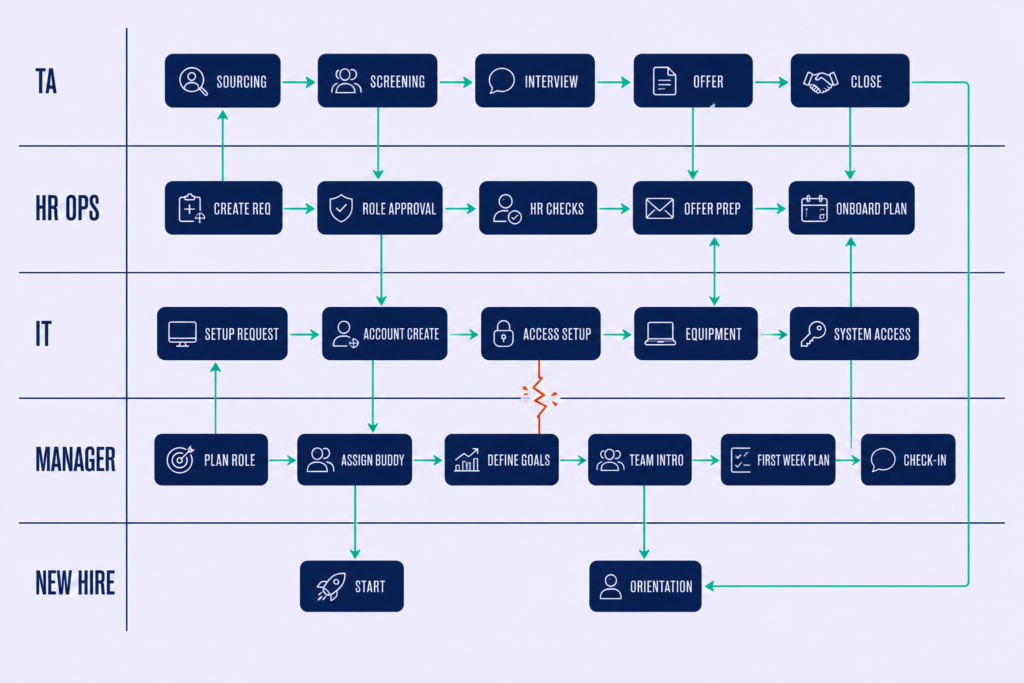
Five lanes: Recruiter or Talent Acquisition, HR Operations, IT, hiring manager, and the new hire. The horizontal axis runs from offer accepted through day 90. Every task sits in exactly one lane, and every arrow that crosses a lane boundary is a handoff that must be labelled with what is being handed over.
Build that and the diagram makes its own argument. Onboarding does not fail inside the lanes. It fails on the arrows between them.
A handoff with two owners has no owner.
⚠ WATCH OUT
Red flag: two arrows break more often than all the others combined. Offer accepted into IT provisioning, and Talent Acquisition into the hiring manager. Label both, name the person on each side, and put a date on the handoff rather than a dependency.
The new hire lane is also non-negotiable. If the new hire has no lane, the process is being done to them rather than with them, and their tasks are the ones that will silently slip.
This is the Talent Supply Chain applied one stage further downstream. I treat recruitment as a circular supply chain rather than a linear hiring plan, and the supply chain does not terminate at signature. The join between Talent Acquisition and the business is the length of pipe nobody documents, which is exactly why it leaks.
The Five Decision Points Every Onboarding Flow is Missing
Look at any published onboarding flowchart and count the decision diamonds. There are none. Boxes and arrows, start to finish, one path.
Real processes branch. Here are the five branches that occur often enough to belong in the diagram.
Here’s how to build it:
| Decision | Owner | Default path |
|---|---|---|
| Background check returns an issue | HR Operations | Start date held, not cancelled; adverse-action process follows local law |
| Start date moves after equipment is ordered | Recruiter | Re-trigger provisioning with a new verification date |
| Hiring manager on leave in week one | Hiring manager’s manager | Named deputy holds the lane, including the 1:1s |
| Role scope changed between offer and start | Hiring manager | 30/60/90 reissued before day one, not after |
| Day-30 check shows the ramp off track | Hiring manager and HRBP | Re-scope the 60-day plan and log the reason |
Each row has a decision, an owner, and a default. That is what separates a control from an awareness campaign.
The principle behind this is the same one that runs Intelligence-Led Sourcing: map the market before the vacancy exists so the expected exception is already planned for. Build onboarding flows the same way. The happy path is the one case that never needed a process, and the branches are where every real hire ends up.
Background check rules also vary sharply by jurisdiction. Permissible scope and adverse-action obligations are legally defined, and what is routine in one market is unlawful in another, so write your default path against your own legal advice rather than against a template.
Once the branches are drawn, the failure patterns become predictable. Six of them show up repeatedly, and they are catalogued in the onboarding failure modes section further down.
The New Employee Onboarding Process, Step by Step
The best-ranking step-by-step guide on this topic spends its first four steps on writing the job advert, interviewing, and checking references. That is recruitment. By the time onboarding begins, those decisions are already made and cannot be unmade.
All twelve steps below sit after offer acceptance, which means every one of them is load-bearing. Every one also carries a named owner, because a step without an owner is a suggestion.
Here’s how to build it:
1
Step 1: Confirm the Start Date and Notice Period
Owner: Recruiter
Agree the start date against the candidate’s notice obligations and any leave already booked, then log it as the trigger date. Every downstream task counts backward from this one number, so an unconfirmed start date silently invalidates the whole schedule. Get it in writing, not in a call summary.
2
Step 2: Trigger Provisioning on Signature
Owner: Recruiter, handing to IT
One trigger, fired on the signature event, that starts the laptop order, account creation, licence assignment, building access, and payroll setup at the same time. Each item gets a named owner and the whole set gets a verification date at start-date-minus-three-days.
The arithmetic is what makes this non-negotiable. Hardware procurement and security provisioning routinely run 10 to 15 working days, which is most of a standard notice period.
⚠ WATCH OUT
Common mistake: raising the IT ticket in the week the employee starts, then blaming IT for a delay that was created by the trigger date. A tool will not fix this. Software laid over a late trigger automates the same failure faster and adds a licence fee.
3
Step 3: Issue the Contract and Clear Compliance
Owner: HR Operations
Contract, work authorisation, background checks, payroll, and benefits enrolment. This is table stakes and it should be boring.
One warning: documentation requirements are jurisdiction-specific. I-9, W-4, and E-Verify are US requirements; right-to-work checks are the UK equivalent; background check scope is constrained by FCRA in the US and by data protection law in the EU and UK. Confirm every item against local employment law rather than against any published list, including this one.
4
Step 4: Run the Pre-Boarding Engagement Sequence
Owner: Recruiter and hiring manager
Counter-offers land during the notice period, and the deciding factor is usually which employer feels more real to the candidate at that moment. Five scheduled touchpoints, each with an owner and a date, so it happens for every hire rather than for the ones somebody remembered.
- Within 24 hours of signature. Recruiter sends confirmation plus the named contact.
- Notice week one. Hiring manager makes direct personal contact. A call, not an email sent by HR on their behalf.
- Notice week two. Team introduction. A short note from the team, or an invitation to a low-stakes team ritual.
- Notice week three. Role context pack. What the team is working on now, not the company history deck.
- Start date minus two days. First-week schedule and joining logistics.
◆ FROM THE LAB
Real implementation: this exact sequence, plus accelerated offer release, produced an offer-to-join ratio above 90% across a 420-hire campaign.
If it holds at 420 hires under a 10-week deadline, it holds at four. Volume is the harder case, not the easier one.
5
Step 5: Write the 30/60/90 Before Day One
Owner: Hiring manager
Three named deliverables per window, each with a stakeholder attached. Written before the employee arrives, because a 30/60/90 drafted in week two is written around whatever the employee happens to be doing by then, which defeats the point of having one. If the manager cannot name three deliverables for the first 30 days, that is a scoping problem worth surfacing now rather than at day 60.
6
Step 6: Send the First-Week Schedule 48 hours Ahead
Owner: Hiring manager
The actual calendar. Meetings, names, times, rooms or links. It costs twenty minutes and it removes most of the cognitive load from a first morning, because the new hire arrives already knowing what is going to happen to them. It also signals, before anyone says a word, that somebody prepared.
7
Step 7: Verify Access, Don’t Request it
Owner: IT and hiring manager
Someone logs into each account before day one and confirms it works. “Access requested” and “access tested” are different states, and the gap between them is where most week-one blockers live. Test the permissions too, not just the login, because an account that exists with no group membership fails on day two instead of day one.
8
Step 8: Run day one to the three-job standard
Owner: Hiring manager
Working tools, a named human, and a written plan. Here is the shape that delivers all three.
- A 10am start, so the manager has an hour to prepare rather than arriving alongside the new hire
- Access verification first, done sitting together so any failure surfaces immediately
- Introductions limited to people the role depends on in week one, each with a stated reason
- The named contact introduced explicitly, by name, as the person to ask anything for 30 days
- One real, small task completed before end of day
- A 15-minute end-of-day check that asks what is still unclear
◆ PRO TIP
The honest downside: the 10am start needs manager buy-in and it does not survive a shift environment, where the start time is set by the rota and the safety induction is a hard gate. If that is your world, the deskless version further down replaces this step rather than adapting it.
9
Step 9: Assign the first owned deliverable by day 10
Owner: Hiring manager
Real work, with a due date and a named stakeholder who will receive it. Small enough that a mistake is recoverable, real enough that the output can be judged. This is the single control that converts stage three from observation into competence-building, and day 10 is late enough to be fair and early enough to leave room to correct.
10
Step 10: Hold weekly 1:1s with a fixed agenda
Owner: Hiring manager
Completed, blocked, did not understand. Three items, same order, every week.
The third one is the reason the agenda is fixed. It is the item that surfaces knowledge gaps a new hire will not volunteer, and it is the item managers quietly drop first when the week gets busy.
11
Step 11: Run the day-30 ramp check
Owner: Hiring manager and HR Business Partner
Three questions answered on the record. Is the employee producing the output the 30-day window called for, what is the single largest blocker, and is the 60-day plan still realistic given what we now know.
Why this works:
Day 30 is chosen deliberately. It is late enough for a signal to exist and early enough that an intervention still changes the 90-day outcome.
When the answer is off track, three interventions are available: re-scope the 60-day plan, add a subject-matter mentor for a fixed period, or escalate a structural blocker that is not the employee’s to solve. The check has to produce one of those. A note is not an outcome.
This is Talent Market Pre-Alignment applied one stage later. TMPA moves hiring from reactive to demand-led by acting on the forecast rather than the vacancy, and the day-30 check does the same thing to a ramp. You intervene on the trajectory, not on the result.
12
Step 12: Issue the 90-day verdict and process retro
Owner: HR Business Partner and hiring manager
Capability verdict against the exit condition, then the process retro that feeds the next cohort. Log the Time-to-Productivity figure while it is accurate, because reconstructing it three months later produces a number nobody believes. Two people, forty minutes, once per hire.
Who Owns The Onboarding Process?
Every competing article on this topic is written in a passive voice that implies one mythical owner. Assign a buddy. Set up their workstation. Schedule check-ins.
Who? In a real organisation those three tasks sit with three different functions, on three different reporting lines, with three different sets of incentives. Ownership ambiguity is why your process fails, not ignorance of the steps.
Here’s the deal:
Build the RACI across the five functions from the swimlane map against the twelve steps. One rule holds it together: exactly one A per step. Multiple R’s are fine and expected.
| Step | Recruiter / TA | HR Ops | IT | Hiring manager | New hire |
|---|---|---|---|---|---|
| 1. Start date confirmed | A | I | I | C | C |
| 2. Provisioning triggered | A | I | R | I | |
| 3. Contract and compliance | I | A | I | R | |
| 4. Pre-boarding sequence | A | I | R | C | |
| 5. 30/60/90 written | I | I | A | ||
| 6. First-week schedule sent | I | A | I | ||
| 7. Access verified | I | I | R | A | C |
| 8. Day one run | I | C | C | A | R |
| 9. First deliverable assigned | A | R | |||
| 10. Weekly 1:1s | A | R | |||
| 11. Day-30 ramp check | I | C | A | R | |
| 12. 90-day verdict and retro | I | C | R | C |
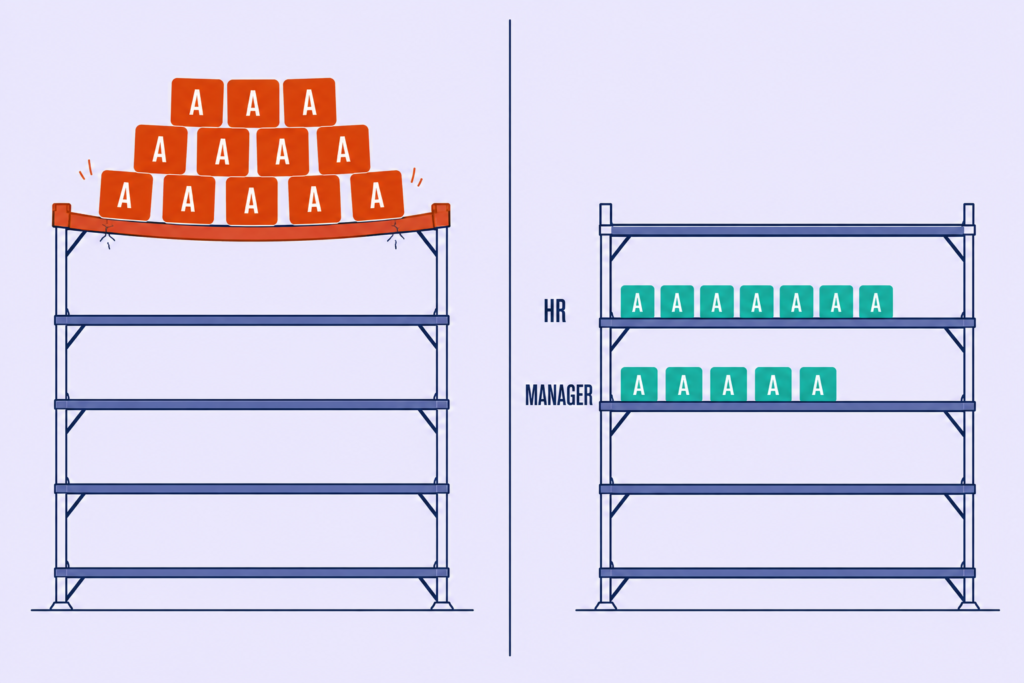
Note where the A column sits after step 8. In most organisations that entire column has collapsed onto HR by default, which means HR is accountable for things it cannot control, including whether a manager holds a 1:1.
HR owns the system. The manager owns the outcome.
HR is accountable for whether the process exists, runs, and is audited. The hiring manager is accountable for whether the person becomes competent. If that split is not made explicit and signed off, the process reverts to HR chasing managers by email, which is how most HRBPs lose a day a week.
The same logic runs the 4-engine architecture behind Intelligence-Led Sourcing: discrete ownership assigned to discrete engines rather than one undifferentiated function carrying everything. The onboarding RACI is that principle applied past the offer stage.
◆ FROM THE LAB
The Sofia lens: I hold that retention problems are mostly systems failures rather than compensation failures. The same lens applies here, and it is unpopular.
Managers do not skip onboarding tasks because they do not care. They skip them because onboarding is unmeasured work competing against measured work, and it lands in the exact week their team is already short-staffed. That is a systems failure, not a character failure.
Two interventions move that behaviour, and they only work together.
The old way
- Send a reminder email
- Escalate to the manager’s manager
- Run a training session on why onboarding matters
- Repeat next quarter with the same result
The Lab Way
- Put new-hire ramp status in the operational review where the manager’s other numbers appear
- Pre-build 30/60/90 templates by role family
- Pre-populate the first-week schedule and the 1:1 agenda
- Cut the manager’s preparation cost from eight hours to about two
◆ PRO TIP
The catch: visibility without cheapness produces resentment and compliance theatre. If you make ramp status visible before you have made the work cheap to do, managers will complete the artefacts and skip the substance, and your dashboard will go green while nothing changes on the floor.
Subsidise first. Measure second. In that order, always.
Onboarding at Volume: The Cohort Model

Every guide on this topic assumes one hire arriving into a stable team. If you are running a ramp-up, a graduate intake, a seasonal peak, or a new site, you are reading advice that does not survive contact with your situation.
Four things break when you go from one hire to forty, and each has a structural response.
- Manager time becomes the binding constraint. Everything that is not role-specific has to convert from 1:1 delivery to cohort delivery.
- Access provisioning becomes a batch job. Easier, not harder, but only if role clusters are defined in advance so access profiles can be pre-built.
- The named contact cannot be the manager. It becomes a cohort lead with a defined span. Roughly one lead per 12 to 15 hires.
- Drop-off risk compounds. A cohort that loses six people loses momentum as well as headcount, and the remaining hires notice.
Here’s what changed everything:
Cohort onboarding is usually better than individual onboarding, not a compromised version of it. The cohort becomes its own support structure, and peer questions absorb load that would otherwise queue at a single manager’s door.
The old way
- Run the individual process forty times in parallel
- Assume managers will absorb the load
- Hold a two-day induction event, then disperse
- Discover in week four that half the cohort is stalled
The Lab Way
- Separate the common layer from the role-specific layer
- Deliver the common layer once, to the whole cohort
- Protect manager time for role-specific work only
- Keep the cohort alive as a peer group through the risk window
◆ FROM THE LAB
My experience: earlier in my career I was handed a requirement for 350 to 500 hires inside an eight to twelve week window. Customer support, operations analysts, junior engineers, and sales support, all at once, against a fixed project launch date.
The binding constraint was never sourcing. It was interviewer capacity, and no amount of budget was going to create senior engineers’ calendar time.
So I planned backward from the business start date instead of forward from the requisition. Weekly hiring targets went against recruiter bandwidth and interviewer availability, and generic role clusters widened the pool without loosening the bar.
Then came the machinery: batch interviews with structured scorecards, daily recruiter stand-ups against a live tracker, SLA-based vendor tracking, and one point of contact per batch so no candidate had to chase.
We delivered 420 hires in 10 weeks. Turnaround Time fell from 32 days to 18 to 20. Offer-to-join held above 90%, 90-day retention landed at 85 to 88%, and recruiter productivity improved by around 35%.
None of that came from working harder. It came from naming the real constraint first and building the entire process around it, which is a decision, not an effort.
The two-week cohort calendar:
| When | Cohort layer | Manager layer |
|---|---|---|
| Day 1 | Compliance, systems, org context, cohort lead introduced | Team integration in the afternoon |
| Days 2 to 5 | Cohort sessions each morning | Role-specific work each afternoon |
| Week 2 | Two cohort touchpoints to keep the peer group live | Predominantly role-specific, first owned deliverable assigned |
The generic role clusters that made sourcing scalable are the same clusters that make cohort onboarding possible. One piece of design work pays for itself twice, on opposite sides of the offer.
⚠ WATCH OUT
The catch: this only works if role clusters were defined at requisition stage. The design work happens before the hiring starts, not after, and a cohort model retrofitted in week one of a ramp will fragment within days.
If you are already three weeks into a ramp with no clusters, run the individual process and fix the design for the next wave.
The Onboarding Nobody Runs: Internal Movers and Promotions
You have almost certainly moved someone internally in the last quarter. They almost certainly received nothing.
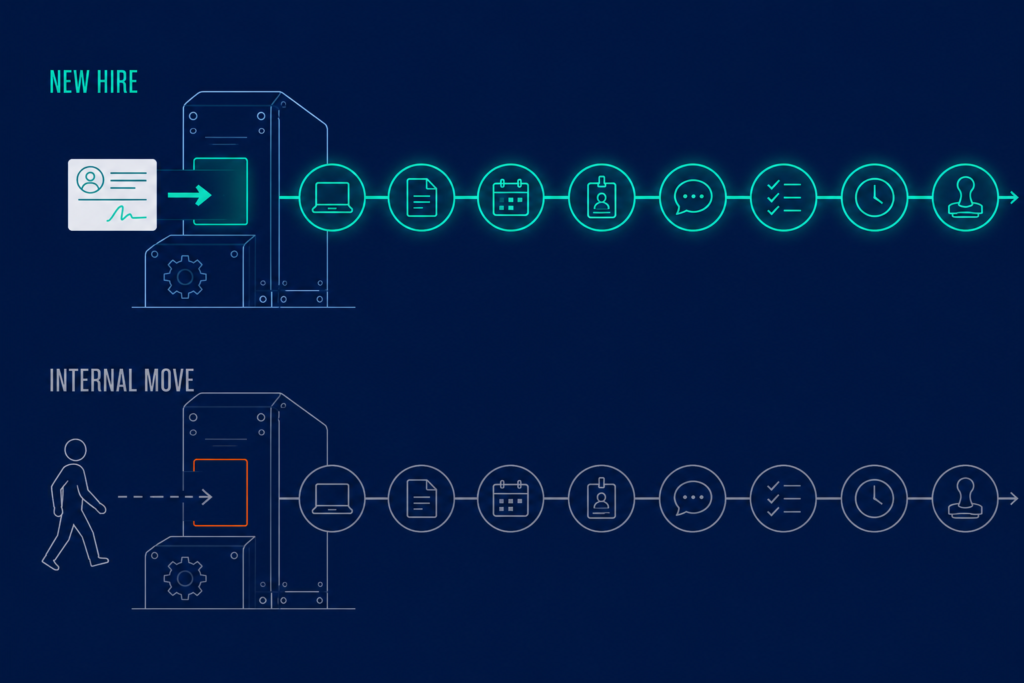
That is not negligence, it is a systems artefact. Onboarding is triggered by a new employee record, an internal move does not create one, so the entire process silently does not fire. Nobody decided to skip it.
The assumption underneath is that the person already knows the company. True, and irrelevant. What they do not know is the new team’s decision-making, priorities, stakeholders, and standard of “good”.
28 vs 67
Days to productivity for internal movers versus external hires into comparable roles. A gap of 40 to 50%, built almost entirely from organisational context rather than skill.
The old way
- They already work here, so there is nothing to onboard
- An informal handover conversation
- No 30/60/90, no named contact, no introduction
- Conclude that internal candidates are weaker
The Lab Way
- Run stages three and four in full
- Compress stages one and two to system access changes
- Same 30/60/90 standard as an external hire
- Measure their ramp against the same benchmark
◆ FROM THE LAB
The Sofia test: at one point I owned a function where external hiring cost and ramp time were both climbing. We installed a First Look policy, a 48-hour internal posting window before anything went external, with recruiters proactively tapping internal candidates rather than waiting for applications.
That year, 23% of hires were internal moves, and their Time-to-Productivity came in at 28 days against 67 for external hires.
Here is the part I got wrong at first. We celebrated the 28 days and gave those movers nothing, because everyone assumed they were already oriented.
The ones who struggled did not struggle on skill. They struggled on assumptions carried over from their old team about how decisions got made, who signed off what, and what a good piece of work looked like in this function.
Once we ran stages three and four properly for internal movers, 28 days stopped being a ceiling.
How to execute:
- Skip stages one and two apart from system access changes
- Make day one in the new team a stakeholder map session, not an orientation
- A 30/60/90 written by the receiving manager, held to the same standard as an external hire
- A named contact inside the new function who is explicitly not the manager
- A day-30 check that asks what they assumed transferred from their old role and did not
◆ PRO TIP
Real talk: that last question is the high-yield one, and it is the one nobody asks. Internal movers fail on transferred assumptions far more often than on missing skills, and an assumption is invisible to the person holding it.
Benchmark them properly too. My best 12-month cohort retention sits at 89%, and internal moves should meet or beat your external retention figure. If they do not, the onboarding gap is the first place to look, not the calibre of the candidate.
Onboarding Remote, Hybrid, and Deskless workers
Most of the process transfers to remote work unchanged, and saying so is more useful than pretending otherwise. Three things genuinely break.
Here’s the difference:
- Ambient learning disappears. The new hire cannot overhear how decisions get made, so it has to be documented or narrated on purpose. Decision logs and recorded context sessions replace the overheard conversation.
- Weak-tie formation fails. They will meet their immediate team and nobody else. Schedule cross-team introductions with a stated purpose, because weak ties are what unblock work in month three.
- Struggle becomes invisible. A remote new hire who is stuck looks identical to one who is working. A daily fifteen-minute check for the first two weeks, dropping to weekly, is the cheapest fix available.
Notice what those three have in common. Each one replaces a mechanism that physical proximity was providing silently and for free, and more video calls is not a replacement for any of them.
Deskless, Shift-Based, and Field roles
The adapted process keeps all four stages and changes the delivery mechanism on every one of them.

- Safety and compliance certification as a hard gate before any productive work, not a form to be completed later in the week.
- A named contact on the same shift pattern, rather than a manager who works days while the new hire works nights.
- Instruction delivered in person or on mobile, never through a portal that requires credentials the person does not have.
- A competency sign-off sheet with observable behaviours in place of the 30/60/90.
- The ramp check run by the shift supervisor, not the HR Business Partner, because the supervisor is the only person who sees the work.
The old way
- Send the onboarding portal link
- Assume they will get to it
- Report completion rates as engagement
- Quietly abandon the programme for those sites
The Lab Way
- Same four stages, different delivery
- Shift-aligned contact, in person or mobile
- Competency-signed rather than document-signed
- Supervisor owns the ramp check
The principle sits in one line. The process does not change, the delivery mechanism does, and confusing those two is exactly why deskless onboarding gets designed once and then abandoned.
The Metrics that Prove Your Onboarding Process Works
Your onboarding dashboard is probably all green while everyone in the business knows the process is not working. That is not a data problem, it is a measurement design problem.
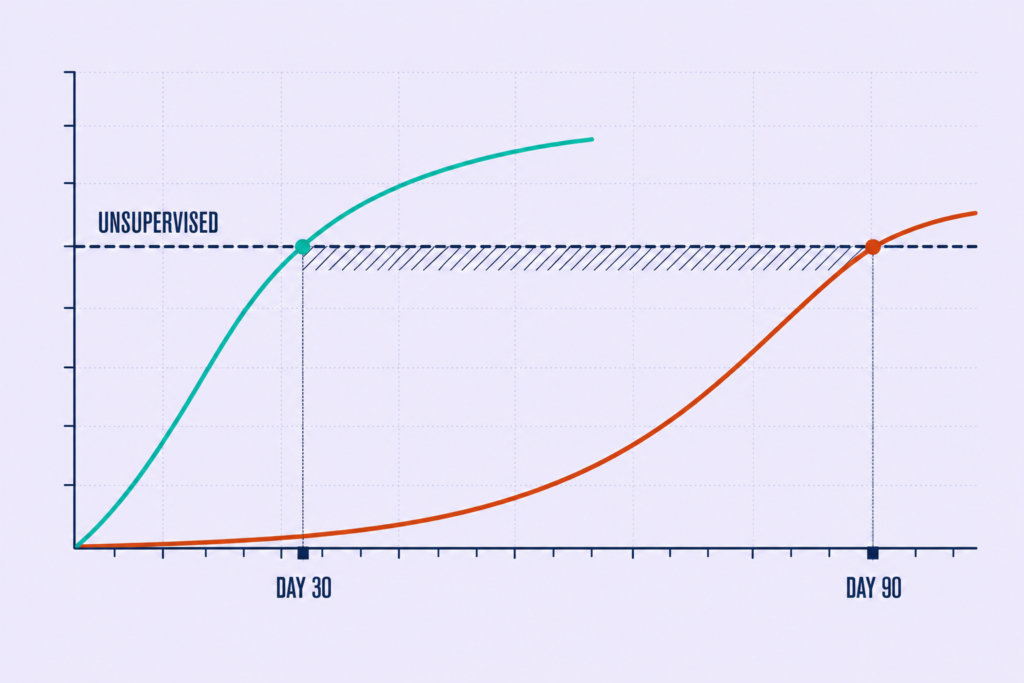
Satisfaction scores are collected immediately after a period in which the employee was being welcomed. They are almost never negative. Twelve-month retention is real, and it arrives a year after you could have done anything about it.
Satisfaction tells you how the first 90 days felt. Time-to-Productivity tells you what they produced.
How to execute:
Time-to-Productivity is the number of calendar days from start date to the date the employee first completes their core recurring responsibility without supervisory input. The manager makes that call at the day-30 and day-90 checkpoints, against the exit condition written before the employee started.
Build your first baseline retrospectively. Take the last ten hires by role family, ask the managers to place the date, and accept that the numbers will be rough. A rough baseline you can improve beats a precise metric you never start.
◆ PRO TIP
The honest downside: yes, this requires a judgement call, and someone in your leadership team will object on exactly those grounds.
The answer is that the judgement is already being made, informally and inconsistently, every time a manager decides whether to keep supervising. Writing the exit condition down does not add subjectivity. It removes it.
◆ FROM THE LAB
My experience: earlier in my career I was asked to scale an automation engineering team faster than the market was willing to supply. Instead of posting and waiting, we ran competitor talent mapping across 12 companies in the industrial IoT space.
By the time the job description was signed off, 37 qualified candidates were already identified. Time-to-Offer fell from 68 days to 34.
The halving is the headline. The mechanism is the lesson. Nothing moved until someone named Time-to-Offer as the number, owned it, and reviewed it weekly in front of the hiring managers.
A cycle-time metric does not improve because you improved the process. It improves because you instrumented it, and the process then changed in response.
My current Turnaround Time benchmarks, 36 days for engineering roles and 39 for volume, exist for the same reason.
Two supporting measures sit underneath it, and one you should stop reporting.
| Metric | Definition | How to collect | What good looks like |
|---|---|---|---|
| Time-to-Productivity | Start date to first unsupervised completion of the core responsibility | Manager call at day 30 and day 90, against the written exit condition | Trending down against your own baseline, segmented by role family |
| 90-day retention | Share of hires still employed at day 90 | HRIS, segmented by hiring manager and role family | Stable against your historical benchmark, with no single manager as an outlier |
| Manager-hours-to-ramp | Total supervisory time consumed per hire | Manager self-report at the 90-day retro | Falling as the process matures. This is the number that proves it is getting cheaper |
⚠ WATCH OUT
Anti-pattern: reporting an aggregate onboarding satisfaction score as a primary measure. It is collected at the friendliest moment in the employment relationship, it correlates poorly with whether the person is any good at the job yet, and it cannot go red.
A metric that cannot go red is not a metric. It is reassurance with a chart attached.
Read your 90-day retention as a process check rather than a headline. On the 420-hire campaign, 85 to 88% at 90 days was in line with the historical benchmark for those roles, and that comparison is the only one that means anything. Published industry averages are drawn from populations that do not resemble yours.
There is also a structural reason the 90-day window carries more weight than it used to. Median employee tenure was 3.9 years in January 2024, the lowest recorded since 2002, according to the U.S. Bureau of Labor Statistics. A 120-day ramp against a 3.9-year tenure is roughly 8% of the entire relationship spent unproductive.
Source: U.S. Bureau of Labor Statistics, Employee Tenure in 2024
◆ PRO TIP
Real talk: segmenting these numbers by hiring manager produces a table that names individuals, and if you introduce it badly the whole programme dies in one meeting.
Sequence it. Report aggregate for two quarters to establish a baseline and normalise the measure, then share segmented data privately with each manager alongside their comparison to the mean.
Only surface segmented data in a leadership forum once the process has been visibly resourced. You cannot hold a manager accountable to a process you have not yet made cheap for them to run, which ties straight back to who owns the process.
One compliance note, because this section involves holding performance data on named individuals. Retain only what the stated purpose needs, be explicit with managers about what is recorded and who can see it, and check the retention period against your own data protection obligations before you build the dashboard.
Where AI helps in the Onboarding Process, and Where it Breaks it

Your leadership team has asked what your AI plan for onboarding is, and every available answer comes from somebody with a licence to sell. I have led AI and prompt engineering work inside a recruitment function, and I have no product to defend, so here is the honest boundary.
Here’s the deal:
- Provisioning orchestration. Firing and tracking the parallel access, equipment, and payroll tasks from a single signature event, then chasing the ones that stall. High volume, low judgement, and the clearest win available.
- Answering the repeated question. A retrieval assistant over policy, process, and systems documentation removes the “who do I ask” tax from week two onward.
- Scheduling and sequencing the first 30 days across multiple stakeholder calendars, which is a coordination problem rather than a judgement problem.
That is the whole list. AI absorbs the logistics so the manager’s hours go to judgement, context, and relationship, and anything claimed beyond that boundary is a vendor claim rather than an operational one.
AI doesn’t replace managers. It replaces the parts of the job that stopped managers from being effective in the first place.
◆ PRO TIP
The catch: the retrieval assistant only works if the underlying documentation is current. Most organisations find out during implementation that theirs is not, and the pilot then gets blamed for a content problem it inherited. Audit the documentation before you scope the tool, not after.
My position on AI in Talent Acquisition has been consistent, and it transfers cleanly to onboarding. AI is a co-pilot, not a decision-maker, with human-led validation at every decision point. It accelerates thinking; people own judgement, context, and the final call.
Where the market is moving is toward agentic pilots rather than assistive tools, systems that execute a workflow rather than return a suggestion. That shift makes the boundary above more important, not less.
The old way
- Buy an onboarding platform
- Automate whatever the platform can automate
- Report adoption as improvement
The Lab Way
- Fix the trigger and the ownership first
- Automate the logistics layer only
- Never automate the relationship
⚠ WATCH OUT
Anti-pattern: three specific ways AI makes onboarding worse. Replacing the named contact with a chatbot, when the week-two problem is permissional rather than informational and a bot cannot tell someone it is acceptable to ask.
Automating the check-ins, because a generated “how’s it going?” is worse than no message. It signals that the process is being performed at the employee rather than run for them.
Scoring ramp progress algorithmically, which converts a coaching conversation into a surveillance signal. Once new hires understand they are being scored during onboarding, they optimise for the score instead of for competence.
Two risks sit underneath all three. An automation arms race, where dependency grows and the personal contact that made the process work quietly disappears. And algorithmic bias, where flawed training data reinforces historical patterns and the result gets called objectivity.
Where any of this touches assessment or ramp scoring, there are legal obligations attached. Automated decision-making about individuals is regulated under GDPR Article 22 and equivalent regimes, and EEOC guidance applies to algorithmic tools used in employment decisions in the US. Take advice before you deploy, not after.
The timing matters too. Gartner identifies the AI revolution and cost pressure as the two forces driving the top four Talent Acquisition trends for 2026. When those two arrive together, the pressure to buy a tool instead of fixing a process is the highest it will ever be.
Source: Gartner Newsroom, Top Four Trends for Talent Acquisition in 2026
Six Onboarding Failure Modes, and How to Recover
You know your onboarding is not working. What you cannot do is say which part, which means improvement effort gets spread across everything and nothing moves.
Here’s the deal:
Take the observable symptom, read across, and fix the one broken control rather than the whole process.
| Failure mode | What you observe | Root cause |
|---|---|---|
| The Ghost Start | No equipment, no access, no plan on day one | Provisioning triggered on the start date instead of on signature |
| The Orientation Cliff | An excellent day one followed by nothing | Ownership never transferred from HR to the manager |
| The Shadow Loop | Six weeks of observing with no owned work | No first deliverable assigned in stage three |
| The Silent Ramp | Nothing between day one and day ninety | The day-30 control is missing |
| The Orphan Move | An internal transfer with no process at all | The process is triggered by a new employee record |
| The Compliance Mirage | Every task marked complete while the person is visibly lost | The process measures activity rather than the exit condition |
⚠ WATCH OUT
The Compliance Mirage is the most dangerous of the six, because it is the only one that looks like success on a report. Every box ticked, every module completed, and a new hire in week eight who still cannot work unsupervised.
The Orphan Move is the most common. It is also the cheapest to fix, because the fix is a trigger, not a programme.
◆ FROM THE LAB
Real talk: this is how I build every system I own. When I designed the Silver Medalist Re-Engagement Loop, I did not improve the whole candidate experience. I found the single point where value was leaking, second-choice candidates going cold after a rejection, and installed one control there.
Four hires came out of it over two years, one of whom became a team lead. Diagnose the leak. Then fix that.
The 30-day recovery protocol:
You have someone at day 45 who is visibly struggling. Your options as presented anywhere else are “more support” or “start performance management”. Here is a third one.
1
Name it Directly with the Employee
Say out loud that the onboarding was not run properly, that this is an organisational failure rather than a performance issue, and that it is being reset. This step is non-negotiable.
A struggling new hire has almost always concluded the problem is them, and every intervention that follows lands differently depending on whether that belief is corrected first.
2
Rebuild the Plan from Today
A fresh 30-day window with three named deliverables and a stakeholder on each. Not a revised version of the original plan, a new one written against where the person actually is now.
3
Install the Named Contact that was Missing
One person, named, who is not the manager, and who has agreed to the role. In nine recoveries out of ten this is the control that was absent from the start.
4
Increase the Check Cadence to Weekly
For four weeks, then step back down. Same fixed agenda as the standard 1:1: completed, blocked, did not understand.
5
Re-baseline with the Manager’s Own Manager
Make the reset visible rather than a private accommodation. A recovery that only two people know about gets forgotten at the next calibration, and the employee carries a record nobody corrected.
◆ PRO TIP
The honest downside: recovery works when the process failed. It does not work when the hire was genuinely wrong for the role, and pretending otherwise wastes another 30 days of everyone’s time including the employee’s.
Distinguishing the two is the manager’s job, and the evidence from the day-30 ramp check is what makes it possible to do honestly. Without that record, you are guessing.
Your Employee Onboarding Process Checklist
Everything above, on one page, with an owner on every line. Take it into a meeting on Monday.
Stage 1: Pre-boarding
- Start date confirmed and logged as the trigger date [Recruiter]
- Provisioning triggered on signature [Recruiter to IT]
- Contract and compliance checks complete [HR Ops]
- Five-touchpoint pre-boarding sequence scheduled [Recruiter and manager]
- 30/60/90 written before day one [Manager]
- First-week schedule sent 48 hours ahead [Manager]
- Access tested, not requested [IT and manager]
Stage 2: Orientation
- Access verified sitting with the employee [Manager]
- Named contact introduced by name [Manager]
- First real task completed before end of day [Manager]
- End-of-day check on what is still unclear [Manager]
Stage 3: Role traction
- First owned deliverable assigned by day 10 [Manager]
- Weekly 1:1s scheduled with the fixed agenda [Manager]
- Cross-function exposure mapped to real dependencies [Manager]
- Day-30 ramp check completed and logged [Manager and HRBP]
Stage 4: Ownership
- Capability verdict issued against the exit condition [Manager]
- Process retro captured from the employee [HRBP]
- Handoff to performance management agreed [Manager and HRBP]
- Time-to-Productivity logged [HRBP]
◆ PRO TIP
Adapt it freely. Delete what does not apply to your organisation, add what your sector requires, and reorder to match your systems. Never delete the owner tag, because a checklist item without an owner is a wish.
Frequently Asked Questions
What are the 5 C’s of onboarding?
The 5 C’s are Compliance, Clarification, Culture, Connection, and Check-back. They describe what onboarding must transmit to a new hire: rules and legal obligations, role expectations and performance standards, how the organisation makes decisions, the working relationships the role depends on, and verification that the first four landed.
They are a content model, not a timeline. That is why they pair with the four stages rather than competing with them, and why running both is not duplication.
What are the 4 phases of onboarding?
Pre-boarding, orientation, role traction, and ownership. Pre-boarding runs from offer accepted to day zero, orientation from day one to week one, role traction from week two to day 60, and ownership from day 60 through day 90 and beyond.
Each phase has a defined exit condition, and the process only moves forward when the previous condition is met. Most published four-phase models list the phases and stop there, which is why they are easy to agree with and impossible to run.
What are the 5 steps of the onboarding process?
Most five-step models compress to: prepare before arrival, orient on day one, train for the role, integrate with the team, and review at 90 days. That compression is where the value leaks out, because it hides the handoffs between functions, and handoffs are where onboarding fails.
If you want a version you can run rather than agree with, use the 12-step process above. Every step carries a named owner.
How long should the employee onboarding process take?
Ninety days for most professional roles, and 120 to 180 days for complex technical or engineering roles. Those are planning assumptions, not targets.
The duration is not the thing you are managing. The exit condition is. Onboarding is complete when the employee can perform their core recurring responsibilities without supervisory input, whenever that falls, and a process that hits day 90 without meeting it has not finished.
What is an employee onboarding process flow?
An onboarding process flow is a visual map of every step from offer acceptance to the end of the ramp period, showing sequence, owners, and handoffs. The most useful version is a swimlane diagram with one lane per function.
Swimlanes make the cross-team handoffs visible, which matters because that is where most onboarding processes break. The mapping section above specifies both models and the five decision points that belong in either one.
Start with one sentence
The organisations whose new hires ramp fastest are not the ones with the warmest welcome. They are the ones who decided in advance what “onboarded” means and then built a process that produces it.
What separates the teams that execute from the teams that document is not sophistication. It is that the ones who execute put an owner on every step and measure one number. Everyone else has a beautiful process document and a four-month ramp.
So do the smallest thing that changes anything. This week, write down the exit condition for one role family, in one sentence, and get the hiring manager to sign it.
Then pick two controls. One from pre-boarding, one from the ramp stage. Implement them over the next 90 days and measure Time-to-Productivity before and after.
Not fourteen sections. Two controls and one sentence.
Field-tested frameworks, real metrics, and AI-driven hiring strategy land in the Lab newsletter every week. The next blueprint goes to subscribers before it goes anywhere else.
I would also like to hear from anyone rebuilding onboarding in their own organisation, especially at volume or in a deskless environment. Let’s connect on LinkedIn.
