

Being in Talent Management from 8+ years, I have onboarded more than 250 people a year.
And the failure I have seen most often does not look like a failure at all. The laptop was issued. The handbook was signed. The HRIS record was created on time. Somebody ticked a box that said “onboarding complete” on day two.
Then in week six the same person is still asking a colleague who approves their expenses.
Most organisations think of employee onboarding as a welcome. It is a handover. Somebody knew what this person was hired to do, what they were promised, and what they were nervous about, and that knowledge had to move from one set of hands to another. Every unfinished handover shows up later as a resignation, a missed deadline, or a manager complaining about “fit”.
Here is how badly the handover is going.
12%
Of employees strongly agree that their organisation does a great job of onboarding new employees.
Source: Gallup, Why the Onboarding Experience Is Key for Retention
Translation: 88% of your workforce is telling you the handover did not happen. Not that it was unpleasant, not that the coffee was bad on day one, but that the transfer of context, access, and expectation they needed to do the job was never completed.
Now put a number on it. An unfilled senior engineering role drains roughly $500 a day in lost output. A hire who arrives on time but takes an extra 40 days to reach full productivity is costing you the same money, quietly, from a seat that finance thinks is filled. That is $20,000 per hire that never appears on a single report.
Here is what this guide contains:
- The onboarding RACI, and why “HR owns onboarding” is the answer that breaks it
- The three failure modes, and a four-line cost model finance can audit on your own numbers
- What to automate, and the four moments you must never automate
- Six practices that survive contact with reality, each with a named failure mode
- The batch model for onboarding 50 or more people at once
HR Insights Lab approach: This page is not a task list. It is the operating manual for the system that produces the task list, written by someone who has run it at volume and watched which parts break first.
The Onboarding Library
This page is the front door. Three companion guides go deeper on the parts that need step-by-step detail:
- The step-by-step guide, stage by stage, for anyone building the sequence from scratch
- The full task list, with owners and completion tests, for anyone auditing what they already run
- How to measure it, with formulas and benchmarks, for anyone defending the budget
What is Employee Onboarding? (And Why it isn’t Orientation)
Employee onboarding is the structured process of integrating a new hire into an organisation’s systems, role expectations, and culture, running from offer acceptance through the first 12 months. It works by sequencing access, knowledge, and relationships so the employee reaches full productivity and decides to stay. Onboarding ends at a measurable outcome, not on a date.
That last sentence is where most definitions collapse. If your definition of onboarding does not contain a number, it is not a definition. It is a to-do list.
Here is what the outcome-based version looks like when you measure it. Across the hiring I have owned, internal movers reached full productivity in 28 days. External hires into comparable roles took 67. Same induction materials, same compliance modules, same handbook. The gap is 39 days of paid output, per hire, and it is entirely explained by how much context arrived with the person.
Here’s the difference:
Four words get used interchangeably in most organisations, usually by the people who control the budget. That confusion is expensive, so define them by owner and exit criterion rather than by activity.
| Term | What it is | Who owns it | How long | What “done” looks like |
|---|---|---|---|---|
| Preboarding | Everything between offer acceptance and the first morning | HR operations | Offer to day one | The hire knows what happens on Monday and their access has been tested |
| Orientation | The induction event: policies, paperwork, introductions | HR | One to two days | Mandatory paperwork complete and compliance modules assigned |
| Onboarding | Full integration into role, systems, and relationships | The hiring manager | Offer to month 12 | The hire is producing at the expected standard without supervision |
| Training | Building role capability | The function | Ongoing, no end date | Certification or demonstrated competence against a defined skill |
The conflation is not a semantic problem. It is a funding problem. An organisation that calls orientation “onboarding” declares victory on day two and stops investing, because by its own definition the job is finished.
◆ PRO TIP
Real talk: this shows up in budget conversations before it shows up anywhere else. When a finance partner asks what the onboarding spend covers and the honest answer is a two-day event and a handbook, you will not get more money. You will get asked why you need what you already have. Fix the definition first, then ask for the budget.
The Four C’s, and The Fifth one Everyone Skips
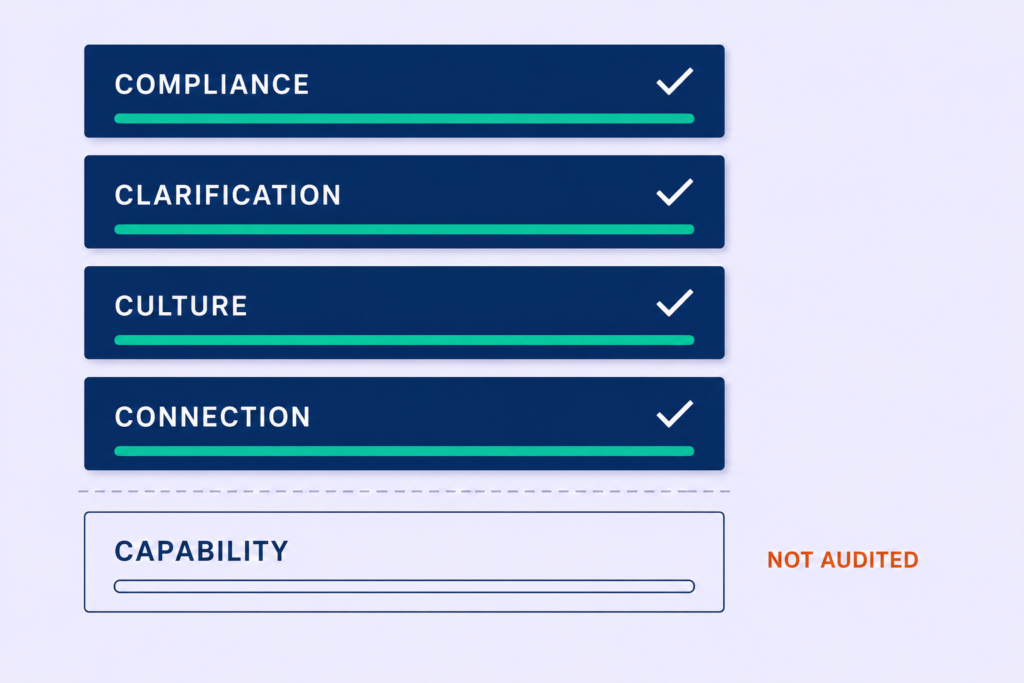
Dr Talya Bauer’s four C’s framework, developed for the SHRM Foundation, is the most durable model in this space and worth keeping. What follows is not the four bullets you have already read. Each C is listed with the failure mode that appears when it gets skipped, because that is the part nobody publishes.
- Compliance. Rules, paperwork, mandatory training. Skipped, it becomes a legal exposure. It is also the only C that is fully auditable, which is exactly why it is the one that never gets skipped and the one everyone over-indexes on.
- Clarification. What the role is and what good performance looks like. Skipped, the hire spends month one guessing, and their first deliverable is judged against a standard nobody told them about.
- Culture. The unwritten norms: how decisions get made, who to ask, what gets escalated. Skipped, the hire commits an avoidable political error in week three and quietly loses credibility they never recover.
- Connection. The relationships that make the work possible. Skipped, the hire has a manager and nobody else, so every question costs them a favour and they stop asking.
- Capability. The fifth one. Can this person do the work with the tools and access they have been given? Skipped, everything above is theatre.
Capability fails silently, and it fails for a structural reason. Compliance is auditable. Culture is felt. But nobody checks on day 40 whether the new hire has write access to the system they were hired to run.
I hire on capability signals over credentials. It would be absurd to then onboard on paperwork signals.
⚠ WATCH OUT
Common mistake: assuming IT provisioning equals capability. A ticket marked “resolved” means an account exists. It does not mean the account has the right permission level, that the licence was assigned, or that the hire can perform the one transaction their job depends on. Run an access-and-tools audit at day 14, owned by the manager, not by IT. The manager is the only person who knows what the hire is supposed to be able to do.
Why Onboarding Fails: The Real Cost of a Broken First 90 Days
Nearly every guide on this topic moves from “what onboarding is” straight to “here are the steps”. That sequence has a hole in it. If you do not know why the last process failed, the new one fails the same way with better formatting.
Here’s what breaks:
Failure Mode 1: The Orphaned Handover
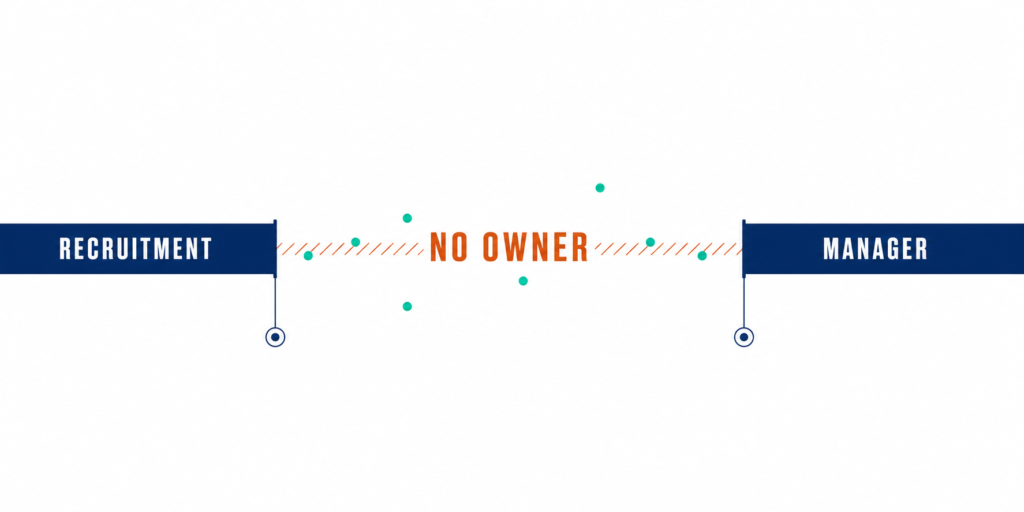
Recruitment owns the candidate until the offer letter. The manager owns them from around day 30, once the noise has settled. Nobody owns the 30 days in between.
You already know the symptoms. No manager one-to-one scheduled in week one. An equipment request raised and never chased because the person who raised it assumed the ticket was the job. Six weeks of project context that lived only in the recruiter’s head, and the recruiter has moved on to the next requisition.
Why this happens:
Onboarding is the only significant HR process with no single accountable owner. Payroll has one. Performance review has one. Onboarding has five contributors and an assumption.
My own work on the sourcing side makes the waste obvious. When I run talent mapping across a competitor set, I build a detailed picture of each candidate months before a job description exists: what they are working on, what would move them, what they are trying to get away from. That intelligence survives every stage of the hiring process. Then it evaporates at the offer letter, because the artefact that carries it does not exist.
⚠ WATCH OUT
Common mistake: responding to an ownership vacuum by adding items to the onboarding checklist. More tasks distributed across the same five functions with no named owner makes the vacuum worse, not better. A checklist without an owner is a wish list. Fix the handoff from recruitment to the hiring manager before you touch the task list.
Failure Mode 2: Onboarding That Ends on Day Two
The organisation runs a genuinely good day-one experience. Welcome pack, leadership video, a properly produced induction. Satisfaction scores come back high, HR reports them upward, and everyone concludes the programme works.
Then week three arrives and the new hire has no structured contact with anyone.
The measurement is the problem. Most onboarding surveys are fielded at day seven, which is precisely the window where the honeymoon effect is strongest and the data is least useful. You are surveying someone who is still relieved to have got the job, and reporting their relief as programme quality.
Which means the damage happens in a window nobody is measuring.
Deloitte finds that one-third of new hires are likely to leave within their first six months, and that workers who felt their onboarding was highly effective are 18 times more likely to feel highly committed to their organisation. Translation: a third of your intake is already leaving, the decision is forming in months two to five, and your survey closed in week one.
Source: Deloitte, New Hire Onboarding
Early attrition then gets attributed to pay, or to “fit”. It is almost never either. Retention problems are mostly systems failures, not compensation failures, and the first 90 days is where the system either transfers what the person needs or does not.
◆ PRO TIP
The honest downside: moving the survey window past the honeymoon will make your numbers worse before they look better, and somebody will have to defend that drop to a leadership team that liked the old number. Prepare that conversation before you move the window, not after the first bad report lands. Frame it as the first accurate reading you have ever had.
Failure Mode 3: Process Without Capability
The new hire completes every module and still cannot work. Compliance training done. Handbook signed. Culture deck watched. No access to the production environment, no introduction to the three people who approve their output, no clarity on what their first deliverable is or when it is due.
Administrative completion is not operational readiness. Most onboarding dashboards track only the first one, because it is the only part that is easy to instrument.
Here’s the difference:
The old way
- Track onboarding completion percentage
- Report 96% completion to leadership
- Hear from managers that new hires take four months to be useful
- Conclude the managers are exaggerating
The Lab Way
- Track time-to-first-meaningful-contribution
- Name the first deliverable, its date, and its internal customer before day one
- Record the date the hire ships something a colleague depends on
- Report that date, in days, alongside the loaded cost of those days
One of those is a compliance metric. The other is a business metric. Only one of them has ever won a budget argument.
Go back to the 28 days versus 67 days split. Internal movers hit productivity in roughly 40 to 50% of the time it takes an external hire, and they do not receive a better induction. They receive nothing extra at all. What they already have is the context: the systems, the people, the politics, the unwritten rules about how work gets approved. That isolates context transfer as the active ingredient, and it means the 39-day gap is not a fact of nature. It is a design choice.
The Four-Line Cost Model
Finance does not fund engagement scores. It funds models it can audit. Here is one you can build on your own cost base in an afternoon, with four lines and no assumptions borrowed from someone else’s benchmark report.
$500 / day
Operational drain from one unfilled senior engineering role. A 60-day vacancy is $30,000 in lost productivity before anyone has been hired.
| Line | How to calculate it | Worked example: one senior engineering hire |
|---|---|---|
| 1. Extended ramp cost | Extra days to productivity x loaded daily cost | 39 days x $500 = $19,500 |
| 2. Manager drag | Hours re-explaining context that should have transferred x manager loaded rate | 3 hrs/week x 8 weeks x $95 = $2,280 |
| 3. Replacement cost if they leave inside 12 months | Full cost per hire, paid a second time | Your cost-per-hire figure, in full |
| 4. Opportunity cost during the re-hire | Vacancy days x loaded daily cost | 60 days x $500 = $30,000 |
Lines three and four are the ones that change the conversation, because they are the same money twice. On the senior engineering roles I have owned, cost per hire ran between ₹6.5L and ₹7.5L before we rebuilt the sourcing model and between ₹3L and ₹3.8L after, a reduction of 45 to 55%. That saving is real and it is also fragile. It exists only until a hire made at the lower number walks out at month nine and you pay the original number again.
This is the cost of hiring them once. A failed onboarding means you pay it twice.
Two notes on using this. Run it on one real role rather than an average, because averages invite arguments about whether the average applies. And treat it as a planning tool rather than a financial projection, which is also how you should present it.
What you will not find in this model is the “it costs six to nine months of salary to replace an employee” figure that appears on almost every competing page. It is untraceable, and the first thing a competent finance partner will ask is where it came from. Build from cost per hire you can evidence instead.
The Five Stages, End to End

Five stages carry a new hire from offer to full contribution. Preboarding runs from acceptance to the first morning. Day One is its own stage because it sets the tone for everything after it. The First Week establishes working rhythm. The First 90 Days builds capability. Months Four to Twelve is where the second attrition wave lives.
The exit criteria:
The stages are not the interesting part. What has to be true before each one closes is.
- Preboarding closes when the hire knows what happens on Monday and their access has been tested by a human, not just provisioned.
- Day One closes when they have had a real conversation with their manager about the work, not the org chart.
- The First Week closes when they know their first deliverable, its date, and who receives it.
- The First 90 Days closes when they have shipped something a colleague depended on, unsupervised.
- Months Four to Twelve closes when they are performing at the standard the role was scoped for and there is a next step they can name.
◆ PRO TIP
The catch: a stage with no exit criterion is a stage nobody can fail, which means it is also a stage nobody audits. That is the whole reason onboarding drifts. Every other operational process in your business has a definition of done.
Stage names are where most guides stop. Exit criteria are where the system starts. The sequencing detail, what happens inside each stage and in what order, is where the execution lives, and that is covered separately in the complete employee onboarding process, stage by stage.
Who Owns Onboarding (and Why “HR” is the Wrong Answer)
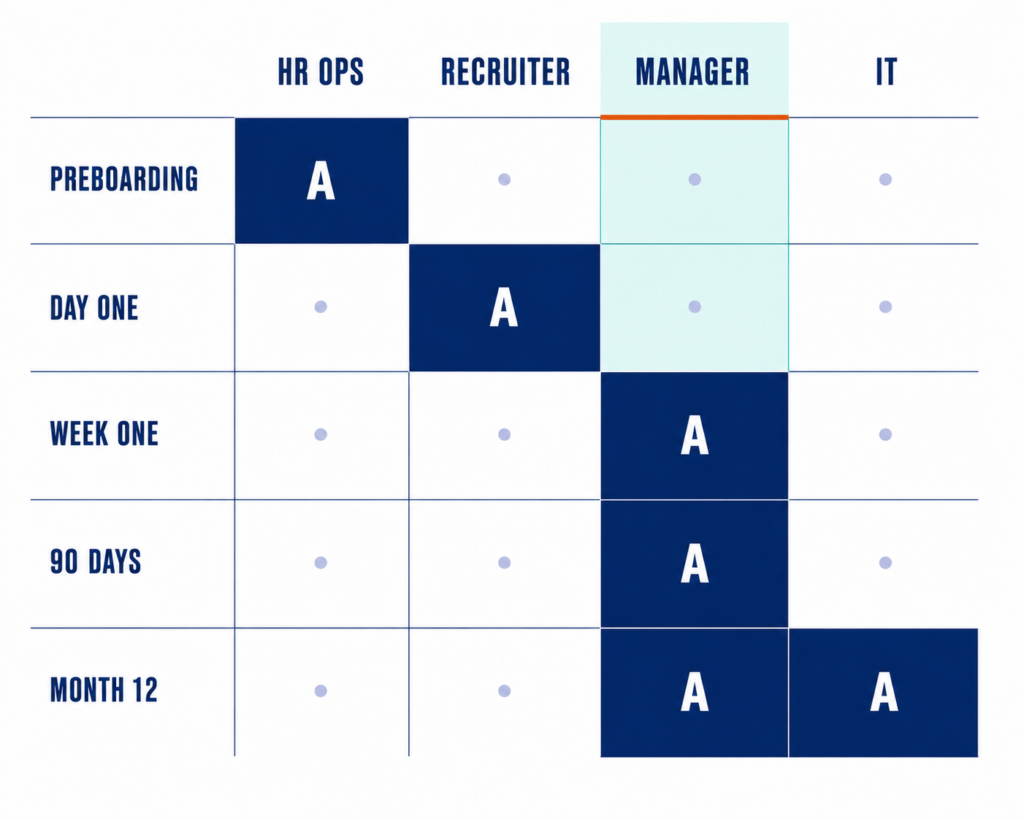
Ask ten organisations who owns onboarding and nine will say HR. That answer is the reason it fails.
HR cannot be accountable for whether a person becomes productive in a job HR does not do, on a team HR does not sit in, using systems HR does not administer. What HR can be accountable for is that the system runs. Those are different things and confusing them is why HR gets blamed for outcomes it has no lever on.
HR owns the system. The manager owns the outcome.
How to execute:
Build a RACI across the five stages. Responsible does the work. Accountable carries the consequence. Consulted is asked before. Informed is told after. This is the version I run.
| Stage | HR Ops | Recruiter | Hiring Manager | Buddy | IT | New Hire |
|---|---|---|---|---|---|---|
| Preboarding | A | R | C | I | R | I |
| Day One | R | I | A | R | C | I |
| First Week | C | I | A | R | I | R |
| First 90 Days | C | I | A | C | I | R |
| Months 4 to 12 | A | I | R | I | I | R |
One rule holds the whole table up: exactly one Accountable per stage. Never two. The moment a stage has two Accountables it has none, because each will assume the other has it.
The manager is Accountable for three of the five. That is deliberate, and it is the part that gets pushed back on.
When a manager says onboarding is HR’s job, the counter is not a values argument. It is this: you were accountable for the hiring decision, you will be accountable for the performance review, and you are the only person who can tell whether this hire is capable yet. HR cannot hold accountability for a judgment only you are qualified to make. What HR will do is remove every piece of administrative work between you and that judgment.
Where the table flexes: the Consulted and Informed columns move freely by organisation size. In a 200-person business the buddy and the manager are often the same person and that is fine. Where it does not flex: one Accountable per stage, and the manager holds Day One through the first 90 days. Everything else is negotiable.
This is the Talent Supply Chain applied past the point most organisations stop applying it. Treating hiring as a supply chain means every handoff has an owner and a spec. Onboarding is the final leg of that chain, and it is the leg most organisations leave unowned.
The Context Transfer Document
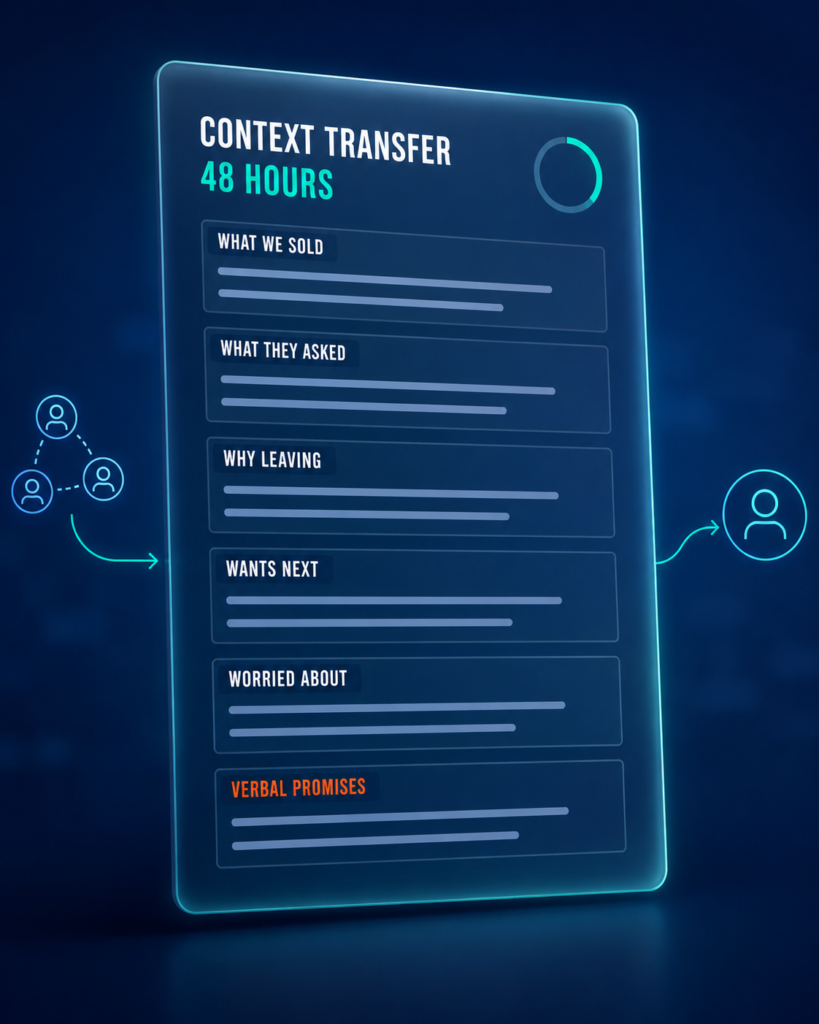
The RACI names who is accountable. This is the artefact that makes the first handoff survivable.
The old way
- Recruiter forwards the CV and the signed offer
- Manager reads a document written for a different purpose
- Six weeks of candidate conversations are never written down
- Manager starts from zero on day one
The Lab Way
- One page, six named fields, delivered inside 48 hours of acceptance
- Written by the recruiter who ran the process, not a template
- Manager arrives at day one already knowing who they are getting
- Reviewed in the first manager one-to-one, then retired
The CV tells the manager what the candidate has done. The context document tells them who they are getting. Six fields, and none of them optional:
- What the candidate was told about the role, in the words that were used
- What they asked about repeatedly across the process, which is what they care about
- What they are leaving behind, and why they are leaving it
- What they said they want to work on next
- What they were nervous about
- Any commitment made verbally during the process that is not in the offer letter
Field six is the one that saves you. Verbal commitments made in a final-stage conversation, about scope, about a project, about a title in 12 months, are the single most common source of the week-three moment where a new hire realises the job is not what they were sold.
Keep it role-relevant only. No health information, no family circumstances, no protected characteristics. It contains personal data gathered during hiring and should be retained under the same policy and the same retention period as your other recruitment records.
My intelligence-led sourcing work generates exactly this material as a by-product. Mapping a competitor set produces detailed intelligence on dozens of people. The waste is not in gathering it. The waste is throwing it away at the offer stage.
◆ FROM THE LAB
My experience: earlier in my career I inherited a hiring function with an expensive problem. External hiring costs were climbing and ramp times were long enough that managers had started padding their headcount requests to compensate. Everyone assumed the fix was a better sourcing channel.
We introduced a “First Look” policy instead. Every open role was posted internally for 48 hours before it went external, and recruiters were expected to actively approach internal candidates during that window rather than waiting for applications. It was a small structural change and it was unpopular with a few managers who preferred external hires.
Twenty-three percent of that year’s hires came from internal moves. The number that mattered more was Time-to-Productivity: 28 days for internal movers against 67 days for external hires into comparable roles.
Internal movers did not get a better induction. They got no induction at all in most cases. What they had was the context already: the systems, the approval chains, the three people who make decisions, the difference between what the process document says and what happens. That gap of 39 days is the price of context that never transferred.
The lesson I took from it was not “hire more internally”. It was that context transfer is the active ingredient in ramp speed, and if you can isolate it, you can engineer it for external hires too. That is what the six fields above are for.
⚠ WATCH OUT
Anti-pattern: presenting the RACI as a framework the business might like to adapt. Adaptable frameworks get adapted into nothing. Present it as the operating model, name the one rule that does not flex, and let people argue about the Consulted column all they want.
If frameworks like this one are useful to you, the Lab newsletter sends the next one before it goes anywhere else.
The Manager’s Role: The Single Biggest Variable

Onboarding quality is largely a function of one person’s calendar.
Not the induction deck, not the platform, not the welcome pack. Whether the hiring manager blocked the time. Every other input is a rounding error next to this one, and most guides list it as one bullet among ten.
Here’s the deal:
Active involvement is a specific set of behaviours, not an attitude. Present on day one, in person or on video, for a conversation about the work. Weekly one-to-ones from week one, not from month two. Owning the plan rather than receiving it from HR. Running the check-in gates personally. Making the introductions themselves rather than sending a list of names.
Here is what that involvement is worth.
3.4x
When the manager takes an active role, employees are 3.4 times as likely to strongly agree their onboarding was exceptional. Only 29% of new hires say they feel fully prepared and supported to excel after onboarding.
Source: Gallup, 8 Practical Tips for Leaders for a Better Onboarding Process
Translation: seven in ten new hires start the job knowing they are not ready for it. They will not say so, because week four is a bad time to admit you are lost.
Now the harder half. Managers do not skip this because they do not care. They skip it because no time was allocated, because onboarding outcomes appear nowhere in their own goals, and because nobody ever showed them what good looks like. Given a busy week and no forcing function, the new hire loses to whatever is on fire.
The old way
- Send the manager an onboarding checklist
- Run a workshop on onboarding principles
- Chase completion by email
- Escalate when nothing happens
The Lab Way
- Put new-hire 90-day productivity in the manager’s own goal sheet
- Define the measure: date of first unsupervised deliverable
- Review it in their performance conversation, by their own manager
- Hand them a pre-populated pack so the good behaviour is the easy one
Managers do what they are measured on. If onboarding is not measured, it is optional, and optional loses every time. The manager’s calendar is the system, and a system with no forcing function is a suggestion.
◆ PRO TIP
The catch: this only works if the manager’s own manager cares about the number. Getting a line into a goal sheet is easy. Getting a director to ask about it in a review is a separate campaign, and it is the one that determines whether any of this holds. Start there if you have the political capital for only one fight.
The Manager Enablement Pack
“Be involved” is an expectation. A pack is a tool. Hand every manager these five artefacts before the start date, never on day two, because a pack delivered after the hire arrives is a document nobody reads.
- A pre-populated plan template for that specific role, not a blank one
- The context transfer document from the recruiter
- Three suggested week-one deliverables appropriate to the role
- Check-in agendas, each naming the decision that check-in has to produce
- The buddy assignment, already made and already accepted
Do not train the behaviour. Engineer it. Training is what organisations do instead of building the tool, and a workshop attended in March does not survive a busy week in September.
The drafting work in that pack, the role-clarity translation, the first-pass agendas, the plan skeleton, is exactly the kind of task that AI as a recruiting co-pilot should absorb, so the manager’s time goes to the conversation rather than the document. More on where that line sits below.
Six Onboarding Practices That Survive Contact with Reality
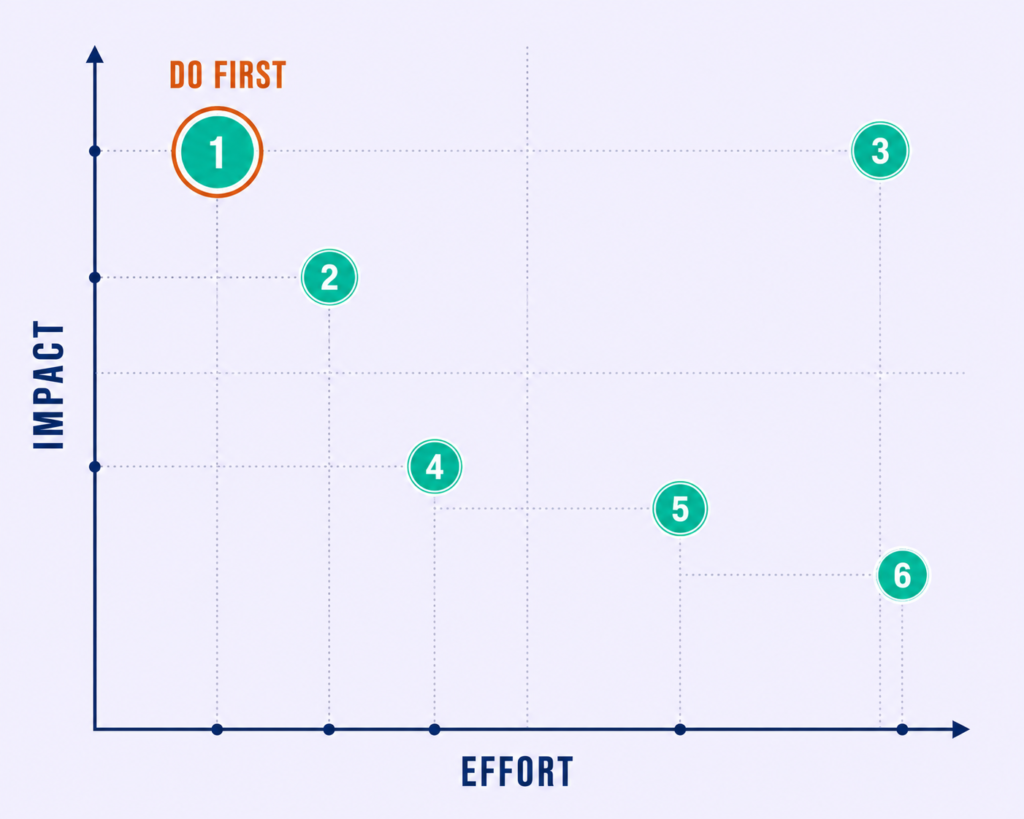
Most best-practice lists give you ten items of equal weight, no difficulty rating, no cost, and no indication of what happens when you implement one badly. That is why you have read four of them and implemented none.
The old way
- Ten practices, all presented as equally important
- No cost, no difficulty, no sequence
- Reader picks the easiest and abandons it in six weeks
The Lab Way
- Six practices, each with a difficulty rating and a time cost
- Each carries a named failure mode
- Reader triages by impact against their own capacity
Advice without a failure mode is advertising. Every practice below names the specific way it breaks.
Start Onboarding at Offer Acceptance
How to execute:
Treat the acceptance email as the start signal, not the finish line. Access requests raised that day. The context transfer document written inside 48 hours. The manager makes contact within the first week of the notice period, about the work, not about logistics.
Why this works:
The notice period is the only free time you will ever get. The hire is committed, has capacity to absorb context, and is at their most anxious about the decision. Silence during that window is what a counter-offer is built on.
◆ FROM THE LAB
Real implementation: at one point in my career I was asked to scale an automation engineering team faster than the market would reasonably allow. The standard answer would have been to open the roles and increase agency spend. Instead we spent the first weeks mapping talent across 12 companies in the industrial IoT space, building a picture of who was where, what they were working on, and what would move them.
By the time the first job description was signed off, 37 qualified candidates had already been identified and warmed. Time-to-Offer fell from 68 days to 34.
Here is the part that took me longer to notice. That mapping work produced something more useful than a candidate list. For every person we spoke to, we understood what they wanted to build, what was frustrating them where they were, and what they would need to see to say yes. Rich, specific, hard-won context.
And on the day each offer was accepted, almost all of it stopped moving. It sat in a recruiter’s notes and a few email threads while the hire spent their notice period hearing nothing, and their new manager prepared to meet a stranger.
The transferable lesson: whatever you invested to win the candidate is also the raw material for onboarding them well. Most organisations discard it at the offer letter and then rebuild the same understanding from scratch over the following three months, at the new hire’s expense.
⚠ WATCH OUT
Failure mode: preboarding that becomes homework. Sending policy documents and compliance modules into someone’s notice period is not engagement, it is unpaid work, and it sets the tone that this organisation takes more than it gives. Contact during notice should be about the work and the people. Nothing that requires a completed form.
Appoint Buddies on a Power Law
How to execute:
Stop assigning buddies on rotation. Identify the 5 to 10% of people who are genuinely good at it, ask them, give the role a name and visible status, and use them repeatedly. Accept that the distribution will be uneven and defend it when someone calls it unfair.
Why this works:
Helping a new person integrate is a skill, and skills are not evenly distributed. A rota optimises for fairness among existing employees. It does not optimise for the new hire, who is the person the scheme exists to serve.
◆ FROM THE LAB
The Sofia lens: I learned this from a referral programme, not an onboarding one. In one of the organisations I worked with, the employee referral scheme was underperforming badly despite being open to everyone and well publicised. The instinct was to raise the bonus.
Instead I looked at who was referring. A small group, somewhere between 5 and 10% of participants, was producing the overwhelming majority of successful hires. Everyone else had referred once, or never.
So we stopped treating it as a democratic scheme. That small group got a name, Talent Scout, along with genuine status, early sight of upcoming roles, and a quarterly conversation with the hiring team about what was coming. One senior engineer in that group referred 11 people. Nine were hired. Eight were still with the business years later. Across the group, referral conversion ran at 82% against a company average of 31%, and the agency fees avoided came to roughly ₹40 lakhs.
The same asymmetry applies to buddies, and for the same reason. Some people are naturally good at reading when a new joiner is lost and stepping in before they have to ask. Spreading the role evenly across a team wastes those people and hands new hires to colleagues who did not want the job. Activate the few, not the many.
⚠ WATCH OUT
Failure mode: a buddy with no remit becomes a lunch companion. If the only instruction is “look after them”, the relationship defaults to social and dissolves in three weeks. Give the buddy two or three specific jobs with dates: walk them through how work gets approved here, introduce them to four named people in week one, and check in on day 21 whether anything is still confusing.
Put 90-day Productivity in Manager Goals
How to execute:
Write one line into the goal sheet of every manager who will hire this year. The measure is the date of the new hire’s first unsupervised deliverable, not a satisfaction score. The reviewer is the manager’s own manager, in the normal performance conversation, not HR in a separate one.
Why this works:
This is the practice that makes the other five stick. Everything else on this list is an improvement to a process that remains optional. This one changes who carries the consequence, which is the only thing that reliably changes behaviour at scale.
⚠ WATCH OUT
Failure mode: a manager goal with no review becomes a line nobody reads. If it is never raised in a performance conversation, you have added administration and changed nothing. Before you write the goal, get one senior leader to commit to asking about it. Without that, do not bother.
Write Goals a Third party can Verify
How to execute:
Apply one test to every onboarding goal you write: could someone outside the relationship confirm whether it happened? “Understands the product roadmap” fails. “Has presented the roadmap back to two stakeholders and answered their questions” passes. The stage-by-stage guide covers how to build the plan itself; this is the rule for what goes in it.
Why this works:
Definitional specificity is what produces measurable improvement, and I have watched this hold on the hiring side repeatedly. Running competition analysis before opening a role lifted Quality of Hire by 12%. Mapping the talent landscape across similar industries added 14%. Building skill-based pipelines off proper market analysis produced a 30% improvement. In each case the intervention was the same: define precisely what you are looking for before you go looking. Vague onboarding goals fail for the same reason vague role definitions do.
⚠ WATCH OUT
Failure mode: the verifiability rule applied too literally produces goals so narrow they measure nothing. “Has completed 14 tickets” is verifiable and worthless. The test is whether a third party could confirm it, not whether it can be counted. Judgment-based goals are fine as long as somebody other than the manager could assess them.
Survey After The Honeymoon, Not During
How to execute:
Move the primary survey window out of the first fortnight. Keep a light day-one pulse if you want an operational check on logistics, but stop treating it as a measure of onboarding quality. The score that matters is collected once the novelty has worn off and the person has had time to discover what they were not told.
Why this works:
A new hire in week one is answering a different question from the one you asked. They are telling you how they feel about having been hired. Later, they tell you whether the handover worked. Only the second one is actionable, and only the second one predicts whether they stay.
⚠ WATCH OUT
Failure mode: moving the window without preparing the leadership conversation. The first honest score will be lower than the dishonest one it replaced, and if nobody has been briefed, the finding gets read as a decline in performance rather than an improvement in measurement. Brief it before you field it.
Design for The Second Attrition Wave
How to execute:
Extend the process past 90 days with a small number of deliberate touchpoints in months four to twelve. Not more induction. A conversation about what the role has turned out to be, a check on whether the growth they were promised is visible yet, and a named next step they can work towards.
Why this works:
The first attrition wave is a mis-hire or a broken start. The second one is different. It happens once the person is competent, has stopped being interesting to their manager, and has enough distance to compare what they were sold against what they got. That comparison happens around month seven, and by then almost every organisation has closed the file.
⚠ WATCH OUT
Failure mode: turning months four to twelve into extra process. If the touchpoints become forms, they get delegated and then skipped. Three real conversations beat a nine-month workflow, and the only one that has to be diarised is the one that names what comes next.
Digital Employee Onboarding: What to Automate and What to Never Automate
Almost everything written about digital employee onboarding is written by someone selling onboarding software. That does not make it wrong. It makes it incomplete in one predictable direction: every article concludes you should automate more, because every author benefits if you do.
I have nothing to sell you. So here is the neutral version.
Here’s the rule:
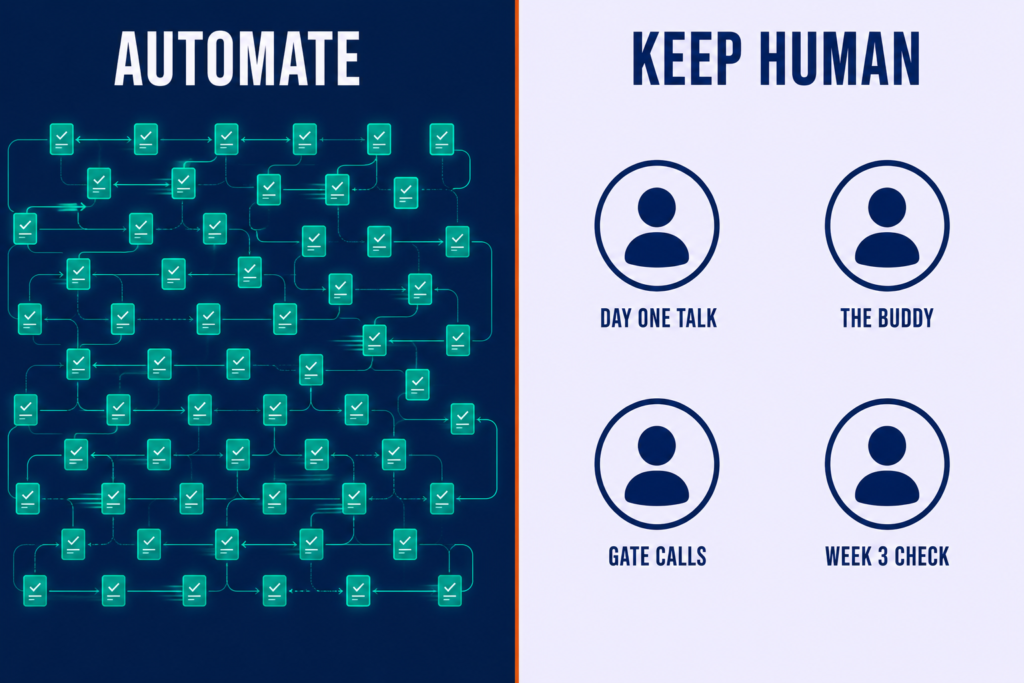
Automate anything that is high-volume, low-judgment, and identical across hires. Three conditions, all of them required. A platform’s feature list is not a strategy, and “our tool supports it” is not a reason to automate something.
What to automate
- Document collection and e-signature
- Compliance and mandatory training assignment, plus completion tracking
- Equipment and access provisioning, triggered by the offer acceptance event rather than by a human remembering
- The preboarding communication sequence across the notice period
- Check-in reminders to managers
- Survey scheduling
- The task tracker spanning HR, IT, facilities, and the manager
Two of those deserve a caveat. Verification requirements for employment eligibility vary by jurisdiction, and e-signature is not universally accepted for right-to-work or I-9 documentation. Check the rule that applies where the person will work before you automate that step.
What to never automate
Here’s what breaks:
Four moments lose all their value the instant they are automated. Not most of their value. All of it.
The manager’s day-one conversation. Replaced by a recorded welcome, it communicates the opposite of what it intends: that this hire was not worth 30 minutes of a real person’s time on the one day they will remember.
The buddy relationship. An automated match produces a name in a field. Nobody has been asked, nobody has agreed, and the new hire is now expected to initiate a relationship with a stranger who does not know they were assigned.
The gate decisions. Whether this hire is on track is a judgment about capability in context. A system can tell you a milestone was missed. It cannot tell you whether that matters.
The “how are you finding it” conversation at week three. Replace it with a survey and you collect a score and lose the reason. The reason is the entire value, and it only ever arrives unprompted, in a conversation, from someone who trusts the person asking.
The old way
- Digitise the whole journey for consistency
- Measure success by how few manual steps remain
- Treat manager time as a cost to eliminate
The Lab Way
- Automate the logistics ruthlessly
- Protect the four human moments absolutely
- Spend the time you saved on the moments you protected
Keeping those four human costs manager time, and that cost has to be planned for rather than wished away. Roughly four hours across the first 90 days, per hire. Budget it or it will not happen.
Automation doesn’t replace the manager. It replaces the parts of the job that stopped the manager from being present in the first place.
⚠ WATCH OUT
Red flag: if an onboarding platform demo shows zero required manager actions, that is not efficiency. That is the manager being designed out of the process, sold to you as a benefit. Ask the vendor which steps require the hiring manager personally. If the answer is none, the product is optimised for the buyer’s convenience rather than the new hire’s outcome.
Where AI is Useful in Onboarding
◆ FROM THE LAB
My experience: I have led AI and prompt engineering work inside recruitment, and my position has not moved. Use AI as a co-pilot, not a decision-maker. It accelerates thinking. Recruiters and managers own judgment, context, and every final call.
What is genuinely working in pilots now: drafting role-clarity and skill-translation content, generating first-draft check-in agendas, answering the new hire’s repetitive policy questions through a knowledge assistant so they are not asking a human the same thing three times, summarising survey free-text at volume, and the agentic orchestration pattern where a missed check-in or a delayed access request triggers a prompt to a named human. That last one is the most underrated. Stall detection is exactly the kind of continuous, low-judgment monitoring no person has the attention span for.
What is not working: capability assessment, the mis-hire decision, and anything that requires knowing how this organisation operates. Those need context the model does not have and cannot acquire.
⚠ WATCH OUT
Two risks, both named before you deploy rather than after. The first is the automation arms race: once dependency starts, usage expands to fill whatever the tool allows, and the human layer thins without anyone deciding it should. Set the dependency limit in writing at the pilot stage.
The second is algorithmic bias. If the training data is flawed, the system reinforces historical patterns rather than correcting them, and it does so invisibly and at scale. HR uses are classified as high-risk under the EU AI Act, which means this is now a regulatory question as well as an ethical one.
Point AI in recruitment at the repetitive-question layer and the stall-detection layer, keep humans on judgment, and the economics work. The broader argument for human and AI teaming in HR, and where agentic AI in HR is heading next, is worth a longer read on its own.
Onboarding at Volume: The Batch Model for 50+ Hires
Every guide on this topic assumes you are onboarding one person. Run that same process fifty times in parallel and it collapses in week two, usually at the point where one HR coordinator is fielding forty variations of the same question.
Here’s what changes:
- Cohort starts, not rolling ones. Fixed start dates, so orientation runs once for thirty people rather than thirty times for one. This is the single change that makes everything else possible.
- Batch orientation with role-specific breakouts. The shared 60% runs collectively. The role-specific 40% splits by function in the afternoon.
- Cohort buddies, not one-to-one. At volume the buddy ratio breaks first. One strong buddy to five or six new joiners in the same function works. One to ten does not, and one to one is arithmetic you cannot fund.
- Standardised plan templates per role cluster. Not per role, per cluster. Fifteen templates, not four hundred.
- A daily stand-up during ramp weeks. Fifteen minutes, HR and the managers, exceptions only.
- One tracker, visible to HR, managers, and IT simultaneously. The moment there are two trackers, there are none.
- A single named point of contact per batch. Forty people with one number to call is manageable. Forty people escalating to whoever answers is not.
◆ FROM THE LAB
Real implementation: at one point in my career I was handed a ramp-up target that did not look survivable. Somewhere between 350 and 500 hires across customer support, operations analysts, junior engineers, and sales support, against an 8 to 12 week window driven by a business start date that was not moving. Limited interviewer capacity, high drop-off risk, and an expectation that quality would hold.
We planned backwards from the business start date rather than forwards from the requisition. Weekly hiring targets, recruiter bandwidth, interviewer availability, and sourcing throughput were all mapped against that end point. Roles were grouped into generic clusters to widen the pool without diluting the requirement. Screening was standardised into a single pre-assessment. Interviews ran in batches against structured scorecards. Daily recruiter stand-ups, real-time tracker dashboards, and a weekly war-room call with hiring managers kept the whole thing visible.
The candidate-facing side mattered as much as the operational one. Mass communication templates with clear timelines, a single point of contact per batch, accelerated offer releases, and structured pre-joining engagement to hold people through their notice periods.
We delivered 420+ hires in 10 weeks. Average Turnaround Time fell from 32 days to roughly 18 to 20. Offer-to-join held above 90%. Ninety-day retention came in between 85 and 88%, in line with the historical benchmark rather than below it, which was the outcome I cared about most. Recruiter productivity improved by around 35%, and the project launched on time.
The transferable lesson: the mechanisms that made this work at volume were all about what got batched and what did not. The logistics went collective. The judgment stayed individual. That distinction is the entire model, and it is the one people get wrong when they try to scale a one-at-a-time process by working harder.
The old way
- Run the standard process fifty times in parallel
- Add coordinator headcount when it strains
- Accept that quality drops at volume as a law of nature
The Lab Way
- Cohort the logistics, individualise the judgment
- Design the model three weeks before the first start date
- Hold 90-day retention as the quality gate, not completion rate
◆ PRO TIP
The honest downside: cohort onboarding buys efficiency and spends personalisation. Two things must stay individual regardless of volume, and they are the manager conversation and the plan. Everything else, orientation content, systems training, policy walkthroughs, buddy structure, and the tracker, can safely go collective. If you find yourself batching the manager conversation, you have crossed the line and you will see it in the 90-day number.
The design work behind this belongs to the same discipline as bulk hiring and ramp-up planning, and if you are onboarding at this scale you are almost certainly hiring at it too.
What to Track, and What to Ignore
Four metrics. Not twelve. Each one earns its place by answering a business question rather than describing an activity.
| Metric | The question it answers | My benchmark |
|---|---|---|
| Time-to-Productivity | How long are we paying for reduced output? | 28 days internal, 67 days external |
| 90-day and 12-month retention, split by manager and hiring source | Where is the leak? | 89% at 12 months |
| Onboarding NPS, fielded after the honeymoon | Is the experience working once novelty ends? | Compare against your day-7 score |
| Manager onboarding compliance | Is the system being run at all? | Track it before you improve it |
Here’s the one that matters:
The fourth is the only leading indicator. The other three report what already happened, which makes them useful for diagnosis and useless for intervention. Manager compliance tells you today whether next quarter’s retention number is being built or broken.
Measuring it is worth the effort because the upside is large. Gartner finds successful onboarding can increase discretionary effort by more than 20% and drive performance by up to 15%. Translation: this is a productivity lever, not a hygiene factor, and it should be argued for as one.
Source: Gartner, Onboarding New Hires Checklist for HR Leaders
Nobody has ever approved a budget for a satisfaction score.
Convert every metric to currency before it goes in front of finance.
◆ PRO TIP
The catch: the leading indicator is the one nobody wants to report, because it names managers. Also worth stating plainly, probation rules and exit rights vary significantly by jurisdiction, so nothing here implies a universal right to exit a hire at day 90.
Naming the four is the strategy. The formulas, collection methods, benchmarks, and survey question sets are a separate job, and that job is measuring employee onboarding.
What good looks like, task by task
You have downloaded four onboarding checklists and used none of them. The reason is structural, not motivational.
Almost every checklist in circulation has two columns: phase and task. A task list with no owner is the orphaned handover from earlier in this article, rendered in bullet form. It looks like a control. It is a reminder.
Here’s the difference:
A working checklist needs four columns. Phase, Task, Owner, and Done when. Owner maps directly to the RACI. Done when has to be verifiable by a third party, which is where most checklists quietly fail.
| Phase | Task | Owner | Done when |
|---|---|---|---|
| Preboarding | Provision system access | IT, verified by manager | New hire has logged into all four core systems and completed one transaction in each |
| Week one | Agree the first deliverable | Hiring manager | Deliverable, due date, and receiving colleague are written down and shared with that colleague |
| Month six | Growth conversation | Hiring manager | A named next step exists that the employee can repeat back unprompted |
Look at row one. “IT access confirmed” is what most checklists say, and it is wrong, because it can be true while the person still cannot work. The version above cannot be ticked by someone who has not checked.
⚠ WATCH OUT
Common mistake: adding an owner column and populating it with “HR”. That is not an owner, it is a department, and departments do not get held to account in a review conversation. Name the role, and make sure it matches the RACI.
Those three rows are a demonstration of the structure, not the artefact. The full version, phase by phase across the whole year, is the 12-month employee onboarding checklist.
Frequently Asked Questions
What is the difference between onboarding and orientation?
Orientation is a single event, usually one or two days, covering paperwork, policies, and introductions. Onboarding is the full integration process running from offer acceptance through the first 12 months, owned by the hiring manager. Orientation is a component of onboarding, not a synonym for it.
The distinction has a cost attached. Organisations that use the words interchangeably tend to declare success on day two and stop funding everything that comes after.
How long should employee onboarding last?
Twelve months. Formal onboarding runs from offer acceptance through the first year. Most organisations stop at 90 days, which is why attrition spikes around month seven. The second drop-off window sits entirely outside their process.
Months four to twelve do not need more induction. They need three real conversations: what the role has turned out to be, whether the promised growth is visible, and what comes next.
What are the 4 C’s of onboarding?
Compliance, Clarification, Culture, and Connection, the framework developed by Dr Talya Bauer for the SHRM Foundation. Compliance covers rules and paperwork, Clarification covers role expectations, Culture covers norms, Connection covers relationships. We add a fifth: Capability, whether the new hire can do the work with the access they have been given.
Capability is our addition, and it fails more quietly than the other four because nothing audits it.
Who is responsible for employee onboarding, HR or the hiring manager?
Both, with a clear split. HR owns the onboarding system: the process, the templates, the compliance layer, and the measurement. The hiring manager owns the onboarding outcome, whether the person reaches productivity and stays. Gallup finds employees are 3.4 times more likely to rate onboarding as exceptional when the manager is actively involved.
The full split, stage by stage, is set out in the onboarding RACI above.
How do you measure onboarding success?
Four metrics: Time-to-Productivity, 90-day and 12-month retention split by manager, onboarding NPS fielded after the honeymoon period, and manager onboarding compliance. The last is the only leading indicator. The other three report what already happened.
Convert each one to currency before presenting it. Finance funds numbers it can audit.
The Last Leg of the Chain
Onboarding is not a welcome programme. It is the last leg of the Talent Supply Chain, and it is the leg most organisations leave unowned.
The gap between organisations that get this right and organisations that keep rebuilding the same broken process is not budget, and it is not software. It is whether one named person is accountable for whether the new hire can do the job by day 90.
That question is about to get harder to avoid. Gartner expects HR to turn roughly a third of its recruiting capacity inward in 2026, and regrettable retention to become the primary productivity barrier. If a third of your hiring becomes internal movement, onboarding stops being a new-hire process and becomes an internal mobility process too. Every one of those moves needs the same context transfer and the same single accountable owner, at a point where the business has already decided it cannot afford to lose the person.
Source: Gartner, Four Trends Talent Management Leaders Should Prepare for in 2026
So pick two. Not six.
One from ownership: the RACI, or the context transfer document. One from the practice list, whichever difficulty rating matches the capacity you have this quarter. Run them for 90 days. Measure Time-to-Productivity before you start and again at the end, in days, and convert the difference to currency before you show anyone.
That number is the argument. Everything else is a conversation about how nice the welcome pack looked.
If you are rebuilding onboarding in your own organisation this year, I would like to hear how it goes. Connect with me on LinkedIn and tell me which two you picked.
