

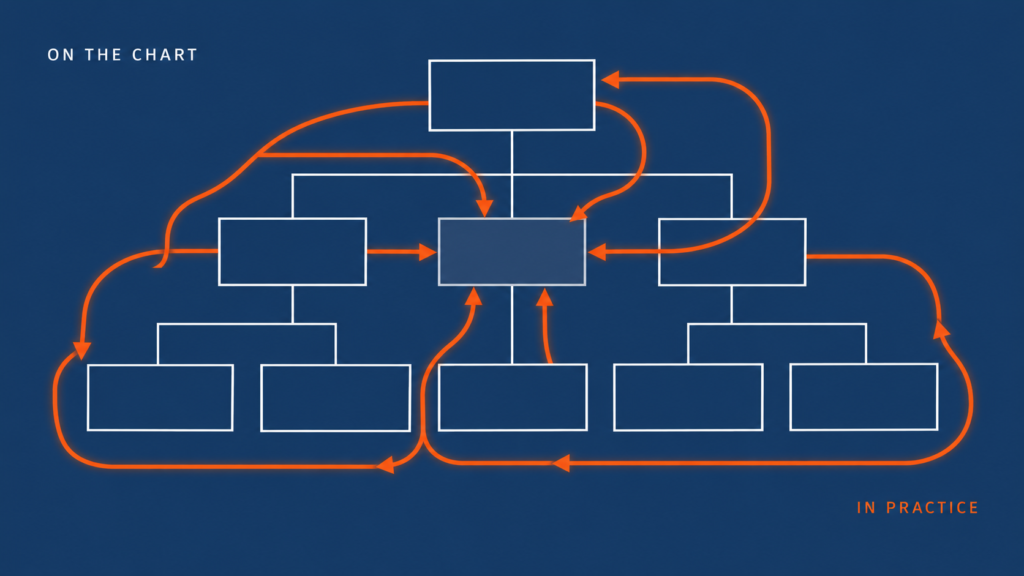
I have spent eight years staffing structures other people drew.
So I recognise the pattern before anyone says it out loud. The redesign was signed off in March. By September the same meetings are back on the calendar, the same decisions escalate two levels the way they always did, and the only thing that changed is the titles on the chart.
Most organizations run these as two projects. Two owners, two timelines, two plans that never meet. That is not a coordination problem. That is the reason the redesign failed.
The people carrying it feel the cost long before a dashboard shows it. Seven in 10 US workers reported disruptive change inside their organization in the last year, and the ones absorbing the most of it are paying in health, not in programme delay.
42% vs 24%
Burnout among employees who experienced extensive disruptive change, against those who did not.
Source: Gallup, Disruptive Change Is Hitting Leaders and Managers Hardest, 2024
Translation: a redesign that stalls does not only miss its benefit case. It burns through the manager layer you need to run the next one.
This guide is the version I wish someone had handed me the first time I was asked to make a finished structure land. By the end of it, you will have:
- A seven-stage blueprint that runs design and adoption as one sequence, from business case to cutover
- The rule for choosing a structure, and the reason decision rights decide more than the shape does
- A matching rule for change models, so you can defend a methodology choice in a steering meeting
- What a redesign does to your workforce plan, your internal mobility, and your cost per hire, in numbers you can put in a business case
- A post-go-live scorecard with measurement windows and a baseline instruction
- Five failure tells you can check against your own programme this week
HR Insights Lab approach:
Every page ranking for this topic is half an article. The design pages never reach adoption. The Organizational Design and change management pages never mention structure. Nobody writes about the seam between them, which is the one part that breaks.
I write from that seam, because it is where my career has been spent: staffing structures after somebody else decided their shape, and watching what that decision cost.
What Is Organizational Design?
Organizational design is the deliberate configuration of structure, roles, decision rights, reporting lines, processes, and reward systems so an organization can execute its strategy. It sets who decides what, who is accountable for which outcome, and how work crosses internal boundaries. The org chart is the output of that work. It is not the work.
Here’s the difference:
The chart shows you boxes and lines. The design is the set of decisions sitting underneath them, and those decisions are concrete and uncomfortable in a way a chart never is.
A span-of-control target that moves managers from four reports to eight. A P&L boundary that shifts a business line under a different owner. A call on whether the finance team sits centrally or embeds inside each unit. Every one of those changes who can say no to whom.
I spent eight years inside a global industrial organization where “the restructure” and “the new org chart” were used as the same word. The gap between those two things is where projects died.
Real talk: most redesign debates never reach the decisions above. They stall on the picture, because the picture is easier to argue about than the authority underneath it.
The structural discipline gets its own page in this cluster. The deep dive on Organizational Design covers the principles, the design factors, and the choices that shape a structure before anyone draws it. This guide stays on the part almost nobody writes about: what happens when a finished design meets the people who have to work inside it.
What Is Organizational Change Management?
Organizational change management is the structured discipline of moving people from the current way of working to a new one, so the change is adopted, used, and sustained. It covers readiness assessment, communication, manager enablement, training, resistance handling, and reinforcement. Its job is adoption, measured in behaviour, not in messages sent.
Here’s the deal:
Change management is not communications. It is not training either.
Communications and training are outputs. Change management is the diagnosis underneath them.
The diagnosis answers four questions: who is affected, how much of their working day changes, what they lose, and what would make them quietly stop cooperating. Answer those four and the comms plan writes itself. Skip them and you have a calendar of events with no theory of why anyone would comply.
Most HR Business Partners get handed “do the change management” three weeks from go-live, with a deck as the deliverable. You were handed a deliverable when the job was a discipline. That is the sentence to use when you push the conversation earlier.
The broader question of Organizational Change, what shifts inside an organization and how that shift travels through it, sits behind this discipline and has a page of its own.
Here’s the difference between the three levels:
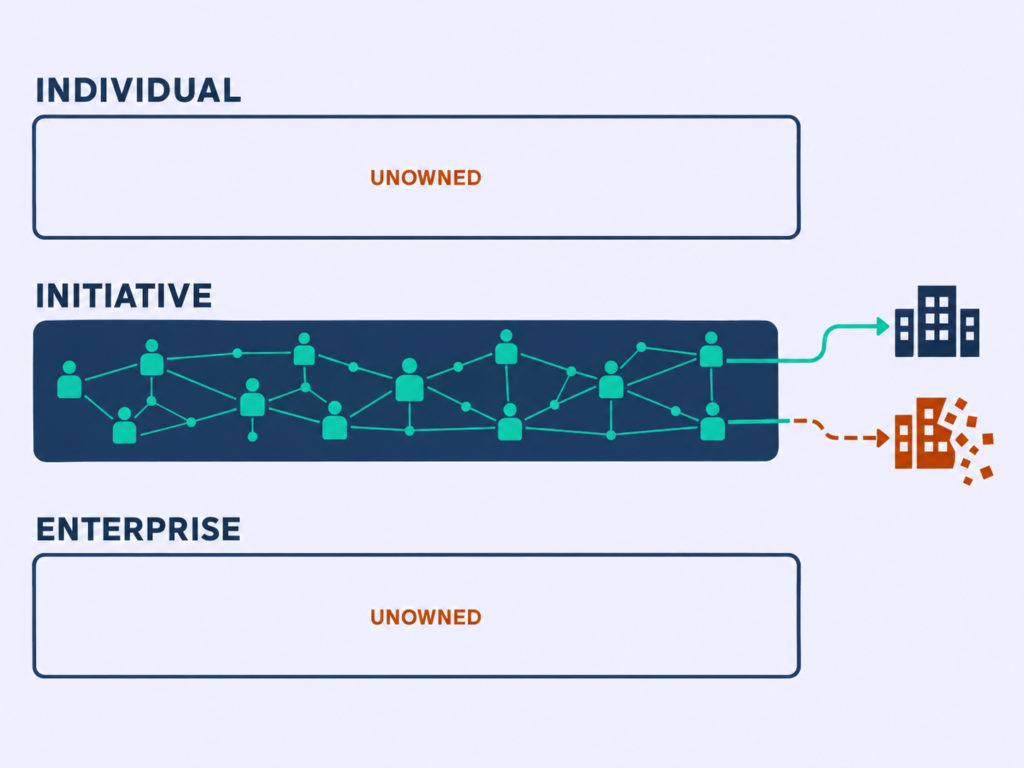
- Individual: one person’s transition through the change. Owned by their line manager.
- Initiative: a single programme’s adoption curve. Owned by the change lead and the sponsor.
- Enterprise: the organization’s standing capacity to absorb change at all. Owned by HR and the executive team.
- The failure: most organizations staff the middle level and leave the outer two empty.
That empty outer ring is why the same change lands cleanly in one business unit and collapses in another. The unit that absorbed it had capable managers and a population that was not already saturated. Neither of those was anybody’s job to build.
We make the identical mistake in hiring. A Talent Supply Chain works because capacity gets built once and drawn on repeatedly, and change capability follows the same arithmetic: build it once, or rebuild it every programme and pay the start-up cost every single time.
If you have to argue for funding that standing capacity, and you will, the business case sits on the importance of change management page in this cluster.
◆ PRO TIP
Real talk: the enterprise level almost never gets funded until a redesign fails publicly and expensively. Nobody budgets for standing capacity. They budget for the programme in front of them, then budget again for the next one, and call the repeated start-up cost the price of doing business.
Organizational Design and Change Management Are One Job, Not Two
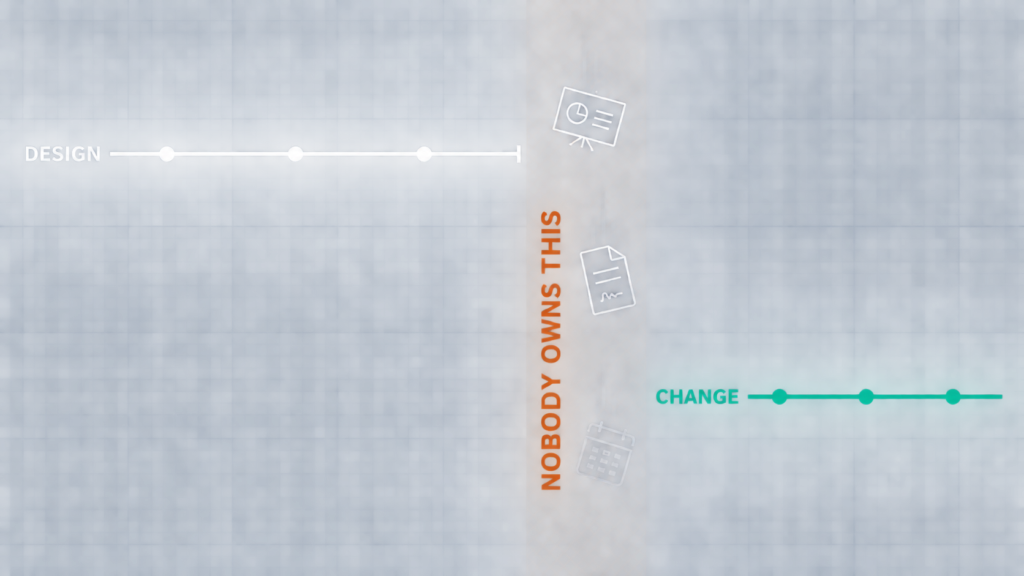
Organizational Design and Organizational Change get treated as two disciplines with two budgets. On the org chart of the programme itself, they report to different people.
Design runs in a small confidential group on a strategy timeline. Change management gets engaged once the design is approved, on a communications timeline. The two groups never share a plan.
The seam between them is where every predictable failure lives. Managers learning their own team’s new shape from a town hall slide. Decision rights that exist on paper and that nobody exercises. A structure that goes live on Monday with no change to how work gets assigned on Tuesday.
Here is the operational claim this whole guide rests on.
Design decisions carry adoption cost. If you don’t price it while designing, you can’t price it later.
A span-of-control change looks free on the chart. Moving a manager population from six reports to twelve costs two quarters of capability building, and if nobody priced that during design, the structure ships carrying a gap nobody planned for.
Price it during design and the arithmetic changes. The cheapest design on paper stops being the automatic winner, because the second-cheapest one might adopt in a quarter instead of a year.
If failed adoption were a local problem, the numbers would look better than they do. Gartner reported in 2025 that just 32% of mid-to-senior business leaders said the last change they led achieved healthy adoption by employees, and a separate survey that April put the share of employees with low trust in change at 79%.
Source: Gartner HR Research, 2025
Translation: your failed redesign is the base rate. The organizations getting this right are doing something structurally different, and it is not better communication.
◆ FROM THE LAB
The Sofia lens: I was recognised inside a global industrial organization as a Key Enabler of Transformation, and the pattern I watched repeat, across functions and at every scale, was always the same one. The design group finished its work and handed over a deck. The managers who had to make it real received that deck at the same moment as their own teams, with no answers for the questions they were about to be asked. I have seen technically sound structures fail on that single handover. I have seen weaker structures succeed because one person held both halves and refused to let the design close before the adoption plan existed. The structure was never the variable.
◆ PRO TIP
The catch: one plan with one owner only exists if an executive grants that authority in writing. Without it you have a coordination meeting, and a coordination meeting cannot overrule a design decision that was already approved.
Here’s the difference:
The Old Way
- Build the business case on cost saved
- Design in a closed room
- Take the chosen option to the board
- Announce at a town hall
- Hand the deck to HR
- Train after go-live
- Demobilise the programme team in week three
- Explain the attrition six months later
The Lab Way
- Build the case with the adoption cost priced in
- Map current-state decision rights before drawing boxes
- Impact-assess every option, not the chosen one
- Brief managers first, with their own team’s answers
- Open an internal window with published criteria
- Cut over on a daily war-room cadence
- Strip the old design out of the systems
- Measure decision latency and regretted attrition
Read the right-hand column again and you have the running order of this guide. Each line is a stage in the organization design process, and the blueprint further down gives you all seven in sequence with the artefacts each one produces.
Before the sequence, one question decides whether any of it is worth running. Most redesigns begin without a stated reason, and a programme with no named trigger cannot be designed against or explained to the population. Here is how to name yours:
What Triggers Organizational Design and Change Management Work
Every redesign has a trigger. Most of them are never said out loud.
The stated reason is the polite version: a strategy refresh, an efficiency programme, a new operating model. The real trigger is something specific and observable, and a trigger is the moment Organizational Change stops being an abstraction and becomes a dated programme with a budget attached.
Here’s the deal:
- Strategy shift. The tell: the new strategy needs a capability no single function owns, and three leaders each claim half of it. The design question: where that capability sits.
- Merger or divestiture. The tell: two structures with overlapping accountability, and two people who both believe they own the same decision. The design question: which decision rights survive.
- Growth past a coordination threshold. The tell: meeting load rises faster than headcount, and a routine decision needs three calendars to make. The design question: span and layers.
- Cost pressure. The tell: the mandate arrives as a number, not as a design. The design question: which work stops, not which people go.
- Technology or AI absorbing a layer of work. The tell: roles hold less judgment than their grade implies, and what remains inside them is coordination. The design question: what the remaining human work is.
- Chronic execution failure in one seam. The tell: the same handoff breaks every quarter regardless of who is sitting in the seat. The design question: whether the problem is the person or the boundary.
The sixth one is the one organizations get wrong. A boundary nobody can succeed at looks exactly like an underperformer, right up until the third replacement fails the same way in the same quarter.
⚠ WATCH OUT
Common mistake: replacing the person in a broken seam and filing it as a performance decision. You have now spent a termination, a recruitment cycle, and nine months of ramp time to reproduce the original failure with a new name on it. Before the second replacement, trace three real decisions through that seam and count how many were made by the person whose job description says they own it.
Trigger three is the one you can see coming. Coordination thresholds arrive on a schedule, which is why I run Talent Market Pre-Alignment against them: engage capability ahead of demand, so the new structure and the people who can run it arrive in the same quarter.
Trigger four carries a cost almost nobody writes down. The numbers for it sit further down, in the section on what all of this does to your hiring plan.
The old way is redesigning because a new leader arrived and wants a structure of their own. The Lab Way is naming the trigger and the design question it raises before anyone opens a drawing tool. Name neither and what you have is a reshuffle.
Here’s what changed everything:
AI gets treated as a tooling decision. Buy the licence, train the team, measure adoption, report a productivity number. That framing misses what it does to a structure.
When AI absorbs high-volume, low-judgment work, it does not shrink roles evenly. It hollows out the middle of a function and changes what a whole layer is for. That is a design event, and it belongs in the trigger list for Organizational Design work, not in the software budget.
◆ FROM THE LAB
My experience: my own function is the clearest case I have watched from the inside. Agentic systems in recruitment no longer surface inputs for a human to act on. They execute the workflow. Semantic search runs across the candidate database. Interview lifecycle orchestration goes well past scheduling. Predictive models flag who is likely to leave alongside who needs hiring. The design consequence had nothing to do with headcount. Recruiter roles stopped being process management and became talent advisory, and that changed three structural things at once: the grade mix inside the team, the span a single manager could carry, and the argument for where the function should report. I did not redraw those roles because a tool arrived. I redrew them because the judgment in the work had moved, and the old grades were sitting in the wrong places.
◆ PRO TIP
The honest downside: three of them, and none are theoretical. An automation arms race, where every competitor adds the same capability, the advantage evaporates within a cycle, and the dependency stays. Thinner personal contact at exactly the points where offers close and candidates decide. And algorithmic bias, because a model trained on flawed hiring history will reproduce that history faster and far more consistently than any human panel ever managed.
AI doesn’t replace recruiters. It replaces the parts of the job that stopped recruiters from being effective in the first place.
That reframe holds well outside recruitment. AI does not replace the role. It removes the parts of the role that stopped people from being effective in it, and the design question is what you rebuild the role around once those parts are gone.
Naming the trigger tells you why you are redesigning. It does not tell you how to run one. The sequence below is the operating version, seven stages with an owner, a cadence, and a named artefact at each step:
The Organizational Design and Change Management Blueprint: Seven Stages From Case to Cutover

Seven stages. One owner across all of them.
The sequence matters more than the content of any single stage, because the handoff gap opens between stages three and four in almost every programme that fails. Stage 4 is the bridge, and it is the stage most organizations skip.
Here’s how to build it:
1
Stage 1: Build The Organizational Design Case
Write down the trigger, the outcome the redesign has to produce, the constraints that cannot move, and the adoption cost you are willing to spend. Constraints means legal, contractual, union, customer commitments, and the cost envelope.
How to execute:
One page. Signed by the accountable executive. One measurable outcome, not three. Force the adoption-cost line onto the page even when nobody wants to estimate it.
You walk out with a one-page case that blocks the two drift failures: scope creep into an unrelated cost programme, and success being redefined after go-live to match whatever happened. This is the first artefact in the organization design process, and every later stage gets tested against it.
The catch: if nobody will estimate the adoption cost, that refusal is your finding. Write it on the page and take it to the sponsor, because an organization unwilling to price adoption at Stage 1 will not fund it at Stage 6.
2
Stage 2: Map The Current Organizational Design
Capture the structure as it operates, not as the chart claims. Real decision rights, meaning who can say no. Real spans. Real reporting, including the dotted lines that function as solid ones. And the workarounds people built to get work done despite the structure.
How to execute:
Interview the seams, not the leaders. The people who sit between two functions absorb the failure daily and can describe it in operational detail. Then pull three real decisions from the last quarter and trace who made each one.
You walk out with a current-state map that differs from the published chart, plus a list of workarounds. That workaround list is the requirements document nobody wrote: it is the shortlist of what the new design has to make unnecessary. This mirrors how I build a talent market picture before a requisition exists, which is the whole point of Intelligence-Led Sourcing.
The deep dive on Organizational Design goes further into what a current-state map should contain.
Pro tip: interview the seams, and interview them alone. In a room with their own leader present, the person in the seam will describe the structure as designed, because describing it as it runs sounds like a complaint about their boss.
3
Stage 3: Draft The Target Organizational Design
Design from the work and the decisions it requires, with no names in any box.
Why this works:
Start from the decisions the organization has to make well and fast. Assign each to one accountable role. Then group roles by the decisions they share, not by the skills they hold, because skill grouping is how you end up with a function that is coherent internally and useless at its boundaries.
Set span and layer targets explicitly, and state the trade-off you are accepting. Wider spans buy speed and spend coaching capacity. Generate at least two viable options and price the adoption cost of each.
You walk out with two costed options, a recommendation, and the rejected option documented. That last artefact is what keeps the decision alive through the first executive who asks why not the other way. Every stage of the organization design process from here forward assumes it exists.
My position on retention transfers straight into this stage: retention problems are systems failures more than they are compensation failures, and the upstream version is that a role nobody can succeed in is a design fault. No amount of hiring or paying fixes it.
⚠ WATCH OUT
Anti-pattern: designing around incumbents. The tell is that you can name who each box is for before the design is finished. The structure bends to fit who is available, and six months later nobody can explain why the shape is what it is, including the person who drew it.
4
Stage 4: Run The Change Management Impact Assessment
This is the bridge stage. Design output becomes change management input here, and this is the stage the entire article argues gets skipped.
For every affected population, state what changes in their working day, what they lose, who they now go to, and what would make them quietly refuse.
How to execute:
Build it as a table by population, not by function. Score each population twice: by impact severity, and by how much the redesign depends on their adoption. The high-impact, high-dependency cell is where your budget and your manager enablement go.
| Population | Change in daily work | Predicted resistance driver |
|---|---|---|
| Middle managers in the merged function | Team composition changes, two reporting lines collapse into one | Loss of scope, and no visible progression path in the flatter layer |
| Specialists moving from central to embedded | New stakeholders, new prioritisation, same technical work | Loss of professional community and calibration of their own standards |
| Front-line teams under a wider span | Less manager contact time, more self-direction | Perceived abandonment, and slower answers on decisions they cannot make |
You walk out with the document that determines the comms plan, the training plan, and the sequencing. All three are derived from this, not written alongside it. The business case for doing it in this order sits on the importance of change management page.
One thing the table will show you every time: loss of status and scope drives more resistance than loss of headcount. The people who keep their jobs and lose their standing are the ones who go quiet, and quiet is what adoption failure looks like at week six.
Comms plans are written by channel. Impact assessments are written by population. Only one of them predicts failure.
Common mistake: calling this a stakeholder map. A stakeholder map lists people by influence and tells you who to keep warm. An impact assessment states what each population loses, which is the only input that predicts behaviour.
5
Stage 5: Staff The New Organizational Design
Names finally attach to boxes. Fill the structure internal first.
How to execute:
Publish the new roles internally before any external sourcing starts, with a fixed window and a stated selection process. Assess against the capabilities the new role needs, not the grade the person currently holds.
Run a slate review before any selection decision is final. That is a quality control, and it is a legal one: selection-for-role decisions inside a restructure carry exposure, which the legal section below covers.
For roles genuinely unavailable internally, start external sourcing during Stage 3. The design is stable enough by then to sketch the profile. Talent Market Pre-Alignment is what makes that possible: engage capability, interest, and availability ahead of the requisition, so the pipeline exists before the role is approved.
◆ FROM THE LAB
The Sofia test: we were spending heavily on external hiring and waiting months for people to become productive once they arrived. So I built the First Look Policy. Every new role went out internally for a 48-hour window before a single external channel opened, and recruiters stopped waiting for applications. They went and tapped people they already knew were capable, which turned an internal posting from a notice board into an actual search.
Two numbers came out of it. Internal moves reached 23% of hires. And Time-to-Productivity landed at 28 days for internal hires against 67 days for external ones, because the internal person already had the context the role depended on and spent none of their first two months learning who to ask.
Inside a redesign that arithmetic gets sharper. The new structure is the thing nobody understands yet, and an internal hire arrives already holding the history of how work really moved under the old one. Your best candidates for the new shape are sometimes already on payroll, and in a restructure they are also the only ones who can tell you what the design will break.
You walk out with a filled structure, a known gap list, and a sourcing plan already running against it. The Organizational Design page goes deeper on how role definitions should be written before this stage begins.
6
Stage 6: Run Change Management Through Cutover

Run the first six to eight weeks of the new structure as a managed operation, not as an announcement.
How to execute:
Brief managers before the population, with their own team’s answers in hand. A manager who cannot answer “what happens to me” for their own reports becomes a resistance source, not a channel.
Hold a daily stand-up for the first two weeks and weekly after that, with a live tracker of open questions by population and a named owner per line. Escalate anything unanswered for 48 hours. Run a single point of contact per affected population, so people are not routed between HR, their old manager, and their new one.
◆ FROM THE LAB
Real implementation: I learned this cadence somewhere that looks nothing like a restructure. A global industrial organization needed roughly 350 to 500 hires across customer support, operations analysts, junior engineers, and sales support, against a business ramp-up that gave us 8 to 12 weeks. Interviewer capacity was thin and candidate drop-off was the obvious way to lose.
The strategy was ordinary. Capacity planned backward from the business start date, multi-channel sourcing, batch interviews on structured scorecards. What held it together was the rhythm underneath. Daily recruiter stand-ups. A tracker everyone could see in real time. A weekly war-room with the hiring managers where blockers got an owner and a date, and one point of contact per candidate batch so nobody fell between two people.
We delivered 420+ hires in 10 weeks. Average Turnaround Time (TAT) fell from 32 days to 18 to 20. Offer-to-join held above 90%, 90-day retention came in at 85 to 88%, and recruiter productivity rose about 35%.
Scale does not fail on strategy. It fails on cadence. The daily stand-up and the live tracker are what convert a plan into delivery, and a cutover is the identical problem wearing a different uniform: a fixed date, a population that will not wait, and a hundred open questions that either close or compound.
You walk out with an open-question backlog that is closing rather than accumulating. That closure rate is the earliest observable signal that adoption is real, and the importance of change management page makes the funding case for staffing a cadence like this.
⚠ WATCH OUT
Watch out: briefing the population before the managers. It takes one town hall to convert your entire manager layer from a delivery channel into a group of people who found out with everyone else, and you do not get that credibility back inside the programme window.
7
Stage 7: Reinforce The Organizational Design
Hold the new design in place against the organization’s pull back toward the old one. Reversion is not a morale problem. It is gravity.
How to execute:
Name the reversion tells and watch for them:
- The old meeting reappears on calendars under a new name
- Decisions escalate past the newly accountable role
- People still route work to their previous manager
- A shadow approval nobody removed from the system is still being used
Then fix the systems that carry the old design: delegation-of-authority schedules, approval workflows, budget codes, distribution lists, and performance objectives still written against the previous structure. Reinforce publicly too. When someone exercises a new decision right correctly, say so where others can see it.
My counter-take on retention applies cleanly here: if people revert, the systems are still paying them to. You walk out with a design that is still the operating design at month six, which is the only version of success that counts. The Organizational Change page covers how change embeds, or fails to, over longer horizons.
◆ PRO TIP
The catch: reversion peaks between weeks eight and twenty, which is well after the programme team has demobilised and the sponsor has moved to the next thing. Nobody is watching at the exact moment the structure is most likely to quietly unwind. Name a reversion owner at Stage 1 and give them a diary entry at week 12, because by then nobody will volunteer for it.
The sequence assumes you have already chosen a shape. That choice is usually made badly, and the debate about it consumes months that Stage 3 does not have. Here is the rule that ends it:
Organizational Design Structures and How to Pick the Right One

Six structures are worth knowing. Every one of them buys something by selling something else, and the cost column is the one that gets left off the slide.
Here’s the difference:
| Structure | What it optimises for | What it costs you | Where it fits |
|---|---|---|---|
| Functional | Depth of expertise | Slow cross-function decisions | Single-product or stable-market organizations |
| Divisional | Accountability by product, region, or customer | Duplicated functions, inconsistent standards | Multi-market portfolios |
| Matrix | Resource sharing across competing priorities | Decision latency and two-boss conflict | Project-driven work with scarce specialist capacity |
| Flat | Speed and autonomy | Thin coaching capacity, unclear progression | Small or highly senior populations |
| Network or partner-led | Access to capability without owning it | Weaker control, knowledge leakage | Volatile capability needs |
| Process-based | End-to-end flow ownership | Awkward fit with functional career paths | Organizations competing on cycle time |
Read the third column first. A structure debate that never names what each option costs is not a design conversation, it is a preference conversation with a whiteboard.
Why this works:
The rule: pick the structure that makes your single most important recurring decision fast and accountable, and accept that it will make some other decision slower.
Work it through. If the decision that most determines your results is “how do we serve this customer segment differently”, a divisional shape wins and you pay in duplicated functions. If it is “how do we deploy scarce specialists across competing priorities”, a matrix wins and you pay in decision latency. You are not choosing a good structure. You are choosing which decision you are willing to make slowly.
The second rule decides outcomes, and it gets almost no airtime. The structure you choose matters less than whether decision rights are explicit within it.
A matrix with explicit decision rights beats a clean functional structure where nobody knows who can say no.
I hold the same view about pipelines, and it transfers. The right five candidates beat five hundred wrong ones, because precision about what you need beats keeping every option open. A structure works the same way: naming exactly who decides what beats preserving flexibility about it.
The old way is debating the shape for three months. The Lab Way is naming the decision that matters most, picking the shape that serves it inside two weeks, then spending the remaining time writing down who decides what. That written record is the whole return, and the organization design process page covers how to produce it.
◆ PRO TIP
The catch: writing down decision rights is slower and far less satisfying than arguing about the shape. It means sitting with named people and forcing them to agree, in writing, which of them can stop a thing. Most executive teams will happily spend another month on the chart to avoid that meeting, and the redesign carries the ambiguity into go-live.
A shape and a set of decision rights tell you what the organization should look like. Neither tells you how to move people into it. That is a methodology question, and you will be asked to name one in a steering meeting:
Organizational Change Management Models and When Each One Fits
Five models earn their place. Every published list describes them and none of them tells you which to use, so here is the version with the failure mode attached.
| Model | What it is good at | Where it breaks |
|---|---|---|
| Lewin (unfreeze, change, refreeze) | A mental model for sequencing, and for explaining why you cannot start at the new state | As an operating plan. Organizations never fully refreeze. |
| ADKAR | Individual-level diagnosis. Tells you whether the blocker is awareness, desire, knowledge, ability, or reinforcement. | When used as a comms checklist instead of a diagnostic |
| Kotter’s eight steps | Building coalition and urgency across large transformations | Small or fast changes, where the ceremony costs more than it buys |
| McKinsey 7-S | A design-consistency check. Catches the redesign that changed structure and left systems, staff, and skills untouched. | As a change plan. It describes state, not sequence. |
| Bridges Transition Model | The psychological transition, especially the neutral zone where productivity dips and people leave | When used instead of an execution plan, not alongside one |
The third column is the section. Everything in column two is available on any of a dozen pages, and the academic lineage behind these frameworks sits on the theories of management of change page for readers who want the origins.
Why this works:
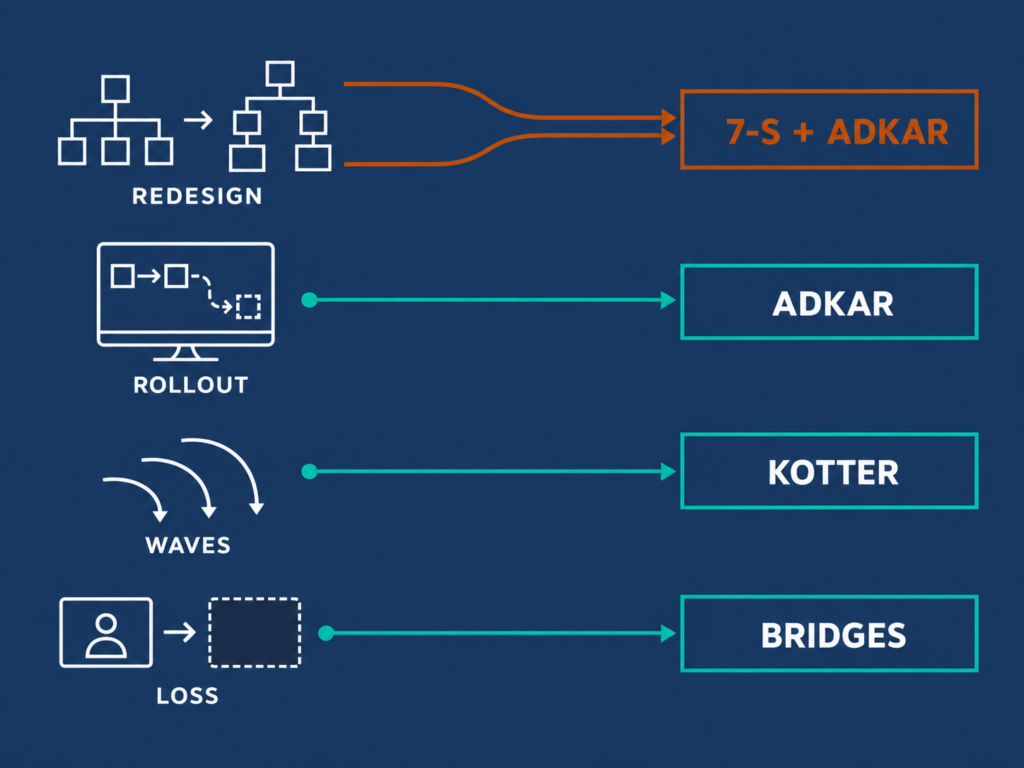
Choose by the shape of the change, not by preference or procurement history. Four matches cover almost everything you will run:
- A structural redesign affecting reporting lines and decision rights: 7-S as the consistency check, plus ADKAR at individual level. The two risks are systems left untouched and people who do not know what changed for them.
- A technology or AI deployment that changes daily work: ADKAR. The blocker is almost always ability or reinforcement, not awareness.
- A multi-year transformation running in several waves: Kotter. At that scale the coalition problem is real and it is the thing that kills momentum between waves.
- A change involving loss, meaning downsizing, role elimination, or site closure: Bridges. The neutral zone is where regretted attrition happens and no execution model addresses it.
Expect to run two. A structural redesign has both a systems dimension and a human one, and a single model will cover one of them well and the other badly. Which type of change you are running, and what each type demands, is the subject of the types of change management page.
I treat these the way I treat AI in recruitment. The model is a co-pilot. It accelerates the thinking and sharpens the questions, and the practitioner owns the judgment and the final call. The moment a framework starts making your decisions, you have stopped diagnosing and started filling in a template. If you need the argument for why any of this deserves funding, the importance of change management page carries it.
◆ PRO TIP
Real talk: no model survives a sponsor who will not spend time on it. ADKAR assumes managers will hold individual conversations. Kotter assumes senior leaders will show up repeatedly over years. If your sponsor gives the programme 30 minutes a month, pick the model that needs the least of them and be honest in the steering meeting about what that choice costs.
Structure chosen, model matched, sequence agreed. Now the part that no competing page on this topic covers, and the part that lands on your desk whether or not anyone planned for it:
What Organizational Design and Change Management Does to Your Hiring Plan
The moment a target design exists in draft, your workforce plan is obsolete. Nobody tells you that.
New roles appear that have never been hired for. Old roles will not be backfilled. A set of capability gaps sits in the draft with no price against any of them, and the business case is being written on the assumption that the structure is staffed on day one.
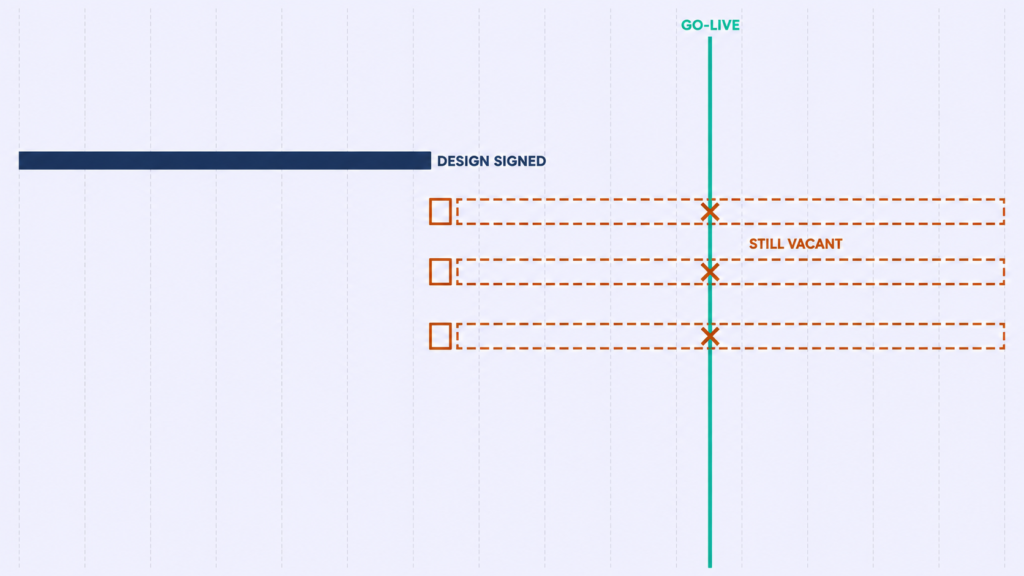
Answer three questions during Stage 3, not after go-live. Which new roles have no internal supply. What the external market looks like for each of them. And what the Time-to-Fill on those roles does to the redesign’s benefit case.
Here is the arithmetic nobody runs. If a senior new role takes 68 days to fill and the design assumed it was in place at go-live, the benefit case is wrong by a quarter. The sponsor has not been told, and the first person who will notice is you, in month four, when the outcome metric does not move.
This is why I treat hiring as a Talent Supply Chain: a circular system with predictive mapping and pre-warmed communities, not a linear plan that starts the day a requisition opens. Talent Market Pre-Alignment is the mechanism inside it, and a redesign is the clearest case for both.
◆ FROM THE LAB
My experience: a global industrial organization I worked inside needed to scale an automation engineering team, and the roles were the kind that do not exist in volume anywhere. The reflex would have been to wait for the job descriptions, post, and hope.
I mapped the competitor market first. Twelve companies across the industrial IoT space, traced by who was building what, which teams were growing, and which engineers were doing the specific work we would need. All of it done before a single job description was written.
By the time the roles were approved, 37 qualified candidates were already identified and warm. Average Time-to-Offer fell from 68 days to 34. Not because we got faster at recruiting, but because the search had already happened while everyone else was still drafting requirements.
Proactive mapping beats reactive posting. Inside a redesign it is the difference between a structure that is staffed at go-live and one that runs half-empty for a quarter while the benefit case quietly fails. Start the mapping at Stage 3, when the shape is stable enough to describe the role even though the requisition does not exist yet.
The old way is approving the design and then asking Talent Acquisition how long it will take. The Lab Way is mapping external supply for every net-new role while the design is still in draft, and putting the real Time-to-Fill into the benefit case before anyone signs it. The Organizational Design page covers how role definitions should be shaped to make that mapping possible.
Here’s the deal on internal mobility:
Internal mobility is the first staffing lever in a redesign, and it wins on three grounds before cost is even mentioned.
Speed: an internal move reaches productivity in a fraction of the time, because the person already holds the context the new structure depends on. The First Look Policy numbers from Stage 5 are the proof, 28 days to productivity internally against 67 externally, and in a restructure that gap decides whether the new shape is working by quarter two.
Signal: a redesign that visibly promotes and redeploys from inside reads as an opportunity. One that goes straight to external hiring reads as a purge, and the population reaches that conclusion within days, long before anyone from the programme team explains otherwise.
Retention: the people most likely to leave during a restructure are the ones who cannot see where they fit. An internal window is the cheapest intervention that answers that question, and it answers it with a role rather than a reassurance.
This is also why I argue that retention is a systems failure before it is a compensation failure. A retention bonus during a restructure pays someone to stay in a situation they cannot read. An internal window shows them a future. One of those addresses the actual driver, and the Organizational Change page goes deeper on how populations read signals during a transition.
◆ PRO TIP
Real talk: this only works if managers are incentivised to release strong performers, and in most organizations they are not. A manager who loses their best analyst to another function absorbs the gap and gets nothing for it. Until release is measured and shows up in a manager’s own review, your internal window will surface volunteers from teams that were happy to lose them.
Here’s the difference on selection:
A redesign creates roles that did not exist. By definition, nobody internally has held the title.
If your selection process screens on title and tenure, every one of those roles goes external by default. The process is not biased against internal candidates. It is structurally incapable of recognising them.
Assess against capability signals the role needs. A capability signal is evidence of the work itself: projects delivered, systems built, problems solved outside the formal job description, things the person did because they saw the gap. That is what Inverted Sourcing Funnels filter on, and it is the opposite of a keyword match on a resume.
◆ FROM THE LAB
The Sofia test: we needed a manufacturing systems analyst. Traditional sourcing gave me 14 qualified resumes, which is what happens when you search for a title that few people hold and fewer advertise.
So I stopped searching for the title and started searching for the evidence. Who had worked on PLC programming projects. Who had documented lean manufacturing work. Not what their job was called, what they had built.
That surfaced 62 candidates. The person we hired was a former factory-floor supervisor who had taught himself Python and automated parts of his own plant’s reporting because nobody else was going to. Every title-based filter in the process would have removed him in the first pass. He now leads digital transformation.
Credential gatekeeping eliminates your best candidates. In a redesign, where no internal candidate has held the new title, it eliminates almost all of them, and you will conclude the talent is not there when the truth is that your filter cannot see it.
The old way is filtering internal applicants by current grade and closest matching title. The Lab Way is defining the capability signals the role needs, then assessing against evidence of the work, including work done outside the formal role. The Organizational Design page covers how to write role definitions that make those signals visible.
⚠ WATCH OUT
Anti-pattern: adopting skills-based selection without building assessor capability. Capability assessment costs more assessor time up front and demands a calibrated judgment that title-matching never required. Organizations that skip the assessor training get inconsistency, not fairness, and inside a restructure inconsistent selection is the version that ends up being examined later.
Here’s the deal on cost:
Executives respond to two numbers in a redesign business case, and neither of them is engagement. Give them these.
$500 a day
Operational drain from one unfilled senior engineering role. Across a 60-day vacancy, roughly $30,000.
Translation: a redesign that leaves fifteen senior roles open for a quarter is carrying close to half a million dollars of cost that appears in no line of the business case. Nobody wrote it down, so nobody is accountable for it.
The second number is your sourcing mix, and it moves further than most people expect. Here is what it did on one initiative I ran.
| Metric | Before | After |
|---|---|---|
| Cost per hire, senior engineering | ~$7,800 to $9,000 | ~$3,600 to $4,600 |
| Time to fill | 70 to 80 days | 45 to 50 days |
| Main cost driver | Agency fees and long cycle time | Internal sourcing and referrals |
◆ FROM THE LAB
Real implementation: the mechanism behind those numbers is dull and it is arithmetic. Agency fees run 18 to 22% of total compensation. On senior engineering roles carrying roughly $54,000 to $60,000, that is $9,500 to $12,000 handed over per hire.
We built direct sourcing, internal referrals, and targeted talent pools until agency reliance dropped 60 to 70%. On one set of six senior roles, four never went to an agency at all. Every role moved off agency sourcing is a five-figure saving, and it compounds across a hiring wave.
These are one organization’s numbers, not an industry benchmark. Run the same arithmetic on your own compensation bands and agency terms, and you will have a figure that belongs in the redesign case at Stage 1, while the design can still change in response to it.
Put both numbers in during Stage 1. At Stage 1 they can change the design. After approval they are a line item somebody absorbs, and the person absorbing them is you. The funding argument for the wider discipline sits on the importance of change management page.
Cost and staffing assume the organization has capacity to absorb the change at all. That assumption fails more often than the design does, and it fails quietly:
Change Fatigue: Why Organizational Design and Change Management Stalls

Change fatigue gets treated as a morale issue and answered with resilience training. That diagnosis is wrong, and the treatment makes it worse by implying the problem is the person.
Fatigue is a capacity problem. The organization is running more concurrent change than its managers have bandwidth to absorb, and the symptom shows up as disengagement because exhausted capacity looks like indifference from the outside.
Three tells, all observable this quarter. Adoption rates falling on changes that would have landed two years ago. Managers deferring their own team conversations, then deferring them again. The same population appearing in the impact assessment of four separate programmes.
⚠ WATCH OUT
Watch out: the same population sitting inside four impact assessments at once. Each programme assessed them in isolation and each concluded the impact was manageable. Nobody added the four together, because adding them up is not in any single programme’s remit, and the aggregate is the number that determines whether any of them land.
Here is the structural cause nobody names: no single function owns the total change load. Each programme is individually reasonable. The aggregate is not, and there is no forum where the aggregate is anyone’s problem.
The volume is not a local complaint either. Deloitte’s 2026 research found that one-third of workers experienced 15 or more major changes in the past year, while only 27% of leaders say their organizations manage change well.
Source: Deloitte, 2026 Global Human Capital Trends
Translation: 15 major changes in a year is three or four per quarter landing on the same manager, each with its own comms plan and its own assumption that it has the floor. Your redesign is competing for attention it was never allocated.
My systems-not-people principle applies straight down: exhausted managers are a capacity design failure, in the same way retention failures are systems failures. The fix is sequencing, not coping.
Here’s how to build it:
- Build one change calendar across all programmes, plotted by affected population. Most organizations have never seen this view, and it is usually the finding on its own.
- Set an explicit concurrent-change limit per population and treat it as a constraint, not a guideline.
- Give one named person authority to sequence across programmes. Without that authority the calendar is a report.
- Protect manager bandwidth explicitly. Through a cutover, a people manager carries roughly one significant change conversation stream, not three.
The discipline is borrowed. In high-volume hiring I map weekly targets backward from the business start date and forecast recruiter and interviewer bandwidth before committing to anything, because committing past capacity does not produce more output, it produces a queue and a quality drop. Change load obeys the identical arithmetic, and the types of change management page covers how different change types draw down that capacity at different rates.
◆ PRO TIP
The catch: all of this works only if someone senior will say no to a programme. If nobody will, the calendar just documents the overload in higher resolution, and you have spent six weeks producing a very clear picture of a problem that nobody has the authority to solve. Establish who can say no before you build the calendar.
Capacity is one constraint on the timeline. There is a second one, it is non-negotiable, and it attaches earlier in the sequence than most programme plans assume:
The Legal Layer in US Organizational Design and Change Management
Restructuring is one of the most legally exposed activities HR runs, and it is scheduled like a project. The obligations below are flags, not guidance. Every one of them is a question for employment counsel.
⚠ WATCH OUT
Red flag: raise each of these with counsel before the design is announced, not after.
- The WARN Act sets advance-notice obligations for qualifying mass layoffs and plant closings at covered employers. Several states operate their own mini-WARN statutes with lower thresholds and longer notice periods, so the federal test is not the only test that applies to you.
- Selection-for-role decisions in a restructure are employment decisions and carry adverse-impact exposure under Title VII and the ADEA. An adverse-impact review of the selection outcome belongs in the process before decisions are final, not after they are announced.
- Where automated or algorithmic tools score employees during re-selection, further obligations may attach. New York City’s Local Law 144 governs automated employment decision tools, and other jurisdictions have introduced comparable requirements.
- Benefit, notice, and consultation obligations vary by state and by any applicable collective agreement.
The routing matters as much as the list. The old way is a legal review after the design is approved and the announcement is drafted, at which point counsel can only constrain what you say. The Lab Way is counsel engaged at Stage 3, while the obligations can still shape the design and the timeline.
Every item above is a question for employment counsel before the design is announced, and none of it is guidance this article can give. The practitioner skill here is knowing what to escalate and when, which is a Compliance Desk subject and will expand into a page of its own. How obligations attach at different points in a transition is part of what the Organizational Change page will cover.
How to Measure Organizational Design and Change Management After Go-Live
The redesign is done. The sponsor wants to know whether it worked, and the only numbers on hand are headcount and cost.
Neither answers the question. Both are inputs you chose, not outcomes you produced, and reporting them as success is how organizations declare victory over a redesign that has not worked.
How to execute:
Measure in three tiers, each with its own window.
| Tier | Metric | Measurement window |
|---|---|---|
| Design health | Decision latency on a fixed sample of recurring decision types, measured from decision raised to decision made | 90 days |
| Design health | Escalation rate past the newly accountable role | 90 days |
| Design health | Proportion of roles operating at their designed span | 90 days |
| Adoption | Share of affected employees who can correctly state who they go to for the three decisions that matter most in their work | 30, 90, and 180 days |
| Business outcome | The single measurable outcome written into the Stage 1 case | 180 days and 1 year |
| Business outcome | Regretted attrition in affected populations, against the pre-redesign baseline | 180 days and 1 year |
The adoption metric is a pulse question, and it beats a satisfaction score by a distance. Satisfaction tells you how people feel about a structure. Knowing who decides what tells you whether the structure exists.
Set the baseline before go-live. None of these can be reconstructed afterwards, and the most common reason a redesign cannot be evaluated is that nobody measured decision latency while the old structure was still running.
A design change should show up in an operating number, and it does when you look in the right place. When the First Look Policy moved Time-to-Productivity from 67 days to 28, that was a structural policy producing a measurable operating result, not a sentiment shift. Your scorecard should be built to catch that kind of movement, and the organization design process page covers where each metric attaches in the sequence.
⚠ WATCH OUT
Common mistake: reporting headcount reduction as an outcome. Headcount removed is a decision you made on day one, not a result the redesign produced. A programme that reports it as the headline is telling you it has nothing else to report, and the follow-up question nobody asks is what the decision latency did.
Here’s the difference on attrition:
Regretted attrition rises in the two quarters after a redesign, and the standard response is a retention bonus or a market pay review. That response misreads the signal entirely.
Post-redesign attrition concentrates in roles where the new design left the work unclear, broke the manager relationship, or made the progression path invisible. None of those three respond to money.
Plot the leavers against the new structure, not against the salary band.
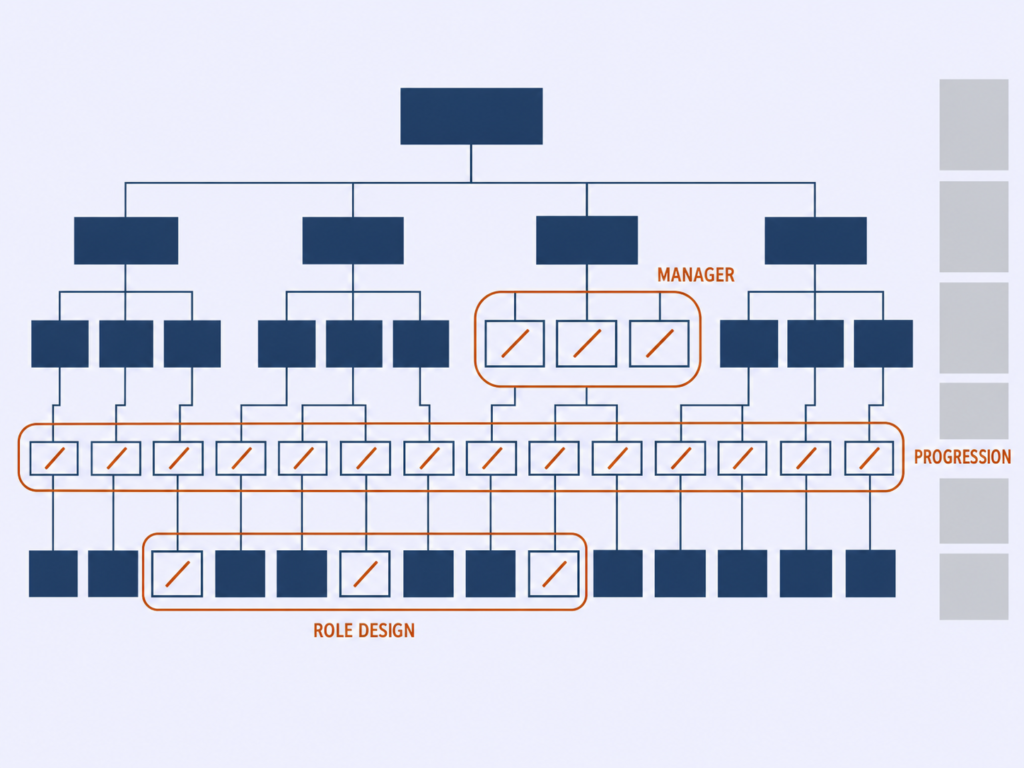
Run the diagnostic. Look at where the leavers sat in the new structure, and read the cluster. If they cluster under one new manager, you have a capability problem. If they cluster in one new role type, you have a role design problem. If they cluster in the layer that was compressed, you have a progression problem.
Three different diagnoses, three different fixes, and a retention budget addresses none of them. This is the practical form of my position that retention problems are systems failures rather than compensation failures: unclear career paths, weak manager capability, thin role clarity, burnout from a bad operating model, and no internal mobility. A redesign can create all five in a single quarter, which is exactly why the Organizational Design page treats role clarity as a design output rather than a communication task.
◆ PRO TIP
Real talk: pay matters up to a threshold. Below-market compensation will cost you people no matter how well the design works, and no amount of role clarity compensates for a band that is 20% behind the market. Check the threshold first, then stop talking about money and read the cluster.
Measurement tells you what went wrong after the fact. The five patterns below are checkable while the programme is still running, which is the difference between a diagnostic and a post-mortem:
Common Organizational Design and Change Management Mistakes
Five mistakes kill redesigns. Each one has a tell you can verify against your own programme this week, and a fix that fits inside this week’s plan.
⚠ WATCH OUT
Run this list against your current programme before you read the rest of this section. If three of the five tells are present, your go-live date is optimistic.
- Designing around incumbents. The tell: you can name who each box is for before the design is finished. The fix: design nameless, attach names at Stage 5.
- Announcing to the population before briefing managers. The tell: managers learn their own team’s shape from the same slide as everyone else. The fix: manager briefings 48 hours ahead, with their own team’s answers in hand.
- Treating go-live as the finish line. The tell: the programme team demobilises in week three. The fix: hold the war-room cadence for six to eight weeks and hunt reversion tells for two quarters.
- Leaving the old design in the systems. The tell: approval workflows, delegation schedules, and performance objectives still describe the previous structure. The fix: a systems-update checklist with a named owner, closed before go-live.
- Ignoring manager load. The tell: the same managers are carrying three concurrent change streams. The fix: cap concurrent change per manager and staff the gap.
The fifth one gets dismissed as soft, and it has the hardest evidence behind it. Gallup found that leaders and managers are 56% more likely to experience extensive disruptive change than individual contributors.
Source: Gallup, Disruptive Change Is Hitting Leaders and Managers Hardest, 2024
Translation: the layer you are depending on to deliver the change is the layer absorbing the most of it. That is consistent with everything I have seen on burnout and attrition, which track to the operating model far more reliably than to individual shortcomings.
The old way is a lessons-learned deck six months after the fact, when the findings are accurate and useless. The Lab Way is five tells you check today. Which of the five bites hardest depends on what kind of change you are running, which is the subject of the types of change management page, and the structural half of each fix traces back to Organizational Design.
Your Next Steps in Organizational Design and Change Management
This guide is the map. Six pages go deeper, and which one you need depends on where you are standing right now.
Where to go next:
- If you are being asked to justify a structure to an executive team, the deep dive on Organizational Design gives you the principles, the design factors, and the decisions that shape a structure before anyone draws it.
- If the structure is settled and the problem is that nothing is moving, Organizational Change covers what shifts inside an organization and how that shift travels through it.
- If you want the thinking behind the frameworks in the models section, the theories of management of change page traces the academic and practitioner lineage they came from.
- If you are running the seven stages and want each one as a standalone walkthrough, the organization design process page is the end-to-end version with the artefacts.
- If your obstacle is the budget conversation, the importance of change management page is the business case, built for the meeting where someone asks why this needs funding.
- If you are not sure what kind of change you are running, the types of change management page is the taxonomy and what each type demands of you.
Real talk: if you are three weeks from announcing, skip the theory pages entirely and go to the process walkthrough. Read the rest afterwards, when you have time to think rather than time to deliver.
Organizational Design and Change Management FAQ
What Is the Difference Between Organizational Design and Change Management?
Organizational design is the decision about structure: roles, reporting lines, decision rights, and how work crosses boundaries. Change management is the discipline of getting people to work that way. Design determines what the organization should look like. Change management determines whether it ever does.
What Comes First, Organizational Design or Change Management?
Neither. They start together. The impact assessment that belongs to change management should run against every design option while the options are still being compared, so adoption cost is priced before a design is chosen. Sequencing them is what creates the handoff gap, and the gap is where redesigns fail.
Who Is Responsible for Organizational Design in a Company?
Accountability sits with the executive whose outcome the design has to deliver. HR owns the process, the impact assessment, and the staffing plan. Line managers own adoption inside their own teams. The failure mode is HR being made accountable for a design it did not choose and cannot change.
Why Do Most Organizational Redesigns Fail?
Because the design is technically sound and the adoption cost was never priced. The concrete causes repeat: designing around incumbents, briefing the population before managers, demobilising the programme team at go-live, and leaving the old structure encoded in approval workflows and delegation schedules.
How Do You Prevent Change Fatigue During a Restructure?
Sequence against capacity, not against programme deadlines. Build one change calendar plotted by affected population, set an explicit concurrent-change limit, and give one person authority to sequence across programmes. Resilience training does not fix a capacity problem, and offering it signals that you have misread the cause.
Organizational Design and Change Management: The Next One Is Already Coming
Early in my career I believed a good structure would carry itself. I watched a well-argued design go live and assumed the logic would be obvious to everyone who had to work inside it.
The results were predictable. Managers who could not answer their own team’s questions. Decisions escalating past people who had just been made accountable for them. Good people leaving in month five, and a retention budget arriving in month six.
The organizations that redesign well are not the ones with better structures. They are the ones that priced the adoption cost before they chose the structure.
What separates them is not ambition. It is whether one person owns the seam between the design and the adoption, and whether the manager layer has the capacity to carry what that person asks of it.
The gap is visible in the data. Deloitte’s 2026 research found that 85% say building the organization’s and workforce’s ability to adapt is critical to success, while 7% report leading in helping their workforce continuously grow and adapt.
Source: Deloitte, 2026 Global Human Capital Trends
Translation: almost everyone knows adaptive capacity decides the next decade, and almost nobody is building it. That gap is your opening, because the next redesign is already forming somewhere above you.
None of this is theoretical. It is the sequence I have run and watched fail when a stage was skipped.
So pick three things. One stage you skipped last time, most likely the impact assessment. One reversion tell to check this week against a structure that went live months ago. One metric to baseline before your next go-live, while the old structure is still running and the number is still capturable. Work them over the next 90 days, then measure what moved.
The next blueprint lands in the newsletter before it lands anywhere else, and if you are working through a redesign in your own organization right now, connect with me on LinkedIn and tell me which stage is giving you trouble. I answer those.
