
In eight years of building talent management and managing more than 250 hires a year, I learned that the most expensive training decision happens before anyone designs a single slide. It is the choice of method. And most organisations make it badly.
Here is how the choice usually gets made. Someone checks which platform the company already pays for, books whatever room is free, and defaults to the format everyone is used to. The learning objective barely enters the conversation.
That is choosing a training method the way you book a conference venue: by budget and availability, not by what the work actually requires. It is also the single biggest reason training fails to change anything.
Method selection is the highest-leverage decision in the entire training cycle. Choose the wrong method for the right content and you get compliance theatre. People attend, complete, and change nothing.
Choose the right method and you get behaviour that actually shifts on the floor. Same content, same budget, completely different return. The variable that decides which outcome you get is the method.
The cost of getting this wrong is no longer just a wasted afternoon. The skills your workforce relies on are turning over faster than most training calendars can keep up with.
39%
of existing skill sets will be transformed or become outdated over the 2025 to 2030 period.
Translation: nearly two-fifths of what your people know how to do today will be partly or fully obsolete within five years. The wrong training method does not just fail. It burns the budget and the reskilling window at the same time.
This guide is a decision architecture, not a list. By the end of it, you will be able to:
- What are employee training methods, and how they differ from techniques and methodology
- The 7 core methods, with the honest trade-offs of each
- Training techniques, and how the same method delivers different results
- How to choose the right method using the SIFT framework
- Types of training by business purpose, from onboarding to safety
- How to build a blended training architecture that actually sticks
The Lab approach is simple to state and hard to practise. Start with the objective, match the method to it, then choose the format last. Everything that follows is built on that order.
What are Employee Training Methods?
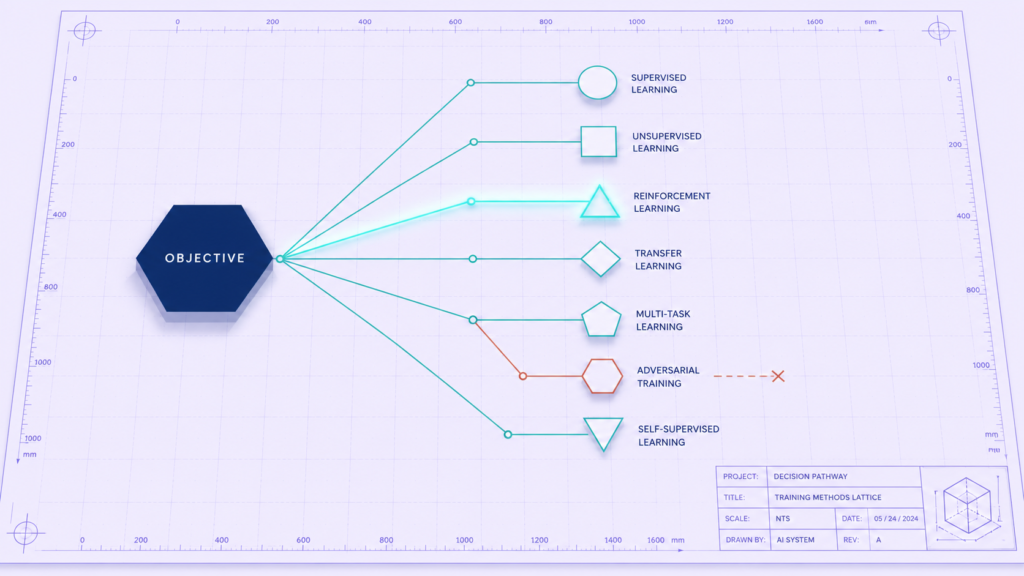
Employee training methods are the delivery channels an organisation uses to build knowledge, skills, or behaviour in its people. They include instructor-led training, on-the-job training, e-learning, microlearning, mentorship, simulation, and peer learning. The method is the vehicle. It decides how the learning reaches the learner.
Most articles stop there and start listing. The problem is that they quietly blur three different things, and that blur is exactly what trips up programme design.
◆ PRO TIP
Keep three terms separate or your design will wander. A training method is the delivery channel (instructor-led, on-the-job, e-learning). A training technique is the activity inside that method (role-play, case study, discussion). A training methodology is the framework you design the whole programme with (ADDIE, Kirkpatrick, 70-20-10). Most content treats all three as one word. The distinction is where practitioner work begins.
Why does this matter before a single course is built? Because the method is a strategic choice, not a logistics detail. It gets decided first, and it determines whether the investment holds.
This is not an abstract worry. The skills gap is already a boardroom conversation, which means the method you pick is being judged at executive level whether you frame it that way or not.
Nearly half of learning and development professionals, 49%, agree that their executives are concerned employees do not have the right skills to execute business strategy.
Source: LinkedIn, Workplace Learning Report 2025
Earlier in my career, running training across high-volume hiring, I stopped treating method as a default. The method became the first design choice, never the last. When you mention an LMS as a delivery channel, remember it is one option for e-learning, and choosing it well starts with reading guidance on how training management software fits your design, not with the licence you already hold.
Why Most Employee Training Fails Before a Single Session Runs
Most training does not fail in the room. It fails at the design stage, before anyone shows up.
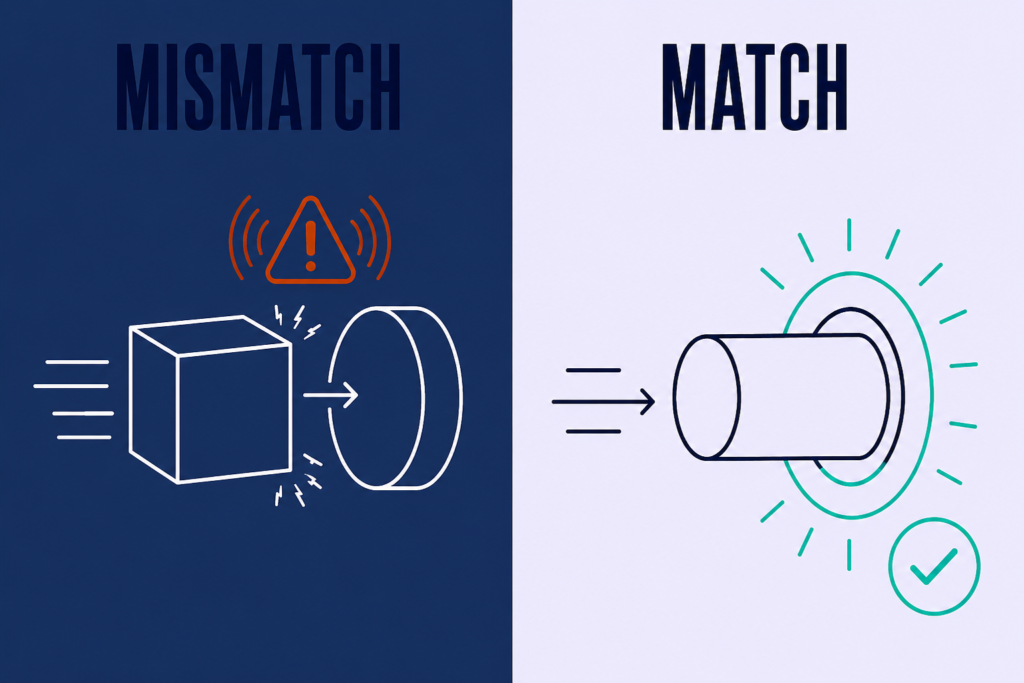
The failure mode is specific, and it is almost always the same. Organisations choose a method based on cost, availability, and familiarity, then apply it to an objective it was never built to serve. The classic version is using knowledge-transfer methods, e-learning and lecture, to chase a behaviour-change goal like getting managers to give harder feedback.
You cannot watch a video about feedback and walk out braver. That is a method-objective mismatch, and it is the precise point where the budget leaks.
The old way
- Default to whichever LMS is already subscribed
- Run mandatory e-learning for everything
- Measure completion rates
- Report “100% trained”
- Watch behaviour stay exactly the same
The Lab Way
- Name the objective type: knowledge, skill, or behaviour change
- Match the method to that objective
- Select the delivery format last
- Measure behaviour change at 30, 60, and 90 days
- Build reinforcement in before the first session
Here is the difference in one line. The old way measures whether training ran. The Lab Way measures whether it worked.
There is a second failure that compounds the first. Even when training exists, it often misses the people with the most leverage over outcomes, and managers are the clearest example.
Only 44% of managers report having received any formal training, yet managers account for 70% of the variance in team engagement. The method problem and the access problem multiply each other.
Source: Gallup, State of the Global Workplace 2025
There is a parallel here from my own work that made the principle land for me. In recruitment, changing the sourcing method, not the budget, improved Quality of Hire by up to 30%. Training behaves the same way: the method is the variable that decides whether the spend delivers.
⚠ WATCH OUT
Completion rates are the most misleading training metric in HR. A 100% completion figure tells you who clicked through. It tells you nothing about what changed. If your reporting stops at completion, you are measuring training effort, not training outcome, and you are reporting a number that will not survive contact with the business.
Name the mismatch and most of the fix follows. If you want the companion checklist on what to avoid at design stage, our guide to employee training best practices covers the failure points one by one. The rest of this article gives you the method-level decisions that prevent them.
The 7 core Employee Training Methods
Every method below works. None of them works for everything. The skill is matching the method to the objective, and each one carries a metadata row so you can scan its fit before you read the detail.

Instructor-led training (ILT)
Instructor-led training is live teaching led by a facilitator, either in a physical room or over video. It covers everything from a half-day workshop to a multi-week leadership cohort. The defining feature is a skilled human directing the learning in real time.
ILT is not dying. It is being reserved for what only a person in a room can deliver: psychological safety, nuanced discussion, and judgment built through live scenarios. A values conversation or a difficult-feedback rehearsal needs the room dynamic to be the training.
The failure mode is using ILT for plain knowledge transfer that e-learning handles at a fraction of the cost. That choice exhausts facilitators and bores learners who did not need a room to absorb a policy update.
◆ PRO TIP
The honest downside of ILT: it scales badly. When you need 200 people trained in three weeks on the same compliance topic, ILT is the wrong vehicle. Reserve it for the topics where the room dynamic itself is the lesson, and push everything repeatable and procedural to digital delivery.
On-the-job training (OJT)
On-the-job training builds capability while the employee does the actual work. It is the most used and least designed method in most organisations. The difference between good and bad OJT is structure.
Structured OJT has a defined task list, an assigned mentor, and progress checkpoints. Unstructured OJT is watch-and-learn, sink-or-swim, then a manager wondering why the new hire is slow. Most teams run the second version and call it learning from experience.
A real OJT programme needs a task inventory, a mentor assignment protocol, daily check-ins for the first two weeks, and a 30-day milestone review. Without those, OJT is just supervision wearing a training label.
◆ FROM THE LAB
The Sofia test: a few years ago I inherited a team facing high external hiring costs and slow ramp times. We built a “First Look” policy, a 48-hour internal posting window before any role went external, with recruiters proactively tapping people already inside.
The result reshaped how I think about OJT. Internal hires reached full productivity in 28 days. External hires took 67. That gap was not the onboarding deck, because both groups got the same one.
The gap was the OJT scaffold internal movers did not need. They already carried the contextual knowledge: the systems, the people, the unwritten way work gets done. Internal mobility, run deliberately, is structured OJT at the level of the whole system, and it is why your fastest-productive hires are sometimes already on payroll. For external hires, the lesson is blunt: the only thing that closes that 39-day gap is a designed OJT scaffold, not a longer orientation.
Structured OJT has a direct, measurable effect on Time-to-Productivity, which makes it one of the easiest methods to justify to a sceptical finance partner. If you want the build patterns, our guide to employee training programs and design patterns lays out the task-inventory approach in full.
E-learning and online training
E-learning is digital training delivered through a platform, either synchronously through webinars and virtual ILT, or asynchronously through self-paced courses. It is the highest-return method for knowledge transfer and one of the weakest for standalone skill development.
Here is the honest position. E-learning is convenient and scalable for knowledge. It is inconvenient and ineffective for skills, because learners cannot practise, get feedback, or have their behaviour corrected without a human in the loop.
So it works for compliance, systems training and performance, and knowledge onboarding. It does not work for communication, leadership, or anything that needs reps and correction. E-learning is a delivery channel, not a training strategy, and an LMS comparison only matters once you know which slice of your programme belongs on it.
⚠ WATCH OUT
The completion trap shows up hardest here. A 95% course-completion figure sounds like success. It measures click-through, not learning. If your L&D reporting ends at completion, you are evidencing activity while the skill gap stays exactly where it was.
Microlearning
Microlearning delivers one concept at a time in short modules, usually three to seven minutes, built for immediate use. Its best application is not as the primary method for complex skills. It is the reinforcement layer that stops the forgetting curve from undoing your ILT investment.
That distinction matters because the continuous-reskilling problem is now structural, not occasional. When a large share of today’s skill inventory is going stale, the training model that wins is the one that fits inside the workday.
With 39% of current skill sets set to be transformed or outdated by 2030, the format that scales is one that integrates into workflow, not one that pulls people out for a day every quarter.
Source: World Economic Forum, Future of Jobs Report 2025
◆ PRO TIP
The forgetting curve is the real enemy of training return. Ebbinghaus showed we lose roughly 70% of new information within 24 hours without reinforcement. Microlearning pushed at Day 1, Day 7, and Day 30 after a session is the cheapest antidote there is. It costs almost nothing and can double retention, which is why a good employee training platform earns its keep on spacing, not on content volume.
Mentorship and coaching
Mentorship and coaching look similar and do different jobs. A mentor is an experienced peer who shares navigational wisdom through an organic relationship. A coach builds capability through structured questioning and feedback loops, often as a trained professional.
Both fail the same way: underprepared mentors with no structure and no defined outcome, and “coaching” that is really just advice-giving. The differentiator between an effective programme and a dead one is role clarity and outcome definition.
What makes it work is design, not enthusiasm: matched pairing criteria, a defined conversation frequency, milestone outcomes, and a clear end-state. Volunteer-based, unstructured mentoring is why so many programmes meet once and quietly stop.
◆ FROM THE LAB
My experience: the cohorts where I reached 89% 12-month retention had one thing in common. Structured onboarding mentorship in the first 60 days.
The programme was not expensive. It was deliberate. Matched pairs, a set agenda, and a checkpoint at 30 and 60 days. Retention problems are mostly systems failures, and mentoring is one of the systems most organisations leave to chance.
Simulation and experiential training
Simulation training puts learners through a realistic version of the task before they face the real one. It comes in three forms: digital simulations like VR and AR scenarios, physical simulations like role-play and mock environments, and case-based decision simulations.
It produces the highest retention of any method because it engages procedural memory, not just declarative memory. The learner does not recall what good practice looks like. They have already performed it, and the emotional engagement of a real scenario encodes the lesson more durably than watching a video of the same situation.
The economics are asymmetric. Simulation is expensive to build and cheap at scale, and the calculation changes entirely once you count the cost of the mistake it prevents. In safety-critical and technical work, the cost of one configuration error in a live environment can outweigh the entire simulation budget.
◆ PRO TIP
Role-play is the most underused simulation method in HR training, and the cheapest. For coaching skills, feedback delivery, and difficult-conversation training, a structured 20-minute role-play with a feedback rubric beats a two-hour e-learning module every time. You do not need a VR budget to get the retention advantage of simulation. You need a rubric and a willing partner.
Peer learning and social learning
Peer and social learning move capability sideways through communities of practice, collaborative problem-solving, knowledge-sharing forums, and peer teaching. It sits at the centre of the 70-20-10 model, the 20% of learning that comes from other people, and it carries most of an organisation’s tacit knowledge.
The failure mode is launching a “knowledge sharing” initiative with no structure. People do not share because there is no incentive, no dedicated time, and no visible reward. The medium is not the programme.
A working system needs a facilitator, a meeting cadence, a shared problem to solve, and a way to record and distribute what was learned. Design the container, not the aspiration.
One pattern from my own work transfers directly here. In a referral programme, a single senior engineer referred 11 people, 9 were hired, and 8 are still with the company. The lesson is the same as peer learning: activate the top 5 to 10% of contributors rather than expecting even participation from everyone. For lean teams, this is often the highest-return option available, which is why it features heavily in our guide to employee training for small business.
⚠ WATCH OUT
Peer learning without structure becomes the rumour mill. The most common failure: launch a Slack channel for “knowledge sharing,” see three posts in week one and zero by week four. The medium is not the programme. The programme is the design, the incentives, and the facilitation.
Training Techniques for Employees: How Methods are Delivered
A method is the channel. A technique is what learners actually do inside it. Most articles blur the two, which is why so many programmes pick a delivery format and never decide what happens once people are in it.
The technique is where the skill transfers. Get it wrong and the best method in the world delivers nothing.
Active versus passive techniques
Techniques sit on a line from passive to active. Passive techniques, lecture, video, and reading, have the learner receive. Active techniques, role-play, practice, peer teaching, and problem-solving, have the learner produce.
The retention gap between them is large and well documented: passive techniques tend to leave a fraction of the material behind, active techniques retain most of it. The implication is not “never use passive.” It is “use passive to build the knowledge foundation, then switch to active for the skill.”
So every training session should end with a production task. Something the learner creates, writes, teaches back, or practises, not a summary slide and a round of questions.
Group versus individual techniques
Group techniques, workshops, peer discussion, and collaborative problem-solving, build shared mental models. They are the right choice when the outcome depends on a team executing the same process the same way.
Individual techniques, self-paced e-learning, one-to-one coaching, and personal project work, allow depth without pace constraints. Use them when the gap is personal and skill levels vary widely across the group.
The decision rule is simple. Group when the outcome needs shared understanding or team synchronisation. Individual when the gap is personal. At real scale, group techniques are often the only viable option, which means the programme design has to compensate for individual variation through structured OJT reinforcement underneath.
The reinforcement techniques most programmes skip
The most underused category is reinforcement, and it is nearly free. Spaced repetition revisits content at Day 1, 7, 30, and 90. Retrieval practice tests memory instead of re-reading it. Manager accountability check-ins ask whether the behaviour actually changed in the real work context.
These are not expensive techniques. They are design choices that dramatically extend the return on the primary training investment, and most L&D programmes leave them out entirely.
◆ PRO TIP
Do not say “follow-up is important” and leave it there. Design the mechanism: a microlearning push at Day 7, a manager observation checklist at Day 30, and a peer accountability pair from Day 1. The platforms that track spaced repetition and retrieval, covered in our guide to employee training management software, make this the cheapest part of the programme to run.
What is a Training Methodology?
A training methodology is the structured framework you use to design, deliver, and evaluate a training programme. It is the “how we design” layer that sits above individual methods, which are the “how we deliver” layer. It is what separates a programme from a collection of training events.
Three frameworks do the real work in practice. Here is how each one shows up in HR, not in a textbook.
ADDIE runs Analysis, Design, Development, Implementation, and Evaluation. For manager feedback training, Analysis is not a survey of preferences. It is surveying 20 managers on their most common feedback failures and interviewing five direct reports about how feedback currently lands.
The Kirkpatrick model evaluates on four levels: Reaction (did they like it?), Learning (did they acquire it?), Behaviour (did they apply it?), and Results (did it move the business?). It is the measurement framework you layer on top of ADDIE.
The 70-20-10 model sets the design ratio: 70% experience, 20% social and peer, 10% formal training. Most organisations fund only the 10% and then wonder why the 70% is inconsistent. The methodology is what stops you from over-relying on formal courses, and it is the design layer our guide to employee training programs and design patterns builds on directly.
◆ FROM THE LAB
The Sofia lens: I apply Kirkpatrick backwards. Start with Level 4, the result the business actually needs, and design the programme from there.
Most L&D programmes are designed forward, from content to hope. Ours are designed backward, from outcome to method. In talent work I did exactly this with Quality of Hire: define the outcome first, then engineer the sourcing methodology to reach it. Training design works identically.
How to Choose The Right Employee Training Method
No competitor gives you a real decision process for this. They give you a list and wish you luck. Here is the sequence I use, built as four filters that run in order.
1
Step 1: Match method to learning objective type
Every objective is one of three types, and each matches a different family of methods.
Knowledge objectives, where the learner needs to know something, match e-learning, microlearning, and instructor-led information sessions. Skill objectives, where the learner needs to do something, match OJT, simulation, role-play, and practice-based coaching. Behaviour-change objectives, where the learner needs to think or act differently, match coaching, group reflection, simulation with emotional stakes, and peer accountability.
The most expensive error in L&D is applying knowledge methods to behaviour goals. An e-learning course on feedback teaches managers what good feedback looks like. It does nothing to the instinct that makes a hard conversation feel threatening, and that instinct is the actual target.
The decision table:
| Objective type | Best methods | Core techniques |
|---|---|---|
| Knowledge (know) | E-learning, microlearning, ILT sessions | Reading, video, retrieval quiz |
| Skill (do) | OJT, simulation, coaching | Role-play, paired practice, teach-back |
| Behaviour (act differently) | Coaching, peer accountability, simulation with stakes | Group reflection, live scenario, observation |
One caution before you reach for learning styles. Matching method to a learner’s preferred “style” has been largely debunked as a basis for design. The variable that matters is objective type, not preference, a point we return to in our guide to employee training best practices.
2
Step 2: Match method to workforce segment
The same objective reaches different segments through different methods, because access and context vary.
Engineers and technical roles favour hands-on simulation, peer learning, and project-based OJT, with low tolerance for lecture. Frontline and operations need visual, mobile-first microlearning and cannot sit through two-hour classroom blocks. Leadership cohorts respond to peer cohorts, coaching, case studies, and action learning. New hires need a blend: ILT for culture, OJT for the role, e-learning for systems. Remote teams need asynchronous e-learning, virtual ILT, and peer platforms on a structured cadence.
Segmentation is not personalisation theatre. It is removing the barrier to skill transfer. A frontline employee who cannot attend a two-hour session is not unwilling to learn. They are in a format built for someone else’s context.
◆ FROM THE LAB
Real implementation: on one large-scale ramp-up, I had to onboard a mix of customer support, operations analysts, junior engineers, and sales support, several hundred people against an aggressive launch date.
We did not build one programme. We built three training tracks, technical, operational, and commercial, because the learning objectives and the segments were fundamentally different. Each track ran its own OJT scaffold with daily stand-ups and structured batch assessment.
One programme would have failed all three groups at once. Segmenting the method to the workforce is what let us hold quality while moving at volume, with a 90% offer-to-join ratio holding through the campaign.
Avoid the generational trap while you segment. “Millennials learn this way, Gen Z learns that way” is not supported by evidence. Segment by role context, accessibility, and objective, never by birth year. Small teams that cannot segment at all will find the single-programme blended approach in our guide to employee training for small business.
3
Step 3: Apply the cost and time constraint filter
Now, and only now, the budget filter. Map each method onto a two-by-two of cost against time investment.
Low cost and low time: microlearning, peer learning, basic OJT. Low cost and high time: structured mentoring, coaching, structured OJT. High cost and low time: off-the-shelf e-learning, LMS-delivered content. High cost and high time: custom ILT, simulation and VR, bespoke coaching programmes.
The practitioner rule: when budget is tight, sequence matters more than method. A low-cost method in the right sequence beats an expensive method delivered in isolation.
| Low time investment | High time investment | |
|---|---|---|
| Low cost | Microlearning, peer learning, basic OJT | Structured mentoring, coaching, structured OJT |
| High cost | Off-the-shelf e-learning, LMS content | Custom ILT, simulation/VR, bespoke coaching |
This is where my recruitment experience maps cleanly onto training. I cut cost-per-hire by 45 to 55% by redesigning the sourcing method, not by cutting the budget. Training follows the same logic: the design decision sets the return, not the spend, and external providers earn their place only at specific points, which our guide to employee training companies walks through.
4
Step 4: Run the SIFT framework
SIFT is the pre-flight checklist I run before any training design conversation. Four filters, in order, and each one eliminates methods before you commit.
S, Skill level of learners. Novice, intermediate, or expert decides whether foundational delivery or advanced practice is the priority. I, Intent of the objective. Knowledge, skill, or behaviour change sets the method category. F, Format constraints. Technology access, group size, time, and location set the delivery mode. T, Time horizon for application. Immediate, 30-day, or 6-month sets the reinforcement schedule.
Worked example: onboard 30 engineering managers in six weeks, mixed remote and in-person. S is intermediate, so skip the basics. I is behaviour change, so coaching and simulation lead, not e-learning. F is split-location, so a virtual cohort with in-person intensives. T is six months, so reinforcement runs monthly. The architecture emerges from the filters; you do not guess at it.
◆ FROM THE LAB
The Sofia test: I developed SIFT after running programmes that failed not because the content was poor, but because we had not filtered the method against the right constraints. It is the checklist I now run before anything gets designed.
On that high-volume ramp-up, SIFT was applied in practice. S was entry-level, novice learners. I was skill objectives, process execution and system operation. F was group training at scale, batch scheduling, a daily stand-up model. T was immediate, with application on the project launch date.
The architecture that fell out of those filters delivered 420-plus hires in 10 weeks, cut average Turnaround Time from 32 days to roughly 18 to 20, and held a 90%-plus offer-to-join ratio. The framework did not just pick a method. It produced the whole design. Once you have run SIFT, the question of which training management software fits the Format constraint answers itself.
Types of Employee Training by Business Purpose
The methods above answer “how is it delivered?” This taxonomy answers a different question: “what type of training do I actually need to run?” Six purposes, each with its own design logic.
1. Onboarding training
Most organisations confuse orientation with onboarding. Orientation is day-one logistics. Onboarding is a 90-day role-readiness programme with three layers: cultural integration, role-specific skill transfer, and relationship mapping.
The trajectory matters. The first week covers culture and tools. The first 30 days build role proficiency. Days 30 to 90 move the hire to independent contribution, with milestones at each stage.
◆ FROM THE LAB
My experience: I have watched the same number repeat across teams. Internal movers reached full productivity in 28 days, external hires in 67. The external Time-to-Productivity gap is an onboarding design problem, not a candidate quality problem, and the fix is a designed 90-day scaffold rather than a longer first week.
Build it as a 3-layer architecture, not a day-one information dump, using the patterns in our guide to employee training programs and design patterns.
2. Compliance and mandatory training
Compliance is the most under-designed category, treated as a checkbox rather than a behaviour-change programme. The anti-pattern is the annual four-hour generic module everyone clicks through. The goal is not the completion certificate. It is the changed decision in the moment that matters.
The fix is bite-sized, scenario-based modules that use real penalty framing, what actually happened to a real organisation, to create genuine recall under pressure. Assess against behaviour, not completion. Specific legal requirements vary by jurisdiction, so confirm yours against our guide to employee training legal requirements before you finalise the content.
⚠ WATCH OUT
Compliance training that achieves legal completion but not behaviour change quietly creates liability. You have the certificate and none of the protection. If your only evidence is a completion log, you have documented that people watched, not that anyone would act differently when it counts.
3. Technical and skills training
This is the highest-return category for engineering and technical organisations. It splits into upskilling, expanding existing capability such as a data analyst learning machine learning, and reskilling, acquiring new capability such as a mechanical engineer learning PLC programming.
Apply 70-20-10 here above all. Roughly 70% of technical skill transfer happens through doing, not courses. Design the OJT component first, then build the formal 10% around it, because skill transfer for technical roles needs a practice environment, not a content library.
The pressure is not theoretical. With 39% of existing skill sets set to be transformed or outdated by 2030, a large share of today’s technical inventory will be partly obsolete within the planning horizon, which makes reskilling a standing function, not a one-off project.
Source: World Economic Forum, Future of Jobs Report 2025
◆ FROM THE LAB
Real implementation: once, hunting for a manufacturing systems analyst, traditional sourcing gave me 14 resumes. I inverted the search to look for capability signals instead of credentials, and the pool jumped to 62 candidates.
The person we hired was a former factory-floor supervisor who had taught himself Python. He now leads digital transformation work. He is the clearest proof I have that skill development follows curiosity and application, not course completion, and that a credential filter eliminates your best self-reskillers before you ever meet them.
For skills tracking and the platform layer that supports it, see our guide to the right employee training platform for technical teams.
4. Leadership development training
Leadership development fails most often on one distinction: events versus programmes. A one-day leadership workshop is an event. A 12-month programme with coaching, action learning, 360 feedback, and a peer cohort is a programme. Only the second changes behaviour.
Treat the work itself as the curriculum. Real challenges are the content, coaching is the reflection mechanism, and for senior leaders coaching, not training, is the highest-leverage investment.
The case writes itself once you look at the numbers. Only 44% of managers report receiving formal training, and managers drive 70% of the variance in team engagement. When fewer than half of your highest-leverage people are developed at all, a structured programme is not a luxury.
Source: Gallup, State of the Global Workplace 2025
⚠ WATCH OUT
A one-day workshop labelled “leadership development” is the most common way budget disappears with nothing to show for it. If there is no coaching, no application window, and no follow-up, you have run an event and called it a programme. Behaviour does not change on a single day.
5. Soft skills training
The most underinvested category, and one of the highest-return for team performance. The core skills are communication, specifically feedback and difficult conversations, collaboration across functions, and emotional intelligence under pressure.
The failure is always the same: lecture-based delivery for a behaviour-change objective. You cannot learn feedback delivery by watching a video about feedback delivery. The fix is also always the same: role-play, peer feedback, and live application within 48 hours.
◆ PRO TIP
The cohorts with my highest retention, around 89% at 12 months, were the ones where managers were trained on growth-conversation facilitation. Not through a workshop. Through structured practice with a feedback observer in the room. Remove the lecture, add the rep, and the skill actually transfers.
6. Safety and regulatory training
High-stakes, mandatory, and often the most poorly designed training in the building. The standard for safety-critical roles is simulation: VR for hazardous scenarios, physical simulation for emergency procedures. Safety training that fails produces consequences that cannot be reversed.
The anti-pattern is reading regulatory documentation and calling it safety training. The Lab Way is scenario-based, tested, and refreshed at intervals, not just delivered once at induction. Design to match the consequence, not the budget, and check jurisdiction-specific obligations against our guide to employee training legal requirements.
⚠ WATCH OUT
An annual e-learning module is rarely adequate for a safety-critical role. The cost of realistic simulation is small against the cost of a single incident it prevents. If the consequence of inadequate preparation is irreversible, the method has to match the stakes, not the line item.
Building a Blended Training Architecture
“Blended learning” is a generic term for mixing online and offline. A blended training architecture is something sharper: a deliberate, sequenced combination of methods calibrated to the stages of learning. The component mix matters less than the order you deploy it in.
The old way
- Add an e-learning module to a classroom day
- Call it “blended”
- Hope the two halves connect
The Lab Way
- Sequence methods from the objective backward
- Prime, then build, then embed
- Design the reinforcement before the first session
The architecture runs in three phases. Each one uses different methods because the learner needs something different at each stage.
1
Phase 1: Awareness
Build the knowledge foundation before anyone enters a room. Asynchronous e-learning, microlearning, and a pre-read do this cheaply and at the learner’s pace. The classroom time is then spent on application, not on transmitting facts that a video could have delivered.
2
Phase 2: Application
Build the skill through practice. ILT, simulation, OJT, and peer practice give the learner reps and feedback. This is where the behaviour actually forms, and it is the phase organisations most often skip when they treat e-learning as the whole programme.
3
Phase 3: Reinforcement
Embed the behaviour so it survives contact with the day job. A microlearning drip, a coaching check-in, and a spaced retrieval quiz keep the learning alive past the forgetting curve. This is the phase that makes the whole investment stick, and it is nearly free.
Why the order is non-negotiable: the same microlearning unit primes a learner before a session and reinforces them after it. Same content, different position in the sequence, different outcome. The delivery layer that carries this, covered in our guide to the right employee training platform, is worth choosing only once the sequence is set.
◆ FROM THE LAB
The Sofia test: I run five questions before any training design goes live. It has stopped at least three expensive programme launches that would not have hit their objective.
- Does the method match the objective type: knowledge, skill, or behaviour change?
- Is there a reinforcement loop designed in, not bolted on as an afterthought?
- Is the method accessible to the target segment in their real work context?
- Have we defined how we will measure behaviour change, not just completion?
- Does the sequence match how adults learn: knowledge, then practice, then reflection?
Five clean yeses and the design is ready. A single no is a launch worth pausing. If field-tested design blueprints like this are useful to you, they go out to subscribers before they reach the public archive, and you can join that list at the end of this guide.
How to Measure Employee Training Method Effectiveness
You have chosen the method and run it. Now leadership asks the only question that matters: did it work? Most HR teams can answer with completion rates and satisfaction scores. Neither one proves a method was effective.
The Kirkpatrick model gives you four levels to measure against. The mistake is stopping at the first two.
1
Level 1: Reaction
A satisfaction survey. Useful for facilitator feedback, useless as a measure of training effectiveness. Whether people enjoyed a session tells you nothing about whether they changed.
2
Level 2: Learning
A knowledge assessment. It tests recall, not application. A high score means they can pass a quiz, not that they will act differently on Monday.
3
Level 3: Behaviour
Manager observation at 30, 60, and 90 days. Did the behaviour change in the real work context? For skill and behaviour training, this is the level that actually matters, and almost nobody measures it.
4
Level 4: Results
Business impact: Time-to-Productivity, Quality of Hire, error-rate reduction, retention. This is the language leadership funds in, and it is where Levels 3 and 4 together close the loop between training and outcome.
Levels 1 and 2 measure training effort. Levels 3 and 4 measure training outcome. The practitioner who can report behaviour change and business results owns the training return conversation, and stops defending the function on completion logs.
This is exactly how I treat the numbers in talent work. Quality of Hire was my Level 4 metric, and changing the sourcing method improved it by up to 30%, with a 12% lift from competition analysis and 14% from talent-landscape mapping along the way. Those are outcomes, not satisfaction scores.
Metrics by training method:
| Method | Primary effectiveness signal |
|---|---|
| E-learning | Knowledge assessment score + 30-day retention quiz |
| Instructor-led | Pre/post knowledge test + Level 3 manager observation at 30 days |
| On-the-job | Time-to-Productivity milestone + error rate |
| Coaching / mentoring | 360 feedback delta at 6 months + goal completion |
| Simulation | Error rate in live application + response-time improvement |
| Microlearning | Quiz scores at spaced intervals + task accuracy |
| Peer learning | Knowledge contribution rate + cross-functional application |
Measuring at Levels 3 and 4 also connects training directly to the outcome executives care about most. 88% of organisations are concerned about employee retention, and providing learning opportunities is the most common retention strategy they use. If you cannot measure whether the learning worked, you cannot defend it as a retention lever.
Source: LinkedIn, Workplace Learning Report 2025
⚠ WATCH OUT
Level 1 alone is a vanity metric. A glowing satisfaction score with no behaviour data is how training budgets get approved and then quietly cut. Platforms that support Level 3 and 4 tracking, covered in our guide to employee training management software, are the difference between reporting effort and reporting impact.
