

I’ve spent eight years building talent acquisition systems, and I can tell you exactly where most recruitment budgets haemorrhage: the gap between posting a job and actually finding the right person.
Most organisations call this “hiring.” At HR Insights Lab, we call it expensive hope.
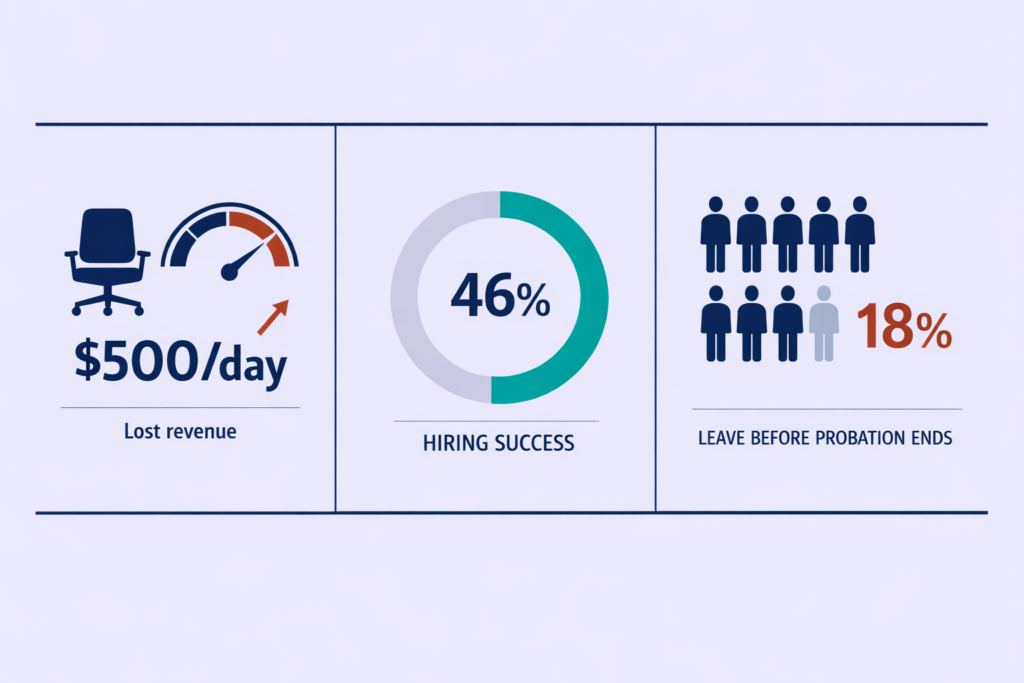
$30,000
Lost productivity from a senior engineering role sitting vacant for 60 days — before you’ve made a single offer.
The numbers get worse. Overall hiring success sits at just 46% in major global markets. Translation: more than half of your recruitment and selection efforts are missing the mark entirely. And even when you do make a hire? 18% of new employees leave before their probationary period ends.
“That’s a systems failure, not just a hiring problem.”
This isn’t a list of recruiting strategies scraped from generic HR blogs. This is the modular architecture I’ve tested across high-volume manufacturing hiring, tech talent wars, and leadership succession planning.
You’ll get:
- The Talent Supply Chain framework that replaces reactive “post and hope” with predictive talent mapping
- 25 battle-tested recruitment strategies organised by function: Sourcing Intelligence, Experience Engineering, AI Integration, Cultural Design
- The exact metrics — Quality of Hire, Offer Acceptance Rate, Diversity Pipeline Ratio — that prove ROI to your CFO
- Real implementation blueprints, not theoretical models
Lab Note — The Lab Approach
We don’t just recommend strategies. We show you what broke, what worked, and what the data said three months later. If you’re a Head of TA or HR Director tired of tactics that sound good in webinars but fail in practice, this is your system redesign.
The Architecture of Modern Recruitment Strategies
Stop thinking of recruitment as a “hiring plan.” Start thinking of it as a Talent Supply Chain.
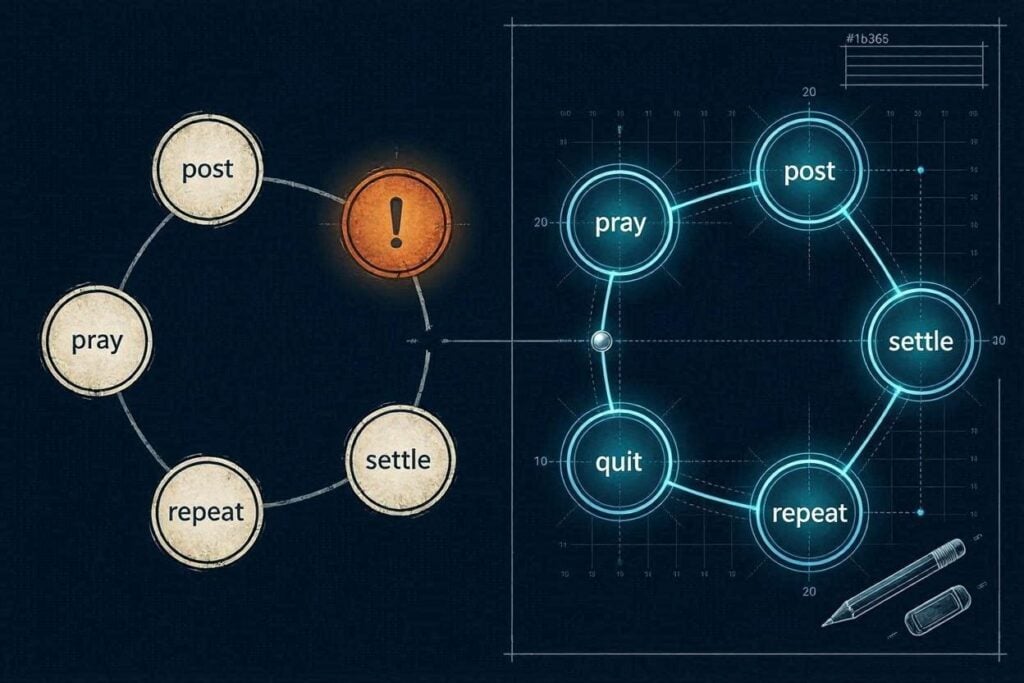
A hiring plan is linear. It reacts to vacancies. You post → you screen → you interview → you hire → you repeat when someone quits.
A Talent Supply Chain is circular. It predicts demand, maintains inventory (talent communities), and optimises for long-term cost and quality.
The Old Way
- Wait for a resignation
- Panic-post to job boards
- Pray for qualified applicants
- Settle for “good enough” because the role has been open 90 days
- Repeat when that mediocre hire quits in 11 months
The Lab Way
- Map your industry’s talent clusters before you have openings
- Build relationships with silver medalists and passive candidates
- Activate pre-warmed communities when a role opens
- Hire based on capability verification, not resume keywords
- Track Quality of Hire at 12 months, not just Time-to-Fill
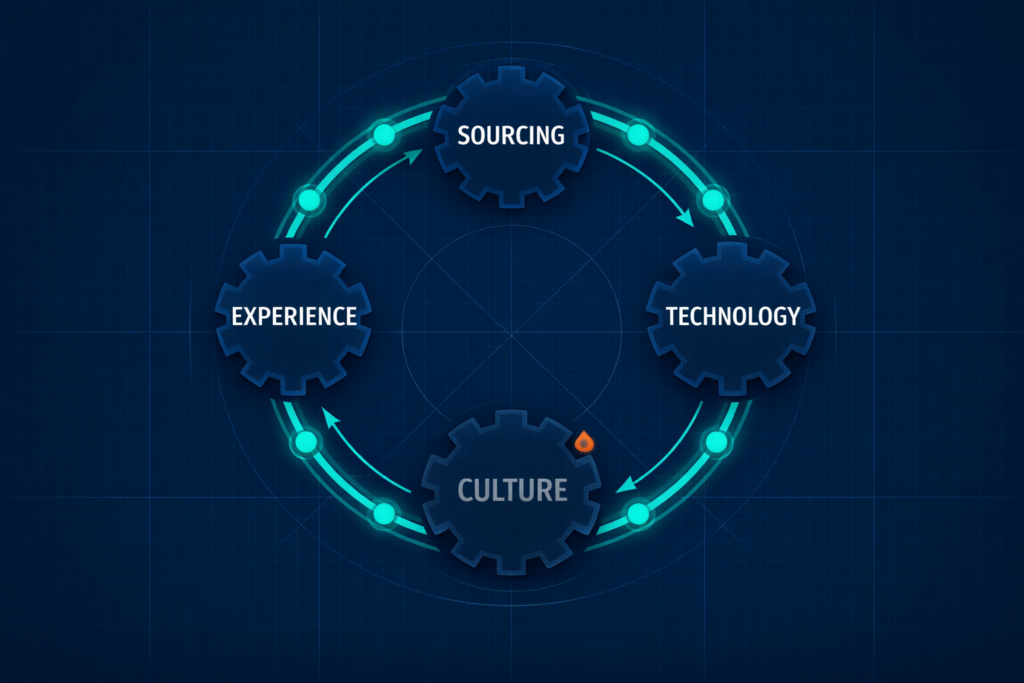
The organisations winning the talent war aren’t the ones with the biggest budgets. They’re the ones whose hiring and recruiting strategies run as one system. Every Talent Supply Chain needs four engines running simultaneously:
The Four Engines
- Intelligence-Led Sourcing — market mapping, competitor analysis, skill-first identification
- Experience Engineering — frictionless application, transparent communication, brand authenticity
- Technology Integration — AI-assisted screening, predictive analytics, automated nurturing
- Cultural Design — onboarding as retention, manager quality, diversity infrastructure
When one engine fails, the whole system stalls. When all four run together? You stop competing for talent and start attracting it.
Category 01 / 04
Intelligence-Led Sourcing: Recruitment Strategies That Start Before the Vacancy
Most recruiting strategies start working only when a vacancy opens. That’s already too late. Intelligence-Led Sourcing means you’re mapping the market continuously — so when a role opens, you’re activating a pre-built intelligence network, not starting from zero.
Strategy #01
1. Talent Mapping & Competitor Benchmarking
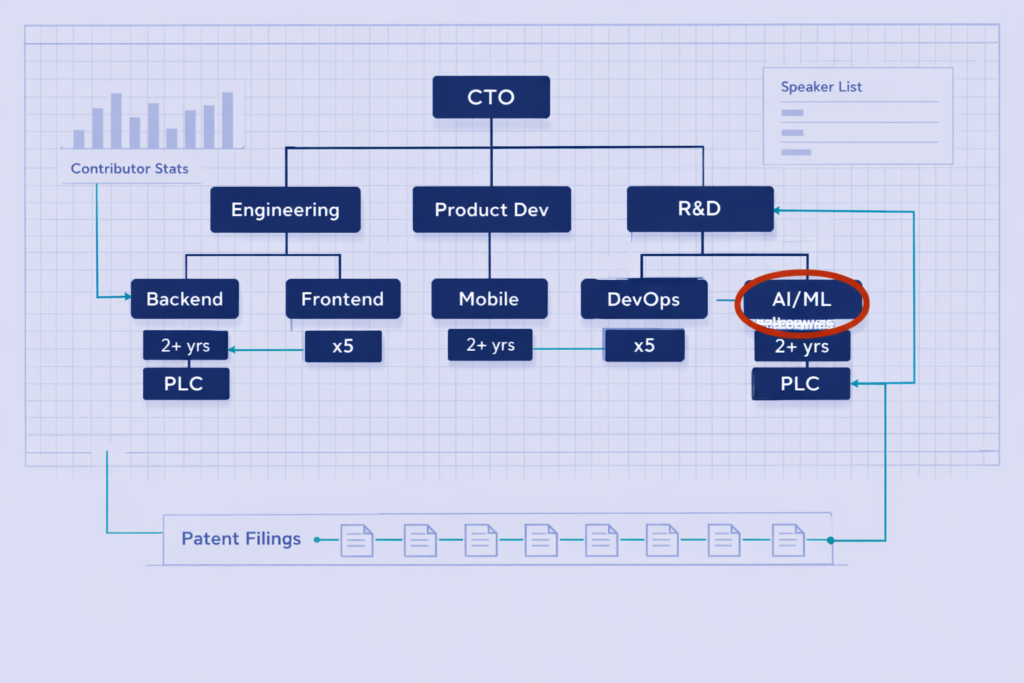
Before you have an opening, identify the 10–15 companies that employ the best people in your target specialty. Then map their organisational structure — not the job postings they’ve published, the actual team structure.
How to execute: Start with LinkedIn’s company pages. Navigate to the “People” tab. Filter by job title and location. Then cross-reference with:
- GitHub contributor graphs (for technical roles)
- Conference speaker lists (for thought leaders)
- Patent filings (for R&D specialists)
- Industry award recipients
Create a live spreadsheet with: target company name, number of specialists in your target role, average tenure (signals stability or flight risk), recent team expansions (signals budget and growth), and key technologies in their stack.
Lab Note — The Sofia Test
I ran this exact process when my company needed to scale our automation engineering team. We mapped 12 competitors in the industrial IoT space. Result: when we opened three roles, we had pre-identified 37 qualified candidates before writing the job description. Average Time-to-Offer dropped from 68 days to 34 days.
Common mistake: Mapping once and never updating. Talent moves. Companies restructure. Your map needs quarterly refreshes to stay useful.
Strategy #02
2. The “Silver Medalist” Re-Engagement Loop

For every person you hire, you probably interviewed 2–5 strong candidates who were almost right. Most companies send them a rejection email and forget they exist. That’s leaving money on the table.
Treat your #2 and #3 candidates as a priority talent pool for future opportunities. The system:
- Day 0 (Rejection): Standard “we went with another candidate” email, but add: “We were genuinely impressed by your background. We’d like to stay connected for future opportunities.”
- Month 3: “Coffee chat” invitation — no job pitch, just: “I’d love to hear what you’re working on now.”
- Month 6: Share a relevant article, case study, or company milestone. No ask. Pure value.
- Month 9–12: When a similar role opens, they’re the first outreach.
3–5×
Higher conversion rate for silver medalist re-engagement vs. cold sourcing. You’ve already screened them. They’ve already expressed interest. The relationship is warm.
Implementation: Minimum viable version is a Google Sheet: Name, Role Applied For, Interview Date, Skill Strengths, Next Touch Date. Advanced version: use your ATS or a basic CRM (HubSpot Free, Streak, Airtable) to automate the sequence.
Anti-pattern: Don’t make the re-engagement feel transactional. If your first contact in 11 months is “Hey, we have a job, interested?” you’ve already lost them. Build the relationship first.
Strategy #03
3. Inverted Sourcing Funnels (Skill-First)

Traditional sourcing filters by: 5+ years in product, MBA or equivalent, experience at recognisable tech companies. You’ve just eliminated every brilliant career-changer, self-taught specialist, and unconventional thinker who could transform your team.
6.1x
Expansion of global talent pool when organisations adopt a Skills-First hiring approach — focusing on demonstrated capability rather than pedigree or job titles. For AI-specific roles, that multiplier jumps to 8.2×.
Instead of filtering by resume keywords, filter by capability signals.
- Step 1: Define the actual skills required — not “5 years of product management” but discrete capabilities: user research synthesis, SQL for data analysis, stakeholder negotiation, roadmap prioritisation frameworks.
- Step 2: Identify where those skills show up publicly — GitHub commits, Behance portfolios, Kaggle competition rankings, published tutorials, open-source contributions.
- Step 3: Source by capability, not title — search for “published SQL tutorial” instead of “Data Analyst.”
Lab Note — Real Application
When we needed a manufacturing systems analyst, traditional sourcing gave us 14 qualified resumes. Inverted sourcing (searching for “PLC programming projects” and “lean manufacturing case studies”) yielded 62 candidates, including a former factory-floor supervisor who had taught himself Python and built optimisation models. He’s now leading our digital transformation initiatives.
Trade-off: This takes longer upfront. But your Quality of Hire skyrockets, and your diversity metrics improve automatically because you’re not filtering by “traditional pathways.”
Strategy #04
4. Programmatic Job Advertising

Moving from manual job board postings to AI-driven ad placement that optimises budget allocation based on real-time performance data. Think Google Ads, but for job postings.
The old way: Post your job on LinkedIn, Indeed, and Glassdoor. Pay a flat fee. Hope for the best.
The programmatic way: Your job ad becomes a campaign with dynamic budget allocation across 20+ platforms, automatic bidding adjustments based on conversion rates, audience targeting (location, skills, employment status), A/B testing of job titles and descriptions, and real-time performance dashboards.
Platforms to consider: Appcast, Recruitics, PandoLogic, Joveo. Most integrate directly with major ATS platforms. Implement UTM tracking (covered in Strategy #19) to measure true cost-per-quality-hire, not just cost-per-click.
Warning
Programmatic amplifies your job description quality. If your JDs are vague or biased, you’ll spend more money attracting the wrong people faster. Fix the JD first.
Strategy #05
5. Internal Mobility as a Sourcing Channel

Your best candidates might already be on your payroll. Internal hires ramp 40–50% faster than external hires. Retention improves. Recruiting costs drop. But most organisations treat internal mobility as an afterthought.
The three-step system:
- Build a live skills inventory. Survey every employee annually: What are your top 5 technical skills? What projects are you proud of? What roles interest you? Store this in your HRIS. Tag it. Keep it current.
- Create visible career pathways. For every role family, publish what skills and experiences qualify someone for the next level. Make the map transparent so employees can self-navigate.
- Proactive outreach. When a role opens, have recruiters or hiring managers actively tap high-potential internal candidates with a direct message: “Based on your work on the X project, I think you’d be a strong fit.”
Lab Note — “First Look” Policy
We instituted a “First Look” policy: every role is shared with the internal team 48 hours before going external. Hiring managers are required to review the skills inventory before posting externally. Result: 23% of our hires last year were internal moves. Average Time-to-Productivity: 28 days vs. 67 days for external hires.
The catch: This only works if managers are incentivised to release high performers to other teams. Track “internal mobility rate” as a core TA metric. If it’s below 15%, you’re either not communicating opportunities or you’ve built silos that trap talent.
Strategy #06
6. Employee Referral “Power-Users”

Employee referral programs exist everywhere. But most are treated as a democratic free-for-all. The data tells a different story: in most organisations, 5–10% of employees generate 60–70% of successful referrals. These are your Talent Scouts.
How to identify them: Pull your referral data from the last 18 months. Filter by number of referrals submitted, number that reached interview stage, number hired, and retention rate at 12 months. Power-users have high scores across all four.
The activation system:
- Tier 1 — Recognition: Give them a formal title (“Talent Scout”). Announce it in company meetings.
- Tier 2 — Exclusive perks: Early access to job openings (1 week before general staff), direct line to recruiters, higher referral bonuses or non-monetary rewards (extra PTO, conference tickets).
- Tier 3 — Active partnership: Invite them to quarterly “Talent Scout” meetings where you share upcoming hiring needs, profiles of ideal candidates, and market intelligence on where to find them.
82%
Referral-to-hire conversion rate for a top Talent Scout in our programme, vs. the company average of 31%. He saved an estimated ₹40 lakhs in agency fees in 18 months.
Anti-pattern: Don’t just throw money at referrals and hope. Most employees don’t refer because they don’t know (a) what roles are open, or (b) what “good” looks like. Solve the information problem first. The referrals follow.
Strategy #07
7. Hyper-Personalised Outreach (The 10/10 Rule)
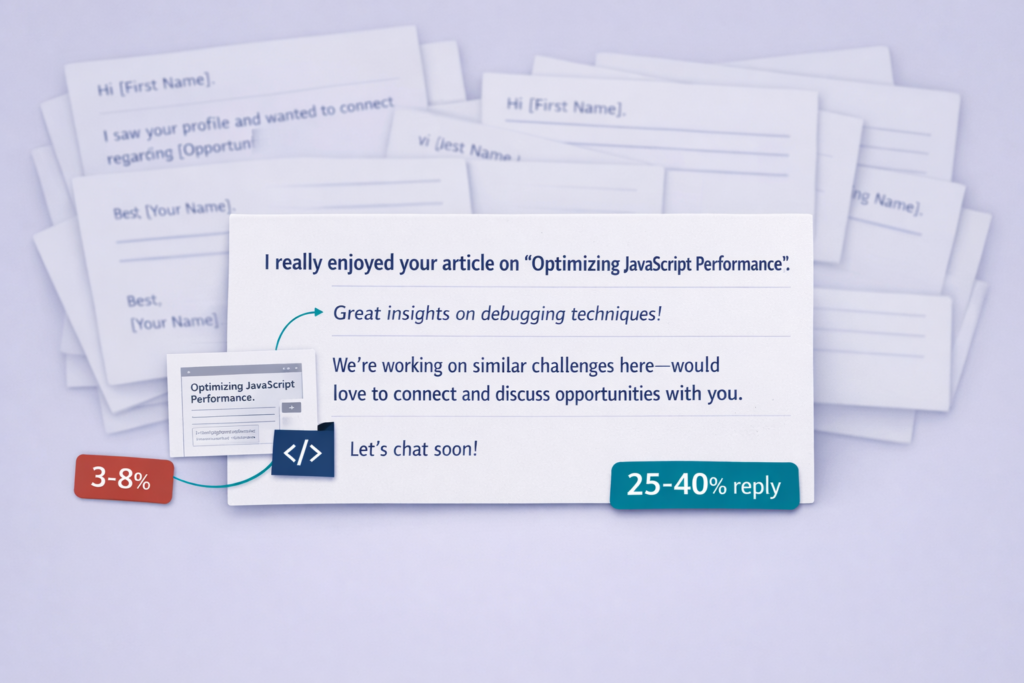
Most recruiter messages are templates with the candidate’s name swapped in. Candidates can tell. And they ignore them.
The 10/10 Rule: Spend 10 minutes researching the candidate. Write a 10-line email that proves you did.
The research phase: Read their recent posts or articles. Check their GitHub — what are they building? Review their portfolio or published work. Find any podcasts, webinars, or conference talks they’ve given. What you’re hunting for: a specific, genuine reason this person is uniquely suited for your role.
The email structure:
- Line 1–2: Personalised hook (reference their actual work)
- Line 3–4: Why this matters to your role
- Line 5–6: What’s in it for them (impact, autonomy, learning — not just salary)
- Line 7–8: Lowering the barrier (15-min call, no pressure)
- Line 9–10: Respect their time, clear ask
25-40%
Response rate for hyper-personalised outreach, vs. 3–8% for templates. The difference is not the length of the message. It’s the evidence that you actually know who you’re writing to.
Honest trade-off: This doesn’t scale to 100 candidates per week. This is for your top 10–15 dream candidates per role — the ones where a 25% response rate justifies the 10-minute investment. For high-volume roles, use templates. For the hires that matter, spend the 10 minutes.
Strategy #08
8. Strategic Passive Talent Communities

Instead of reaching out to passive candidates when you have a vacancy, build ongoing relationships through value-first engagement — before you need them.
Host quarterly webinars, workshops, or roundtables on topics relevant to your target talent. Not recruiting pitches. Pure value. Attendees register with their email. You deliver genuinely useful content. No job pitches during the session.
Post-event: Send follow-up emails with resources and recordings. Add them to your talent community list. Over time, this list becomes your warm pipeline. When a relevant role opens, you email the community first.
47
Applications from a community of 340 engineers when 5 senior roles were opened — with zero external job board spend. Built over 10 months of “Tech Talk Tuesday” webinars. 12 hires made.
Lab Note — Talent Farming
We ran a “Future of Industrial Automation” webinar series. Four sessions. Average attendance: 85 people per session. Six months later, when we needed IoT specialists, we had pre-qualified, pre-engaged candidates ready to talk. Call it talent farming — because that’s closer to what it actually is.
The catch: This is a long game. You won’t see immediate hiring ROI. But after 6–12 months, you’ll have a proprietary talent network your competitors can’t access.
Strategy #09
9. Collaborative Hiring (The “Squad” Method)

The traditional model: recruiter sources candidates, hiring manager interviews, decision gets made. The recruiter never truly understands the role nuance. The hiring manager doesn’t see enough candidates to calibrate quality. Both sides fail.
The Squad Method: the recruiter and hiring manager operate as a two-person sourcing team from Day 1.
How it works:
- Week 1 — Strategy session (90 mins): Define specific skills required, capability signals to look for, deal-breakers vs. nice-to-haves, and candidate personas.
- Week 2–4 — Joint sourcing: Both parties spend 2–3 hours per week actively searching. Hiring manager covers technical communities and direct outreach. Recruiter handles Boolean search and ATS management. Weekly 30-min sync to review pipeline.
- Interview phase: Recruiter pre-screens for culture and logistics. Hiring manager handles technical depth. Both are calibrated because they’ve been collaborating from the start.
Lab Note — Real Outcome
We tested the Squad Method for a plant engineering manager role that had been open 4 months with no hire. Hiring manager and I co-sourced for 3 weeks. We identified 22 candidates. Hired within 6 weeks. Post-hire feedback: “This is the first time I felt like the recruiter truly understood what I needed.”
The resistance you’ll face: Hiring managers will say they don’t have time. The truth: they’re already spending time reviewing bad candidates and explaining why they don’t work. The Squad Method frontloads that time to prevent wasted interviews later. Start with one pilot role with a frustrated hiring manager. Prove the model. Scale from there.
Strategy #10
10. Alumni Network Re-Sourcing

People who used to work for you. The outdated view: employees who leave are “lost.” The Lab view: former employees are brand ambassadors and future boomerang hires if you treat them right.
The system:
- Formalise the alumni network. Create a LinkedIn group, Slack community, or email list exclusively for former employees. When someone leaves (on good terms), add them within their first week of departure.
- Provide ongoing value. Share company updates and wins, industry insights or resources, networking opportunities. Occasional job postings are fine — but not the primary content.
- Re-recruit strategically. When a relevant role opens, send personalised outreach to alumni with the right skills. They already know your culture. They already passed your interview bar. They have new skills and perspectives from time elsewhere.
50%
Faster Time-to-Productivity for boomerang employees vs. external hires, according to organisations with active alumni programmes. Boomerang hire rates: 10–15% of total annual hires in best-in-class organisations.
Mistake to avoid: Don’t make the alumni network a transparent recruiting funnel. If every communication is a job pitch, people will disengage. Make it a genuine community first. The hiring opportunities are a natural byproduct.
Category 02 / 04
Experience & Brand Engineering: Recruiting Strategies Candidates Actually Feel
You can have the best sourcing strategy in the world. But if your candidate experience feels like filing taxes, you’ll lose them before the first interview. Most candidates form their opinion of your organisation within the first 10 minutes of interaction. This category covers how to audit and fix the friction points that cost you talent.
Strategy #11
11. The “Frictionless” Candidate Audit
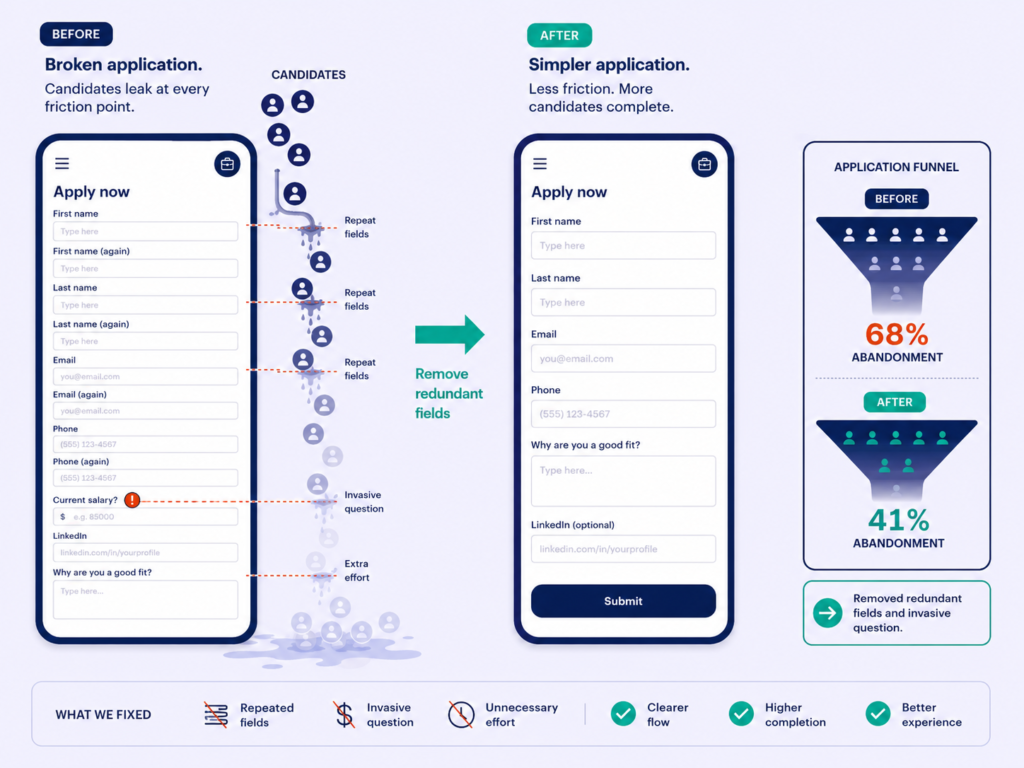
The exercise: apply to your own job. Actually do it. Right now. Pull up your careers page. Find an active role. Click “Apply.” Every point where you think “this is annoying” is a point where top candidates are dropping off.
The audit process:
- The mystery shopper test. Have 3–5 people (not from HR) apply to a test role. Document time to complete, number of clicks required, redundant or invasive fields, and overall frustration level (1–10).
- The mobile test. 70% of candidates browse jobs on mobile. If your application process doesn’t work on a phone, you’re eliminating the majority of your potential pipeline. Test on an actual device — not just “responsive design.”
- The data review. Pull your application abandonment rate from your ATS. Industry benchmark: 60% of candidates who start an application don’t finish it. If you’re above 60%, you have a friction problem.
- The fix prioritisation. List every friction point. Rank by impact × ease of fix. Start with high-impact, easy fixes.
Lab Note — Quick Wins
Common friction points that are easy to fix: requiring account creation before viewing the form; requesting the same information three times; no progress indicator during the application; mandatory current-salary fields for entry-level roles; no confirmation email or timeline expectation after submission. Each of these takes less than a day to fix and can meaningfully improve your candidate-to-applicant conversion.
Strategy #12
12. Authentic “Day-in-the-Life” Video Funnels

Candidates don’t trust polished employer brand videos. They’ve seen too many. But a 90-second clip of a software engineer explaining a debugging session? That’s verifiable reality. It self-selects the right people before the first interview.
Why this works: If someone watches a video of your engineers deep in technical problem-solving and thinks “that looks exciting,” you’ve found culture alignment before the screening call. If they watch and think “not for me,” you’ve saved both parties a wasted hour.
38%
Higher offer acceptance rate for candidates who watched day-in-the-life videos before applying, vs. those who didn’t. They already knew what they were signing up for. No surprises. No mismatched expectations.
The common mistake: Over-producing the video. The moment it looks “corporate,” you’ve lost the authenticity value. Use a smartphone. Let the employee film parts of it themselves. Embrace the rough edges.
Pro Tip
Create a “Day in the Life” series and publish it monthly. Every employee who posts becomes your best recruiter without even trying.
Strategy #13
13. Transparent Salary & Benefit Branding
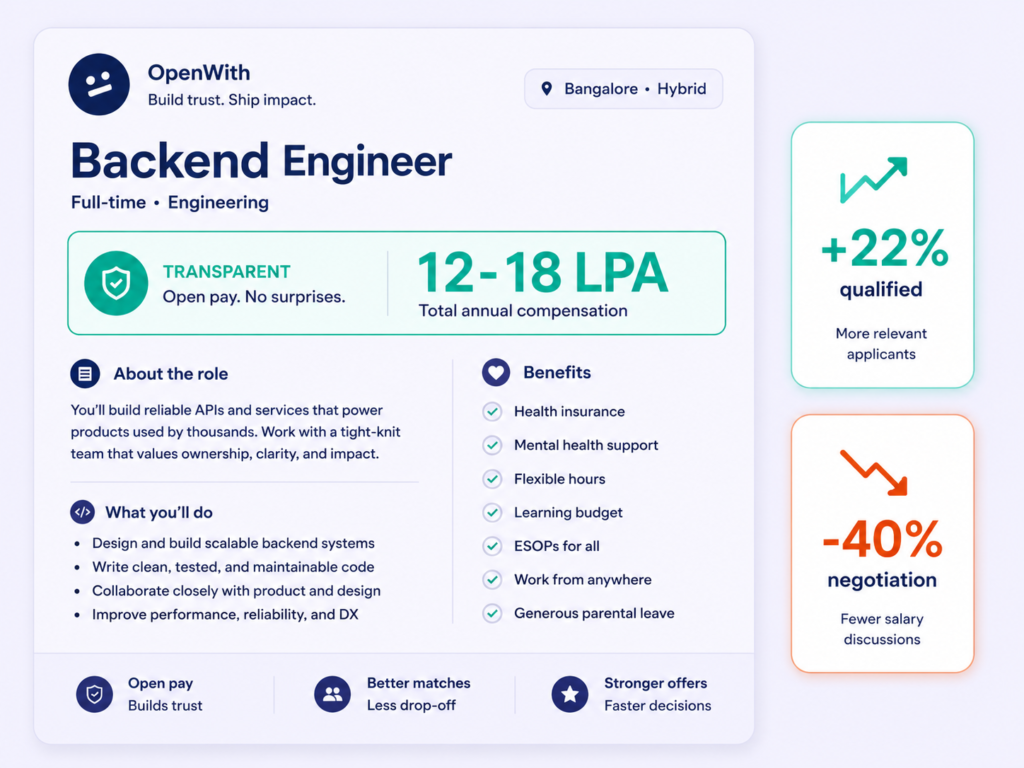
If you hide the salary range, candidates assume one of two things: you’re lowballing and don’t want them to know, or you’re disorganised and haven’t figured out the budget. Neither is a good look.
What to include in your job postings:
- The range: Base salary minimum to maximum with context for what determines where someone falls
- Benefits summary: Don’t say “competitive benefits” — list them (health insurance details, PTO days, remote work policy, L&D budget, equity/bonus structure)
- Salary philosophy: A single sentence on how you think about compensation equity
Lab Note — The Data From Our Pilot
When we started listing salary ranges on senior engineering roles: application volume dropped by 15%, but qualified application volume increased by 22%, and time spent on salary negotiation decreased by 40%. We lost the tyre-kickers. We gained serious candidates.
The common objection: “But competitors will see what we pay!” The reality: they already know. Salary data is available on Glassdoor, AmbitionBox, and Levels.fyi. Pretending it’s secret just makes you look out of touch.
Strategy #14
14. The “Value-Add” Rejection Letter
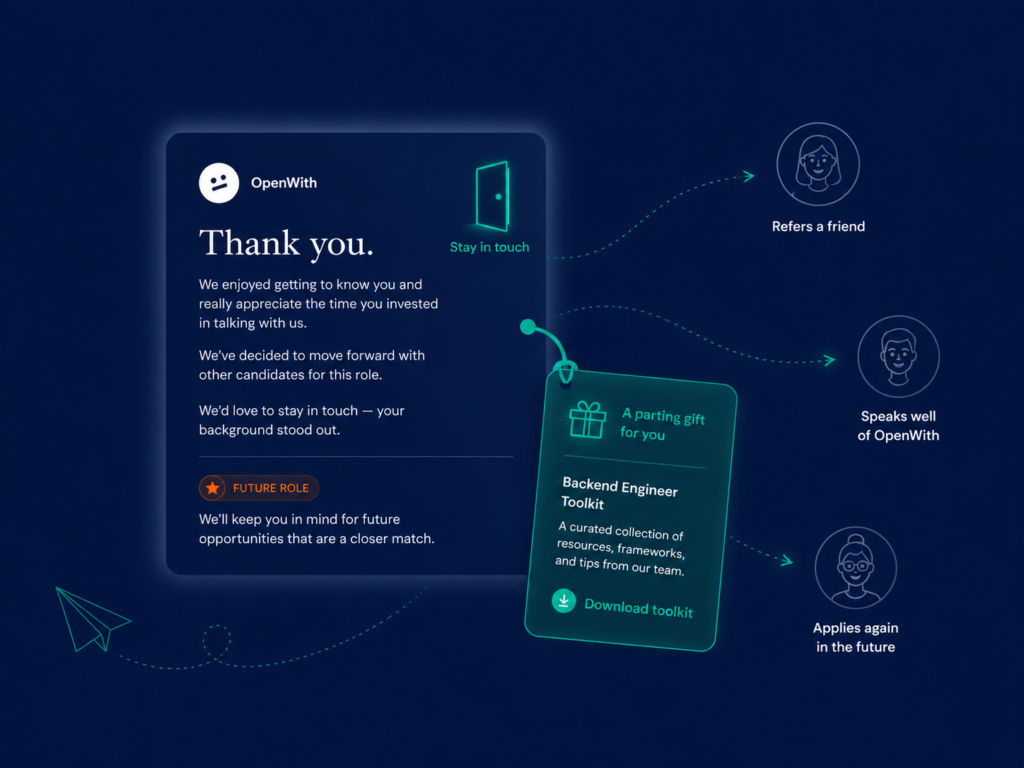
The standard rejection email: “Thank you for your interest. We’ve decided to move forward with other candidates. Best of luck.” What the candidate hears: you’re not good enough, go away. What you’re missing: every rejection is a chance to turn a disappointed candidate into a brand advocate.
The structure that works:
- Line 1–2: Acknowledge their effort genuinely
- Line 3–4: Be specific about what impressed you (one real observation)
- Line 5–6 — The value add: A resource relevant to their career goals, feedback on their interview (if possible), or a referral to another role or company that might be a better fit
- Line 7–8: Keep the door open — ask if it’s OK to reach out for future roles
Real outcome: I’ve had rejected candidates refer friends to open roles, write positive Glassdoor reviews specifically mentioning the rejection experience, and re-apply (and get hired) for later positions. One rejected candidate referred three people over the next year. Two were hired.
Mistake to avoid: Don’t give false hope. But you can still provide value and maintain the relationship. Create 3–4 templates for different scenarios: early-stage rejection, final-round rejection, skill-mismatch rejection. Personalise 2–3 sentences per candidate. It takes 3 minutes.
Strategy #15
15. Agile Interview Sprints

The traditional interview timeline: 6 weeks, 5 stages, multiple stakeholders. By Week 6, your best candidates have already accepted offers elsewhere. The Agile Sprint compresses all stages into a 48–72 hour window.
The Sprint structure:
- Day 1 AM: Phone screen (30 mins). If the candidate passes, they’re immediately invited to the Sprint with a clear agenda.
- Day 2: Realistic work simulation (2–3 hrs) + hiring manager interview (60 mins)
- Day 3 AM: 30-min sessions with 2–3 team members + 45-min interview with senior leader
- Day 3 PM: Internal debrief, offer extended or decision communicated — that same day
9.1/10
Candidate satisfaction score after Agile Sprint implementation (up from 7.2). Time-to-offer dropped from 11 days to 3 days. Offer acceptance rate rose from 64% to 81%. Most common feedback: “I’ve never experienced a hiring process that respected my time like this.”
When NOT to use Sprints: Junior/high-volume roles where the coordination ROI doesn’t justify the effort. Roles where cultural fit requires slower relationship building. Organisations without leadership commitment to rapid decision-making.
The setup: Run a pilot Sprint for one role. Document the process. Train your interview panel. Execute. Then measure: did we hire faster? Did we get better candidates? Did candidates report a better experience?
Category 03 / 04
The Data-Driven Lab: AI-Powered Hiring and Recruiting Strategies
Technology isn’t replacing recruiters. But recruiters who use technology are replacing those who don’t. 90% of CHROs anticipate greater AI integration by late 2025. This isn’t a trend — it’s a restructuring of how talent acquisition operates. AI should handle the repetitive, data-heavy work that burns out recruiters, freeing humans to do what humans do best: build relationships, assess cultural nuance, and negotiate complex situations.
Strategy #16
16. AI-Augmented Screening (The “Bias Blocker” Filter)
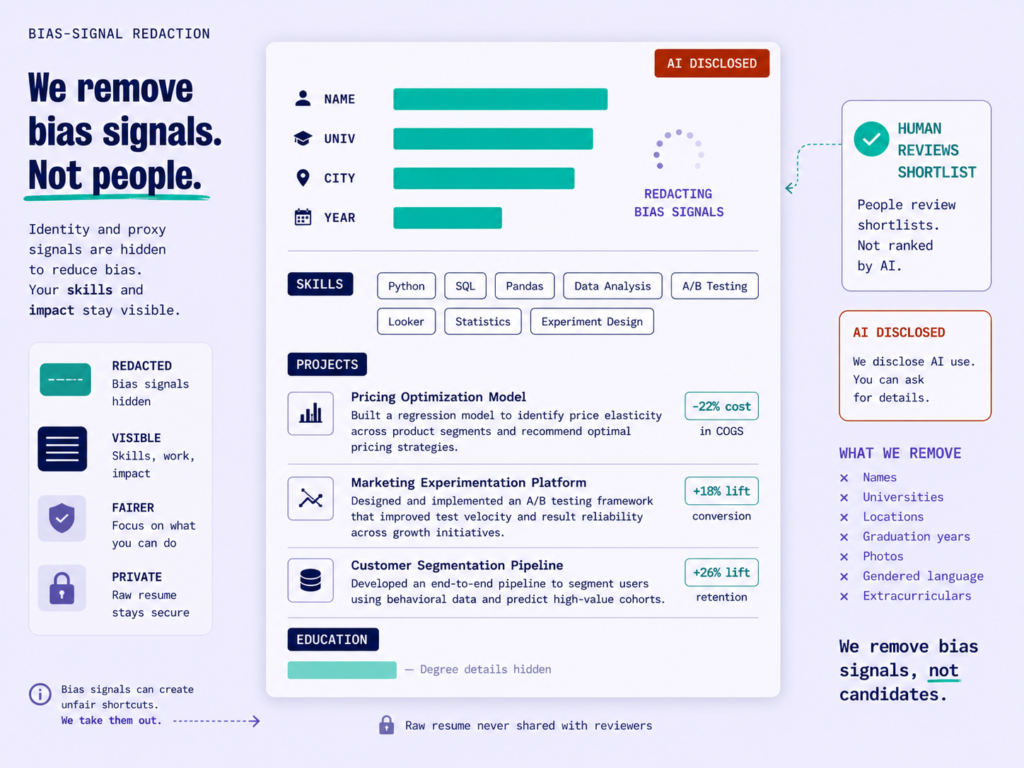
A better approach: use AI to remove bias signals, not make final decisions.
The 3-step “Bias Blocker” approach:
- Redaction, not ranking. Configure your AI tool to strip names (removes gender and ethnic bias), university names (removes pedigree bias), geographic indicators, and age signals. What remains: skills, project descriptions, measurable achievements.
- Skills-based parsing. The AI extracts and scores on technical capabilities mentioned, relevant project experience, and quantified results. It compares candidates to your skill requirements — not to each other.
- Human review of the shortlist. AI surfaces the top 30–40 candidates. A human recruiter reviews before anyone moves forward. Context and judgment calls the algorithm can’t make.
Lab Note — Pilot Results
We piloted this for a manufacturing technician role with 320 applications. Traditional manual screen: 8 hours recruiter time, 42 candidates shortlisted. AI-augmented screen: 45 minutes recruiter time reviewing the AI-generated shortlist, 38 candidates shortlisted. The AI-screened pool had the same interview-to-offer conversion rate as the manually screened pool. We saved 7+ hours with no loss in quality.
Tools worth considering: HireVue (video + resume screening), Pymetrics (gamified assessments), Eightfold.ai (skills-based matching), Textio (job description bias optimisation).
Critical Warnings
Don’t use AI screening for subjective roles (creative, leadership). Don’t let the algorithm learn from past hires if those hires were homogeneous — you’ll automate existing bias. Audit your AI tool quarterly with bias reports.
Strategy #17
17. Predictive Attrition Modeling

What if you could predict which employees are likely to leave before they give notice? You’re reading patterns, not minds.
Common signals that precede resignations:
- Tenure milestones (employees often leave at 18 months, 3 years, 5 years)
- Performance trajectory — sudden drops or plateaus
- Engagement scores declining over 2–3 quarters
- Decreased participation in internal programmes (training, events, referrals)
- Sudden increases in PTO usage
- LinkedIn profile updates — new headshots, skill additions, “Open to Work” badges
The model: Build a predictive algorithm (or use platforms like Visier, ChartHop, or Crunchr) that assigns a “flight risk score.” High score = likely to leave within 90–180 days. Then intervene: proactive career development conversations, role redesign, compensation adjustments, manager coaching.
Lab Note — Real Scenario
We built a basic attrition model using tenure data, engagement survey scores, and performance ratings. It flagged 12 employees as high flight risk. We had managers conduct “stay interviews” with all 12. Result: 9 of 12 confirmed they were actively considering leaving. After targeted interventions, 7 of the 9 stayed for at least another year. Estimated savings: ₹63 lakhs in recruiting and productivity loss prevented.
The Ethical Boundary
Do not surveil employees. Use only data you’re already collecting for legitimate business purposes. And be transparent — frame it as “we want to spot problems before they become resignation decisions.”
The recruitment connection: Once you know which roles are likely to open soon, you can start sourcing before the vacancy exists. You shift from reactive to proactive. This is strategic workforce planning, not just a faster hiring process.
Strategy #18
18. Automated Nurturing Sequences (The CRM Method)
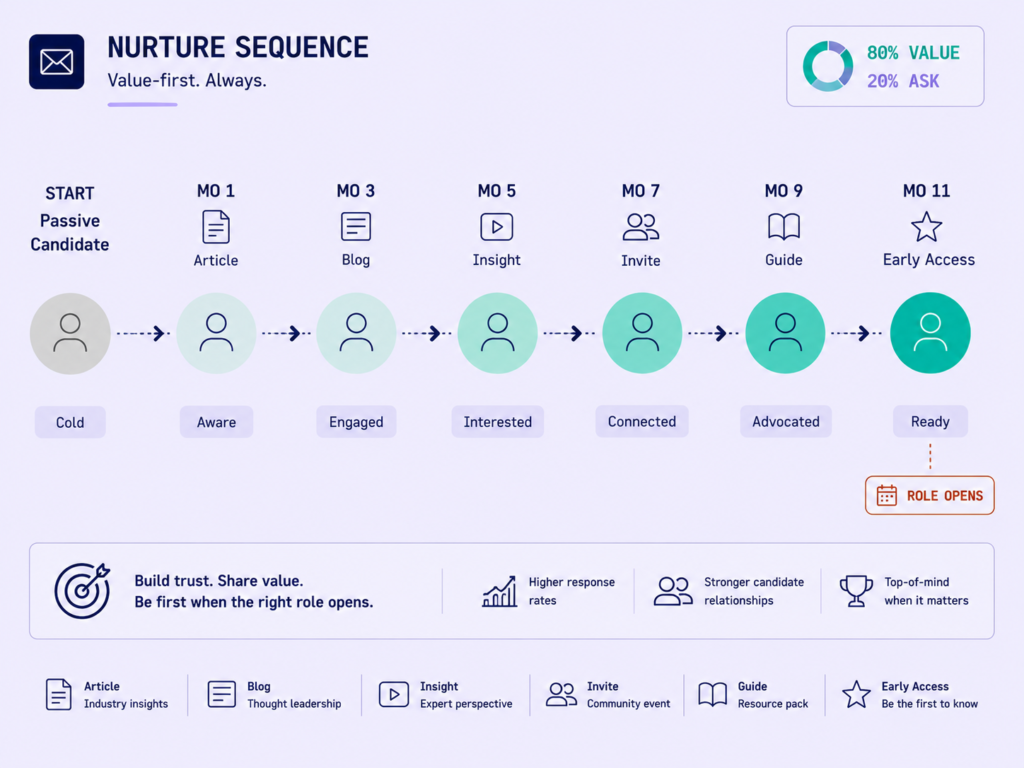
You meet a great candidate. They’re not looking right now. You say “let’s stay in touch.” Then you forget they exist until 18 months later when you’re desperate to fill a similar role. Treat passive candidates like sales leads.
In sales, when you meet a prospect who’s not ready to buy, you put them in a nurturing sequence — automated emails that provide value over time. You stay top of mind. When they’re ready to move, you’re the first call they make. Apply this to recruiting.
The nurturing sequence:
- Week 1 (after first contact): Personal note — “Great to meet you at [event/call]. I’ll keep you in mind for [role type] as we grow.”
- Month 1: Share a relevant article or industry insight — no job pitch
- Month 3: Check in on their current work — genuine interest, not a recruiting call
- Month 6: Invite to a company webinar, event, or talent community session
- When a role opens: “Based on our conversations, I thought you’d want to hear about this opportunity first.”
Tools: HubSpot (free CRM), Streak (Gmail-based), Airtable, or your existing ATS if it has candidate relationship management features. The goal: no qualified candidate should ever fall out of your pipeline simply because you forgot to follow up.
Strategy #19
19. Recruitment Marketing Attribution (The UTM Strategy)

Without attribution, you’re spending recruiting budget blind. You’re guessing which channels work. With UTM tracking, you’re making data-informed decisions about where to invest your time and money.
How it works: Add UTM parameters to every job posting URL — source (LinkedIn, Indeed, career fair), medium (organic, paid, referral), and campaign name. Track candidates through the funnel. For every hire, capture: source channel, Time-to-Hire, Offer Acceptance Rate, 90-day retention, 12-month performance.
+31%
Improvement in Quality of Hire after cutting Indeed spend by 60% and redirecting to employee referral bonuses and LinkedIn targeting. Hiring volume dropped 8% — but quality of those hires improved significantly as measured by 12-month performance and retention.
Example channel data: LinkedIn = high cost per hire (₹45,000 avg) but best 12-month retention (91%). Indeed = low cost per hire (₹12,000 avg) but poor quality (58% retention at 12 months). Employee referrals = moderate cost (₹18,000 avg) but highest performance ratings.
What you do with this data: Shift budget to channels that produce not just more candidates, but better candidates. Review attribution quarterly. Adjust sourcing budget allocation based on what’s working.
Strategy #20
20. The Talent Analytics Dashboard

Most TA teams track Time-to-Fill and Cost-per-Hire. Those metrics tell you how fast and how cheap you hired. They don’t tell you if you hired well. A proper Talent Analytics Dashboard tracks the full lifecycle.
The 6 core metrics:
- Quality of Hire (QoH): (Performance Rating + Hiring Manager Satisfaction + Retention at 12 months) / 3. Survey hiring managers at 90 days and 12 months.
- Offer Acceptance Rate (OAR): 85%+ is healthy. Below 70% means you’re losing candidates at the finish line.
- Time-to-Productivity: Days from start date to “fully productive.” A fast hire who takes 6 months to ramp is worse than a slower hire who ramps in 3 weeks.
- Diversity Pipeline Ratio: % diverse candidates at each stage vs. % in initial applicant pool. If 40% of applicants are from underrepresented groups but only 10% reach final interviews, you have a funnel problem.
- Source Channel Performance: Volume, quality (conversion rates), cost per hire, and 12-month retention per channel.
- Candidate Experience Score (NPS-style): 50+ is good. Below 30 means you’re damaging your employer brand.
Lab Note — How to Tell the Story
Don’t just generate reports. Tell the story. Example: “Our Time-to-Fill increased by 12 days this quarter, but our Quality of Hire improved by 18%. We’re taking slightly longer because we’re being more selective, and the data shows it’s working. 12-month retention is up, and hiring manager satisfaction scores are at an all-time high.” That’s how you prove TA is a strategic function, not just a cost centre.
Start with 6–8 core metrics. Master those. Add more later if needed. Dashboards that track 30 metrics get ignored.
Category 04 / 04
Organisational & Cultural Design: The Recruitment Strategy That Makes People Stay
Here’s the uncomfortable truth: you can have the best hiring and recruiting strategies, a flawless candidate experience, and the best AI tools in the market. But if your organisation is a toxic place to work, none of it matters. Managers are responsible for 70% of the variance in employee engagement. Organisations that prioritise manager development see a 23% increase in productivity and a 51% drop in turnover — directly lowering recruitment pressure.
Strategy #21
21. “Culture Add” vs. “Culture Fit” Assessment

Most hiring managers say they want someone who “fits our culture.” What they actually mean: “someone who looks, talks, and thinks like the people we already have.” The result: homogeneous teams, groupthink, stagnation.
Culture Fit question: “Would I want to grab a beer with this person?”
Culture Add question: “What unique perspective or experience does this person bring that we’re currently missing?”
How to operationalise this:
- Define your actual values — not the poster on the wall, but the behaviours you genuinely reward and promote.
- Build interview questions around values + diversity of thought. Bad: “Tell me about a time you worked with a difficult team member.” Better: “Tell me about a time you disagreed with your team’s approach. What was your perspective, and how did you handle it?”
- Train interviewers to recognise bias — affinity bias, confirmation bias, and similarity bias all masquerade as “culture fit.”
- The Culture Add audit: During debrief, require every interviewer to answer: “What unique perspective or capability does this candidate bring that our current team lacks?” If no one can answer, you’re hiring for sameness.
Similar Read: The Practitioner’s Guide to Recruitment Assessment Tools in 2026
Lab Note — Real Example
Two finalists for a manufacturing engineer role. Candidate A: top university degree, 8 years at large corporations, textbook answers. Everyone liked him. Candidate B: non-traditional background, started as a technician, self-taught engineer. Half the panel was unsure. We hired Candidate B. Within 6 months, he redesigned a production process that reduced defect rates by 14%. His unique perspective — an engineer who understood the technician’s world — was exactly what we needed.
Strategy #22
22. Fractional & Gig-Based Talent Integration

You need a data scientist. You hire full-time. They work 40 hours per week. But you might only have 15 hours of actual data science work. You’re paying for 40. You’re getting value from 15. Fractional talent solves this.
Why this matters for recruitment:
- “Try before you buy”: Work with someone for 3–6 months. If they’re exceptional and the workload justifies it, convert to full-time. If not, part ways without the complexity of termination.
- Access talent you couldn’t otherwise afford: A senior product strategist at ₹15 lakhs for 10 hrs/week is viable where ₹60 lakhs full-time is not.
- Reduce hiring risk for unproven roles: Not sure if you need a full-time growth marketer? Hire fractionally for 6 months and let the data tell you.
Good candidates for fractional work: Specialised expertise needed intermittently (legal, finance, data science, design), new role types where you’re testing the need, project-based work with clear deliverables.
Platforms: Toptal (vetted developers, designers, finance experts), Flexiple (tech talent), Upwork (broad range), your professional network (often the best source).
Strategy #23
23. The “Candidate-Partner” Onboarding Experience
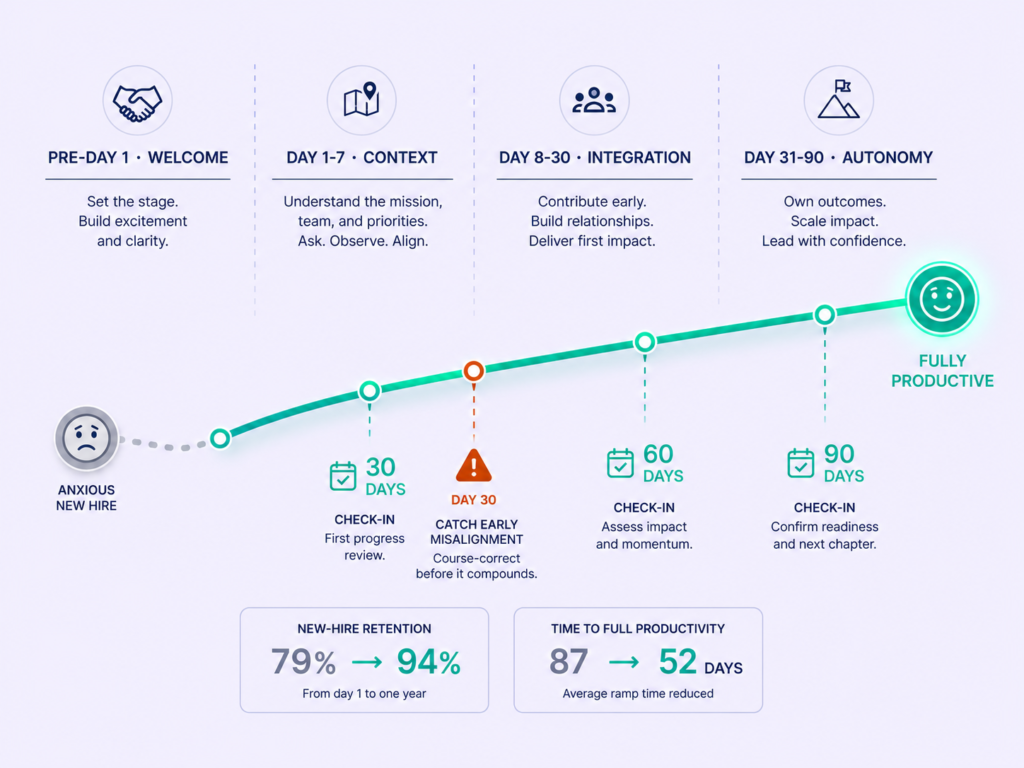
The traditional onboarding: Day 1 — IT setup, paperwork, orientation. Week 2–4 — figure it out as you go. The result: slow ramp time, early regret, increased likelihood of early turnover. Treat the first 90 days as Phase 2 of the recruitment process.
Recruitment doesn’t end at offer acceptance. It ends when the person is fully productive, integrated, and committed to staying.
The 4-phase framework:
- Pre-Day 1 (The “Welcome” Phase): Send a welcome package one week before start date — personalised video from their manager and team, org chart showing where they fit, first-week schedule, “who to ask for what” cheat sheet, and light pre-reading on company strategy and team goals.
- Day 1–7 (The “Context” Phase): IT setup ready before they arrive. 60-minute 1:1 with manager on Day 1. Lunch with a buddy (not their manager). End-of-day check-in. Goal: understand the business model, meet key stakeholders, complete one small achievable task.
- Day 8–30 (The “Integration” Phase): Complete first real project or deliverable. Shadow 3–5 team members to understand workflows. Weekly structured 1:1s with manager. 30-day check-in: what’s going well, what’s confusing, what support is needed.
- Day 31–90 (The “Contribution” Phase): Clear 90-day goals defined in Week 1. Monthly performance conversations. Identify development opportunities. Assess cultural integration and flag any concerns before they become resignation decisions.
Lab Note — The Retention Connection
18% of new hires leave before their probationary period ends. Most of these are preventable. The root cause is almost always one of three things: unclear expectations, no relationships built, or a mismatch between what was sold in the interview and the reality of Day 1. A structured 90-day plan addresses all three directly.
Strategy #24
24. Skill-Based Assessment Centres (The Lab Test)

Interviews measure how well someone interviews, not how well they do the actual job. Assessment Centres close this gap by evaluating candidates against real work simulations in a structured environment.
What a Lab Test includes:
- Work simulation: A task or case study that mirrors actual day-to-day challenges in the role. For a TA Manager role: build a sourcing strategy for a hard-to-fill position. For an analyst role: interpret a dataset and present findings.
- Structured behavioural interviews: Standardised questions with a scoring rubric — every candidate assessed on the same dimensions, not on “gut feel.”
- Group exercise (for leadership roles): Observe how candidates facilitate, disagree constructively, and bring others along — impossible to fake in a one-on-one interview.
- Assessor calibration: Multiple evaluators score independently, then compare to eliminate individual bias.
Why this matters: Assessment Centres have a significantly higher predictive validity for job performance than unstructured interviews alone. The investment in design pays back in lower early attrition and faster Time-to-Productivity for senior hires.
Strategy #25
25. The “Talent Brand” LinkedIn Employee Advocacy Programme

Your employees have a combined LinkedIn reach that dwarfs your company page. Every post they write about their work is organic employer brand content that your marketing budget cannot buy. Build a system to activate it.
The programme structure:
- Run a 90-minute “LinkedIn for Employees” workshop covering profile optimisation, what makes a good post (storytelling, specificity, vulnerability), and how to share company content without sounding like a corporate robot
- Create an “Employee Story” content library — templates, prompts, and examples that make it easy for employees to share without starting from scratch
- Celebrate publicly: feature employee posts in company newsletters and team meetings to reinforce the behaviour
- Never mandate participation — the moment it feels forced, authenticity dies
The compound effect over time: Every employee who posts builds your employer brand. Their network sees your company as a place where smart, engaged people work. Over time, this becomes a passive recruiting engine that runs without ad spend.
Measurement: Track the number of employee posts about work per month, reach of those posts (impressions), and whether inbound candidate referrals and direct applications increase over the subsequent quarter.
The Recruitment Strategy System You’ve Been Missing
Eight years ago, when I started building talent acquisition systems, I made every mistake in this guide. I posted jobs and hoped. I measured speed instead of quality. I treated candidates like transactions. I handed new hires off to managers on Day 1 and considered my job done.
The results were predictable: high recruiting costs, mediocre Quality of Hire, early turnover, and a constant sense of running on a treadmill — filling roles faster than I could build relationships.
“I stopped thinking of recruitment as a series of tasks and started thinking of it as an interconnected system.”
The Four Engines — Running Together
- Intelligence-Led Sourcing — you know where the talent is before you need them
- Experience Engineering — your process attracts rather than repels top performers
- Data-Driven Operations — you use AI and analytics to eliminate bias and measure what matters
- Organisational Design — you build a culture where people stay, reducing the need to hire constantly
When one engine fails, the whole system stalls. When all four run together, you stop competing for talent and start pulling it toward you.
The transformation looks like this: Instead of panic-hiring when someone quits, you activate a pre-warmed pipeline of silver medalists and passive candidates you’ve been nurturing for months. Instead of losing 60% of applicants to a broken application process, you’ve audited and fixed every friction point. Instead of relying on gut feel in interviews, you’re using structured assessments that predict actual job performance. Instead of watching 18% of new hires leave in their first 90 days, you’ve built an onboarding system that integrates people fully.
Your next step: Pick three recruitment strategies from this guide. Three, not all 25. One from Sourcing Intelligence. One from Experience Engineering. One from Cultural Design. Implement them over the next 90 days. Measure the impact. Iterate. Then add three more.
“The organisations consistently winning the talent war aren’t doing everything perfectly. They’re building systems where each improvement compounds the next.”
FAQ: Recruitment Strategies for 2026
What is the most effective recruitment strategy for 2026?
The shift from Reactive Sourcing to Talent Intelligence. Organisations that map the market continuously, build “always-on” talent communities, and maintain relationships with passive candidates before roles open consistently outperform those relying on job board postings. Speed-to-hire drops by 40–60% when you already know where the talent is.
How do you measure the ROI of a recruitment strategy?
Look beyond Time-to-Fill and Cost-per-Hire. The Lab focuses on Quality of Hire (QoH) — specifically performance ratings and retention at the 12-month mark. Track: Offer Acceptance Rate, Time-to-Productivity, 12-month retention, and hiring manager satisfaction scores. If you’re hiring fast and cheap but losing 30% of new hires within a year, your ROI is negative.
How can AI improve recruitment without losing the human touch?
AI should manage scheduling, initial parsing, and bias redaction — the administrative work that burns out recruiters. Use it to strip names and universities from resumes so you focus on skills. Use it to automate candidate nurturing sequences. But keep humans in the relationship-building, cultural assessment, and final decision-making roles. Transparency is critical: tell candidates you use AI and explain how. 79% of candidates demand this, and providing it builds trust.
What’s the difference between culture fit and culture add?
Culture Fit asks: “Would this person blend in seamlessly?” It leads to homogeneous teams and groupthink. Culture Add asks: “What unique perspective or experience does this person bring that we’re currently missing?” You’re still hiring for core values alignment, but you’re actively seeking diversity of thought, background, and approach. Teams that hire for Culture Add innovate faster because they have cognitive diversity, not just demographic diversity.
How long should a modern recruitment process take?
For competitive technical or leadership roles, traditional 4–6 week processes lose top candidates to faster-moving competitors. Consider Agile Interview Sprints (48–72 hours from phone screen to offer) for critical hires. For standard roles, 2–3 weeks is reasonable. Key metric: if your Offer Acceptance Rate is below 75%, speed is likely a factor.
Should we always hire externally or prioritise internal mobility?
Internal mobility should be your first sourcing channel for any role where internal candidates exist. Internal hires ramp 40–50% faster, have stronger cultural alignment, and cost significantly less to recruit. Aim for 15–20% of annual hires to come from internal moves. But don’t force it — if no internal candidate is qualified, go external.
What’s the biggest mistake companies make in recruitment?
Treating it as a transactional event rather than a strategic system. They post jobs reactively. They optimise for speed rather than quality. They measure the wrong things. And they think recruitment ends when the offer is signed, ignoring that 18% of new hires leave before probation ends. Recruitment is a supply chain that includes sourcing, experience, decision-making, onboarding, and retention. Break any link, and the system fails.
